Skip to content
When a loved one passes away without a will, their family is often left facing a complicated and expensive court process. For many in our Kingwood and Humble communities, the Texas Small Estate Affidavit (SEA) offers a lifeline—a simpler, faster, and far less costly alternative to a full probate.
This legal tool is designed specifically for modest estates, allowing families to transfer assets like bank accounts and vehicles directly. It helps bypass the formal complexities of probate court, providing real relief during an already difficult time. At The Law Office of Bryan Fagan, we're here to help our neighbors in Northeast Houston understand this process.
A Practical Alternative to Full Probate
Losing a family member is hard enough without the added stress of navigating the Harris County probate courts. The traditional probate process can feel overwhelming. It’s often long, public, and expensive, filled with court dates and administrative red tape that can drag on for months.
This is exactly why the Texas small estate affidavit form exists.
The Texas legislature created this process to help heirs settle the affairs of a loved one who died without a will (known as dying “intestate”). It's essentially a sworn statement filed with the court that details the deceased's assets, their debts, and who the rightful heirs are. If approved, it allows property to be transferred without a formal, drawn-out court battle.
Key Benefits for Kingwood and Humble Families
So, what makes the SEA a go-to option for so many local families? The advantages are pretty clear:
- Serious Cost Savings: You can avoid most of the court costs and hefty attorney fees that come with a full probate administration.
- Much Faster Timeline: The process is typically resolved much more quickly, letting your family access funds from a bank account or take ownership of a car without a long wait.
- Simplicity and Privacy: Since it avoids a formal court proceeding, settling the estate becomes a more private and straightforward matter for everyone involved.
The Small Estate Affidavit was designed with one goal in mind: to give families with modest estates a common-sense path forward. It recognizes that not every estate needs the full, formal weight of the court system.
Think of the SEA as a legal shortcut. It’s a powerful tool that makes a real difference for grieving families in the Kingwood area by simplifying what could otherwise be a legal nightmare.
Of course, using an SEA isn't an option for everyone. There are strict requirements about the estate's value and the family situation that must be met. If you're looking into all your options, you might also find our guide on how to avoid probate in Texas helpful.
At The Law Office of Bryan Fagan, our Kingwood attorneys know Harris County probate law inside and out. We can help you figure out if a Small Estate Affidavit is the right move for your family. Schedule a free consultation with our local team to get clear, supportive guidance without any obligation.
Does Your Situation Qualify for This Process?
When a loved one passes, sorting out the legal side of things can feel overwhelming, especially for families here in Kingwood and the Humble area. Before you even think about filling out a Texas Small Estate Affidavit form, it's crucial to stop and see if your situation actually fits the legal requirements. This isn't a catch-all solution; it’s a specific tool for very specific circumstances.
The Texas Estates Code lays out some firm rules. This affidavit is only an option if the person who passed away did not leave a will. If there's a valid will, you'll need to look at other probate options, like a muniment of title or a more formal administration. On top of that, every single legal heir has to be on the same page and willing to sign the affidavit.
The $75,000 Asset Limit Explained
This is one of the biggest hurdles. The total value of the decedent’s property—not counting their homestead and certain other exempt assets—cannot be more than $75,000. This cap is exactly why the affidavit is such a practical tool for many families in Northeast Houston dealing with more modest estates.
So, what does that really mean in practical terms for a Kingwood resident?
- What Counts Towards the Limit: Think bank accounts, cash on hand, stocks, and any real estate that wasn't their primary home.
- What Doesn't Count: The value of the family home (the homestead) is excluded. So are other exempt items like one vehicle for each licensed driver in the family, household furniture, and family heirlooms.
This distinction is a game-changer for local homeowners. The Small Estate Affidavit reflects a more modern, streamlined approach to probate, and the asset threshold was recently increased to $75,000 to make the process more accessible. Because the homestead is excluded, families can often transfer assets worth much more than the limit without needing to go through a full probate. For example, a home in Kingwood valued at $300,000 won't disqualify an estate, as long as the other assets fall below that $75,000 ceiling. You can learn more about this important legislative update from the experts at dallaselderlawyer.com.
This decision tree gives you a quick visual to see if the Small Estate Affidavit might be the right path for you.
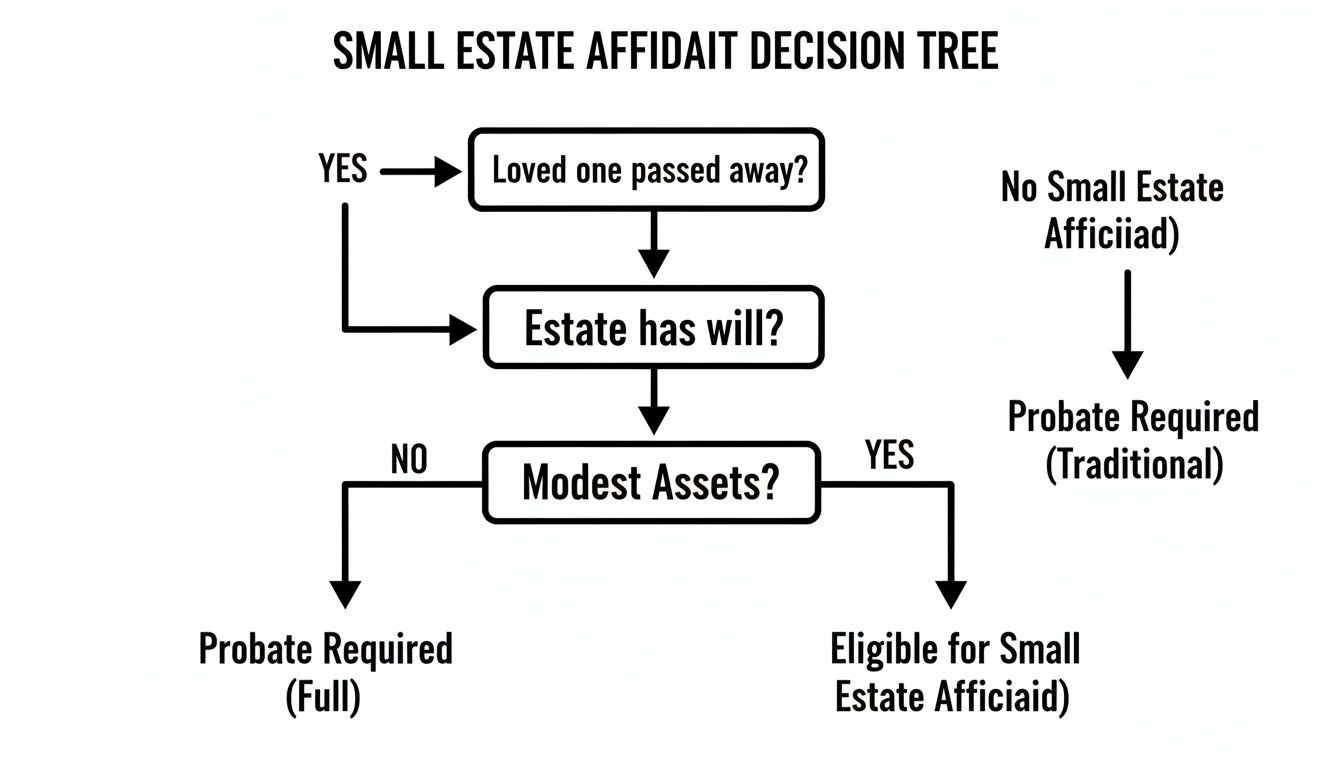
As you can see, the two biggest starting points are passing away without a will and having a relatively small estate.
Disqualifying Factors to Consider
Even if the estate seems to be under the asset limit, a few other things can stop you from using this process. The most common snag is debt. The total value of the estate's assets must be more than its total known debts (not counting a mortgage or other loans secured by exempt property).
If your loved one’s debts are higher than their assets, the Small Estate Affidavit simply isn't the right tool. It’s designed to help distribute property, not to navigate a complicated financial situation with multiple creditors. Another major disqualifier is owning other real estate—if the decedent owned any property besides their primary home, the estate won't qualify.
Key Takeaway: The Small Estate Affidavit is strictly for intestate estates (no will) with assets under $75,000 (excluding the homestead) where the assets outweigh the debts. If your situation deviates from these rules, you'll need to pursue a different legal path.
Getting these criteria right from the start is the most important step you can take. To make it easier, here is a quick checklist to help you see where your family's situation stands.
Small Estate Affidavit Eligibility Checklist for Kingwood Families
This table is a quick reference to help Harris County residents determine if their situation meets the strict criteria for using a Small Estate Affidavit.
| Requirement | Does Your Situation Qualify? | Explanation for Kingwood Residents |
|---|---|---|
| No Will | The person must have died without a valid will. | If a will exists, even an outdated one, the estate isn't eligible for this specific process. |
| Asset Limit | Non-exempt assets can't exceed $75,000. | Your Kingwood home's value doesn't count against this, but bank accounts and investments do. |
| Debts vs. Assets | The estate's assets must be greater than its known debts. | You have to be certain that known debts won't eat up the entire value of the estate. |
| Heir Agreement | All legal heirs must agree and sign the affidavit. | If even one heir is unreachable or refuses to cooperate, you can't move forward with this. |
| No Other Real Estate | The only real property owned can be the homestead. | Owning a rental property or even a vacant lot in Harris County will disqualify the estate. |
These rules can feel a bit tangled, and it's perfectly normal to feel unsure. If you’re a Kingwood resident trying to figure this out, you don't have to go it alone. The Law Office of Bryan Fagan offers a free consultation to review your case and give you the clear, straightforward advice you need. Contact our Kingwood office today to get started.
How to Complete the Affidavit Form Correctly
Tackling legal paperwork is often the most dreaded part of settling a loved one's affairs. The Texas Small Estate Affidavit form, with all its boxes and unfamiliar legal terms, can certainly look intimidating at first glance. But for families here in Kingwood and across Northeast Houston, getting this form right is the key to a much simpler probate alternative.
Let's walk through it, piece by piece, so you can feel confident you're doing it correctly.
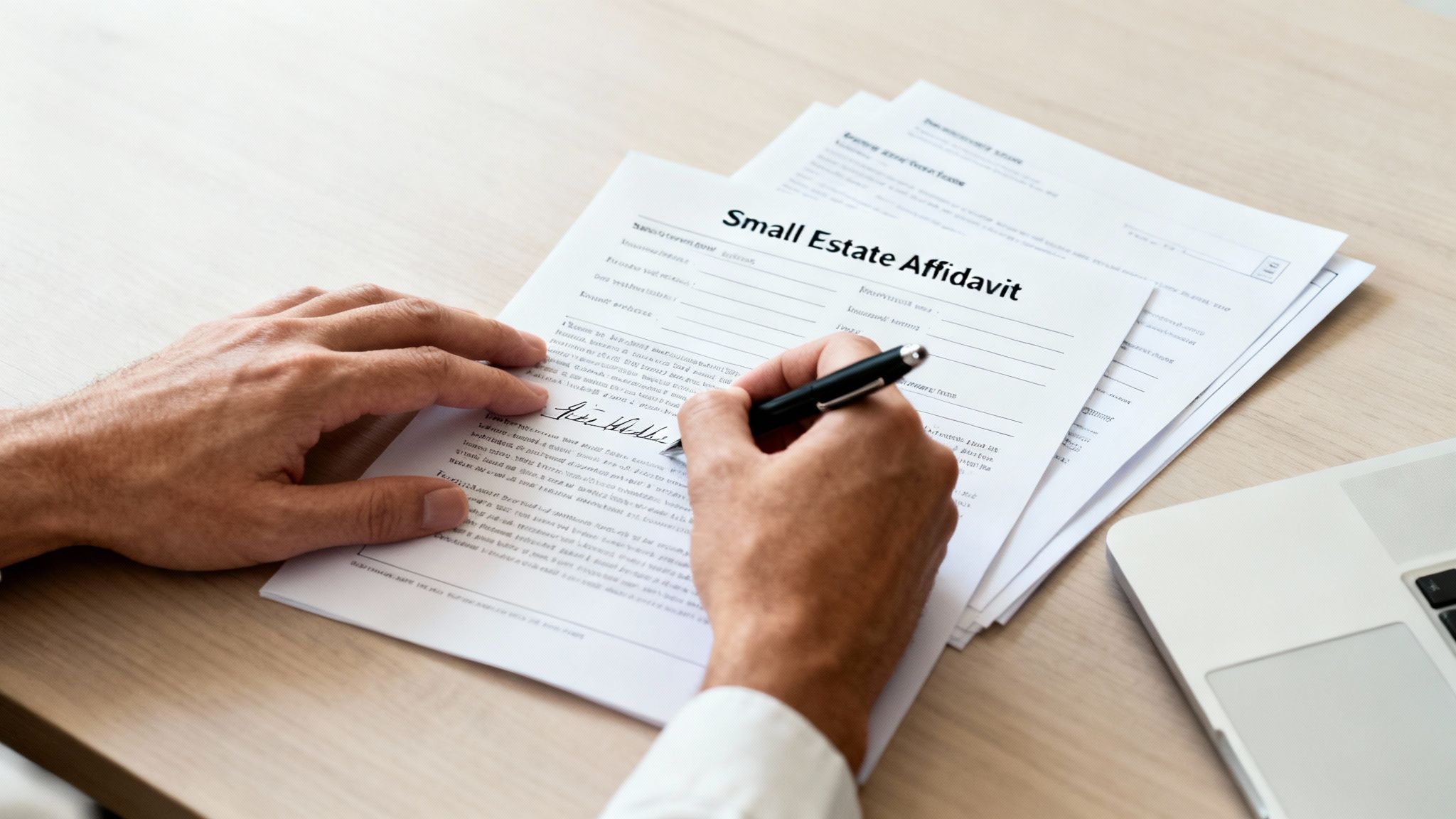
Our goal here is to demystify the form and translate the court's requirements into plain English. Getting this document right the first time is crucial—it can save you from frustrating delays and rejections by the Harris County court.
Section 1: Decedent’s Information
Think of this as the foundation of your affidavit. It has to be perfect, as even a small mistake here can bring the whole process to a halt. You'll need to provide the decedent's full legal name, their date of birth, the date they passed away, and the county where the death occurred.
For most local families, that county will be Harris County. You'll also fill in their last known address, which for many of our clients is right here in Kingwood or a neighboring community like Humble. Keep the official death certificate handy; it contains most of this information, and you'll have to attach a copy to your filing anyway.
Section 2: Listing All Assets
Next up is a complete and honest list of everything the decedent owned. This is where we see people get tripped up the most. The court needs full transparency, so you'll have to gather some very specific details for each asset.
Here are the most common assets you'll need to list:
- Bank Accounts: Get the name of the bank, the last four digits of the account number, and the exact balance on the date of death. Don't guess—call the bank and get the precise figure.
- Vehicles: For any car, truck, or motorcycle, you need to list the year, make, model, and the full Vehicle Identification Number (VIN).
- Personal Property: This is a catch-all for items like furniture, jewelry, or other valuables. You’ll just need to provide a brief description and a realistic, good-faith estimate of what it’s worth.
This section requires a bit of detective work. For example, if your mother had a small savings account at a local bank in Northeast Houston, you’ll need to get a statement showing the exact balance on the day she passed. Being meticulous here will prevent a lot of back-and-forth with the court later.
Section 3: Identifying All Liabilities
Just like you did with assets, you must now list all the estate's known debts and liabilities. The court has to see that the value of what's left is greater than what's owed.
This includes things like:
- Unpaid credit card statements
- Lingering medical bills
- Any personal loans
- Final utility bills
For each one, list the creditor's name and the amount owed. One important note: you can exclude debts secured by exempt property, like the mortgage on a primary home (the homestead). You'll need to do a thorough search for any bills or financial statements to make sure this section is accurate.
A Critical Note on Accuracy: Remember, the affidavit is a sworn statement made under oath. Deliberately leaving out assets or debts isn't just a reason for the court to reject your form—it can lead to serious legal trouble. Take your time and get it right.
Section 4: Heirship and Family History
Frankly, this is the most complex section and where many Kingwood families decide to ask for help. The affidavit requires you to lay out the decedent's complete family history to legally prove who the heirs are under Texas law. This isn't just a simple list of names; it's more like a narrative of the family tree.
You’ll need to provide details about the decedent’s:
- Marital History: Were they married, divorced, or widowed? You'll need to provide dates for each of these life events.
- Children: You must list all children, including any who were adopted or born outside of a marriage. If a child has passed away, you then have to list their children (the decedent's grandchildren).
- Parents and Siblings: If the person who died had no spouse or children, the form goes a step further and asks for information about their parents and siblings.
This part of the Texas small estate affidavit form is what officially establishes the "distributees"—the people legally entitled to inherit the property. It has to be flawless. While navigating the specifics of legal documents, some find tools like an AI for drafting affidavits helpful for ensuring precision.
This section can also be emotionally draining, as you're digging into sensitive family history during an already difficult time. If you have any doubts about heirship or how to document a complicated family situation, this is the perfect time to seek legal advice. Our attorneys at The Law Office of Bryan Fagan have deep experience with heirship matters and can make sure this is done right. We offer a free, no-obligation consultation at our Kingwood office to help you handle these challenges with confidence and compassion.
Gathering Essential Documents and Signatures
Once you’ve filled out the Texas Small Estate Affidavit, the next part is all about proof. You need to back up every statement you made with official paperwork and collect the right signatures. This isn't just a bureaucratic step; it’s where you prove your case to the Harris County court. Getting this part wrong is probably the number one reason these affidavits get rejected, forcing you to start all over again.
Think of yourself as an investigator. You've asserted facts about the deceased's assets, their debts, and who the rightful heirs are. Now, you have to present the evidence. The court needs this documentation to ensure the estate is settled fairly and legally.
Your Document Checklist
Before anyone signs, you'll need to pull together a packet of supporting documents. Each one validates a piece of information on the affidavit.
- Certified Copy of the Death Certificate: This is non-negotiable. You can't use a photocopy; it must be an official, certified copy from the vital statistics office.
- Proof of Assets: For every asset you listed, you need paper proof. This means bank statements showing the exact balance on the date of death, vehicle titles listing the VIN, or stock certificates.
- Proof of Homestead: If the person owned a home in Kingwood or anywhere else in Harris County, you’ll need a copy of the deed and the most recent property tax statement. This confirms its status as their homestead.
- List of Known Liabilities: Gather whatever you can find to back up the debts you listed. Credit card statements, medical bills, and loan documents are all good evidence.
The Signature Requirements Explained
This is where things can get tricky, and it’s a common stumbling block for families in Humble and Northeast Houston. The law is crystal clear about who needs to sign and how it has to be witnessed.
First, all legal heirs, also known as distributees, must sign the affidavit. Their signature is a sworn statement that they agree with all the facts presented—the assets, debts, and the complete list of heirs. Every single signature must be notarized, which means signing in front of a notary public.
But that's not all. You also need two disinterested witnesses to sign. This is a critical legal safeguard.
A disinterested witness is someone who has zero financial interest in the estate. They can't be an heir, a spouse of an heir, or a creditor. They also can't be a minor. Their job is to swear under oath that they knew the deceased person and believe the family history laid out in the affidavit is true.
These witnesses are essentially vouching for your heirship claim. We often advise clients in Kingwood to ask a long-time family friend, a trusted neighbor, or a colleague who knew the deceased but won't inherit anything. Their signatures must also be notarized.
Coordinating Signatures Across Distances
What if one heir lives in California and another lives in Florida? This is a very common scenario. Thankfully, you don't all need to gather in the same room in Kingwood to sign.
Each heir can print a signature page, sign it in front of a local notary, and mail the original, notarized page back to you. You then compile all the individual signature pages to create one complete, valid affidavit for filing.
It's crucial to remember that the Texas Small Estate Affidavit only works if the person died intestate—without a will. The entire process is built on establishing heirship according to state law. If a will suddenly turns up, this affidavit is void. That's why you have to be certain there isn't one. You can learn more by reading our guide on how to find a deceased person's will.
Juggling documents and coordinating signatures can feel overwhelming. If you're struggling with out-of-state heirs or just aren't sure who can serve as a disinterested witness, we can clear things up. Contact our Kingwood office at The Law Office of Bryan Fagan for a free consultation to make sure your affidavit is done right the first time.
Filing Your Affidavit in Harris County
You’ve done the hard work—the Texas small estate affidavit form is filled out, signed, and notarized. Now it's time for the final, most crucial part of the journey: making it official. For anyone in Kingwood or Humble, this means filing your paperwork with the Harris County Clerk's office.
This is where your diligence pays off, but you have to stick the landing. Following the county's specific procedures is non-negotiable if you want to avoid delays.
Let’s walk through exactly what to do, what you can expect, and how to use the court-approved document to wrap everything up.
Getting the Paperwork Submitted
Your affidavit needs to be filed with the Probate Court division of the Harris County Clerk. While the main courthouse is downtown, Harris County has several satellite offices that might be closer to home if you're in Northeast Houston. We always recommend calling ahead or checking the Harris County Clerk's website to confirm which locations are currently handling probate filings.
You'll also have to pay a filing fee. These fees can change periodically, so it’s smart to confirm the current amount before heading out. The clerk’s office usually takes cash, credit cards, or a cashier's check.
What Happens After You File
Filing the affidavit doesn't mean it's immediately effective. Once submitted, your paperwork goes before a Harris County probate judge for a thorough review. The judge is going to scrutinize every detail to make sure it complies with the Texas Estates Code.
Here’s what they’ll be looking for:
- The total estate value is under the $75,000 threshold.
- All assets and debts are listed accurately.
- The family history and heir information are complete and correct.
- Every signature and notarization is properly in place.
If everything checks out, the judge will sign an order approving the affidavit. That order is what officially makes it a valid legal instrument for transferring property. Be prepared to wait a bit—this review process can take a few weeks, depending on how busy the court is.
Key Takeaway: The judge's approval is everything. Without the signed court order, banks, car dealerships, and other institutions won't recognize the affidavit, and you'll be stuck.
Using the Approved Affidavit to Transfer Assets
Once the judge approves the affidavit, you're on the home stretch. Your next step is to get certified copies of both the affidavit and the judge’s order from the clerk. There’s a small fee for each copy, and it’s a good idea to get several. You’ll probably need an original certified copy for every bank, financial institution, or agency holding an asset.
With certified copies in hand, you can finally start settling the estate.
- For a bank account: Present the bank with a certified copy. They will use it as legal authority to close the decedent's account and release the money to the heirs named in the affidavit.
- For a vehicle: Take your certified copy to the Harris County tax assessor-collector’s office. They will process the paperwork to transfer the car’s title.
This is the final step that brings closure, allowing you to distribute the assets as Texas law requires. While the Small Estate Affidavit is an excellent tool, it's not the only simplified probate option. If there's a will but no need for a full administration, looking into a muniment of title might be another great way to go.
The filing and approval process can feel a bit overwhelming. If you have any questions or just want an experienced eye to make sure your Texas small estate affidavit form is ready for the judge, our Kingwood office can help. Schedule a free consultation with The Law Office of Bryan Fagan for practical, local guidance.
Common Questions About the Small Estate Affidavit
Losing a loved one is hard enough without having to navigate a maze of legal questions. For many of our clients here in Kingwood and Northeast Houston, the Texas Small Estate Affidavit seems like a good option, but it's completely normal to have questions about how it really works.
Let's walk through some of the most common issues we see come up.
What If an Heir Is Missing or Uncooperative?
This is, without a doubt, one of the toughest hurdles families can face. The Small Estate Affidavit is an all-or-nothing deal—it requires a signature from every single legal heir. If you can't track someone down, or if one family member simply refuses to sign, this process comes to a halt.
When you find yourself in that situation, the estate will almost certainly need a different court proceeding, like a formal determination of heirship. This is a more involved legal path, and it’s a good time to get some professional advice to understand your next steps in Harris County.
Can You Sell the House with This Affidavit?
We get this question all the time from families in Humble and Porter who are dealing with a loved one's home. The short answer is no. A Small Estate Affidavit can only be used to transfer the title of the decedent’s homestead to the heirs. It doesn't grant anyone the power to sell the property.
If selling the home is the ultimate goal, you'll need to go through a different probate process that provides the legal authority to handle a real estate transaction.
Key Insight: Think of the Small Estate Affidavit as a tool for transferring ownership to heirs, not for liquidating assets. Getting this distinction right from the beginning can save your family a world of frustration and wasted time.
What Happens if We Find a New Debt?
It can be a shock to find a surprise bill after you thought everything was settled. Under Texas law, any heir who receives property through the affidavit is on the hook for the deceased's valid debts, but only up to the value of the assets they received.
This means a creditor can still come directly to the heirs to collect. That’s why a thorough, diligent search for all potential debts before you file the texas small estate affidavit form is absolutely critical.
If you're weighing your options and wondering if you need legal help, it's useful to know what to expect. Understanding costs like the lawyer consultation fee can help you make an informed decision.
How Long Does Approval Take in Harris County?
While it’s definitely quicker than full probate, the Small Estate Affidavit isn't an overnight process. Once it's filed, a judge has to review it. If your paperwork is flawless, you might see an approval in a few weeks, but the court's docket can always change that timeline.
Be warned, though: any mistakes, missing details, or incorrect signatures will get the affidavit kicked back by the court, causing major delays. This is where working with a local Kingwood attorney can really pay off, helping ensure your filing is correct the first time and smoothing the road to approval.
You don't have to figure all this out on your own. At The Law Office of Bryan Fagan – Kingwood TX Lawyers, we're here to offer the clear, compassionate guidance our Kingwood neighbors deserve. Schedule a free, no-obligation consultation with our experienced team to talk about your situation and find the right path for your family. Contact us at https://kingwoodattorneys.com today.