
The simplest way to think about a durable versus a medical power of attorney is to separate your life into two distinct parts: your money and your health. One document manages your finances, and the other manages your healthcare. A Durable Power of Attorney gives a trusted person the authority to handle your financial, property, and legal matters. In contrast, a Medical Power of Attorney lets someone make health-related decisions for you, but only when you're unable to speak for yourself.
For families in Kingwood and the surrounding communities, having both documents in place is the cornerstone of a truly comprehensive estate plan.
Your Guide to Powers of Attorney in Texas
Planning for the unexpected isn't just a good idea—it's one of the most powerful things you can do to protect your family. For residents in Kingwood, Humble, and across Northeast Houston, understanding your legal options is the first step toward genuine peace of mind. This guide from The Law Office of Bryan Fagan is here to demystify two of the most critical documents you'll need: the Durable Power of Attorney and the Medical Power of Attorney.

We'll skip the dense legal jargon and get straight to the point. Our goal is to explain the very different roles these documents play under Texas law, offering practical advice to help you safeguard your assets and ensure your healthcare wishes are honored, no matter what. You'll quickly see why you almost certainly need both to prevent family arguments and costly legal battles down the road right here in our Kingwood community.
Of course, a secure future goes beyond legal paperwork. It also involves thinking about the practical side of aging, like creating a thoughtful aging in place checklist to maintain independence. But for now, let’s start with a clear, side-by-side look at what each document actually does.
Quick Look: Durable vs Medical Power of Attorney in Texas
To start, this table gives a snapshot of the primary functions and scope of each power of attorney document as they are defined under Texas law.
| Attribute | Durable Power of Attorney | Medical Power of Attorney |
|---|---|---|
| Primary Focus | Financial, legal, and property decisions. | Healthcare and medical treatment decisions only. |
| Typical Scope | Paying bills, managing investments, selling real estate, filing taxes. | Consenting to surgery, choosing doctors, accessing medical records. |
| When It's Used | Can be effective immediately or upon incapacity, per your choice. | Only becomes effective when you are unable to make your own medical decisions. |
| Key Purpose | To ensure your financial life continues smoothly without court intervention. | To ensure your medical wishes are followed by someone you trust. |
As you can see, their responsibilities don't overlap. One protects your wallet, and the other protects your well-being.
Protecting Your Assets with a Durable Power of Attorney
When you think about planning for the future, protecting your financial life is just as vital as protecting your health. For our clients here in Kingwood and across Northeast Houston, the Durable Power of Attorney (DPOA) is probably the single most important document for making sure your financial and legal affairs are handled by someone you trust if you ever can't handle them yourself.

This legal tool is designed to provide seamless continuity by appointing an "agent" to act on your behalf across a wide range of matters. It prevents your financial world from grinding to a halt during an unexpected illness or injury.
What Makes a Power of Attorney "Durable" in Texas
The key word here is "durable." Under Texas law, that one word means the agent's authority continues even if you become incapacitated—in other words, mentally or physically unable to make your own decisions. Without that key provision, the document would become useless at the exact moment your family needs it most.
The difference between a durable and a general power of attorney has massive legal and practical consequences. A general power of attorney is voided the instant you're deemed incapacitated. A durable one, however, stays in full effect. This critical distinction means that without a durable POA, families in Kingwood could be forced into the expensive and public process of a court-appointed guardianship. You can learn more about how a durable POA avoids this difficult legal scenario by reading our post: https://kingwoodattorneys.com/what-is-a-durable-power-of-attorney/.
This durability is what lets your chosen agent step in and manage things without a judge's permission, saving your family the stress and cost of a guardianship proceeding in Harris or Montgomery County.
A Critical Protection: A Durable Power of Attorney is your private solution to a public problem. It keeps your family out of court and ensures the person you handpicked is the one making decisions, not a stranger appointed by a judge.
The Scope of Your Agent's Authority
When you create a DPOA, you’re not just handing over a vague permission slip; you're giving your agent a detailed set of instructions. Texas even provides a statutory DPOA form that outlines these powers, which you can grant or withhold as you see fit.
Common powers you can grant to an agent include the authority to:
- Manage Real Estate Transactions: Selling your home in Humble or managing a rental property in Porter.
- Handle Banking and Financial Accounts: Paying monthly bills, making deposits, and managing investment accounts.
- Oversee Business Operations: Making decisions for a small business you own in Northeast Houston.
- File Taxes and Deal with Government Benefits: Interacting with the IRS or the Social Security Administration on your behalf.
- Manage Personal Property: Handling transactions related to your vehicles, furniture, and other belongings.
Step 1: Immediate vs. Springing Powers
One of the most important decisions you'll make is when your DPOA becomes effective. Texas law gives you two main options, so you have complete control over when your agent's authority kicks in.
- Effective Immediately: The DPOA is active the moment you sign it. This means your agent has the legal authority to act for you right away, even while you are still perfectly capable. This approach is often chosen by spouses or by people who want immediate help managing their finances.
- Springing Power: The DPOA only "springs" into effect after a specific event—usually, a determination of your incapacity. The document itself will state that one or more physicians must certify in writing that you can no longer manage your own affairs. This option is popular among Kingwood residents who want to retain full control for as long as possible.
Deciding between these two comes down to your personal comfort level and your family dynamics. Here at The Law Office of Bryan Fagan, our Kingwood lawyers can walk you through the real-world pros and cons of each choice to figure out what truly works best for you and your situation.
Safeguarding Your Health With a Medical Power of Attorney
If a durable power of attorney is all about your money and property, the Medical Power of Attorney (MPOA) is all about you—your health, your body, and your well-being. For families here in Kingwood and Humble, this document is one of the most important tools you can have to make sure your medical wishes are honored when you can't communicate them yourself.

Here in Texas, there’s a key difference in how these powers kick in. Unlike a financial POA that can be effective the moment you sign it, a Texas MPOA is what we call "springing." It only becomes active once your attending physician certifies in writing that you are unable to make your own healthcare decisions. This is a critical safeguard, ensuring you’re always in the driver’s seat of your medical care for as long as you’re able.
The Scope of Your Agent's Medical Authority
When you name a healthcare agent, you’re handing them the authority to make almost any medical decision you could make for yourself. It's a profound responsibility. Your agent essentially becomes your voice, your advocate, and your decision-maker in any healthcare setting.
The authority granted to an MPOA agent in Texas is intentionally broad and can include the power to:
- Consent to or refuse any medical treatments, surgeries, and medications on your behalf.
- Choose your doctors, specialists, and healthcare facilities, whether in the Kingwood area or anywhere else.
- Make decisions about admitting you to or discharging you from a hospital or long-term care facility.
- Access all of your protected health information (PHI) under HIPAA, which is vital for them to speak freely and get the full picture from your medical team.
Your agent has a legal duty to make choices based on what they believe you would want. That's why signing the document is only half the battle; having candid, detailed conversations with your chosen agent about your values and wishes is just as important.
Step 2: How an MPOA Fits Into Your Overall Healthcare Plan
Think of your MPOA as a cornerstone in your advance care plan. It’s part of a bigger picture. To truly safeguard your health decisions, it's helpful to understand the full range of common advance directives, which work together to create a clear, legally sound roadmap for your care.
For instance, an MPOA is almost always created alongside a Directive to Physicians, which most people know as a Living Will. While your MPOA names who gets to make decisions, the Living Will spells out your specific wishes about life-sustaining treatment if you have a terminal or irreversible condition. Getting clear on the differences between a Medical Power of Attorney vs. a Living Will is crucial for a watertight plan.
A Vital Distinction: Your MPOA gives your agent flexibility to make real-time decisions as medical situations evolve. Your Living Will provides black-and-white instructions for specific end-of-life scenarios, taking that heavy burden off your agent's shoulders.
Despite how critical these documents are, it's surprising how few people have them. Research shows that only about 18% to 36% of Americans have completed any kind of advance directive. This is a massive gap, because every adult in Kingwood—regardless of age or current health—should have a designated healthcare agent ready to step in.
Putting a Medical Power of Attorney in place is truly an act of love. It gives your family the clarity and legal authority they need during what could be an incredibly stressful and emotional time. The team at The Law Office of Bryan Fagan can help our Kingwood neighbors put this essential protection in place.
Comparing Powers of Attorney for Kingwood Families
When we talk about estate planning, people often hear "Power of Attorney" and think it’s a single, catch-all document. In reality, there are two distinct and equally vital documents: the Durable Power of Attorney and the Medical Power of Attorney. They operate in completely separate worlds. One governs your finances and legal rights, while the other protects your health and well-being.
For our clients here in Kingwood, grasping this fundamental difference is the key to creating a truly comprehensive plan. Let's walk through how these work in real-world situations you might face right here in our community.
Scope of Authority: The Bright Line Between Money and Medicine
The single most important thing to understand is that these documents grant entirely different powers. There is absolutely no overlap. You can't use one to do the job of the other.
A Durable Power of Attorney (DPOA) is your financial quarterback. Imagine you're in a serious car accident on Highway 59 and are laid up, unable to handle your affairs for a while. Your agent under a DPOA could immediately step in to:
- Pay the mortgage on your Kingwood home so you don't fall behind.
- Manage payroll for your small business over in Porter.
- Access your bank accounts to cover medical bills that insurance doesn't.
- File your taxes if the deadline is looming or handle other urgent financial matters.
On the flip side, a Medical Power of Attorney (MPOA) appoints your healthcare advocate. In that exact same accident scenario, your MPOA agent is the one at the hospital making the tough calls, such as:
- Giving consent for a necessary surgery.
- Talking with the doctors to understand your prognosis and treatment plan.
- Deciding if you should be moved to a rehab facility in Humble.
- Making sure your end-of-life wishes, as detailed in your Living Will, are honored.
Your MPOA agent has zero authority over your bank account, and your DPOA agent cannot make a single medical decision for you. This strict separation is intentional—it ensures clarity and prevents potential conflicts.
Activation Triggers: When Does Each Document Kick In?
Another critical difference is when your agents can actually start making decisions for you. Texas law has different rules and options for each, giving you precise control where it matters most.
A DPOA offers you a choice. You can make it effective immediately upon signing, or you can design it as a "springing" power, which means it only activates after a doctor certifies that you’ve become incapacitated. The immediate option is quite common for spouses who already manage finances together. The springing option, however, is often preferred by people who want to keep full control for as long as they possibly can.
An MPOA, on the other hand, is always springing in Texas. It only becomes effective after your attending physician certifies in writing that you can no longer make your own healthcare decisions. This is a vital safeguard built right into the law, protecting your medical autonomy until it's absolutely necessary for someone else to step in.
Key Takeaway: You get to decide when your financial agent gets authority (immediately or upon incapacity), but Texas law dictates that your medical agent's authority begins only upon your incapacity.
Step 3: Texas Signing Requirements—Why the Details Matter
How you sign these documents is incredibly important. If you get it wrong, the document could be worthless right when your family needs it most. The legal formalities in Texas are slightly different for each one.
-
Durable Power of Attorney (Financial): This document must be signed by you (the "principal") in the presence of a notary public. While witnesses aren't technically required by the statute, our Kingwood office strongly recommends them. It adds another layer of defense against any future challenges to its validity.
-
Medical Power of Attorney (Healthcare): This requires you to sign in the presence of two competent adult witnesses. The rules are specific: at least one witness cannot be related to you, be an heir, or be an employee at your healthcare facility. Using a notary is also an option instead of witnesses, but witnessing is the more standard practice.
Understanding these differences is crucial. The following table breaks it down for an easy, at-a-glance comparison. You can also learn more about the general concept of a power of attorney in our article.
Key Differences: Durable POA vs. Medical POA in Texas
This chart provides a clear, side-by-side look at how these two essential documents function under Texas law.
| Feature | Durable Power of Attorney (Financial) | Medical Power of Attorney (Healthcare) |
|---|---|---|
| Primary Domain | Manages financial, legal, and property affairs. | Manages healthcare and medical decisions only. |
| Activation | Can be immediate or "springing" upon incapacity. | Always "springing" upon a doctor's certification of incapacity. |
| Agent's Role | Your financial manager and legal representative. | Your healthcare advocate and medical decision-maker. |
| Texas Execution | Must be signed and acknowledged before a notary. | Must be signed before two qualified witnesses OR a notary. |
| Example Scenario | Paying your bills while you recover from surgery. | Consenting to that surgery on your behalf. |
As you can see, having both isn't redundant—it’s the only way to build a complete shield that protects every aspect of your life. The Law Office of Bryan Fagan is here to help our Kingwood neighbors create a plan that leaves no gaps. Schedule a free consultation with us today to ensure your future is secure.
Common Planning Mistakes to Avoid
Putting a power of attorney in place might seem simple enough, but a few common missteps can unfortunately make these crucial documents worthless right when your family needs them most. Here at our Kingwood law practice, we've helped countless families from Northeast Houston get back on track after running into these preventable problems. Knowing what to watch out for is the first step toward a plan that truly works.
This infographic gives you a quick visual breakdown of what each power of attorney does, making it clear how separate the financial and healthcare roles really are.
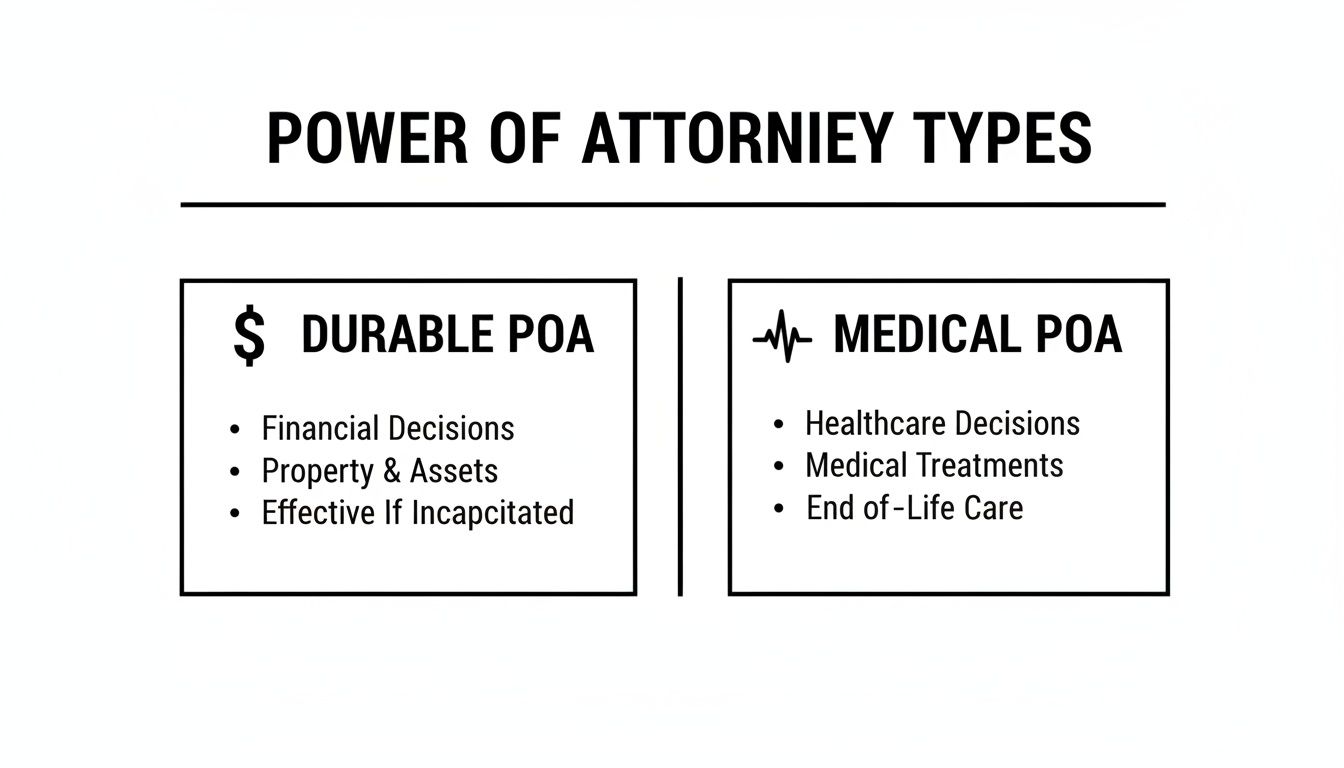
As you can see, these documents operate in completely different worlds—one protects your money, and the other protects your health. That separation is exactly why avoiding these planning mistakes is so critical for both.
Selecting an Unsuitable Agent
One of the most frequent errors we see is simply picking the wrong person for the job. Your oldest child or your closest sibling might feel like the default choice, but the person who handles your finances and the person who makes your medical decisions need very different skills and personalities.
- Financial Agent (DPOA): This person has to be organized, financially savvy, and assertive enough to deal with banks, creditors, and government agencies. You need someone you trust implicitly to manage complex financial tasks without letting emotions get in the way.
- Healthcare Agent (MPOA): This role demands someone who can stay level-headed in a crisis, be a strong advocate for you in a hospital, and make incredibly tough, emotional decisions based on your wishes, not their own.
Think about it this way: the best person to manage your real estate in Humble might not be the same person you'd want talking about end-of-life care with doctors at a Kingwood hospital. Take a hard look at each person's true strengths before you decide.
Using Vague or Ambiguous Language
In a legal document, clarity is king. Using fuzzy phrases like "handle my affairs" or "make medical choices" is an open invitation for confusion, family arguments, and even legal battles down the road. A power of attorney needs to be crystal clear.
A Lawyer’s Insight: The whole point of a power of attorney is to prevent conflict, not cause it. Specific, unambiguous language is your best defense against future disagreements among your loved ones.
For instance, your durable power of attorney should explicitly grant or withhold specific powers, like the ability to give gifts on your behalf or change your beneficiary designations. In the same way, your medical power of attorney should be backed up by detailed conversations so your agent truly understands what "quality of life" means to you.
The Dangers of Generic Online Templates
A free online form can seem like a great deal, but it's one of the riskiest shortcuts you can take. These one-size-fits-all documents often miss the nuances of Texas law and almost never address your unique family and financial circumstances.
Here are the common problems we see with DIY forms:
- Incorrect Execution: They might not give you clear instructions on Texas’s specific rules for witnesses and notarization, which could make the whole document invalid.
- Lack of Customization: They are often too basic and lack the specific clauses you might need, such as granting authority over digital assets or outlining certain healthcare instructions.
- Forgetting to Name Alternates: Many templates don't stress how vital it is to name successor agents. If your first choice can't serve, you’re left with no one, potentially forcing your family into a costly and stressful guardianship proceeding.
Forgetting to Name Successor Agents
What happens if the person you appointed passes away, becomes incapacitated, or simply decides they can't handle the job? Without a backup, the document is useless. It is absolutely essential to name at least one—and ideally two—alternate or successor agents for both your durable and medical power of attorney. This creates a clear line of succession, ensuring someone is always ready to step in without delay.
Steering clear of these common mistakes isn't hard when you have the right guidance. Working with an experienced Kingwood attorney ensures your documents are not only legally sound but also perfectly aligned with what you actually want. Don't leave your family’s future to chance—schedule a free consultation with The Law Office of Bryan Fagan today to get it right from the start.
How Our Kingwood Legal Team Can Help You Take the Next Step
Now that you've seen the difference between a Durable and a Medical Power of Attorney, you understand just how critical each one is. The next step? Putting that knowledge into action. Getting these documents in place now is one of the most thoughtful things you can do for yourself and your family, heading off potential conflict and confusion down the road.
At The Law Office of Bryan Fagan, our Kingwood attorneys are focused on helping our neighbors right here in Northeast Houston build estate plans that actually work when you need them most.
Guidance Tailored to Your Life in Kingwood
Every family's situation is unique, and your legal documents should be too. We’ve seen firsthand how one-size-fits-all templates can fail, creating more problems than they solve. That’s why our process starts with a conversation. We take the time to understand your family dynamics, your financial picture, and what matters most to you.
We can walk you through the critical decisions, like:
- Choosing the most trustworthy and capable agents for your financial and medical decisions.
- Weighing the pros and cons of an immediate vs. a springing Durable Power of Attorney.
- Crafting clear, specific instructions to leave no room for doubt or disagreement.
- Ensuring every document is signed, witnessed, and notarized correctly according to Texas law, so it’s ironclad.
A well-crafted power of attorney isn't just a legal document; it's a clear set of instructions for your loved ones during a stressful time. It's about protecting your legacy and ensuring your voice is heard, no matter what.
Your Local Kingwood Partner in Planning
Thinking about incapacity and end-of-life decisions can feel heavy, but you don’t have to figure it all out on your own. Our team isn’t just based in Kingwood—we live here. We understand the concerns that families in our community, from Humble to Porter, are facing every day. We’re committed to providing clear, straightforward advice without the confusing legal jargon.
Your future is too important to leave to chance. Let our experienced local team help you get the peace of mind that comes with a solid plan. Reach out to The Law Office of Bryan Fagan in Kingwood today to schedule your free, no-obligation consultation.
Common Questions About Texas Powers of Attorney
Even when you understand the basics, it's natural to have more questions. Planning for the future brings up a lot of "what-ifs." Here are answers to some of the most common questions we hear from our clients right here in the Kingwood area.
Can the Same Person Act as My Agent for Both Documents?
Yes, in Texas, you absolutely can name the same person to handle both your financial and medical decisions. Many people instinctively choose a spouse or a responsible adult child for both roles, and often that works out perfectly.
But it's worth taking a moment to think this through. The skills needed to manage investments, pay bills, and deal with banks are quite different from the emotional strength required to make tough, life-or-death medical choices. Are they truly the same skill set?
Sometimes, the best strategy is to split the roles. You might pick your brother who's a CPA for your Durable Power of Attorney and your sister who's a nurse for the Medical Power of Attorney. It’s all about putting the right person in the right seat. We can talk through your family dynamics to help you decide what makes the most sense for you.
What If I Don't Have a Power of Attorney and Something Happens?
This is the scenario everyone wants to avoid. If you become incapacitated in Kingwood or anywhere in Northeast Houston without these documents in place, your loved ones are left with only one path: going to court to establish a guardianship.
A guardianship is a public, time-consuming, and expensive court process. A judge in Harris or Montgomery County will have to appoint someone to manage your affairs. This person may not be who you would have chosen, and the court process itself can easily cost your family thousands of dollars, all while your personal matters become public record.
The Reality Is: Powers of attorney are a private solution to what could become a very public problem. They keep your family out of a courtroom, save them money and stress, and guarantee the person you trust is making the calls.
How Can I Change or Cancel a Power of Attorney?
Life changes, and your plans might need to change, too. As long as you are mentally competent, you have the absolute right to revoke or change your power of attorney at any time.
In Texas, this has to be done in writing. You’ll need to sign a formal revocation document. The next crucial step is to deliver a copy of that revocation to your former agent and to any institution that has the old document on file, like your bank or doctor’s office.
By far, the cleanest way to do this is to simply create a new Power of Attorney. A well-drafted new document will include specific language that automatically revokes all previous versions. Getting the legal details right is critical to ensure the revocation is effective, and our Kingwood team can handle the process to make sure it's done correctly and without ambiguity.
At The Law Office of Bryan Fagan – Kingwood TX Lawyers, we've seen firsthand how a little bit of planning can prevent a world of trouble down the road. You don't have to wait for a crisis to get your affairs in order.
Schedule your free consultation with us at kingwoodattorneys.com and let our local, experienced team provide the trusted guidance you and your family deserve.