You found the box of old bank statements, the closing papers, and the inheritance check stub, then realized half the trail is missing. That's the moment many Kingwood spouses panic. They assume a premarital account, a house bought before marriage, or an inherited investment will stay safe, then learn Texas doesn't care what you remember, it cares what you can prove.
If you're going through a divorce in Kingwood, Humble, Porter, or Northeast Houston, separate property tracing is the difference between keeping an asset out of the marital estate and watching it get divided. Texas law starts with a presumption that property possessed during divorce is community property, and the burden falls on the spouse claiming separate property to prove it with hard records, not just a story. That's why the paper trail matters so much.
Why Your Premarital Assets Are Not Automatically Protected
A Kingwood client once comes in thinking the same thing: “I owned that account before we married, so it's mine.” That sounds reasonable, but Texas divorce law doesn't work on common sense. It starts with a presumption that property held during divorce is community property, and the spouse claiming otherwise has to prove a separate-property claim with clear and convincing evidence. Texas also treats property owned before marriage, or acquired during marriage by gift, devise, or descent, as separate property, but that label only helps if you can prove it. Texas property division guidance
The problem is not ownership, it's proof
If a premarital savings account still exists in the same form, the claim is straightforward. Once that account has been merged with paychecks, moved between institutions, used for down payments, or swept into investments, the issue becomes tracing. Texas family law materials make the point plainly, the spouse must connect the current asset back to its separate origin with a documentary trail, not general recollection. Texas tracing guide
That's where people lose ground in Kingwood, Humble, and Northeast Houston divorces. The law doesn't reward certainty in your own mind, it rewards records that show where the money came from and how it moved. If the trail breaks, the community-property presumption can win.
Practical rule: if you can't show the chain from origin to current asset, assume the other side will argue it's community property.
A lot of clients also overlook how fast a clean claim gets messy. A premarital brokerage account becomes harder to defend once dividends are reinvested, a house gets refinanced, or separate cash gets mixed with family spending. The same pattern shows up in estate, probate, and civil disputes too, where old documents disappear and people rely on memory instead of proof.
For families dealing with related questions like parentage or support rights, a Paternity Lawyer in Kingwood deals with establishing legal paternity and related rights in Harris County. That's a different issue, but the same lesson applies, legal rights depend on documentation.
Texas Community Property Rules and the Clear and Convincing Standard

A Kingwood divorce often starts with a hard presumption. If property exists during the marriage, Texas treats it as community property unless one spouse proves a separate-property claim by clear and convincing evidence. That is a demanding standard. A judge wants records, not a story that sounds reasonable in the moment. Texas property division guidance
What counts as separate property
Texas recognizes separate property in a narrow set of situations. Property owned before marriage stays separate, and property acquired during marriage by gift, devise, or descent also stays separate. That can include inherited cash, a premarital home, or a gifted vehicle, but only if you can show where the asset came from and how it changed over time.
The label on an account or title does not carry the case. Courts look past the label and into the paper trail. Testimony can support a claim, but it does not replace documentation, and that is where weak cases fall apart. Tracing methodology in Texas
Why records matter more than memory
Your affidavit, your recollection, and your spouse's agreement may help, but they do not prove tracing by themselves. Bank statements, deeds, closing files, transfer confirmations, and account histories do the essential work. Texas tracing materials tell you to gather account records early, because once statements disappear or accounts get mixed, the claim becomes much harder to prove. Texas tracing guide
That point matters in Kingwood, Humble, and Northeast Houston divorces where a separate-property claim can get buried under bad recordkeeping. A premarital account gets muddied when dividends are reinvested. A house claim gets harder when one refinance changes the paper trail. Separate cash gets harder to defend once it is mixed with household spending, and that same problem shows up in other disputes where people rely on memory after the records are gone.
If the file is incomplete, do not stop there. Subpoenas, forensic reconstruction, and secondary records often rescue claims that look lost at first glance. A careful lawyer can use old statements, tax returns, closing papers, pay records, and bank production to rebuild the path of the money. For local property disputes, the rules on the Kingwood property division page control the analysis, and the spouse claiming separate property must prove it with evidence strong enough to satisfy a skeptical judge.
For parties dealing with related family-law issues, a Paternity Lawyer in Kingwood handles legal paternity and related rights in Harris County. The issue is different, but the lesson is the same, rights in court depend on documents, not assumptions.
The same tracing problem comes up outside Texas too, and asset tracing UK services can show how investigators rebuild a financial trail when records are missing or incomplete.
How Tracing Actually Works From Origin to Current Asset
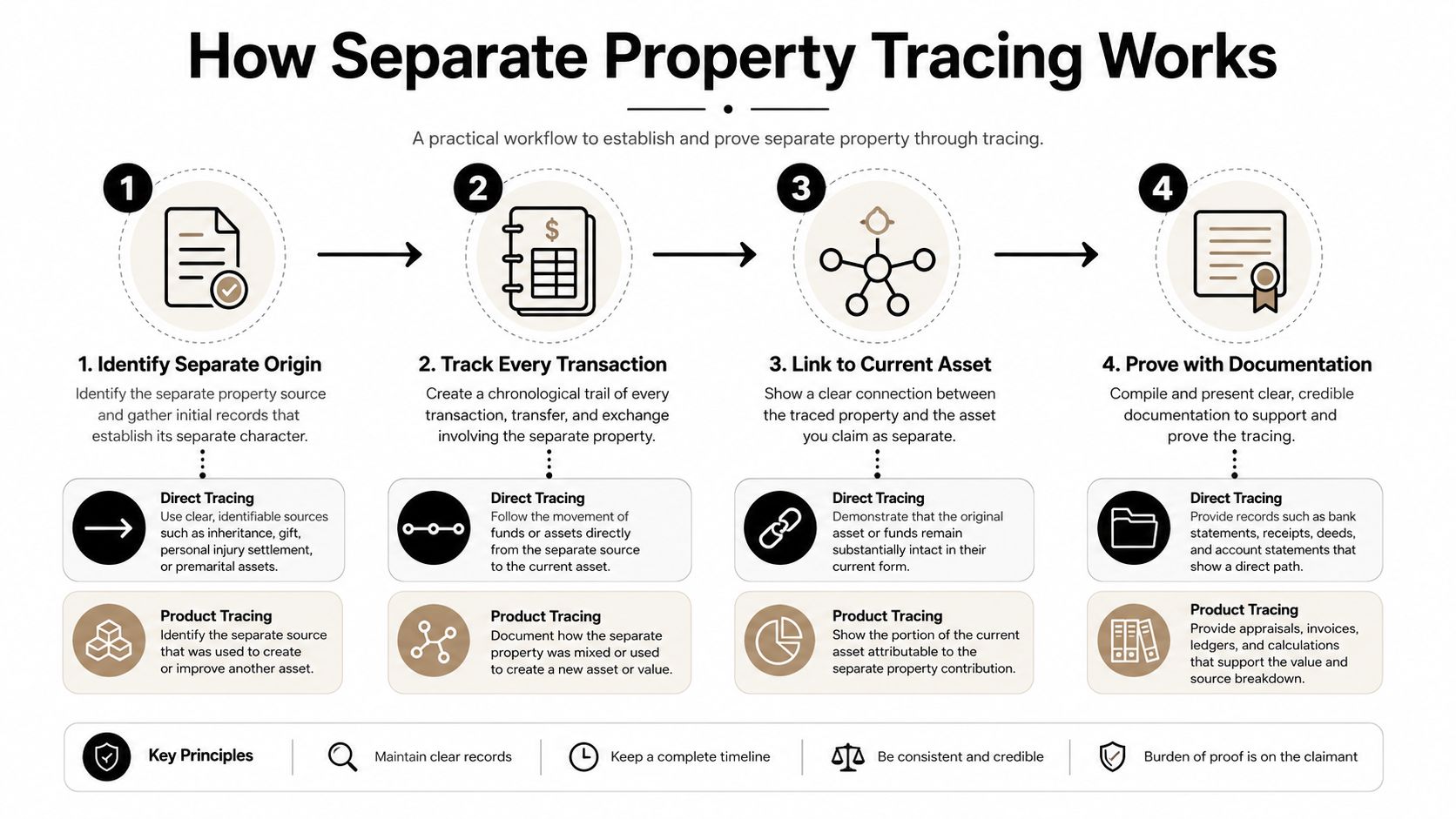
Tracing is a reconstruction project. The goal is simple. Start with a separate source, follow each deposit, withdrawal, transfer, reinvestment, or sale, and show how the asset on hand at divorce still connects back to that source. For non-cash assets, the analysis starts with the inception of title. For cash assets, it starts with the full transaction history.
Item tracing and cash tracing are different jobs
Real estate and vehicles usually call for item tracing, because the asset can be identified and tracked as a thing. Bank accounts, brokerage accounts, and other commingled funds require cash tracing, because the money changes form over time. The methods Texas lawyers use for mixed accounts include community-out-first, identical-sum inference, minimum-sum-balance, and pro-rata allocation.
That difference matters in Kingwood divorces. A premarital house presents one kind of proof problem. A premarital account used for household expenses, stock purchases, or business reinvestment presents another. A house bought before marriage can often be shown through deed and closing records. A bank account that has been active for years usually needs a ledger-style reconstruction, and the analysis gets tougher as transactions pile up.
What a usable trace looks like
A strong file has a beginning point, a chain of transactions, and a clean ending point. That means the original statement showing the separate source, each transfer or deposit that followed, and the current statement showing what remains. If a spouse can produce that chronology, the separate-property claim gets stronger. If the chain breaks, the presumption of community property gets harder to beat.
A judge does not need your best explanation. The judge needs the paper trail that proves it.
When the records are thin, the work shifts to reconstruction. Subpoenas, archived records, tax returns, closing files, payroll records, and bank production can fill gaps that look fatal at first. If the account history is spread across institutions, a forensic accountant can rebuild the flow of funds and organize the evidence in a way the court can follow. That is the same kind of reconstruction used in asset tracing UK services, where the point is to turn scattered financial records into a coherent timeline.
If you think a spouse has hidden or moved money, a Kingwood divorce asset hiding investigation may uncover the missing trail before the claim collapses.
Video also helps people see how the chain works in practice.
A simple example makes the point clear. If a spouse had a premarital brokerage account and later rolled those funds into a different investment platform during marriage, every transfer and reinvestment matters. Continuous records can keep the claim alive. A broken chain weakens the trace fast.
What to Do When Records Are Missing or Incomplete
A missing paper trail does not end a separate property claim. It just means you have to prove the source of funds with whatever records still exist and fill the gaps with disciplined reconstruction. Texas courts care about proof, not excuses, and testimony by itself usually does not carry a separate-property claim when the documents are thin.
Start with the records that are easiest to find. Tax returns, closing documents, retirement summaries, loan files, wire confirmations, and third-party account statements often show enough of the chain to keep the trace alive. If an institution still exists, subpoenas can force archived records into the case. If the trail runs through several banks or brokers, a forensic accountant can rebuild the flow of funds and sort the transactions into a timeline the court can follow.
That is also where hidden transfers start to matter. If you think a spouse moved money, changed accounts, or stripped records out of reach, the Kingwood divorce asset concealment page is the practical place to look at that problem before the claim gets weaker. Missing documents are common. Missing honesty is a different issue.
A trace can survive incomplete records if the origin is clear and the secondary evidence fills the gap. Bank statements, payroll records, mortgage histories, and tax filings often do that work when the direct statement history is gone. A claim falls apart when all you have is memory, a few screenshots, and no reliable chain from the original separate source to the current asset.
Bottom line: partial records are better than no records, but unsupported assertions almost never carry a separate-property claim in Texas court.
The right move is to gather what you can early, then decide whether subpoenas or forensic reconstruction are needed. If the missing links are small, secondary records may be enough. If the gaps are large or the spouse controlled the paperwork, the trace may still be worth pursuing, but you need a tighter evidentiary strategy.
Tracing Modern Assets Like Retirement Accounts and Businesses
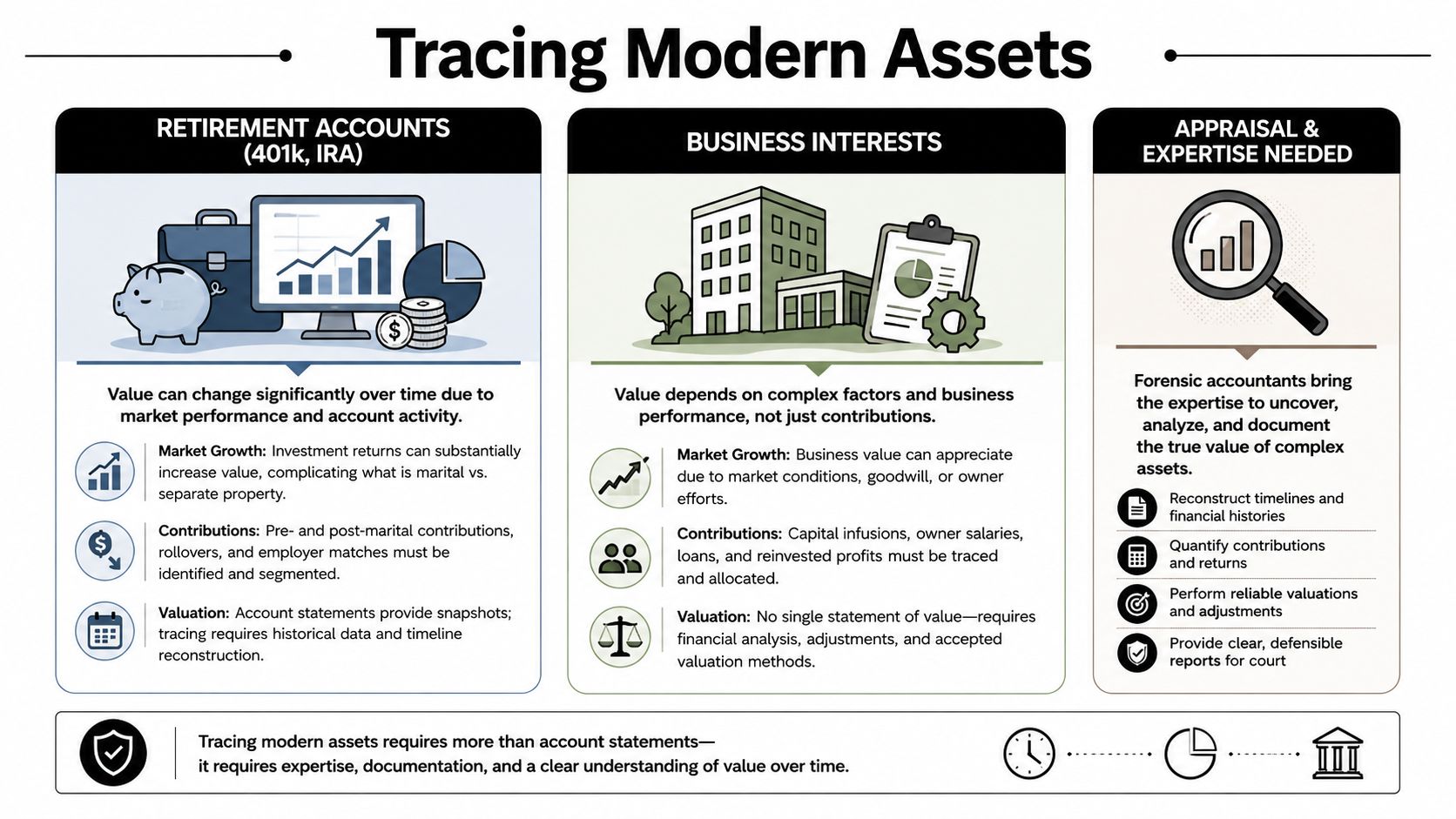
A modern divorce rarely involves a clean paper trail. Retirement rollovers, brokerage accounts with constant trading, business interests, and digital assets can shift form so often that the original separate source gets harder to prove. Texas tracing materials distinguish between value tracing for cash assets and item tracing for non-cash assets, but active accounts create a harder problem because the asset keeps changing while the case is pending. Tracing methodology in Texas
Retirement and brokerage accounts create chain problems
A retirement account earned before marriage may begin as separate property, but later contributions during marriage, rollovers, and market movement complicate the analysis. Brokerage accounts can be even messier because dividends, splits, and repeated trading blur the line between separate and community funds. If the transaction history is broken up, the separate-property claim gets harder to prove.
For retirement funds, the tracing question often turns on plan history and division mechanics. A spouse who wants to protect a premarital account needs clean records showing what came in before marriage, what was added later, and what happened after each transfer. Kingwood retirement account division page addresses that problem directly because retirement divisions in divorce depend on more than the account balance on the day of filing.
Business interests need a tighter reconstruction
Business ownership brings a different layer of difficulty. A company started before marriage may still be separate in part, but growth during marriage, community labor, and marital funds used to keep it running can make characterization and valuation much harder. In a real Kingwood divorce case, the court is not just asking what the business is. It is asking how much of it stayed separate and how much was built with marital effort or marital money.
That is why the paper trail matters even more when the business is active. Tax returns, profit-and-loss statements, payroll records, loan documents, and ownership changes can show whether separate capital stayed intact or whether the business absorbed community contributions. If those records are incomplete, the trace does not automatically fail. It just has to be rebuilt with better support.
Digital assets and active management raise the stakes
Digital assets create a different kind of gap. Wallet histories, exchange records, and platform exports may be incomplete, inconsistent, or hard to read. That produces a tracing problem similar to a commingled bank account, except the records are usually scattered across more systems. The same issue comes up when a spouse actively manages an asset, sweeps cash into new forms, or keeps moving money between accounts.
If the asset kept changing form, the trace has to follow each change.
That is where forensic review becomes more useful than argument. A forensic accountant can compare account histories, valuation records, and transfers to determine whether the separate source still shows up after repeated changes. When records are thin, secondary documents, subpoenaed records, and forensic reconstruction can still carry the case if they line up with the asset history. If you are a business owner, investor, or executive in Kingwood or Northeast Houston, do not assume a modern asset is beyond tracing just because the paperwork is messy. The court wants a precise reconstruction, and that starts with the records you can still pull together.
Your Documentation Checklist and Next Steps in Kingwood
Start gathering your file now, before your spouse hires counsel and starts controlling the paper trail. Texas family-law guidance supports collecting 24–36 months of statements and related records early when divorce is on the horizon, especially for bank, brokerage, retirement, and real-estate transactions. That is the practical starting point for a serious tracing effort in Kingwood, Humble, and Northeast Houston.
Build the file in three groups
- Financial records: bank statements, brokerage statements, retirement account histories, and tax returns.
- Asset documents: deeds, titles, closing statements, loan files, and transfer confirmations.
- Proof of origin: inheritance documents, gift letters, probate records, and premarital account statements.
Keep the records organized by asset, then by date. A clean file makes it easier to show where the money came from, how it moved, and whether community funds were ever mixed in.
If some records are already gone, do not stop there. Start with what you have, then use subpoenas, third-party statements, or forensic reconstruction to fill the holes. Secondary records often matter more than people expect, especially when the original statements were deleted, lost, or never kept in one place. As the Texas tracing guide explains, the point is to reconstruct a reliable chain of ownership, not to give up because the first folder is incomplete.
When to bring in an attorney or expert
Get legal help fast if your spouse has moved money, sold property, changed account access, or started withholding records. You also need counsel quickly if the asset involves a business, retirement account, or real estate with refinance history. Those situations turn messy fast because each new transaction creates another tracing problem.
For Kingwood families who want a local option, the Law Office of Bryan Fagan – Kingwood TX Lawyers handles family law matters, including divorce and property division, and can help organize the records that matter most in a tracing dispute. Keep the focus on facts, not assumptions, because Texas courts follow the documents.
If you are staring at an incomplete paper trail, get it organized now and have a lawyer review it before the other side controls the story. Bring the statements, deeds, tax returns, and transfer records to a free consultation at the Kingwood office, and get a straight answer about whether your claim is strong, weak, or salvageable.