Skip to content
A flood-damaged home near Lake Houston is difficult enough without a divorce proceeding attached to it. One spouse may be living in the house, the mortgage may still be due, repairs may be incomplete, and an insurance claim may be unresolved when the parties need to divide their property. For families in Kingwood, Humble, Porter, and Northeast Houston, the central question isn't just who keeps the home. It's what the home, the damage, the debt, and the insurance proceeds are truly worth, and how the final decree will assign each piece.
This guide explains the practical path for a Lake Houston flood-damaged home division in a Texas divorce. Texas community property rules, flood-aware valuation, claim tracking, temporary expenses, and precise settlement language all matter. A damaged marital residence can shift from a valuable asset to a contested liability, but careful documentation and local legal guidance can keep the damage from creating a second dispute after the divorce ends.
When a Lake Houston Home Floods During Divorce
Suppose a Kingwood couple is already negotiating property division when floodwater damages their marital home. Before the loss, both spouses understood the basic question: one spouse might keep the residence and compensate the other, or they might sell it and divide the net proceeds. After the flood, that calculation changes. The home needs remediation, the market may discount its condition, an insurer may still be evaluating the claim, and one spouse may be paying expenses while the other disputes responsibility.
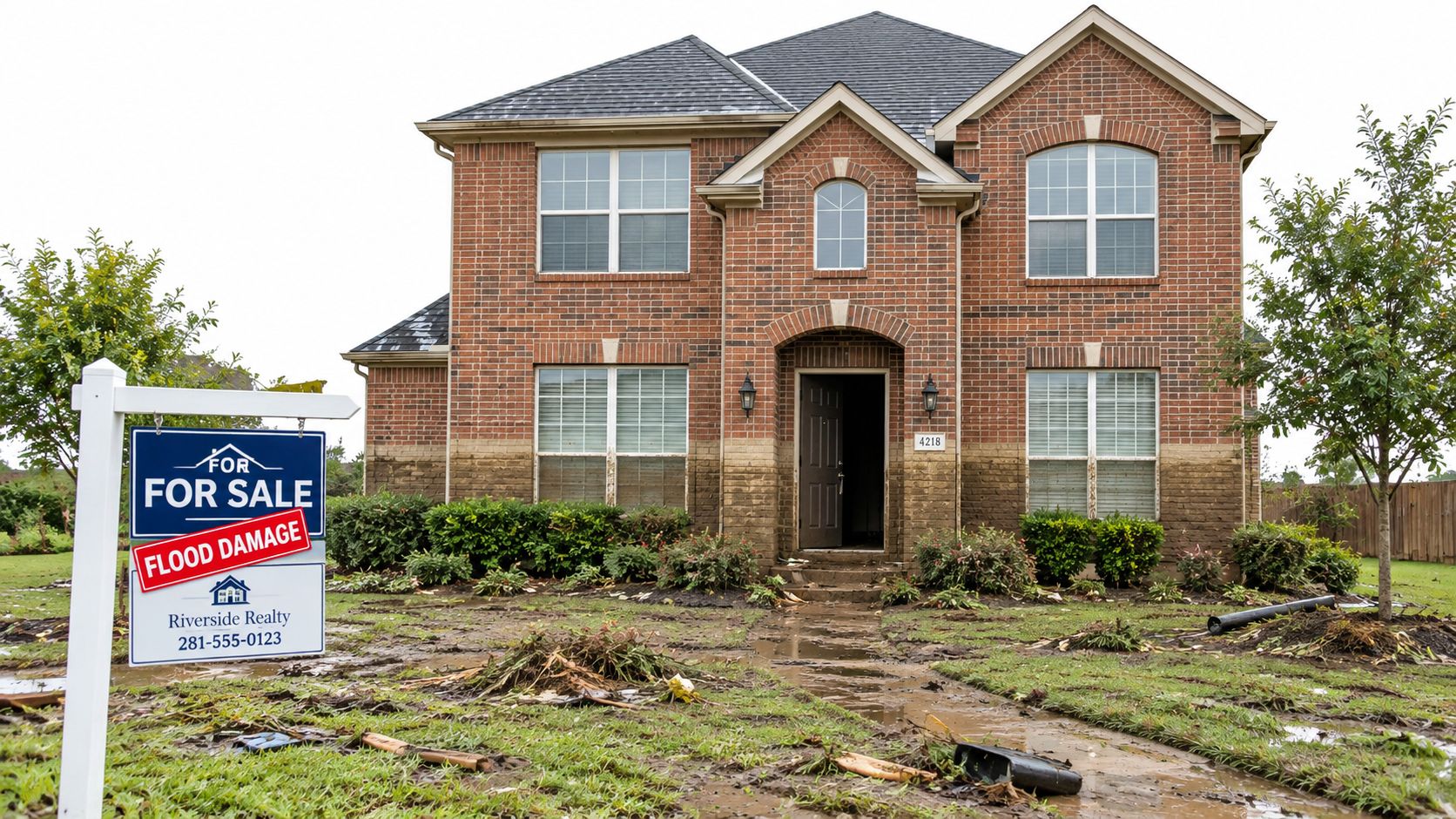
That situation isn't unusual in a region shaped by the San Jacinto River system and the Lake Houston watershed. FEMA estimated that about 72,000 homes in the Houston area were damaged by Hurricane Harvey in 2017, with rainfall exceeding 40 inches in many locations and more than 50 inches in some areas (Texas Courts' Harvey-related report). Those figures help explain why flood damage in Northeast Houston can affect not only repairs, but also marketability, financing, insurance disputes, and the timing of a divorce settlement.
Why timing changes the property dispute
The date of the flood matters. So does the date of the insurance claim, the date repairs began, the date proceeds arrived, and whether the divorce decree was signed before or after those events. A payment received while the case is pending may need to be preserved, documented, and included in the final division rather than spent without an agreed plan.
The court may need to address several connected questions:
- Current condition: Is the residence habitable, partially repaired, or being sold as-is?
- Financial responsibility: Who paid the deductible, contractors, temporary lodging, utilities, or mortgage?
- Insurance status: Is the claim open, denied, partially paid, or subject to further documentation?
- Equity: Does the home have positive equity after damage, debt, liens, and selling costs?
- Future risk: Will the spouse keeping the home accept unresolved repairs and insurance obligations?
Flood cleanup also requires attention to health and property risks beyond visible damage. Before extensive cleanup or renovation, homeowners may find a practical post flood pest prevention guide useful for identifying pest-related issues that can follow moisture intrusion.
Practical rule: Don't negotiate a final home value from an old appraisal while the flood claim and repair scope remain unresolved.
For a Kingwood family, the best first move is to preserve the home, claim, and financial records together. That means avoiding unilateral sale decisions, large repair commitments, or use of insurance proceeds without written agreement or a temporary court order.
How Texas Law Treats Your Flood Damaged Marital Home
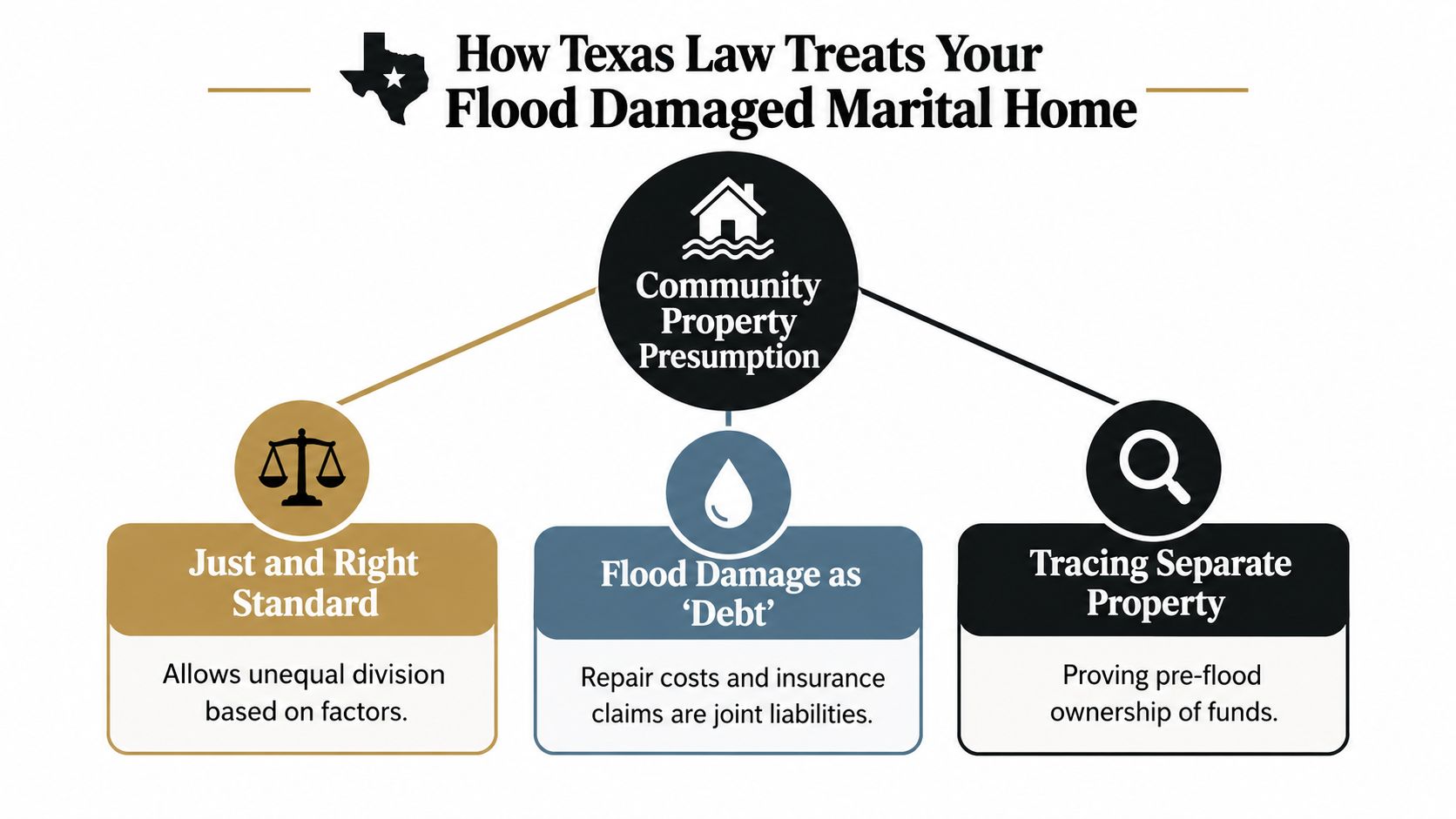
Texas generally treats property acquired by either spouse during marriage as community property, unless a spouse proves that the property is separate. Texas Family Code § 7.001 requires the court to divide the community estate in a manner that is “just and right”, not automatically in an equal split (Texas community property guidance).
That framework matters for a flooded residence. If the marital home was purchased during the marriage, mortgage payments came from marital earnings, or improvements were funded with marital money, the home and related financial consequences will usually require community-property analysis. Flood damage doesn't automatically belong to one spouse because one spouse occupied the home or handled the insurance call.
Start with classification, then calculate consequences
Use this order when reviewing the residence:
- Identify the acquisition history. Gather the purchase documents, closing records, deed, loan documents, and evidence of the source of the down payment.
- Separate ownership from condition. A spouse's separate-property claim concerns the asset's origin. Flood damage concerns the asset's present value and related obligations. Those are different questions.
- Trace marital payments. Mortgage principal, improvements, insurance deductibles, and remediation paid from marital funds can affect reimbursement or accounting issues.
- Review conduct after the flood. Unexplained use of insurance proceeds, refusal to protect the property, or unnecessary depletion of community funds may raise dissipation or waste concerns.
- Apply the just-and-right standard. The judge can consider child-related needs, fault, earning capacity, waste, and other facts supporting an unequal division.
A flood loss can therefore become part of a larger property-division analysis. The court may value the home, assign the mortgage and repair debt, account for insurance proceeds, and determine whether one spouse should receive reimbursement for payments made on behalf of the community estate.
The property division guidance for Kingwood divorce cases provides related information about organizing and dividing marital assets. For a more focused service description, a Property Division Lawyer in Kingwood addresses division of community property and complex assets for Kingwood divorces.
Why damage doesn't decide the entire division
A damaged home may have less equity, but that doesn't mean the spouse who keeps it automatically receives less or that the other spouse automatically absorbs the loss. Texas courts divide the community estate as a whole. The flooded residence may be balanced against other property, debts, retirement interests, or reimbursement claims.
That is why a settlement should not say only, “Spouse A receives the house.” It should also address the mortgage, repair obligations, insurance rights, pending claims, proceeds already received, proceeds still expected, and any sale or reimbursement consequences.
Documenting Damage Insurance and True Market Value
The strongest flood-related property division cases rely on records, not assumptions. A generic appraisal prepared before the water intrusion may no longer answer the legal question. The parties need a current picture of the residence, the repair burden, the insurance claim, and the net value available for division.
Texas divorce inventories and appraisements should identify real property, debts, and values. For a Lake Houston home, create a separate flood file that can be updated as repairs and claims develop. Start with the home's pre-loss condition, then document the damage and calculate the present position.
Build the file in a defensible order
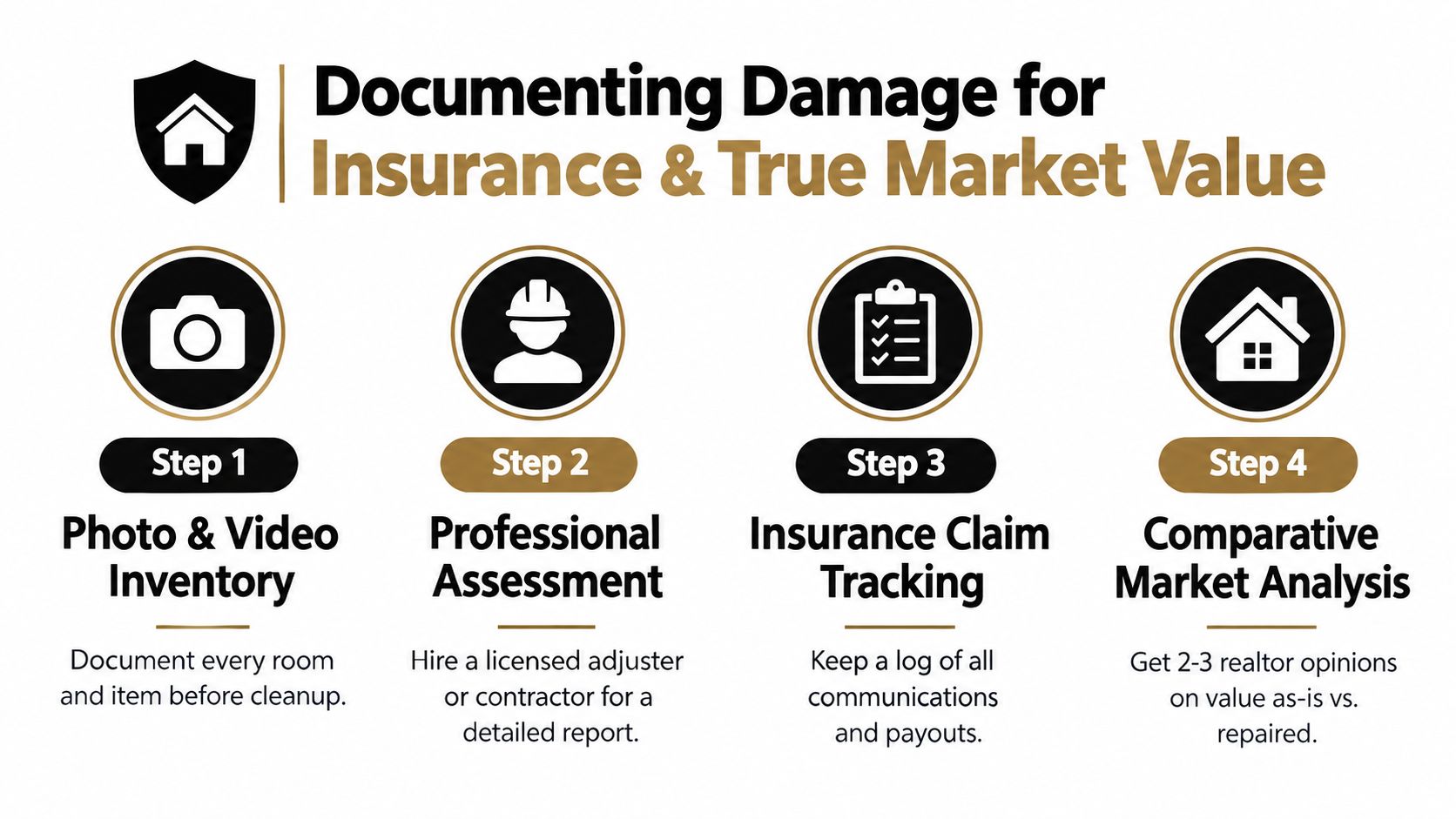
First, preserve pre-flood evidence. Collect prior listing photographs, inspection reports, repair invoices, tax records, photographs, videos, and messages describing the home's condition before the event. If one spouse claims the property already had major defects, the pre-loss record can help distinguish existing problems from flood-caused damage.
Next, document every affected area. Photograph walls, flooring, cabinets, electrical components, appliances, contents, exterior materials, drainage features, and visible mold or moisture. Keep original files and note when each image was taken. Don't discard damaged materials before an adjuster or qualified professional has a fair opportunity to inspect, unless immediate safety or health concerns require removal.
Then, obtain professional assessments. A flood-aware appraiser should understand flood zones, elevation, insurance issues, and code-related repair costs. A contractor or licensed adjuster can define the repair scope, but the appraiser answers a different question, the property's current market value.
Track the claim separately. Keep policy declarations for homeowners, flood, and windstorm coverage, along with prior claims, adjuster communications, estimates, denial letters, payment records, and any elevation certificates. A practical water damage insurance claim resource from RestoTek TX Austin can help homeowners organize claim-related information, but it doesn't replace advice from your own insurance and family law professionals.
Use a living inventory, not a single spreadsheet snapshot
Update the inventory whenever money moves or the home's condition changes. Record who paid, the date, the purpose, and the supporting document. Insurance proceeds should have their own ledger showing the amount received, the account holding the funds, payments made, and the remaining balance.
| Document or Task | Why It Matters in Division | Who Provides It |
|---|---|---|
| Pre-loss photos and inspection records | Helps distinguish prior condition from flood-related loss | Homeowners, inspector, realtor |
| Flood, homeowners, and windstorm declarations | Identifies coverage and policy rights | Insurance carrier or agent |
| Adjuster reports and communications | Shows the claim position and unresolved issues | Insurance carrier, adjuster |
| Repair estimates and invoices | Establishes repair scope, cost, and payments already made | Contractors, homeowners |
| Elevation certificates and flood information | Helps the appraiser evaluate flood-related market concerns | Homeowner, surveyor, local records |
| Current flood-aware appraisal | Supports an as-is or repaired market value | Qualified appraiser |
| Bank statements and payment records | Tracks deductibles, remediation, mortgage payments, and proceeds | Both spouses, financial institutions |
| Updated inventory and appraisement | Allows the decree to divide the home, debts, claim, and proceeds consistently | Both spouses and counsel |
Don't lock in a value before the insurance facts are verified. A home that looks unmarketable today may have a pending claim, while a home that appears repaired may still carry unpaid code-related work, liens, or unresolved coverage disputes. The appraisal, claim ledger, and repair file should be reviewed as one package.
A current value is only useful if the parties know what that value includes and what it leaves out.
If one spouse refuses to preserve records or follow a court-approved repair and payment plan, enforcement may become necessary. Enforcement of Court Orders in Kingwood concerns enforcing divorce decree and custody order provisions in Harris County.
Choosing Between Buyout Offset or Sale After Flood Loss
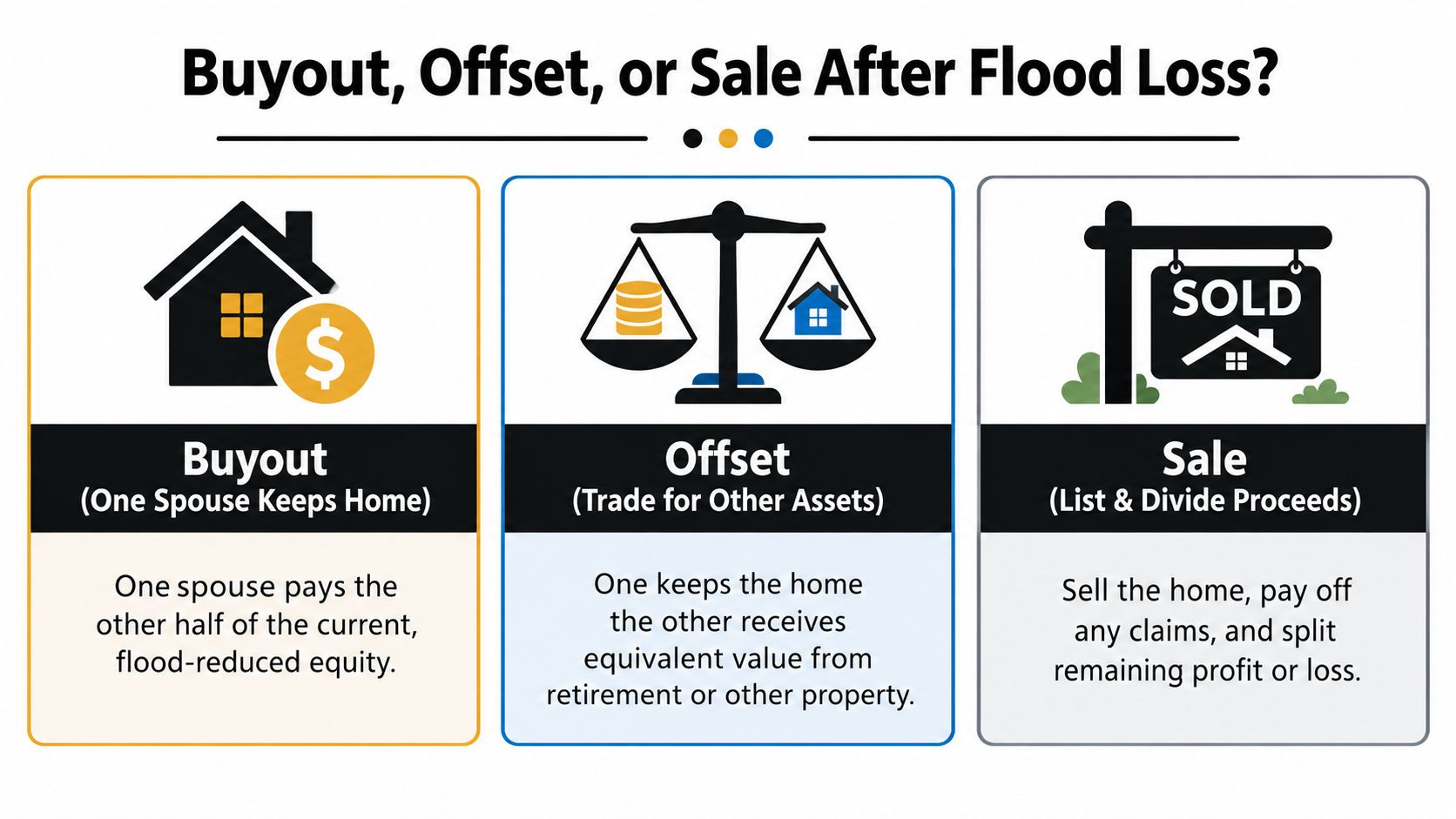
The right solution depends on flood-adjusted equity, not the home's pre-loss price. Texas real-estate divorce guidance describes a common approach: calculate equity, then allow one spouse to keep the residence by paying the other spouse a share of the equity or offsetting that value with other assets (Texas Law Help's real-estate divorce guidance).
For a damaged Kingwood property, the calculation must account for the current appraised value, mortgage balance, liens, necessary repairs, available insurance proceeds, unresolved claim rights, and the costs of selling. A spouse shouldn't agree to a buyout based on a pre-flood estimate or an optimistic repair assumption.
Buyout
A buyout works when one spouse wants to keep the home and can responsibly carry the mortgage, repairs, insurance, and future flood-related costs. The parties use the current value, subtract secured debt and agreed adjustments, and determine the equity subject to division. The spouse keeping the property then pays the other spouse's agreed share or provides a legally sufficient substitute.
This option is attractive when the home remains suitable for the children, the resident spouse can refinance or otherwise manage the debt, and the repair plan is clear. It is dangerous when the buyout depends on insurance money that hasn't arrived or repairs that haven't been priced.
Offset
An offset lets one spouse keep the house while the other receives equivalent value from retirement interests, other real estate, accounts, or another community asset. That can avoid an immediate sale, but the offset must reflect the home's damaged condition and the actual value of the property exchanged.
For example, a spouse might retain a flood-damaged residence while the other receives a different asset. The agreement should identify whether the home is valued as-is, whether pending insurance proceeds are included, and who bears future repair obligations. Community assessments and property-related charges can also affect the result, which is why Kingwood homeowners should review MUD district assessments and divorce property division before finalizing an offset.
Sale
A sale is often cleaner when neither spouse can fund repairs, qualify for refinancing, or agree on the home's value. Texas divorce guidance explains that sale proceeds are generally reduced by the mortgage payoff and other selling costs before the remaining amount is divided under the decree (guidance on splitting home sale proceeds in a Texas divorce).
For a Northeast Houston sale, the decree should address whether the property will be repaired or listed as-is, who chooses contractors and the listing agent, how insurance money is applied, and how liens and closing expenses are paid. The parties should also decide who may approve offers and what happens if the sale produces a loss rather than distributable proceeds.
Decision point: Choose the option that can be funded, documented, and enforced. A theoretically equal division is not practical if it leaves one spouse with an unmanageable repair obligation.
Managing Temporary Possession Expenses and Settlement Language
The divorce may take months while the house remains damaged. During that period, someone must protect the structure, maintain required insurance, pay the mortgage, handle utilities, coordinate remediation, and make decisions about access. Don't leave those responsibilities to informal text messages.
Ask for temporary orders or a written interim agreement covering:
- Possession: Identify which spouse lives in or accesses the home and establish rules for inspections, contractors, and personal property.
- Mortgage and taxes: State who pays each obligation and whether those payments will be considered in the final accounting.
- Insurance: Identify who communicates with the carrier and who may submit supplemental documentation.
- Repairs: Set approval requirements for remediation, emergency work, improvements, and contractor selection.
- Insurance funds: Require proceeds to remain identifiable and limit spending to agreed repairs or documented expenses.
- Records: Require both spouses to receive claim communications, estimates, reports, and payment confirmations.
Treat proceeds as a separate tracking problem
A flood payment that arrives before the divorce is final shouldn't disappear into an ordinary household account. Deposit it into an identifiable account when possible, preserve the payment explanation, and maintain receipts for every related expense. If the check covers replacement-cost work that hasn't been completed, the decree should say who must complete the work and what happens to any remaining funds.
Texas law requires a divorce decree to specifically divide rights in an insurance policy. Texas legal guidance also explains that if the decree doesn't address those rights, the policy and valid claim proceeds may follow the insured property or policy rights awarded in the decree (Texas law concerning insurance policy rights after divorce). That rule makes vague drafting especially risky in a pending Lake Houston flood claim.
Use precise provisions, not a one-line award
A strong decree or mediated settlement should identify:
- The legal description and current condition of the residence.
- The spouse receiving the home, or the sale process.
- The mortgage, taxes, insurance premiums, utilities, and repair debt.
- The policy rights and every pending flood-related claim.
- Proceeds already received and proceeds paid after signing.
- Who controls claim communications and supplemental claims.
- How repair funds may be spent and how unused funds are treated.
- How liens, contractor disputes, and sale expenses are resolved.
- Whether payments made by one spouse create reimbursement claims.
- What documents must be delivered and by what deadline.
If marital money paid flood deductibles or remediation, ask counsel to evaluate whether a reimbursement claim against the community estate should be documented and resolved in the decree. The purpose isn't to create unnecessary conflict. It's to prevent one spouse from discovering after divorce that the order never allocated a claim, payment, or repair obligation.
Moving Forward With Confidence in Kingwood
A flood-damaged marital home needs a different property-division strategy than an ordinary residence. Begin by classifying the home and payment history under Texas community property rules. Then document the pre-loss condition, repair scope, insurance claim, current market value, mortgage, liens, and every dollar paid or received.
From there, choose deliberately between a buyout, an offset, or a sale. The best option depends on current equity, repair capacity, insurance timing, possession needs, and whether either spouse can carry the home's remaining obligations. Finally, make the decree specific about the residence, policy rights, proceeds, repairs, debt, and future sale funds.
Kingwood families shouldn't have to face those decisions without local guidance. The Law Office of Bryan Fagan – Kingwood TX Lawyers serves Kingwood, Humble, Porter, and Northeast Houston with client-focused legal support in family law, along with estate planning, probate, criminal defense, and civil matters. Clear communication and careful document review can help protect both your home equity and your next chapter.
The Law Office of Bryan Fagan – Kingwood TX Lawyers can review your flood-damaged home, insurance proceeds, repair records, and proposed property-division language in the context of your Texas divorce. Schedule a free consultation by visiting Law Office of Bryan Fagan – Kingwood TX Lawyers and take the next step with a local Kingwood legal team.