
A lot of Kingwood couples reach the same stressful moment during divorce. One person wants to keep the house. The other wants a fair buyout. Then the annual tax bill shows a separate MUD line, and suddenly the numbers don't feel simple anymore.
That confusion makes sense. In Kingwood, Humble, Porter, and Northeast Houston, many homes sit in neighborhoods where a municipal utility district adds another layer of carrying cost. During divorce, that extra bill can affect how much equity is really in the home, whether refinancing is realistic, and how a decree should assign responsibility going forward. If no one addresses it clearly, a house that looked affordable on paper can become a source of conflict after the divorce is final.

When Kingwood MUD district assessments and divorce property division meet, the result is a very practical problem. The issue isn't only who gets the home. It's also who carries the tax burden attached to it, how that burden affects net value, and whether the final agreement fits real life after separation. For many families, this becomes one of the most important financial questions in the case.
If you're also trying to understand broader tax issues that show up during a split, this overview of navigating tax hurdles in divorce gives useful context alongside the property-division questions discussed here.
How Texas Community Property Rules Shape Divorce Division
A Kingwood couple may agree on one basic point at the start of divorce: one spouse wants to keep the house. Then the harder question shows up. What is the house worth to the community estate once the court looks at the mortgage, the tax obligations tied to the property, and the cost of carrying it after the divorce?
Texas law starts with ownership classification. Before a court can divide a home, reimburse one spouse, or set up a buyout, it has to identify what belongs to the marital estate and what belongs to one spouse alone.
Marriage property works like one shared account, unless someone proves otherwise
Under Texas Family Code § 3.002, community property generally includes property acquired by either spouse during marriage. Under § 3.003, property either spouse possesses at divorce is presumed to be community property unless that presumption is overcome by clear and convincing evidence, as summarized in this explanation of Texas community property rules.
That rule catches many families off guard. A deed may list one spouse. A tax statement may arrive in one name. The mortgage may even be paid from one paycheck. None of those facts automatically make the house separate property. If the home was purchased during marriage with community funds, the court often begins with the assumption that the value connected to that home belongs to the community estate.
A separate property claim usually rises or falls on paper records. Closing documents, bank statements, gift records, inheritance records, and refinance paperwork often matter more than memory. For a closer look at that proof issue, this local guide to separate property tracing in Kingwood divorce helps explain how tracing works in real cases.
Texas courts divide community property in a just and right way
Texas does not require an automatic 50-50 split. Under Texas Family Code § 7.001, the court must divide the community estate in a just and right manner, as explained in this overview of property division in Texas divorce.
That phrase matters because it gives the judge room to examine real-world fairness. A house with strong resale value may still be expensive to keep each month. A spouse who receives the house may also receive the duty to pay the mortgage, property taxes, insurance, and other charges tied to the property. In Kingwood cases, that practical burden can affect whether a buyout is fair on paper and manageable in daily life.
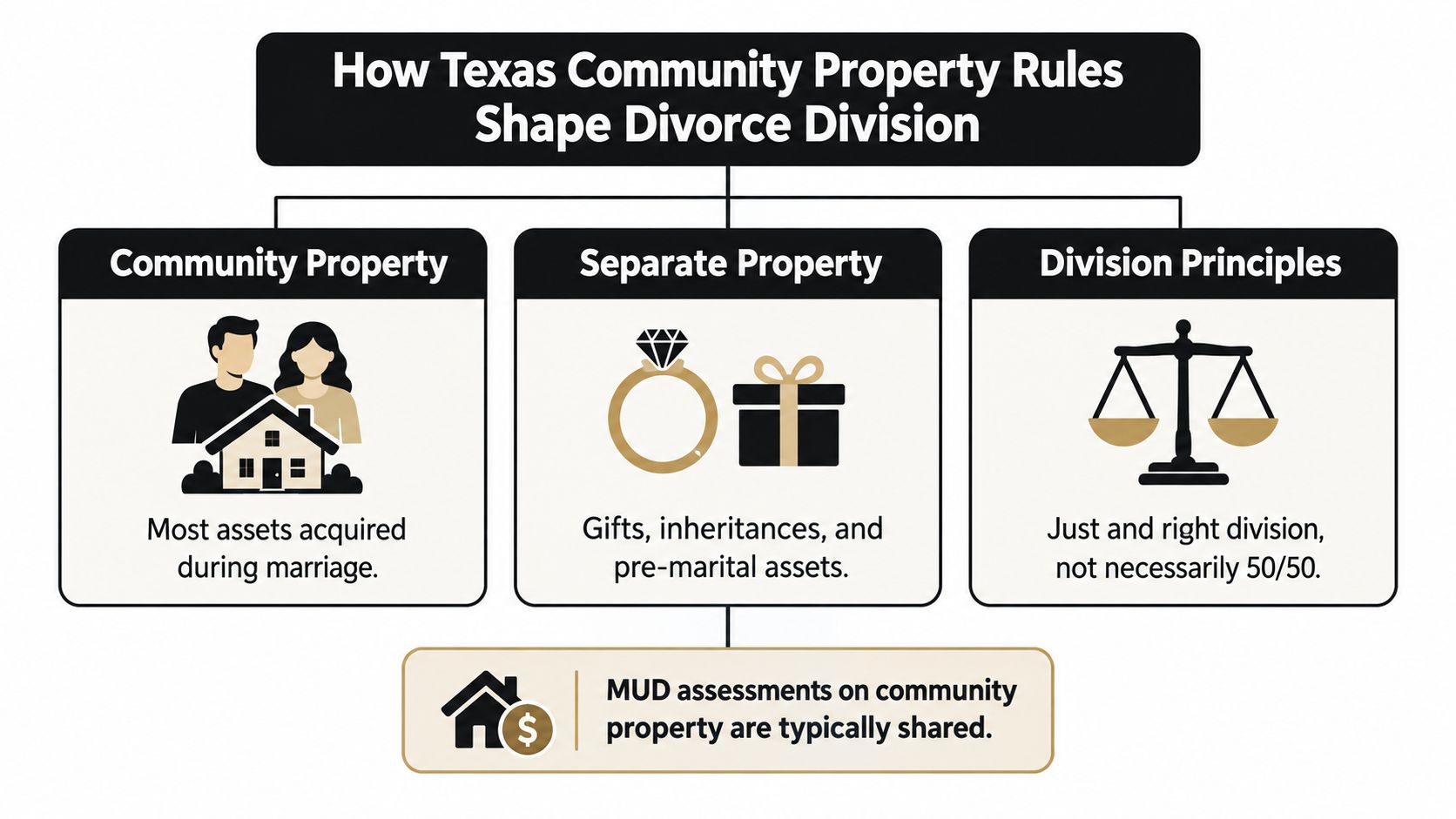
MUD-related costs start to matter to property division, even before the article gets into lien mechanics in detail. A home is not just an asset with a market price. It is also a stream of obligations. If one spouse keeps a Kingwood home served by a MUD, the court or the parties may need to account for how those tax obligations affect usable equity, the amount of any offset owed to the other spouse, and whether refinancing is realistic after the divorce.
Timing can change the division math
Texas also has a statutory 60-day waiting period under § 6.702, according to the Texas State Law Library divorce overview. For property issues, timing often matters far beyond that minimum waiting period.
Here is the practical point. Property division is based on values and obligations that may shift while the case is pending. If a tax bill comes due, if arrears build up, or if one spouse pays carrying costs alone for months before trial or settlement, those facts can shape reimbursement claims and the final just-and-right division. In a Kingwood home case, the question is rarely limited to "Who gets the house?" The better question is "What value does the house contribute after the attached costs are accounted for fairly?"
Property division also affects the rest of the case. Housing decisions influence cash flow, support planning, and whether each spouse can maintain financial stability after the decree. A clear classification and valuation analysis gives the court, and the family, a steadier foundation for every other decision.
Understanding Kingwood MUD Assessments Liens and Long Term Costs
A spouse in Kingwood agrees to keep the house because the market value looks strong and the mortgage seems manageable. Then the annual tax bill arrives, and one line item changes the picture. The home sits in a municipal utility district, or MUD, and that added charge affects monthly affordability, refinance options, and the value of the property in a divorce.
A municipal utility district is a local taxing entity created under Chapter 54 of the Texas Water Code. It raises money for infrastructure such as water, sewer, and drainage, and it can place its own ad valorem tax on top of county, school, and other property taxes. For a homeowner, that means the cost of the house is more like a cart with several items in it. The mortgage is only one item. The MUD tax is another, and it can be large enough to change what the home is worth to the spouse who keeps it.
Public examples in this guide to MUD and PID taxes in Texas show how rates can differ from one district to another. Using the examples in that source, a $300,000 home can face meaningfully different annual MUD costs depending on the district's rate. In divorce, that difference matters because a house with the same market value can produce very different cash flow after the decree.
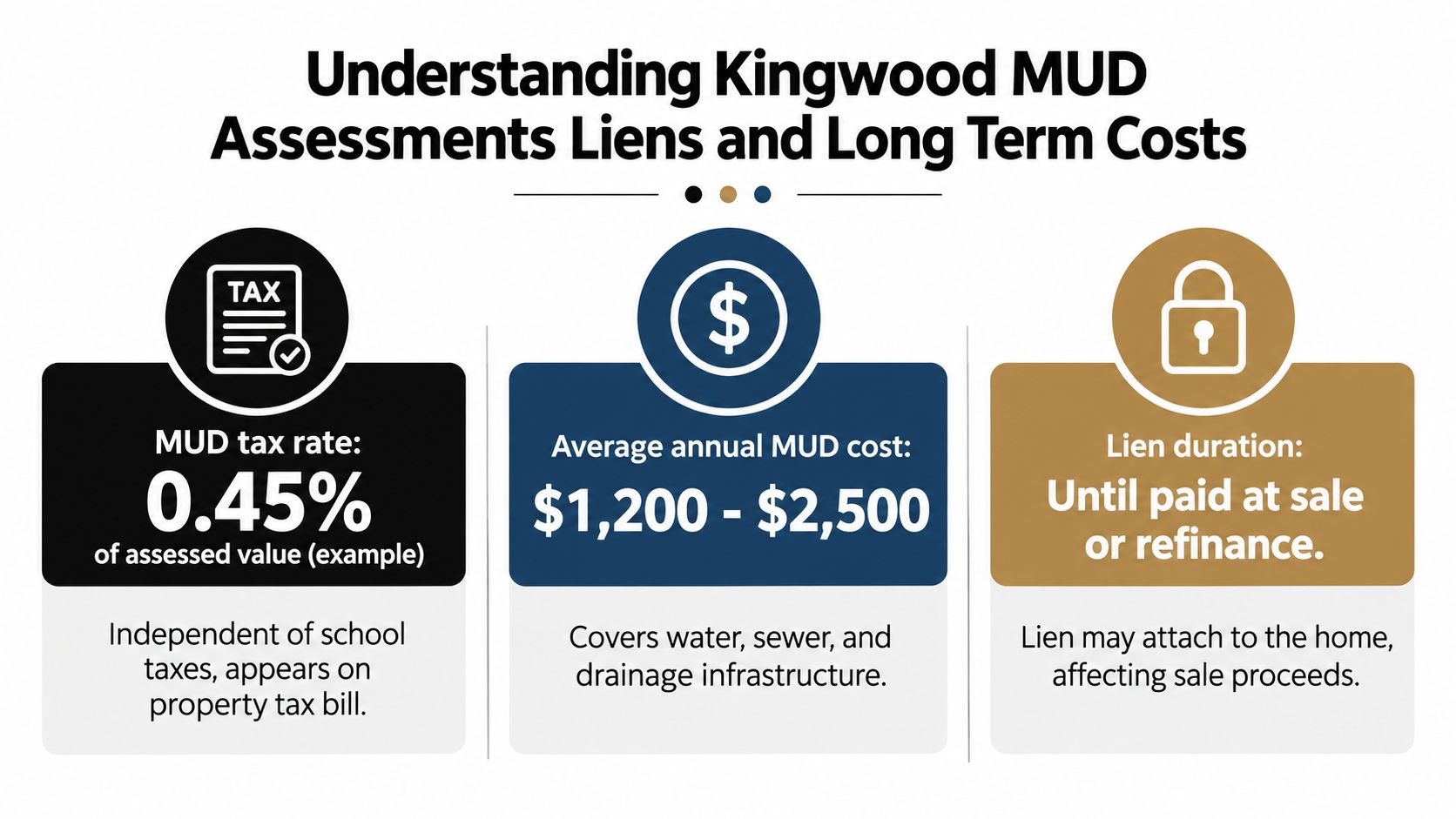
MUD taxes also have a long tail. Many districts collect taxes for maintenance and operations (M&O) and for interest and sinking or debt service (I&S) tied to bonds issued for neighborhood infrastructure. One Texas real estate article explains that this bond debt is often repaid over many years through homeowner tax bills, which helps explain why two nearby homes can have similar prices but very different carrying costs, as described in this article on the tax bill beneath the tax bill.
That long-term feature is where divorce math gets more realistic. A spouse buying out the other is not just taking a roof and four walls. That spouse may be taking years of added tax burden that affects debt-to-income ratios, budgeting, and how much equity can be accessed without strain.
Lien status adds another layer. Property taxes can become a claim against the home itself, so unpaid amounts are not just a budgeting problem. They can interfere with title work, sale timing, and post-divorce transfers. For a general background on how property claims can complicate ownership changes, this overview of resolving contractor claims and tax liens helps explain why clean paperwork matters.
This is why timing matters so much in a Kingwood divorce. A MUD bill that is already due, partly unpaid, or about to come due can affect present equity differently than a future tax obligation that will be paid after one spouse takes the home. The assessment date, payment status, and any existing arrears help answer a practical question Texas courts and spouses care about. How much is this house really worth after the attached obligations are counted fairly?
Debt questions often overlap here. If you want a clearer picture of how courts and spouses often handle liabilities tied to marital property, this local guide on what happens to debt in a Texas divorce provides useful context.
A spouse considering whether to keep the home may also want to speak with a Divorce Lawyer in Kingwood, TX for divorce representation for clients in Kingwood and Harris County.
A Kingwood home can carry strong equity on paper and still create a real cash-flow squeeze after divorce. MUD assessments are often part of that gap.
How Courts Characterize and Allocate MUD Assessments in Property Division
A common Kingwood divorce scenario looks like this. One spouse wants to keep the house, the equity estimate looks healthy, and then the conversation turns to MUD charges. That is often the point where a simple buyout starts to feel less simple, because the home is not just an asset on paper. It also carries attached costs that affect what the property is really worth to each spouse.
Texas courts divide community property in a just-and-right manner. In practice, that means a court or the spouses in settlement must decide how a MUD assessment fits into the larger picture. It may be treated as part of the home's current value, part of the debt assigned with the house, or part of a reimbursement claim if one spouse already paid more than his or her share. The Texas State Law Library's overview of community property and property division in divorce helps frame that larger rule, but the work happens in how the numbers are applied to a specific Kingwood home.
A useful way to picture it is to treat the house like a truck with a trailer attached. The truck may have solid value by itself, but the trailer affects what it costs to keep, move, and finance. A MUD assessment can work the same way. The title to the house may be clear enough to transfer, yet the timing of the bill, whether it is already due, and whether any tax lien has attached can change both equity and cash flow.
Three common ways lawyers and spouses analyze MUD assessments
One approach treats the assessment as a future carrying cost. If one spouse keeps the house, that spouse usually takes on future MUD bills the same way that spouse takes on future insurance, upkeep, and mortgage payments.
A second approach treats the assessment as a present value issue. If a current bill is due now, delinquent, or likely to affect refinancing, that burden may reduce the usable equity available for a buyout today.
A third approach treats the issue as reimbursement. If community funds paid MUD-related charges before division, or if one spouse covered those costs alone while the divorce was pending, the payment history may support an offset in the final property split.
Choosing an Allocation Approach for MUD Assessments
| Allocation Approach | How It Works | Best When | Watch Out For |
|---|---|---|---|
| Equity offset | The spouse keeping the home takes responsibility for future MUD costs, and the buyout reflects the carrying burden | The home will stay with one spouse for the long term | The parties may disagree about how much future costs should affect present value |
| Reimbursement focus | The decree addresses who paid past tax-related costs during the case and whether repayment is appropriate | One spouse covered the house expenses during separation | Records matter. Missing statements can weaken the argument |
| Carrying-cost split during transition | The parties share MUD-related costs for a limited period while the home is sold or refinanced | The house will not be retained permanently by either spouse right away | Vague end dates can trigger post-decree conflict |
Timing often decides which approach makes the most sense.
For example, a MUD charge that has already been billed and remains unpaid looks more like a present obligation tied to the property. A future assessment due after one spouse receives the home often fits better as part of that spouse's post-divorce carrying costs. If taxes are delinquent and a lien issue is in play, the problem becomes more than bookkeeping. It can affect title work, closing plans, and whether the spouse keeping the property can complete a refinance without delay.
That is why characterization matters so much in a Texas just-and-right division. The label shapes the result. If a MUD amount is treated only as a future expense, the spouse keeping the house may receive less adjustment in the buyout. If the same amount is treated as reducing current net equity, the cash equalization figure may change right away. If the issue is framed as reimbursement, the focus shifts to who paid what, when, and with which funds.
In Kingwood divorce cases, the fair result often depends less on the house's headline value and more on whether the attached MUD burden is being counted in the right place.
Why characterization affects negotiating position
A spouse who wants to keep the home must usually do more than accept the deed. That spouse must also be able to afford the property month after month and, in many cases, qualify for refinancing. A MUD obligation can influence both questions. A house with good gross equity can still create a tight post-divorce budget, and that cash-flow pressure may push the parties toward a different buyout number or even a sale.
This is also why local detail matters. Two homes with similar appraised values can produce very different settlement outcomes if one has a larger current MUD burden, an unpaid bill, or a timing problem that interferes with refinance planning. For a broader look at how these issues fit into local divorce cases, see this guide to property division in a Kingwood divorce.
Negotiating Settlement Language That Covers MUD Obligations Clearly
A settlement can look fair and still create trouble later if it doesn't say who pays which property-related charges and when. MUD obligations deserve direct language, especially when one spouse keeps the house or the parties plan to sell it after divorce.
What the decree should address
At a minimum, the parties should identify whether the decree covers:
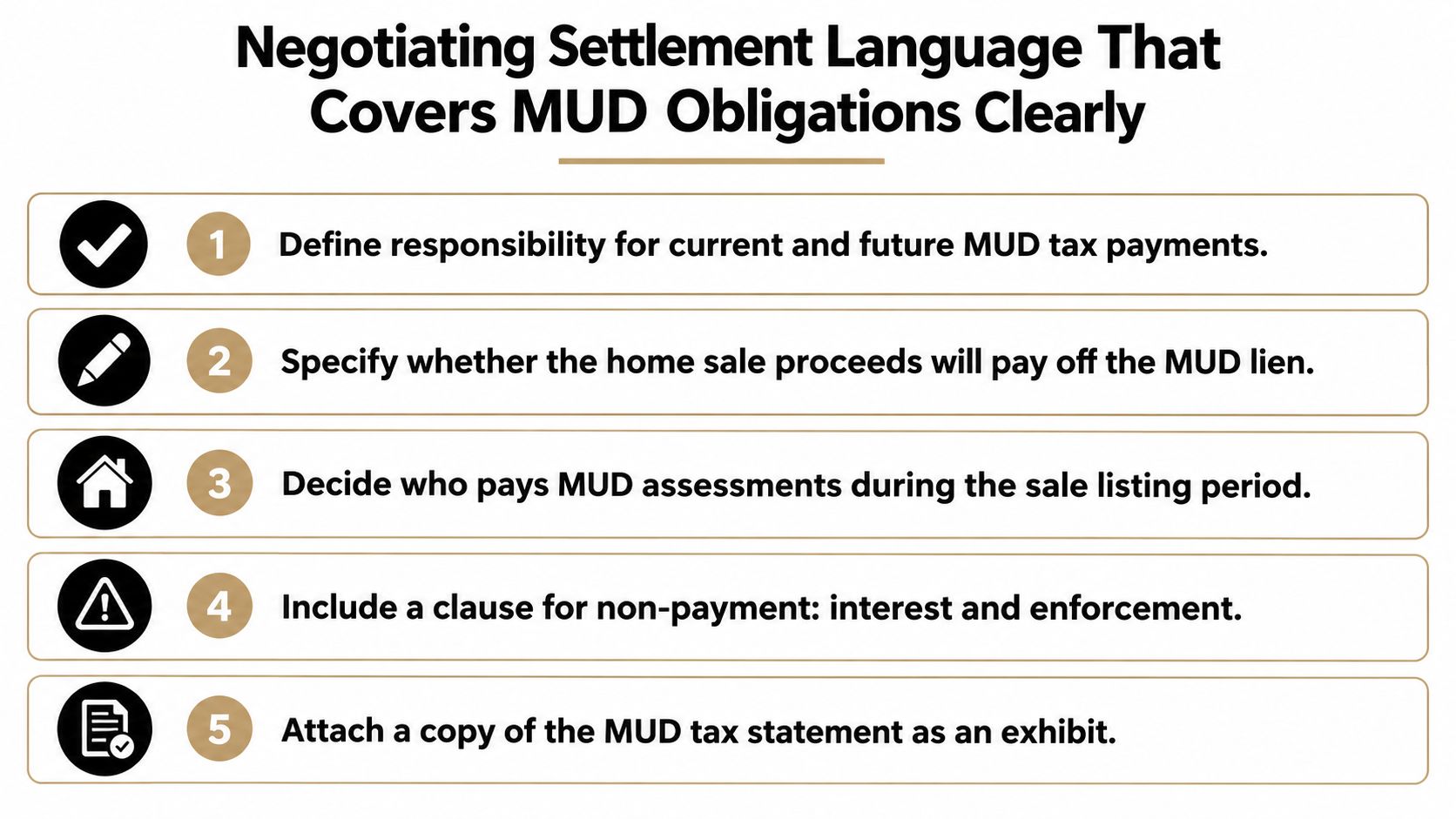
- Current amounts due. If a bill is already issued, the decree should say who pays it.
- Delinquent taxes or penalties. Old balances shouldn't be left to assumption.
- Future assessments. If one spouse keeps the home, the decree should connect future payment responsibility to ownership.
- Listing-period expenses. If the house will be sold, the decree should assign MUD taxes during the period before closing.
- Escrow handling. If the mortgage lender escrows taxes, the decree should match the lender's process rather than fight it.
Why up-front drafting matters
Existing guidance notes that transfers between spouses are usually not taxable, and a marital home sale may qualify for capital-gains exclusions. It also highlights a practical divorce issue. After divorce, the primary-residence gain exclusion can shift from up to $500,000 jointly to $250,000 per person, while property-tax and MUD obligations remain attached to the home, as discussed in this article about how property transfers affect your tax situation.
That same discussion points out another concern. Courts may treat tax-payment obligations tied to property as part of the property division, which can make them difficult to modify later. In plain terms, if the decree is sloppy, fixing it later may be much harder than people expect.
Useful drafting prompts
Instead of relying on broad phrases like “wife receives the residence” or “husband shall pay the mortgage,” the parties should think in more precise terms:
- Tie payment duty to ownership. If title transfers on a certain date, responsibility for MUD assessments should track that date.
- Address statements not yet issued. Tax bills often arrive after a key event in the case.
- Include enforcement logic. The decree should say what happens if the responsible party doesn't pay.
- Match the actual housing plan. Keeping, refinancing, co-owning temporarily, and selling all call for different language.
Drafting insight: Specific language about taxes and assessments often prevents the most expensive misunderstandings after a divorce decree is signed.
For Kingwood families, this same attention to detail often helps in other legal matters too, including estate planning, probate administration, and civil agreements where ownership and payment duties need to be unmistakably clear.
Practical Steps for Title Refinancing and Protecting Your Equity After Divorce
Once the decree is signed, the legal division on paper has to become workable in real life. That usually means dealing with title, mortgage responsibility, tax records, and future affordability.
Start with the property records
Get the current deed, the latest tax statement, and any mortgage escrow information. For a Kingwood, Humble, or Porter homeowner, the key question is whether the property records and tax records match the divorce outcome.
Check for any unpaid amounts, confirm the legal description, and make sure the transfer documents required by the decree are prepared correctly. If a former spouse is leaving title, waiting too long to record the right deed can create title confusion later.
Coordinate deed transfer with refinance
Many people assume removing a spouse from title also removes that spouse from the mortgage. It doesn't. A deed changes ownership. A refinance deals with the loan.
If one spouse keeps the home, that person should talk with the lender early about income, debt load, escrow requirements, and closing timing. For a general borrower-focused overview, these New American Funding refinance tips can help you understand the process questions to raise.
Stress test the budget on one income
MUD costs deserve another hard look here. A house payment after divorce usually includes more than principal and interest. It may also involve insurance, regular property taxes, repairs, and the MUD assessment tied to the home.
Use a realistic checklist:
- Mortgage payment. Include the full escrowed amount if taxes are collected monthly.
- MUD line item. Confirm whether it's already reflected in escrow estimates or must be planned separately.
- Cash reserve. A single-income household has less room for surprise housing costs.
- Refinance conditions. Lenders may look closely at the total carrying burden.
Protect equity with documentation
Keep copies of the decree, deed, refinance papers, and tax statements in one place. If a question comes up later about who was responsible for a payment, documents matter more than memory.
This step matters beyond divorce. Updated ownership records can affect future estate planning, probate administration, and even civil disputes involving the property.
For some former spouses in Northeast Houston, the smartest move is not keeping the house at all. If MUD costs, mortgage terms, and refinance conditions don't fit a post-divorce budget, selling may protect more equity than forcing a buyout that doesn't last.
Moving Forward With Confidence and Local Support in Kingwood
MUD assessments add a layer many divorcing homeowners don't see coming. But the issue becomes more manageable when you break it into parts: classify the home correctly, understand the tax burden, decide how that burden affects equity, draft the decree carefully, and carry out the title and refinance work without loose ends.
For families in Kingwood, Humble, Porter, and Northeast Houston, that local detail matters. Two homes may look similar on a listing sheet and feel very different once MUD obligations, escrow demands, and single-income affordability are considered. A fair result usually comes from looking at the house as both an asset and an ongoing obligation.
If you're gathering records, start with the practical basics. Pull the current tax statement, review county property records, check the deed, and contact the MUD district office if you need clarification about billing or district-specific charges. Those steps won't answer every legal question, but they often reveal the issues that need attention before a settlement is signed.
When children are involved, housing decisions also affect routines, school zones, and parenting schedules. That's one reason many divorce cases overlap with other family law questions, including support and conservatorship. If custody is part of your case, Child Custody Lawyer in Kingwood, TX provides custody and conservatorship representation for Kingwood families.
The goal isn't to make every issue simple. Some divorces won't be simple. The goal is to make the property rules clear enough that you can make informed decisions and avoid preventable surprises later.
If you're dealing with a house in a MUD district during divorce, Law Office of Bryan Fagan – Kingwood TX Lawyers helps Kingwood-area clients work through property division, title concerns, and practical settlement issues tied to the marital home. To discuss your options and schedule a free consultation at the local office, visit Law Office of Bryan Fagan – Kingwood TX Lawyers.