
A flood claim can create a second problem after the water is gone. A Kingwood couple may receive an insurance payment for a damaged home, place it in a joint account, and then face a divorce, probate proceeding, or disagreement about who owns the money. The practical question becomes, are flood insurance proceeds community or separate property in Texas?
The starting rule is straightforward: insurance proceeds generally take the character of the property they replace. That means the payment doesn't automatically become community property merely because it arrives during marriage. The difficult work is proving what the damaged property was, how it was acquired, how it was improved, and where the payment went.
This guide applies that rule to Kingwood, Humble, Porter, and Northeast Houston families. It addresses four recurring questions: how to characterize the home, whether community funds paid the premiums, whether mixed funds create a reimbursement claim, and what happens when the proceeds arrive during divorce or probate. Before entering a damaged structure, families should also review practical resources about safety steps during a home flood so documentation and legal concerns don't come before immediate safety.
A Kingwood Homeowner's Question About Flood Insurance Money
The check doesn't answer the ownership question
Suppose a Kingwood couple's home is damaged by a major storm. The flood policy pays a substantial claim, and the check lists both spouses, the policyholder, or perhaps only one spouse. They may reasonably assume the name on the check decides ownership. Under Texas marital-property law, it usually doesn't.
Texas Family Code § 3.008 provides that insurance proceeds paid or payable for a casualty loss are characterized in the same way as the property connected to the claim. If the damaged structure was one spouse's separate property, the recovery generally follows that separate classification. If the home was community property, the recovery generally follows the community estate.
That rule also applies when a single payment covers several kinds of property. A claim may involve the structure, community-funded improvements, furniture, appliances, and personal belongings. Those items may not all have the same legal character, so a lump-sum check can require an accounting rather than a simple answer.
Practical rule: The bank account receiving the payment is evidence of handling, not conclusive proof of ownership.
Four facts usually control the result
A Kingwood attorney will normally start with:
- Acquisition history: Was the home bought before marriage, inherited, received as a gift, or acquired during marriage?
- Payment history: Were mortgage, repair, and insurance expenses paid from separate funds, community earnings, or both?
- Claim allocation: Does the insurer's file identify what was damaged and how the payment was calculated?
- Timing: Did the loss occur before separation, while a divorce was pending, or during probate?
A flood policy may be issued through the National Flood Insurance Program or by a private insurer. NFIP claims generally must be filed within 60 days after a loss, as explained by the Texas Department of Insurance's flood claim guidance. That deadline concerns presenting the claim, not deciding whether the eventual proceeds belong to a separate or community estate.
The characterization question can affect divorce property division, estate administration, and reimbursement claims. It can also affect how spouses should preserve the money while the legal analysis is still unresolved.
Texas Community and Separate Property in Plain Language
Think of marital property as two baskets. The separate-property basket holds assets connected to one spouse alone, while the community-property basket holds assets acquired through the marriage. Flood proceeds don't receive an entirely new identity when they arrive. They generally replace something that was already in one of those baskets.
Property owned before marriage, received by gift or inheritance, or acquired after separation is generally treated as separate property when the spouse can prove the connection. Property bought or earned during marriage is generally presumed to be community property. The date and manner of acquisition often matter more than whose name appears on a later insurance check.
Why Texas starts with a community presumption
Texas Family Code § 3.003 creates a presumption that property possessed by either spouse during marriage or at dissolution is community property. The spouse claiming separate-property treatment must overcome that presumption with clear and convincing evidence, as stated in the Texas Family Code section on the community-property presumption.
For example, a spouse who owned a Kingwood home before marriage may have a separate-property claim to flood proceeds. But that spouse must connect the payment to the pre-marriage home through reliable records. A deed, closing statement, insurance declarations page, claim file, and bank records can help create that connection.
By contrast, if the spouses purchased the home during marriage with marital earnings, the flood recovery is generally community property. The fact that one spouse handled the claim, paid the adjuster, or deposited the check doesn't ordinarily change the underlying character.
The property and the money must be tracked together
The analysis becomes harder when a separate home receives community-funded improvements. New flooring, remodeled rooms, additions, or other work may create reimbursement issues even though the structure began as separate property. The proceeds may still follow the separate property, while the community estate may assert a claim for qualifying contributions.
Kingwood residents dealing with a disputed home or insurance payment can review separate-property tracing in a Kingwood divorce to understand why documentation matters. Couples who want to define property rights before a dispute may also consider Prenuptial & Postnuptial Agreements in Kingwood, which involve drafting and review of marital property agreements for Kingwood clients.
The key distinction is this: community funds used around separate property may create a financial claim without automatically changing the character of the property itself. A court must examine the records and the applicable statutory remedies.
The Statutes That Decide How Flood Proceeds Are Treated
Several provisions of the Texas Family Code work together. They don't answer every claim from a single document, but they provide a framework for identifying the property, preserving competing claims, and ordering an appropriate division.
Section 3.003 sets the starting point
Section 3.003 creates the community-property presumption. If spouses possess a home or insurance money during marriage or when their marriage dissolves, the court starts by treating the asset as community property. The spouse asserting that the home or proceeds are separate must prove the separate origin with clear and convincing evidence.
That is why a spouse shouldn't rely only on statements such as, “I bought it before we married.” The evidence must connect the original ownership to the damaged property and then connect that property to the insurance payment.
Section 3.008 follows the damaged property
Section 3.008 addresses insurance proceeds from casualty losses. In plain language, the payment follows the character of the property tied to the claim. The rule prevents a payment from becoming community property because an insurer issued it during the marriage.
If a pre-marriage home was separate property, flood proceeds tied to that home generally retain that character. If a community home was damaged, the proceeds generally belong to the community estate. When a policy covers both separate and community property, courts may apportion the proceeds between the estates.
The relevant Texas rule is more precise than asking who endorsed a check. Courts look at what was insured and lost.
Other provisions can affect the final accounting
Section 3.002 concerns management of community property. It can matter when one spouse controls claim negotiations, directs repair spending, or manages the account holding the proceeds. Management authority doesn't eliminate the other spouse's potential ownership interest.
Sections 3.402 and 3.408 address reimbursement and related remedies. If community funds improved separate property, the community estate may have a reimbursement claim. Conversely, separate funds used for a community asset may support a claim by the separate estate. The remedy may affect the division without changing the original character of the home or the insurance recovery.
Texas Property Code provisions may also matter when an insurance policy, claim, or payment right is assigned or transferred. Policy language and insurer consent requirements should be reviewed before anyone attempts to assign a claim.
For Kingwood and Harris County clients needing Divorce representation for clients in Kingwood and Harris County, the analysis normally combines statutory rules, policy documents, title history, and tracing evidence. Texas cases, including Tagle v. Tagle and In re Marriage C.A.S., reinforce the broader principle that casualty proceeds follow the insured property's character and may be apportioned when coverage spans different estates.
Four Common Fact Patterns for Flood Insurance in Texas
The same flood policy can produce different results depending on the underlying property. Consider these four Kingwood examples.
One house, four possible classifications
Scenario one, pre-marriage separate home. A spouse owned the Kingwood house before marriage, and the flood claim concerns that structure. If the ownership history remains traceable, the proceeds generally follow the home's separate character. Repairing the home doesn't automatically convert the insurance payment into community property, although community contributions may support reimbursement.
Scenario two, community home. The spouses bought the home during marriage with marital earnings. The property is presumptively community, so the flood recovery generally belongs to the community estate. A check payable to only one spouse doesn't by itself change that result.
Scenario three, separate home with community improvements. One spouse brought the home into the marriage, but the couple later used community funds for substantial improvements. The home may remain separate, while the community estate may assert reimbursement rights. The claim should be separated between damage to the original structure and damage to improvements or contents when the insurer's records permit that allocation.
Scenario four, community-paid premiums on separate property. Community income paid flood premiums on a separate-property home. That payment history can create a reimbursement issue, but it doesn't necessarily change the character of the insured property or the proceeds. Texas legal materials recognize that casualty proceeds traceable to a separate asset can remain separate even when premiums were paid from community funds.
The practical result is that the answer depends on title history, acquisition date, claim allocation, and traceability. For a property-specific discussion, Kingwood residents may review flood-damaged home division in a Texas divorce.
| Fact Pattern | Underlying Property Character | Proceeds Character | Tracing Burden |
|---|---|---|---|
| Home owned before marriage | Separate, if proven | Generally separate | Separate-property spouse must prove the chain |
| Home purchased during marriage | Community presumed | Generally community | Challenging separate treatment requires clear and convincing evidence |
| Separate home improved with community funds | Separate home, mixed contributions | May require apportionment and accounting | Records must distinguish property and contributions |
| Community-paid premiums on separate home | Separate insured asset, community payment source | Generally follows the separate asset | Separate owner must trace the asset, while the community may seek reimbursement |
Why the check's arrival doesn't flip the result
A spouse may feel that the proceeds became marital money because the check arrived after years of marriage or was deposited into a joint account. The legal question remains what the payment replaced. If the policy covered multiple categories, each category should be identified and connected to its owner.
Repairs also don't necessarily change characterization. Spending separate proceeds on a community home can create a tracing issue, while spending community funds to repair a separate home can create reimbursement questions. The records determine whether a court can separate those interests.
Tracing Flood Proceeds and Reimbursement Claims
Tracing is the process of building a paper chain from the original property to the insurance payment. It matters because Texas begins with a community presumption, and a spouse claiming separate treatment must provide convincing proof.
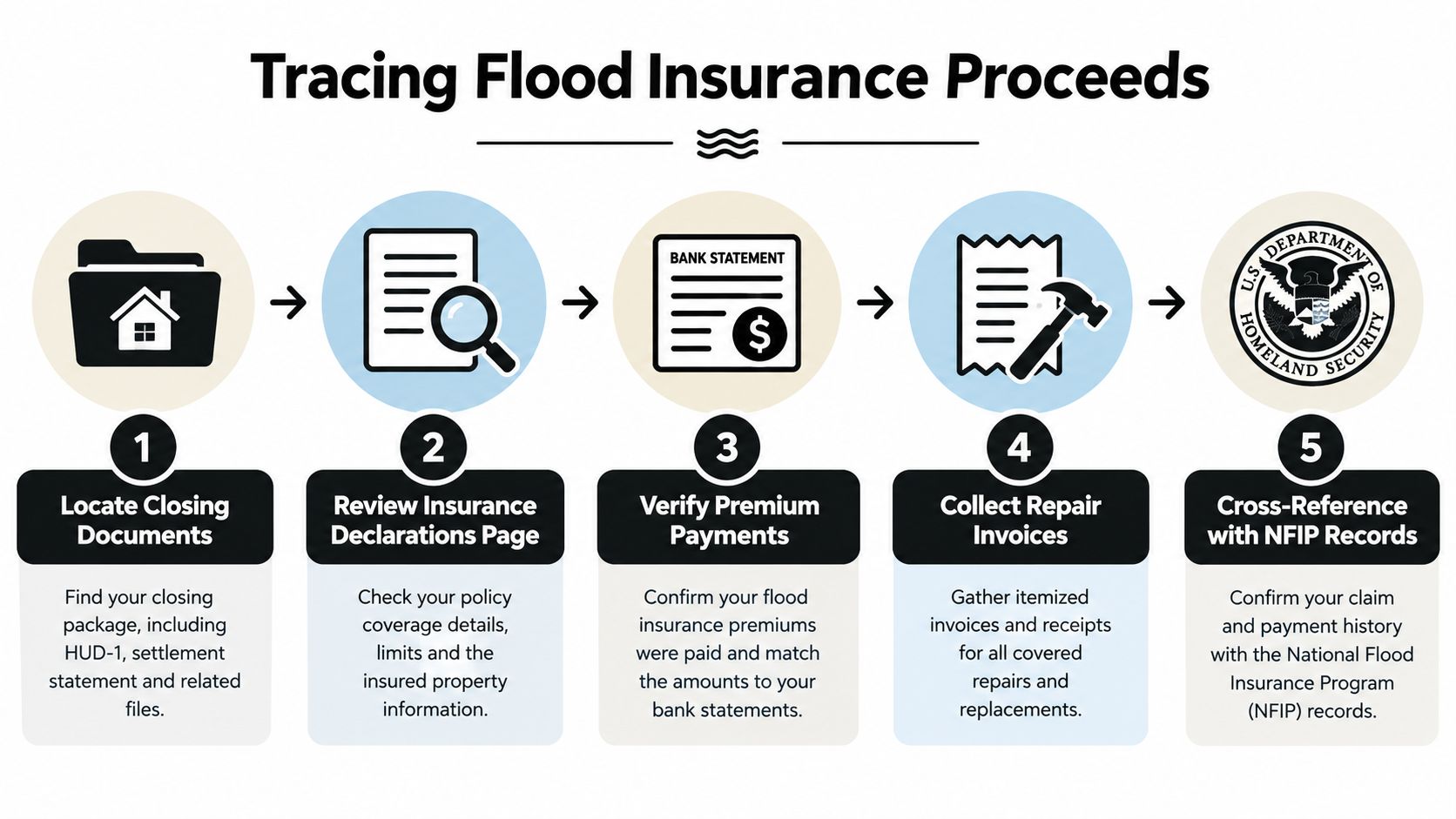
Build the chain in five stages
- Start with ownership. Gather the deed, closing statement, gift instrument, inheritance records, or other documents showing when and how the property was acquired.
- Identify the insured asset. Review the insurance declarations page, policy schedule, inventory, adjuster's estimate, and NFIP claim letters. Determine whether the payment concerns the structure, improvements, contents, or several categories.
- Verify payment sources. Collect bank statements showing who paid premiums, mortgage obligations, renovations, and emergency work. Community-paid premiums may support reimbursement analysis, but the source of premiums doesn't automatically decide the character of the insured property.
- Match damage to spending. Keep repair invoices, contractor agreements, receipts, photographs, and proof of payment. These records help show which proceeds were spent on which portion of the loss.
- Preserve the payment path. Record the date the insurer issued the check, where it was deposited, every transfer, and each expenditure. A separate account is easier to analyze than a joint account used for ordinary household expenses.
Reimbursement is different from ownership
Suppose a spouse owned a home before marriage, but marital income paid for improvements. The proceeds tied to the separate home may remain separate, while the community estate may seek reimbursement under Texas Family Code Chapter 3. Section 3.408 provides a remedy framework for claims between marital estates.
Useful evidence includes:
- Title records: Deeds, closing papers, loan documents, and inheritance records.
- Policy records: Declarations pages, endorsements, inventories, adjuster estimates, and claim correspondence.
- Financial records: Premium statements, canceled checks, bank statements, and transfer histories.
- Damage records: Dated photographs, contractor bids, invoices, receipts, and proof of payment.
- Timing records: Marriage documents, separation dates, loss dates, claim submissions, and payment dates.
Commingling doesn't always make tracing impossible, but it makes the analysis more difficult. Once proceeds are mixed with marital funds, the spouse claiming a separate interest must still identify the separate source and follow the funds. A local explanation of this issue is available through reimbursement claims against the community estate in Kingwood.
Keep the original evidence. A spreadsheet can organize the trail, but it can't replace the underlying statements, invoices, policy documents, and claim correspondence.
Divorce, Probate, and Timing Traps With Flood Proceeds
The date a check arrives isn't always the date that determines ownership. A flood loss may occur during marriage, the claim may be adjusted after separation, and payment may arrive while the divorce is still pending. The underlying property's character remains central.
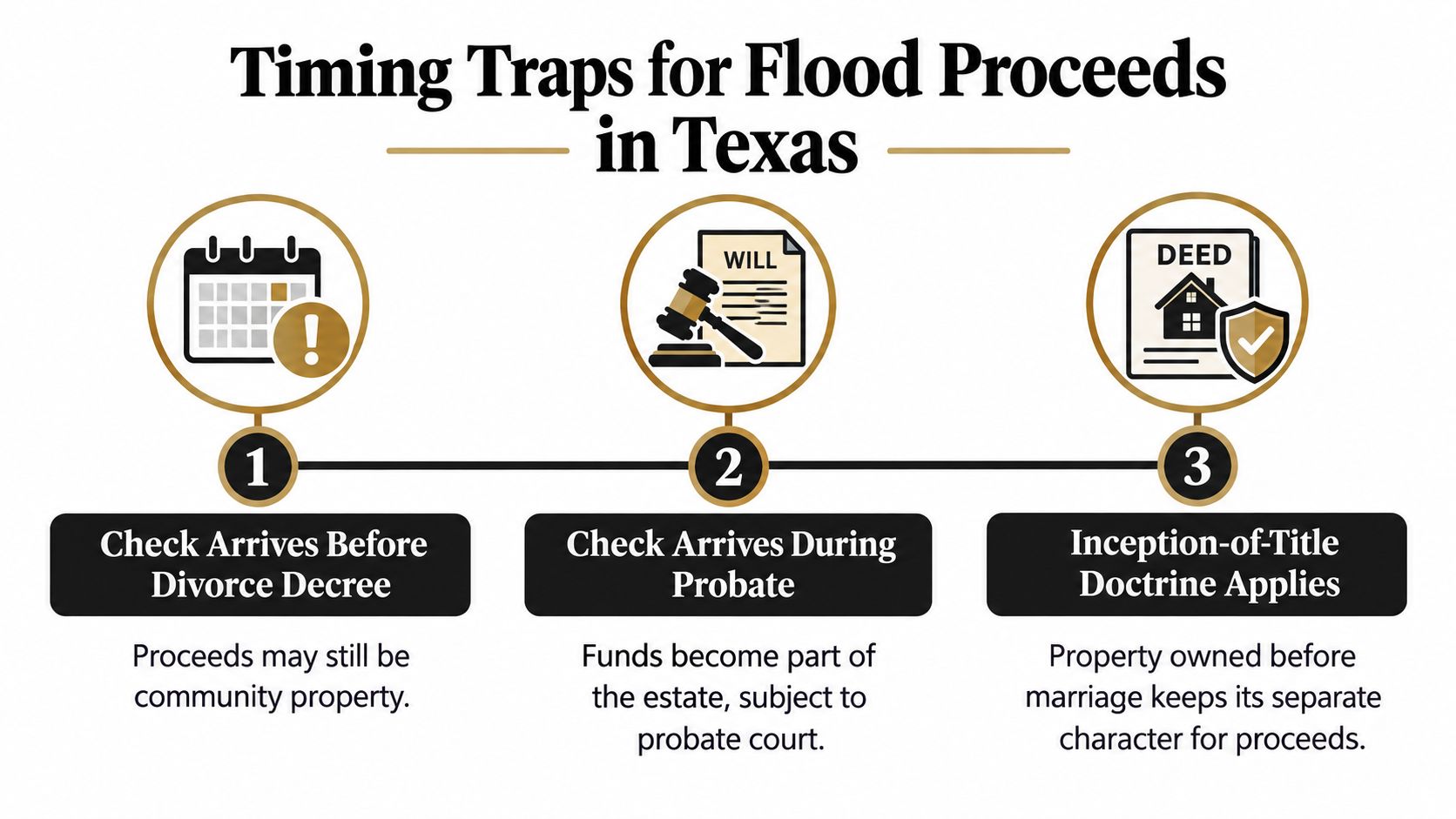
If the loss occurs before a divorce decree, the proceeds may still be part of the community estate when the payment arrives. A final decree should specifically address rights in the insurance policy and future claim proceeds. Texas provisions provide that, for non-life policies, valid proceeds generally follow the property award, proportionally if both spouses received interests, or to the spouse receiving the insured interest.
Pending divorce requires careful handling
A spouse shouldn't spend, transfer, or conceal disputed proceeds before the court or a written agreement addresses them. Spending the money on urgent repairs may be reasonable, but the person should preserve invoices, photographs, and proof that the expenditure protected the property.
The decree should identify the policy, the insured property, pending claims, future proceeds, responsibility for claim cooperation, and treatment of expenses. Vague language can leave former spouses arguing about a check issued after the case ends.
Families working through financial negotiations may find a practical guide to financial disputes useful when organizing assets and settlement discussions. It isn't a substitute for Texas legal advice, but organized financial information can help identify the issues that require formal treatment.
Probate creates a related ownership question
If a spouse dies while a claim is pending, the payment may become an estate asset, but the surviving spouse may still assert a community-property interest. The policy's named insured and the title history are relevant, yet neither alone necessarily resolves the character of the proceeds.
The executor, heirs, and surviving spouse should preserve the policy, claim file, title records, and bank history. They should also avoid treating the entire payment as belonging to one person until the estate and marital-property interests have been reviewed.
Practical Tips and When to Talk to a Kingwood Attorney
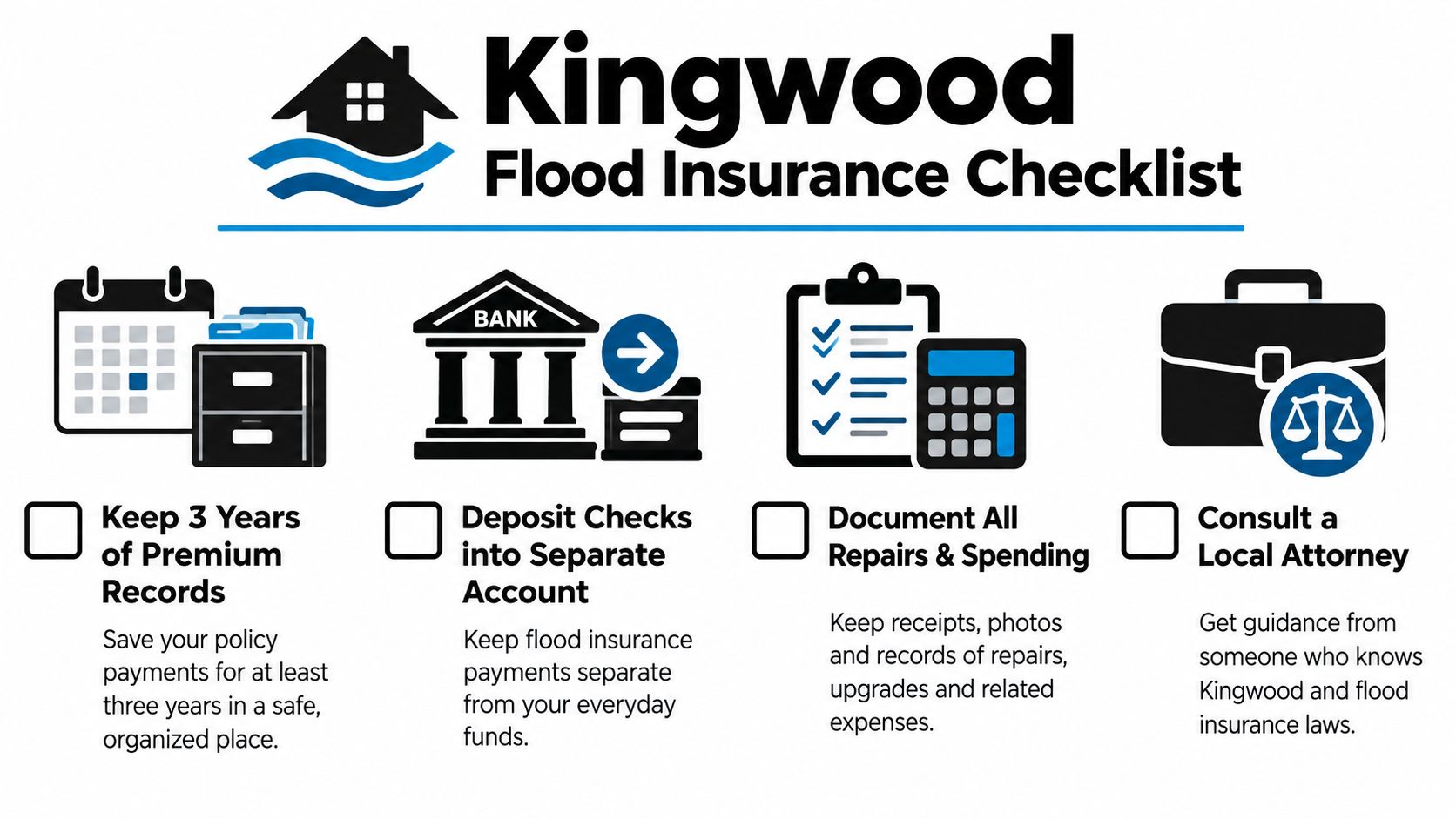
Kingwood homeowners can protect their position by treating the insurance payment as a disputed asset until its character is clear. These steps help preserve evidence and reduce avoidable tracing problems:
- Keep records: Retain premium payment records and bank statements from at least three years back.
- Separate the payment: Deposit the check into an account that matches the claimed character when possible, rather than a joint account used for ordinary expenses.
- Document repairs: Save every invoice, receipt, contractor agreement, photograph, and proof of payment.
- Photograph first: Take photographs or video of the damage before cleanup or repairs, when it is safe to do so.
- Avoid commingling: Don't combine disputed proceeds with marital funds before characterization and reimbursement issues are settled.
A lawyer's review becomes especially important when a divorce is pending, community and separate funds were mixed, a spouse has died, or the insurer denied or underpaid the claim. Counsel may examine the policy declarations, payment history, title records, marriage and separation dates, settlement documents, repair evidence, and NFIP claim file.
For insurance-specific support after a loss, residents may also consult flood damage legal help PostDamage. A Texas family or property attorney can then focus on the separate question of ownership and division under Texas law.
The Law Office of Bryan Fagan – Kingwood TX Lawyers handles community-property division, tracing, probate, and reimbursement disputes for Kingwood and Northeast Houston families. Schedule a free consultation to review your flood policy, property records, payment history, and pending claim before the proceeds are spent or divided.
The Law Office of Bryan Fagan – Kingwood TX Lawyers offers local guidance on Texas family law, property division, estate administration, and related civil disputes involving flood insurance proceeds. Visit the Kingwood office for a free consultation so an attorney can help you preserve the payment trail, identify separate and community interests, and address the claim in your divorce or probate matter.