You're looking at old bank statements, a mortgage payoff history, and maybe a stack of receipts for work done on a house that was yours before the marriage. That's the kind of paper trail that decides a reimbursement claim community estate Kingwood TX case, not gut instinct and not a vague sense that “we paid for that together.” In Kingwood, Humble, and Northeast Houston, the spouse who can prove the transfer usually has the upper hand, and the spouse who can't trace the money usually loses the claim.
What a Reimbursement Claim Means for Kingwood Families
A reimbursement claim starts with a simple idea, one marital estate used property from another marital estate in a way that would create unjust enrichment if the receiving estate kept the benefit without paying for it. Texas law puts the burden on the claimant to prove the cross-estate benefit and its value under Texas Family Code § 3.402. That matters in Kingwood divorce and probate disputes because the money usually moved slowly, through one mortgage payment, one repair bill, or one transfer at a time.
A common local example is a couple living near Lake Houston while community income is used to pay down a home that one spouse owned before the marriage. The home can remain separate property if the title and tracing support that result, but the other estate may still have a repayment claim for the benefit it provided. Texas also recognizes reimbursement for certain improvements that increase value, and for some uncompensated time, toil, talent, or effort that enhanced separate property. Texas Family Code § 3.402 is the statute that anchors that analysis.
Practical rule: reimbursement is a repayment claim, not a title fight. If you want ownership, you need a different theory.
The cleanest way to handle it is this. The claim is equity-based, not automatic, and it turns on measurable financial contributions. That is why the records matter so much in Kingwood cases. If the documents show the community estate benefited a spouse's separate property, the court can turn that benefit into a dollar figure and include it in the broader property division. If you need a local explanation of how that plays out in a divorce case, the guide on property division in a Kingwood divorce gives the right context.
In plain terms, you need proof of the transfer, proof of the source, and proof of the value. If one of those pieces is missing, the claim gets weak fast. That is where reimbursement claims fail in Kingwood more often than people expect, because the money may have been spent years ago and the trail gets broken by missing statements, vague repairs, or incomplete payoff records. If you are dealing with a divorce, a probate dispute, or both, a local property division team can help you organize the evidence before the claim turns into a guessing contest, and the Property Division Lawyer in Kingwood page is a straightforward place to start if you need that kind of case handling in Kingwood.
Reimbursement Claims Versus Contribution and Ownership Claims
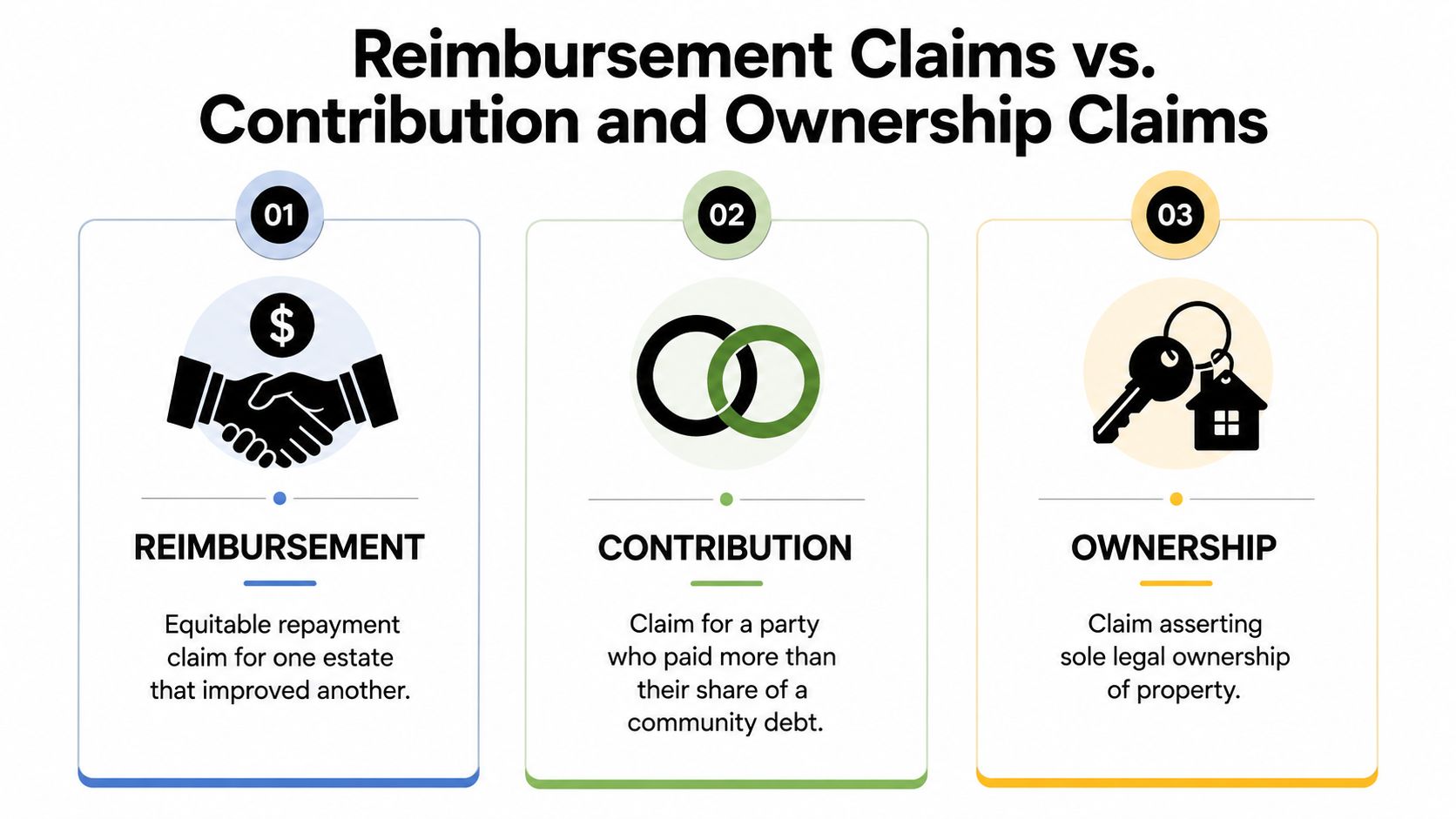
A lot of people in Kingwood lump every money dispute into one bucket. That's a mistake. Reimbursement, contribution, and ownership are different theories, and if you file or negotiate under the wrong one, you can end up asking the court for the wrong remedy.
A reimbursement claim says one estate should pay the other back because it was enriched by the transfer. A contribution claim is narrower and often comes up in specific statutory settings where one party paid more than their share of a community debt. An ownership claim is different again, because it asserts title to the asset itself. If community funds paid a separate-property car loan, that points toward reimbursement. If community funds bought a vehicle and title sits in one spouse's name, title issues may matter more, depending on the source of funds and the proof.
The remedy tells you how to argue the case. Reimbursement gives you a money offset, not a deed change. Ownership claims seek control over the asset, which can be a much bigger fight and often depends on tracing, title, and the character of the property from the start. If you're sorting out separate-property tracing issues in a Kingwood divorce, the separate property tracing divorce Kingwood TX resource is the right kind of issue-specific page to review before you decide what theory fits.
A useful local distinction is this. If you want the court to recognize that one estate carried another estate's financial load, reimbursement is the cleaner theory. If you're trying to prove the asset itself belongs to you alone, you're in ownership territory. Those are not the same thing, and treating them as the same thing is how good claims get diluted in Humble and Northeast Houston cases.
For readers comparing service pages while they sort out the legal theory, Property Division Lawyer in Kingwood fits disputes involving community property and complex assets in Kingwood divorces. That doesn't change the law, but it does help you match the issue to the right legal lane.
The Five-Step Workflow for Asserting Your Claim
The strongest reimbursement claims do not start with a speech. They start with a file. If you're in Kingwood, Humble, or Northeast Houston and you suspect one estate funded another, the workflow is brutally practical: identify, classify, trace, quantify, and defend against offsets.
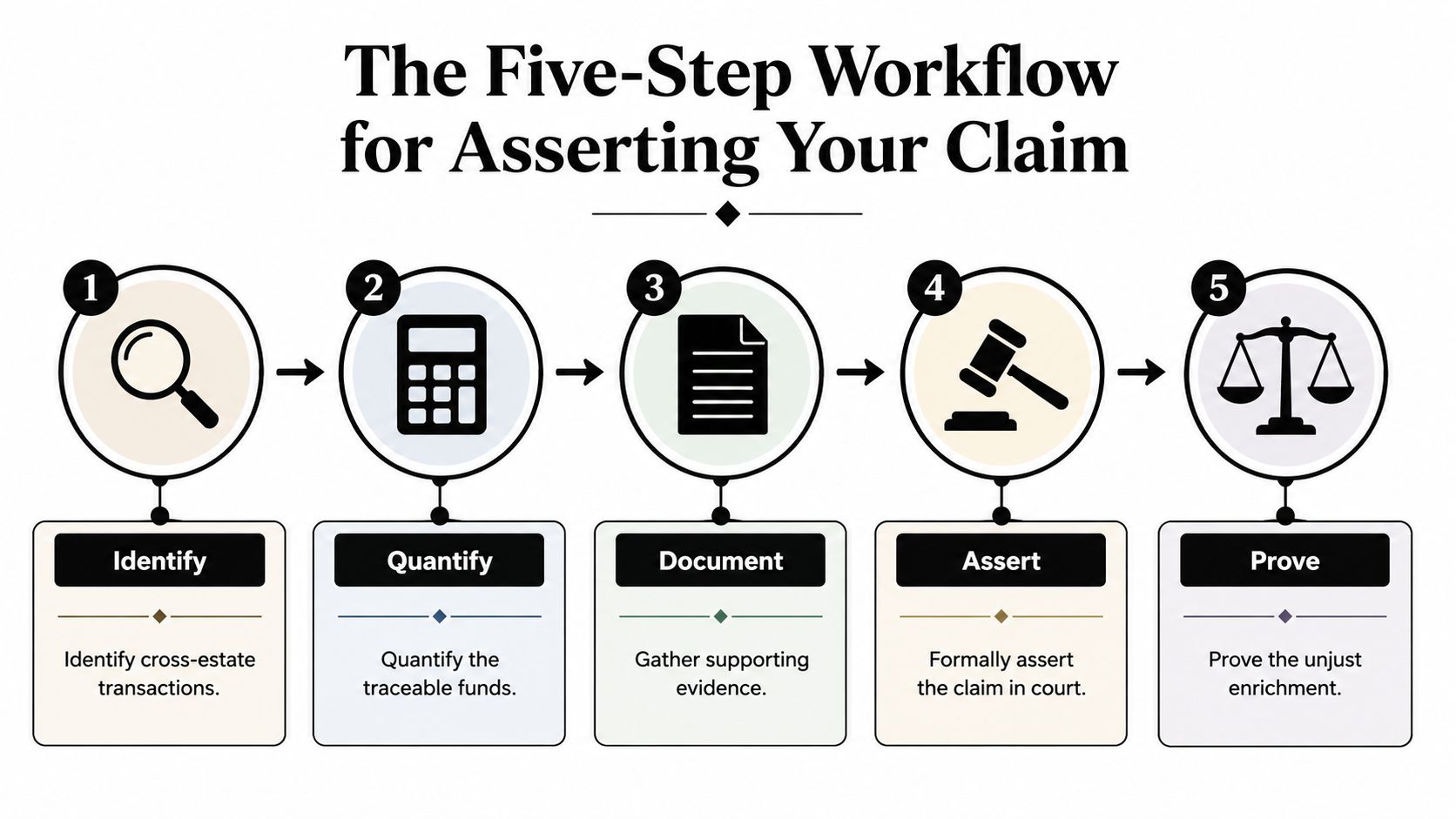
Step one identify every cross-estate transfer
Start by listing every time community money, separate money, or one spouse's effort flowed into another estate's asset. Mortgage payments, remodel checks, tuition, insurance, medical costs, and business expenses all belong on the table if they benefited the other estate. Don't trust memory. Build the list from statements, tax records, and loan histories.
Step two classify the type of benefit
Not every payment is treated the same way. A debt paydown, an improvement, and uncompensated labor are all different, and the valuation method changes with the category. If you classify the transfer correctly now, you avoid the most common argument later, which is that the other side is measuring the wrong thing.
The fastest way to weaken a claim is to mix categories and hope the court sorts it out for you.
Step three trace the funding source
Tracing is where cases live or die. You need to show exactly where the money came from and where it went, especially when accounts were mixed or cash moved through several deposits before it hit the asset. Texas practice materials stress that incomplete tracing is the most common failure point, and that's exactly what happens when people wait until trial to rebuild the paper trail. How to Present a Reimbursement Claim explains why early claim charts, discovery, and appraisals matter so much.
Step four establish amount and timing
A good claim shows when the money moved and how much value it produced. That means dates, balances, appraisals, invoices, and payoff records, not just a total pulled from a memory bank. If the claim sits in a divorce or probate case in Harris County or Montgomery County, timing also affects whether the issue is properly before the court.
Step five anticipate offsets and defenses
The other side will not just roll over. They'll argue about fairness, benefit, use of the property, or missing records. Build those answers before mediation, because a claim that looks strong on paper can collapse if the defense exposes commingled funds or a gap in the timeline.
How Texas Courts Measure the Reimbursement Amount
Once the court accepts that a reimbursement claim exists, the key question becomes how much it's worth. Texas doesn't use one blanket formula for everything, and that is where a lot of Kingwood cases get lost. The measure depends on whether you're dealing with debt paydown, improvements, or another type of benefit.
Debt paydown uses principal reduction
For community funds used to pay down secured debt on separate property, Texas limits the claim generally to the amount the principal balance was reduced after the September 1, 2009 statutory change. That means you don't get to grab the whole mortgage payment and pretend interest, escrow, and other charges all count the same way. Texas Bar guidance also notes that because each spouse owns a one-half community interest, half of that reimbursement claim belongs to the community estate and half belongs to the non-owning spouse. Texas Bar guidance on reimbursement and principal reduction is the clearest place to see that principle in practice.
Improvements are measured by value gained
If the community spent money improving separate property, the court looks at enhancement in value, not just the cost of the work. The Texas Court of Appeals in In re Marriage of McCoy explained that the calculation is the difference between the property's fair market value with the improvements and what its fair market value would have been without them at dissolution. That is a much tighter measure than the contractor's invoice alone. In re Marriage of McCoy is the case to know on this point.
Real cases show the stakes
Texas appellate files show that reimbursement claims can move serious money. In FARISH v. FARISH, the trial court found a community-estate reimbursement claim of $429,750 tied to payments for child support, tuition, health insurance, and health care. In In re Estate of Vernon O. Baker (2021), the trial court found community contributions enhanced separate property by $203,200 and awarded $101,600 to reflect the spouse's one-half community interest. Those figures show why a weak spreadsheet is not enough in a Kingwood divorce or probate fight. Texas appellate reimbursement examples illustrate how large these disputes can get.
A good Kingwood attorney will push the court to measure the claim the right way, because the wrong formula can shave off a large part of what you're owed.
Documentation Checklist and Filing Options in Kingwood
A reimbursement claim only works if the paper trail is real. In Kingwood, Humble, and Northeast Houston, I tell clients to gather records before emotions take over, because missing documents are what sink otherwise valid claims. If you're building a reimbursement file, start with these core items:
- Bank statements showing transfers between estates.
- Loan documents if community property debt was paid with separate funds or separate property debt was paid with community funds.
- Property appraisals to measure value added by improvements.
- Tax returns to track income, reporting, and ownership patterns.
- Title records to confirm how the property was held.
- Contractor invoices and receipts to tie the work to the asset and the payment source.
Practical rule: if the money moved, keep the statement. If the asset changed, keep the appraisal.
You also need to file the claim in the right case. In a divorce, reimbursement should be raised in the petition or counter-petition and resolved before the final decree. In probate, the issue comes up when a spouse has died and the community estate is being administered. Texas practice materials are clear that reimbursement is not automatic, and if it isn't affirmatively raised in the underlying case, it can get lost. The secure legal document printing resource is useful when you need clean copies of records, exhibit packets, and supporting documents for court or mediation.
The local question is not just “Do I have a claim?” It's “Can I prove it in the right forum before the deadline or decree cuts me off?” That is why people in Kingwood and nearby areas should get organized early, especially when accounts were mixed and the paper trail runs through several years of marriage.
Prenuptial Agreements Waivers and When to Consult an Attorney
Many people assume a prenup wipes out reimbursement claims automatically. It doesn't work that way. Texas law recognizes reimbursement as an equitable claim between marital estates, and Texas authorities note that marital property agreements may waive or release those claims depending on the wording. A vague agreement is not the same thing as a clear waiver, and blended-asset marriages make the analysis even messier.
If you want to understand the agreement side of the issue, the What Is a Prenuptial Agreement page is a useful starting point for the basic framework. The fight is the waiver language itself, because courts look at what the document says, not what someone now wishes it had said. Recent Texas appellate discussion in 2025 shows these waiver and tracing disputes are still actively litigated, which tells you the issue is fact-heavy, not automatic. For a broader look at agreement review and family-law vetting, the HireParalegals vetting guide is a practical reference for judging whether a legal team knows this area well.
Timing matters too. The 2009 change narrowed debt-paydown claims to principal reduction, so old assumptions about full mortgage payments are outdated. If your records are old, your accounts were mixed, or your agreement is silent or loosely worded, don't wait and hope the issue sorts itself out later. That's how valid claims disappear.
If you're in Kingwood and you're dealing with separation, probate, a prenup waiver dispute, or a messy tracing problem, talk to the Law Office of Bryan Fagan before you file or sign anything. The right move is to get the claim mapped, the records preserved, and the legal theory locked down before the other side gains control of the narrative.
If you're sorting out a reimbursement claim tied to community estate property in Kingwood, the Law Office of Bryan Fagan – Kingwood TX Lawyers can help you trace the money, organize the records, and press the claim in the right divorce or probate case. Visit Law Office of Bryan Fagan – Kingwood TX Lawyers to schedule a free consultation and get clear guidance from a local team that handles property division, estate disputes, and family-law matters in Kingwood, Humble, and Northeast Houston.