You thought the divorce was done. The decree is signed, the house is settled, and the other side agreed to split the retirement account. Then the plan administrator sends a letter saying the money still can't move until the right order is approved. That is the moment a lot of Kingwood, Humble, and Northeast Houston families realize the decree and the retirement plan are two different worlds.
In a retirement division, the wrong paperwork doesn't just slow things down, it can stop the transfer altogether. In Texas, that matters because retirement benefits are often one of the biggest assets on the table, and the rules depend on the type of plan, the wording of the order, and who has to approve it. If you're sorting out a divorce and you keep hearing QDRO and DRO, the right answer usually comes down to the plan itself, not just the label on the court paper.
| Plan Type | Order Required | Approving Authority | Typical Division |
|---|---|---|---|
| Private-sector 401(k) or pension | QDRO | Plan administrator under federal rules | Marital share or percentage stated in the order |
| Texas public plan like TRS | Qualified DRO / QDRO-type approval | Plan administrator must determine it's qualified | Division only after system approval |
| ERS account | System-approved division order | ERS administration | Redirection allowed only in family-relationship changes |
| TCDRS account | QDRO filed with the system | TCDRS approval | Ex-spouse share only after approval |
| Mixed-benefit pension | QDRO for private plan, system order for public plan | Depends on the plan | Usually marital portion, not the whole benefit |
When a Divorce Decree Is Not Enough to Split a Retirement Account
A Kingwood spouse sits at the kitchen table, reads the final divorce decree, and expects the retirement money to move next. Then the plan administrator refuses to release a dollar. That is not a paperwork glitch. It is the plan following its own rules.
A divorce court can award the retirement benefit, but the plan still has to accept the order before it pays anyone. The U.S. Department of Labor explains that a QDRO has to identify the participant and each alternate payee, name each plan, and state the dollar amount or percentage to be paid, and the order cannot force the plan to offer benefits or payment forms it does not already provide (Department of Labor QDRO rules). A decree by itself usually does not do that job.
Why the split can stall
In private-sector cases, the decree is the family-law ruling, but the plan order is the instruction that tells the administrator how to pay. If that instruction misses the federal requirements, the administrator sends it back. A Humble or Porter family can be left waiting while the account stays put.
Practical rule: if the plan has not approved the order, the money usually is not moving.
Texas public systems are stricter in a different way. TRS says the plan administrator, not just the judge, must decide whether the domestic relations order is qualified, and TRS says it cannot pay an alternate payee without that approved order (TRS divorce and DRO guidance). So if the retirement account sits in a public system, the decree and the retirement order have to match the plan's requirements exactly.
Kingwood divorce clients usually need the plan type sorted out before they worry about the label on the order. Private ERISA plans, TRS, ERS, and TCDRS all follow different approval paths, and the math also matters. A decree that says “divide the retirement” is not enough if nobody has identified the marital share, the separate share, and the coverture formula that tells the plan what portion belongs in the division. For a local walkthrough of how that works in practice, see dividing retirement accounts in a Kingwood divorce.
What a DRO and a QDRO Are Under Federal and Texas Law

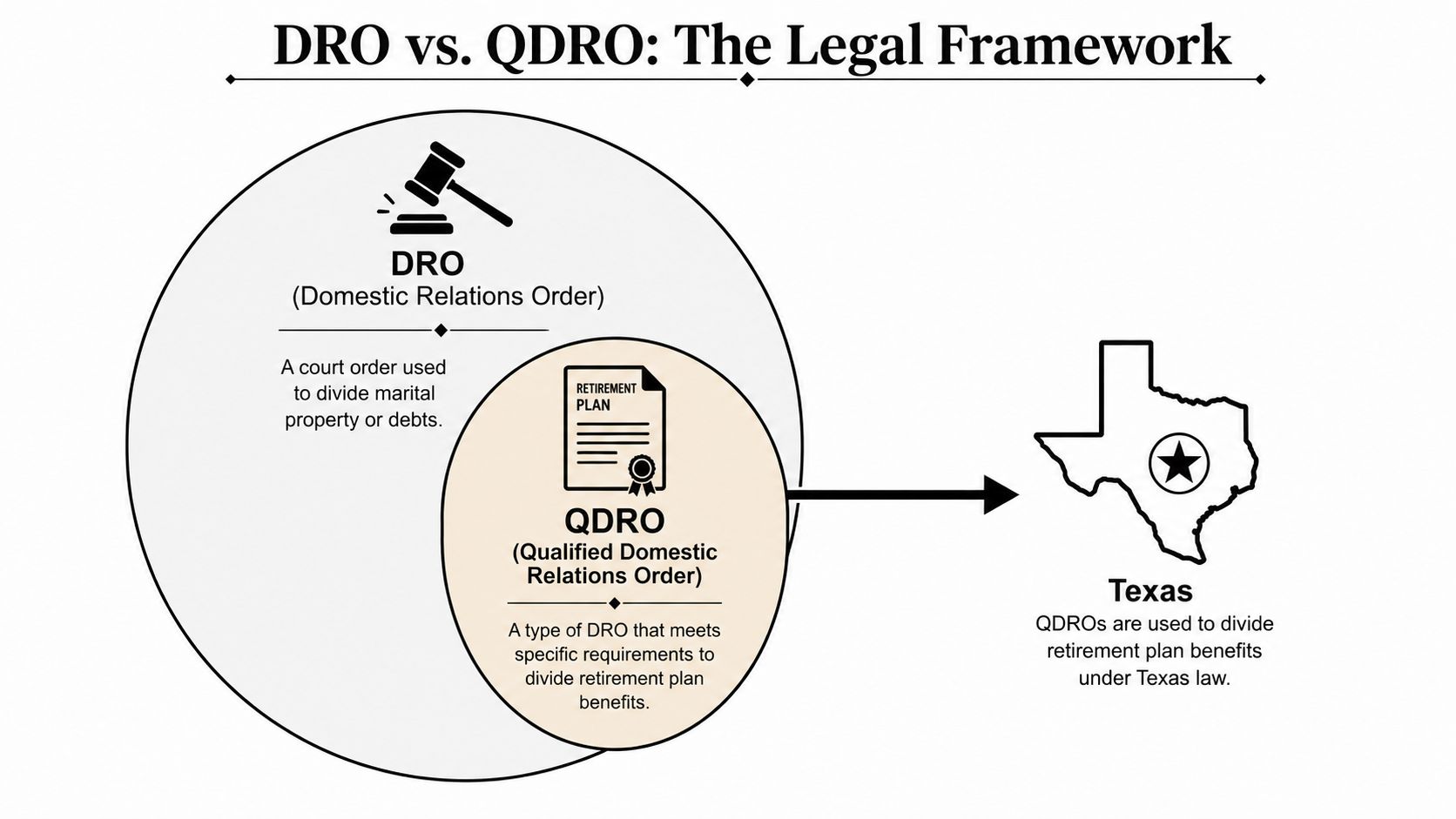
A DRO is the broad label. It means a domestic relations order, a court order in a divorce or other family-law case that deals with retirement benefits. A QDRO is the narrower federal version, the kind a private retirement plan can accept so it can pay an alternate payee, usually a former spouse, without tax trouble or a plan violation.
That federal rule set comes from ERISA and the Retirement Equity Act of 1984, which created the framework for assigning retirement benefits to a former spouse or dependent in family-law cases (Department of Labor ERISA and QDRO background). For private plans, Texas divorce law sits on top of that federal structure, but it does not replace it.
What Texas adds to the picture
Texas is a community-property state, so retirement contributions and benefit accruals earned during the marriage are usually treated as community property, while premarital and post-divorce accruals stay separate property. That is why Kingwood divorces rarely turn on a loose instruction like “split the retirement.” The marital portion has to be identified first, then the order has to match the plan.
A decree by itself does not tell the plan administrator how to pay. If the order does not fit the plan rules, the plan will reject it or delay payment, and the money stays where it is. If you want the plain-English version of why that happens in Texas, see why retirement accounts do not divide themselves without a QDRO in Texas.
Public systems follow their own approval process. TRS requires qualified approval before payment, ERS limits benefit redirection to family-relationship changes, and TCDRS uses its own system review before an ex-spouse can receive any share. For Kingwood families, the label on the order matters less than the plan type sitting behind it. Private ERISA plans, TRS, ERS, and TCDRS each demand a different path, and the coverture math has to be right before any division works (A diagram illustrating how to calculate the marital share of a retirement account for QDRO division purposes.).
Side by Side How a QDRO and a DRO Apply to Different Plan Types
A Kingwood divorce lives or dies on the plan type. A private 401(k) or pension runs on federal QDRO rules. A Texas public retirement system uses its own approved domestic relations order process, even if lawyers still use the shorthand DRO in conversation.
| Plan Type | Order Required | Approving Authority | Typical Division |
|---|---|---|---|
| Private 401(k) | QDRO | Plan administrator | Marital share or stated percentage |
| Private defined-benefit pension | QDRO | Plan administrator | Marital portion of future payments |
| TRS | Qualified DRO / QDRO-type order | TRS plan administrator | Approved share after review |
| ERS | System-approved order | ERS | Only family-relationship changes can redirect benefits |
| TCDRS | QDRO filed with the system | TCDRS | Ex-spouse share after approval |
| Federal plan with survivor benefits | QDRO | Plan administrator | Assigned survivor or payment rights if the plan allows it |
| Military retirement | Separate federal order process | Military retirement system | Division follows the service rules, not a Texas form order |
The practical answer by plan
If the account is a 401(k) in the private sector, you usually need a QDRO, not just a divorce decree. The same rule applies to a private pension. The plan administrator checks whether the order fits the plan document before any payment goes out, and that is exactly why a decree alone does not move money. If you want the plain-English version of what goes wrong when people try to split a retirement account without the right order, read dividing retirement accounts without a QDRO in Texas.
Public plans follow their own rules. TRS requires approved domestic relations paperwork before it will pay an alternate payee, and ERS limits redirection to family-relationship changes. That is why a generic form pulled from the internet usually falls apart fast in Texas.
TCDRS is its own animal, too. It does not follow the same private-plan playbook as a 401(k), and it does not move money just because a judge wrote “divide the retirement” into the decree. The order has to match the system's rules and the benefit type that is being divided.
If there is a safety issue in the home, retirement division and protection orders may need to happen at the same time. Protective Orders in Kingwood explains the family safety side of that problem.
Where people get tripped up
The trap is assuming any signed court order will work. It will not. For private plans, the order has to identify the participant, the alternate payee, the plan name, the benefit amount or percentage, and the payment period. It also cannot force a benefit form the plan does not already offer, and it cannot override an earlier recognized order for the same benefit stream (Department of Labor QDRO chapter, Department of Labor QDRO rules).
Kingwood families with TRS, ERS, or TCDRS need the same discipline, but the approval path changes with the plan. Texas public retirement systems decide what they will accept, and the paperwork has to fit that system before any benefit gets redirected (TRS guidance).
For Kingwood, Humble, and Porter divorces, the right move is simple. Match the order to the retirement plan, then make sure the plan administrator will accept it. Anything else wastes time and can leave the money exactly where it started.
How the Marital Share of a Retirement Account Is Calculated
A Kingwood divorce often starts with the wrong question. People ask who gets the retirement account. The better question is what part of that account is community property and what part stays separate.
For a defined-contribution account like a 401(k), the division starts with timing. You look at what was in the account before the marriage, what went in during the marriage, and what was added after separation or divorce. Texas treats retirement benefits earned during the marriage as community property, while premarital and post-divorce accruals stay separate, which is why the dates matter so much (Tovar Retirement Texas QDRO overview). A decree or order that sweeps in the whole balance can grab separate property by mistake.
A simple way to think about it
If one spouse came into the marriage with money already in the plan, that opening balance is usually treated differently from later deposits and later growth. The marital share is the part tied to the marriage period. That is the slice a Texas judge can divide in a fair way.
For defined-benefit pensions, Texas practice uses a coverture-fraction or Berry-formula approach (Tovar Retirement Texas QDRO overview). The order measures service earned during the marriage against total credited service at division or retirement. That formula captures the marital portion of the pension stream, not the full pension.
If the plan keeps growing after the marriage ends, the order has to say whether that later growth belongs to the participant, the alternate payee, or follows the marital fraction.
A clean settlement usually picks one of three paths, a present-value buyout, a percentage of future benefits, or a coverture-fraction-based order. I prefer the method that fits the plan and the family's real goal, not the one that only looks simple on paper. In a volatile account or a pension that will not pay out for years, the wrong method can shift value from one spouse to the other without anyone noticing until much later.
A Kingwood lawyer and the person drafting the order have to translate that marital-share math into language the plan administrator will accept. The plan does not care what the parties meant. It cares what the order says, and it also cares whether the file is handled cleanly by the team using Cloudvara legal practice management.
Drafting and Court Approval Steps a Kingwood Family Goes Through
A Kingwood divorce often stalls at the same point. The decree says one thing, the plan needs another, and the retirement money sits untouched until the paperwork matches the plan's rules. That is why retirement division works best when the divorce decree and the separate order are treated as two linked documents.
The decree sets out the parties' deal. The QDRO or DRO tells the plan administrator how to carry it out.
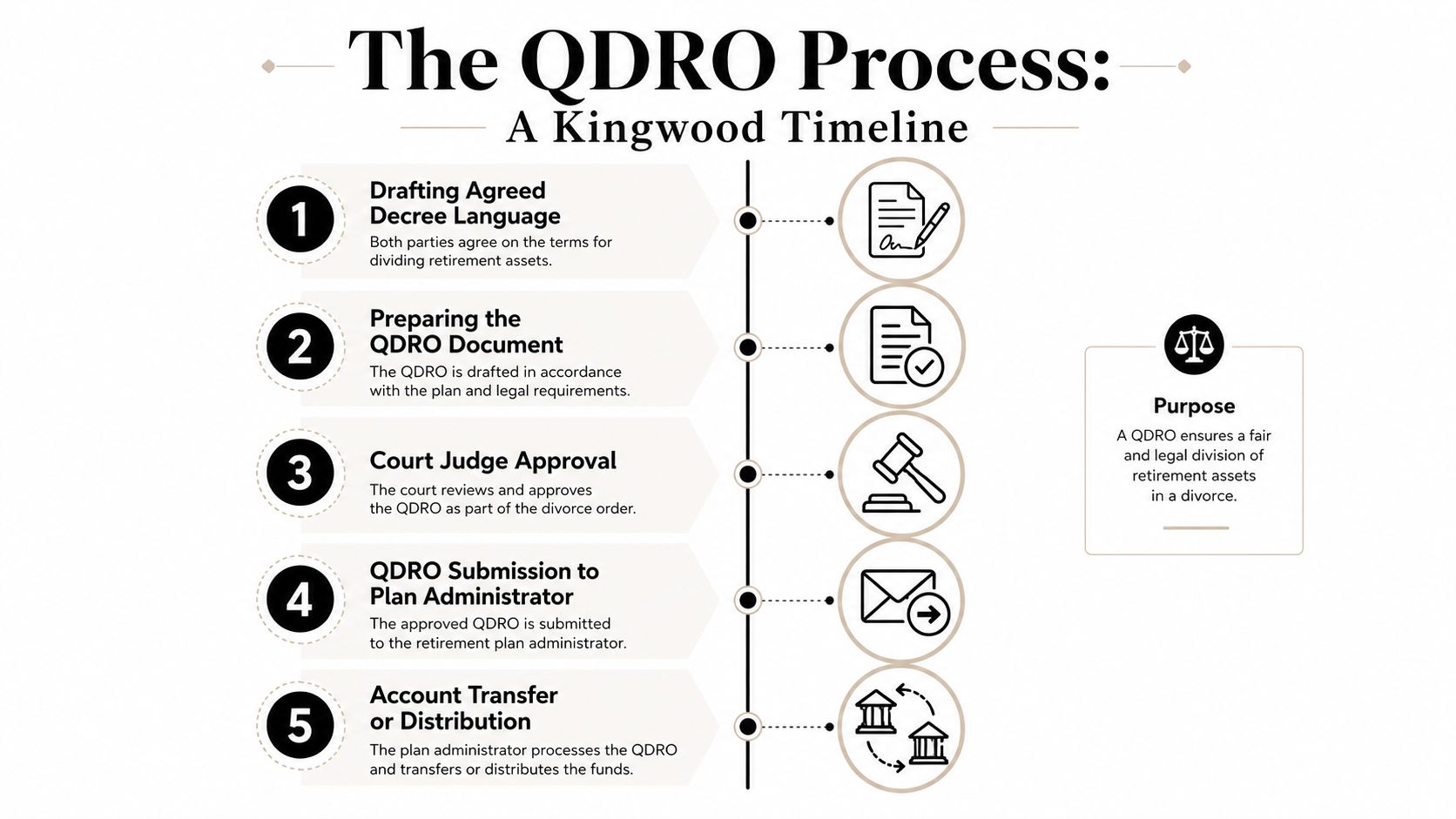
The sequence that usually works
- Draft the decree language. The divorce judgment should spell out the retirement split in plain terms, so the later order has a solid foundation.
- Prepare the separate QDRO or DRO. This is the technical document that names the participant, alternate payee, plan, amount or percentage, and payment period.
- Get attorney review. Someone has to catch the wording problems before the plan rejects them.
- Submit to the plan administrator. For ERISA plans, the administrator decides whether the order is qualified. Texas Teacher Retirement System plans use their own divorce order process and qualification review before payment, and state retirement systems follow their own rules rather than the private-plan rules discussed earlier (Department of Labor QDRO chapter, TRS guidance).
- Finish with court signing and implementation. Once the order is approved, the plan can process the split.
The order has to match the plan, not the parties' shorthand. A private ERISA plan follows the federal qualification rules discussed earlier, while a Texas state retirement system uses its own divorce order procedure. The drafting changes with the plan type, and that is where a lot of Kingwood families get tripped up.
What usually slows things down
The holdup is almost always the wording. A plan administrator will reject an order that asks for a benefit form the plan does not offer, tries to increase the benefit, or conflicts with an earlier order for the same stream. That is the rule under federal qualification standards, and the same practical problem shows up in Texas state plans when the order does not fit the plan's forms and procedures (Department of Labor QDRO rules).
A sloppy draft wastes time. It also gives the other side room to argue over the marital share, the payment timing, or the survivor benefit language after the decree is already signed.
If you are juggling other family-law issues, organization matters. A practice-management system like Cloudvara legal practice management helps firms track drafts, deadlines, and plan revisions without losing the paper trail.
The same discipline matters in other family cases too. Grandparents' Rights in Kingwood deals with custody and visitation rights for grandparents in Harris County, and those cases can land on the same crowded court calendar and filing process.
Pitfalls That Can Derail a Retirement Division in Texas
A divorce decree can sound clean on paper and still fail in practice. That is where a lot of Kingwood families get burned. The fastest way to lose your position is to sign an order that looks fair but cannot be implemented by the plan.
The plan administrator follows the plan document, not the language people wish they had used in court. A QDRO cannot force a private ERISA plan to offer a payout form it does not already provide, and it cannot create a bigger benefit than the plan allows. That is the federal rule, and it is why the wording has to match the plan from the start. For a plain-language summary, see the Department of Labor QDRO rules.
That same problem shows up with Texas public retirement systems, just through their own order procedures. TRS, ERS, and TCDRS each have their own paperwork and their own review process, so a decree that reads fine to a spouse can still get rejected if it does not fit the plan's rules. The Texas family-law piece is the part clients usually understand. The retirement-plan piece is where the money is protected or lost.
Common mistakes that cost people money
- Ignoring the loan balance: a 401(k) with an outstanding loan is not the same thing as a clean account with no debt attached.
- Forgetting vesting changes: stock-match vesting that happens after separation can change the marital math.
- Treating military pensions like private plans: federal military retirement rules can intersect with Texas community property, but they are not divided like a simple retail retirement account.
- Using a generic form order: if the language does not fit the plan, the administrator can reject it.
A bad decree also creates a second problem. If one order is already accepted for the same benefit stream, a later order cannot rewrite that stream because the parties changed their minds. That is where cleanup work gets expensive and fights get harder to settle.
Texas readers who serve at Joint Reserve Base or commute from Northeast Houston run into the federal military-pension issue often enough that it deserves careful handling from day one. Texas community-property rules and federal retirement rules have to be read together. If the plan or benefit stream has special federal rules, the order has to respect them at the drafting stage, not after a rejection.
If the divorce also involves house equity, bank accounts, or business assets, the retirement order should be drafted alongside the rest of the property division. A useful place to start is this guide on how to protect assets in a divorce. Organization matters here. Firms that use an attorney services automation guide can keep drafts, deadlines, and plan revisions in one place so the file does not get lost in the shuffle.
Why Working with a Local Kingwood Attorney Protects the Retirement Split
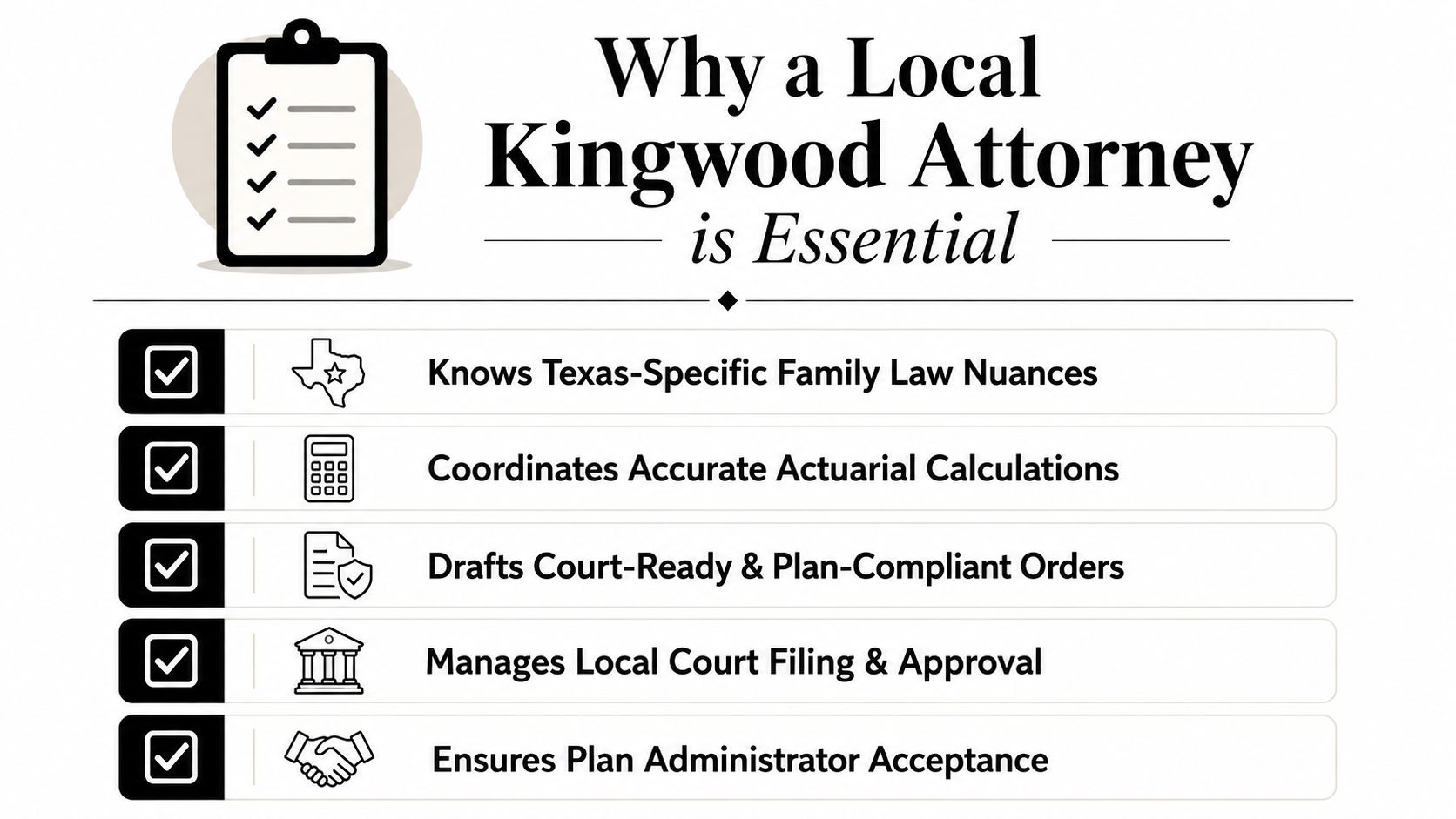
Retirement division is not just a drafting task, it's a coordination job. The decree, the math, the court order, and the plan administrator's review all have to fit together, and that's where a local Kingwood family law attorney earns their keep.
A local lawyer knows which plans need the cleanest language, which administrators are strict, and where Texas community-property rules affect the final split. That matters when you're also dealing with property division, custody, or enforcement issues. If retirement is only one piece of a bigger divorce picture, the case has to be managed as a whole, not in separate silos. For readers comparing options, the firm's page on how to protect assets in a divorce is a useful starting point.
Why local coordination matters
A retirement order often goes through more than one set of hands. The lawyer drafts the language, the QDRO preparer refines the technical terms, the judge signs the order, and the plan administrator decides whether it's qualified. If one person misses a detail, the whole thing stalls.
That's also where modern workflow tools can help a law office stay organized. An attorney services automation guide is a good example of the kind of resource that shows how firms streamline intake, document handling, and follow-up so client files don't sit idle.
The Law Office of Bryan Fagan – Kingwood TX Lawyers handles family law matters with that local coordination in mind, and that matters when a retirement split has to be translated into an order a plan will honor. You want a team that knows Kingwood courts, understands Houston-area family dynamics, and keeps the retirement issue tied to the divorce record from day one.
Common Questions Kingwood Clients Ask About QDROs and DROs
How long does a QDRO take after divorce? It depends on the plan, the draft quality, and how quickly the administrator reviews the order. The key point is simple, the retirement money usually can't move until the order is approved, so a sloppy draft only adds delay.
Do I pay taxes if the funds go into my own IRA? The point of a qualified order is to avoid tax-penalty problems that can come from the wrong kind of transfer. The tax treatment depends on how the distribution is handled, so the order and the rollover need to be coordinated from the start.
What happens if the plan administrator rejects the order? The order gets corrected and resubmitted. That's why a Kingwood divorce needs someone who can respond to the administrator's comments instead of treating the rejection like a surprise.
How do military and federal pensions fit into Texas community property? They still have to be analyzed under Texas property rules, but the federal retirement system can add separate rules about payment and division. That's why military and federal benefits should never be handled like a simple private 401(k).
If your divorce is underway in Kingwood, Humble, or Northeast Houston, don't wait until the plan administrator tells you there's a problem. Bring the decree, the plan paperwork, and any account statements to a local lawyer who handles property division and retirement orders, then get the order drafted the right way before the window closes.
If you're sorting out a retirement split in Kingwood, the Law Office of Bryan Fagan – Kingwood TX Lawyers can help you line up the decree, the retirement order, and the plan approval process so the division gets implemented. Visit Law Office of Bryan Fagan – Kingwood TX Lawyers to schedule a free consultation at the Kingwood office and get clear guidance on your next step.