You signed the decree, you expected the transfers to happen, and instead your ex is stalling on the house, the car title, or the retirement paperwork. That's the moment frustration turns into a legal problem, because a Texas divorce decree is not a suggestion. If you need to enforce a property division decree in Kingwood TX, the court system in Harris County gives you a real path forward, but you have to use it the right way and move fast.
Kingwood, Humble, Porter, and Northeast Houston residents run into the same pattern over and over. One spouse keeps the truck, refuses to sign the deed, ignores the QDRO paperwork, or acts like the decree can be renegotiated after the fact. It can't. The question is whether you can prove the violation, file in the proper court, and pick a remedy that a judge will enforce.
When Enforcement Becomes Your Only Option
A Kingwood client usually doesn't call me because of a technicality. They call because the other side has gone silent, and the property the decree awarded is still sitting in the ex-spouse's name. That's not a misunderstanding anymore. That's defiance.
The situations that trigger enforcement
Refusing to sign over a vehicle title is one of the most common fights. So is dragging feet on a deed after the house has already been awarded or sold under the decree's terms. Retirement accounts create the same problem when one spouse delays paperwork or refuses to cooperate with the transfer process.
Practical rule: if your ex is withholding property, paperwork, or access after the decree is final, start documenting immediately.
Some people hope a polite reminder will solve it. Sometimes it does. If the delay is short and the other side is trying to follow the order, a written demand can be enough. But once you see repeated excuses, disappearing signatures, or outright refusal, you're no longer dealing with a delay. You're dealing with non-compliance.
The stress isn't just emotional. It can also be financial, especially when the property affects housing, transportation, or your ability to move on with your life. That's why the original court matters so much. Texas law lets that court handle enforcement of the property division, which means you don't need a brand-new divorce case to get relief, you need a focused post-decree action in the same system that entered the order. For a deeper look at how property division is handled in the first place, see this guide to property division in Kingwood divorce.
What judges take seriously
Judges in Harris County care about clear, provable violations. They are much more likely to act when the decree says exactly what was supposed to happen and your evidence shows the other side didn't do it. If the property was supposed to be transferred, signed, delivered, or sold, and that never happened, you have a real enforcement issue.
If the order is vague, the court may clarify it. If the order is specific and your ex is ignoring it, the court can step in and enforce it. The key is showing the difference between a clerical delay and a spouse who is choosing not to comply.
Texas Legal Remedies for Enforcing Property Division
Texas Family Code Chapter 9 gives you real tools, but each one fits a different kind of violation. File the wrong request, and you waste weeks while the other side keeps the property out of reach. If you want results in Kingwood, Humble, or Northeast Houston, you need the remedy that matches the way the decree is being ignored.
Motion to enforce and contempt are not the same thing
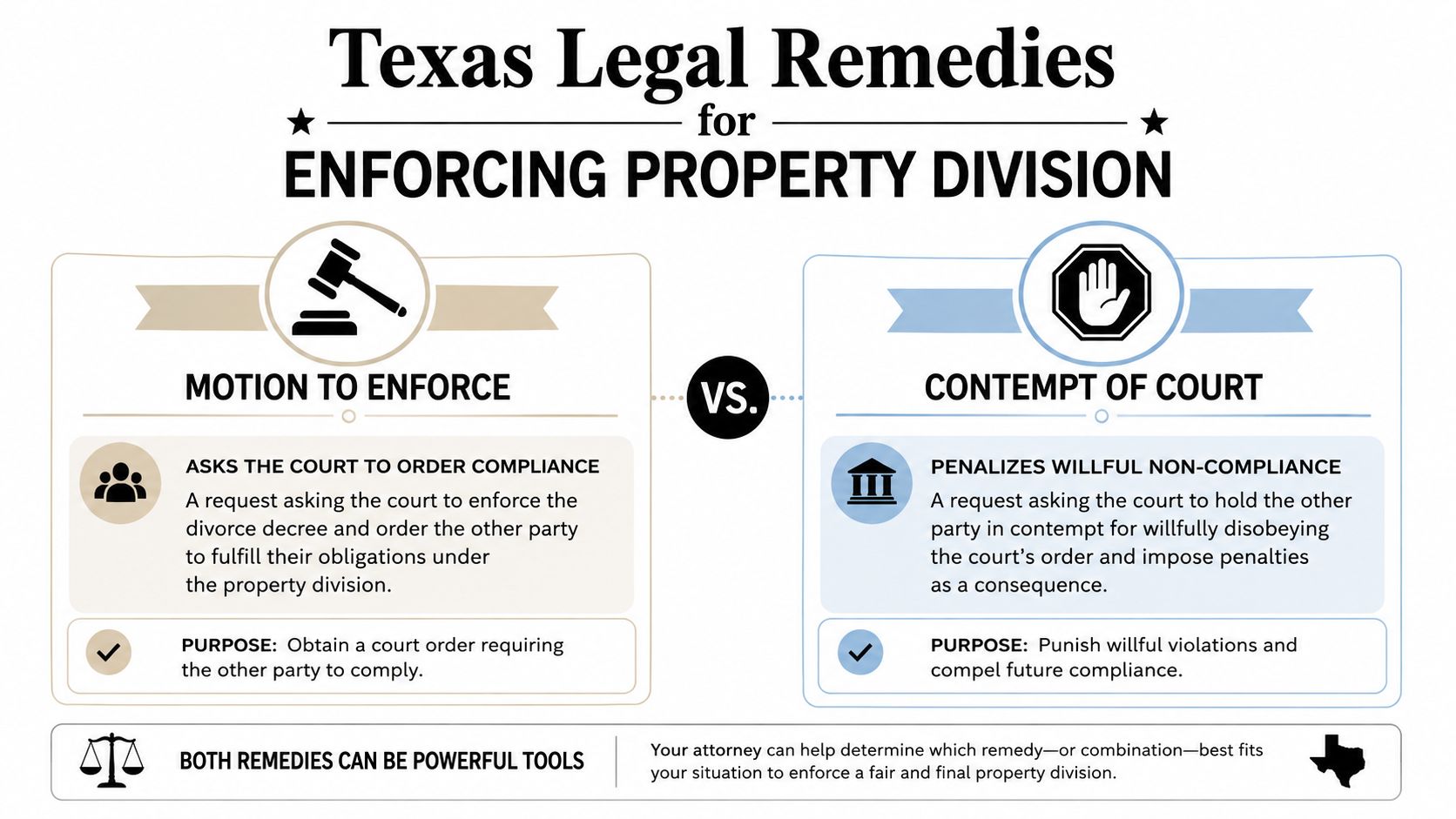
A motion to enforce asks the court to require compliance with the existing decree. That is the best starting point when the division is already written down and the other side just will not follow it. Under Texas Family Code Chapter 9, the affected party can file the enforcement case in the same court that signed the decree, and that court keeps authority over the property division.
A contempt request goes further. It asks the judge to punish willful disobedience, which can include fines or jail in serious cases. Harris County judges reserve contempt for clear, intentional violations, not for sloppy paperwork or an order that leaves room for argument. If the court can clarify the order without punishment, that is usually the cleaner path.
Local guidance such as Enforcement of Court Orders in Kingwood explains how Harris County courts handle decree enforcement and related post-divorce orders. That matters because enforcement happens in the court that already handled the divorce, not in a brand-new case built from scratch.
Other remedies that can move property
A writ of execution can help seize property in some situations. A garnishment order can intercept funds when money is owed. A turnover order can force a non-compliant spouse to hand over property or sign over assets when they are holding them hostage.
The court can also issue orders that clarify or carry out the division, but it cannot change the substantive split already ordered in the decree. That line matters. Judges can help enforce the decree, but they cannot rewrite it because one spouse dislikes the result. For a closer look at how retirement property can be divided and implemented after divorce, see dividing retirement accounts in Kingwood divorce and the rules discussed in Texas Law Help on enforcing property division.
If the decree says one thing and your ex is doing another, focus on enforcement. If the decree is unclear, focus on clarification.
That distinction saves money and time. It also keeps your request aimed at the remedies Harris County judges are most likely to grant.
Required Evidence and Filing Process in Harris County
A frustrated spouse usually walks in with one question, how do I get the court to make my ex follow the decree? The answer starts with paper, not anger. Harris County family judges want a clean decree, a clear timeline, and proof that the other side knew the obligation and still ignored it.
What you need before filing
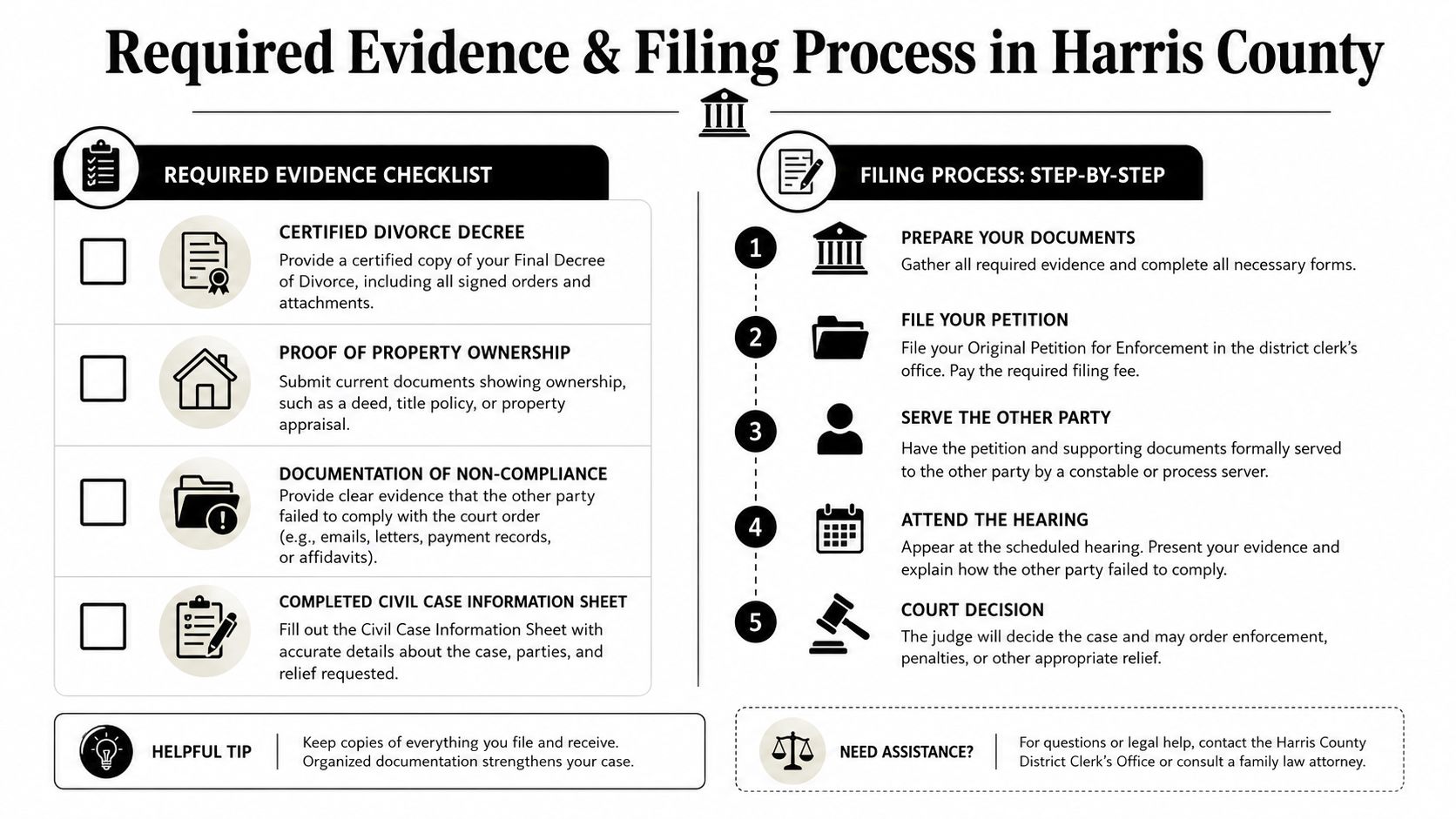
Start with the final divorce decree. Then collect proof of the property at issue, such as title paperwork, deed records, retirement account statements, or other documents that show what was awarded. You also need evidence that your ex knew about the obligation, which usually means texts, emails, letters, or messages through counsel.
The stronger files also show your attempts to get compliance. If you asked for a signature, requested a transfer, or demanded delivery of property and got silence or excuses, that history helps. It shows the court this was not a surprise and that you gave the other side a fair chance to fix the problem.
Put your records in one place before filing.
- Certified decree copy: Get the exact order the judge signed.
- Property proof: Save titles, deeds, account records, and any documents tied to the asset.
- Communication log: Keep messages that show you asked for compliance.
- Failure evidence: Record missed deadlines, refusals, or silence.
If the dispute involves retirement money, gather the account materials early and get a lawyer who knows how to handle the plan documents. The rules are different, and Dividing Retirement Accounts in Kingwood Divorce explains why those cases often need a more careful filing packet.
How the case gets filed
An enforcement suit follows the Texas Rules of Civil Procedure as an original filing, which means you need proper pleadings, service, and a hearing date. A complaint written on the fly will not carry the case. The suit also goes back to the same court that signed the divorce decree, because that court keeps power to enforce the property division.
Your lawyer should draft the petition, file it, and arrange service on the other party. Once service is complete, the other spouse has notice and a chance to answer before the hearing. That step matters. Bad service can stall the case, and judges in Harris County will not fix a sloppy filing for you.
What the first hearing usually looks like
The first hearing is about proof and direction. The judge wants the decree, the missing property, and a plain account of what the other side did or refused to do. If the order is clear, the court can move toward enforcement. If the wording leaves room for dispute, the judge may issue further orders to implement or clarify the decree.
Retirement disputes often need technical follow-through after the hearing. Account transfers, plan requirements, and rollover paperwork can create delays if nobody handles them correctly. That is why the decree alone is not the end of the job.
Timelines Costs and Likely Outcomes
The worst mistake is waiting. Property disputes do not improve on their own. The longer you sit on a decree violation, the harder it gets to prove what happened, the easier it becomes for the other side to hide behind missing records, and the more money you end up spending to clean up a problem that should have been addressed early.
The deadline that matters
Texas gives you a filing window for enforcing a property division decree, and you need to treat that window as real, not theoretical. In many cases, the deadline is two years from the date the divorce decree was signed or became final after appeal, whichever is later. Texas also uses the same two-year window for tangible personal property, and future property claims may be enforced within two years after the right to that property matures or accrues.
That deadline changes the way you should act. If you are anywhere near the limit, do not wait for one more ignored text, one more excuse, or one more round of promises. File the case and force the issue.
What usually happens after filing
Most enforcement cases end one of three ways. Sometimes the other side finally complies after being served. Sometimes the judge signs an order that requires transfer, signature, delivery, or another specific act. Sometimes the court moves into contempt if the evidence shows the violation was willful.
That middle result is what Harris County judges grant most often. They want a clear order that tells a spouse exactly what must be done and by when. They do not want a messy relitigation of the divorce or a new fight over who deserved what in the first place.
Costs depend on how much work the file needs, how much property is involved, and how hard the other spouse fights. A clean case with good paperwork usually costs less than a case that turns into repeated hearings, service problems, or emergency motions. The cheapest case is the one that gets filed correctly the first time, while the deadline is still working for you.
A lot of people spend money in the wrong place. They try to argue first and document later, or they keep paying for delay while hoping the other side will suddenly do the right thing. That approach burns time and gives the other person room to stall.
What judges are most likely to grant
Harris County judges respond best to specific relief. If you ask for an order requiring transfer, signature, delivery, or another clear act, you are giving the court something it can enforce. If you ask the court to fix a property deal because you regret the outcome, you are asking for a fight you will probably lose.
Contempt sounds powerful, but it is not the remedy that solves every case. It works best when the decree is clear, the violation is obvious, and the evidence shows deliberate noncompliance. In many property cases, the more practical win is an enforcement order that gets the asset moved, signed over, or delivered without more delay.
Some remedies look strong on paper and go nowhere in real life. Vague accusations do not move a judge. A clean request tied to the decree does. When the order already says who gets what, the court's job is to make people follow it, not reopen the divorce because one side regrets the result.
Your Enforcement Action Checklist and Common Mistakes
A strong enforcement case starts long before the hearing. The people who do best are the ones who treat this like a records case, not an argument. If your ex is dragging this out, your paperwork needs to be tighter than their excuses.
What to do right now
- Collect the decree: Keep the signed final order in one place.
- List the missing property: Be specific about titles, deeds, accounts, or items still withheld.
- Save every message: Texts, emails, and letters can show refusal or delay.
- Track the timeline: Write down when compliance was due and when it failed.
- Protect the asset: If property could be sold, transferred, or hidden, tell your lawyer immediately.
The most common mistake is filing too late. The second is assuming any lawyer can file any motion and get the same result. Enforcement is procedural, and small errors can waste weeks.
Another mistake is going after the wrong remedy. If the decree needs clarification, don't pretend it's a contempt case. If the spouse must sign a document, ask for an order that compels that action. Match the request to the problem.
What hurts these cases
Silence hurts. So does sloppy recordkeeping. If you can't show the court what the decree required, when the obligation started, and what the other side refused to do, your case gets harder.
Some people also make the process personal. They spend their energy on explaining how unfair their ex is instead of proving the violation. Judges don't need the backstory. They need the order, the breach, and the requested fix.
Keep your tone factual, even when the situation feels outrageous. Judges respond to clean proof, not emotional overload.
For local representation that handles enforcement problems within the broader family law system, the Kingwood office of the Law Office of Bryan Fagan – Kingwood TX Lawyers is a practical place to start. That matters if your file involves property, retirement benefits, or real estate details that need careful handling.
When to Hire a Kingwood Family Law Attorney
If your case involves a house, retirement account, business interest, or property in more than one place, don't try to improvise. Enforcement sounds simple until the paperwork turns technical and the other side starts fighting every step. That's where local counsel earns their keep.
A Kingwood family law attorney can identify the right remedy, file in the correct court, and avoid procedural mistakes that slow everything down. In Harris County, that matters. You want someone who knows how these motions are handled, how to present the decree cleanly, and when to push for contempt versus a simpler implementation order.
If the fight is about transferring retirement assets or untangling property that wasn't handled cleanly, the legal details get real fast. If you need help with divorce, property division, or other family law issues, the Kingwood office can also fit this into the larger picture of your case. That's one reason people lean on local firms that handle family law alongside related services like estate planning, probate, civil disputes, and criminal defense when life gets messy.
The earlier you get help, the better your options stay. A lawyer can often force movement before the dispute turns into a drawn-out courtroom battle, and that saves you time and frustration.
If you're dealing with a spouse who won't follow a property division decree, talk to the Law Office of Bryan Fagan – Kingwood TX Lawyers and get a plan built around your decree, your deadlines, and the property at stake. We help Kingwood, Humble, and Northeast Houston residents push enforcement cases forward in Harris County with clear guidance and local representation. Schedule a free consultation at the Kingwood office and find out which remedy fits your situation.