If your spousal maintenance payment in Kingwood is squeezing your budget, or you're on the receiving end and the money has stopped matching reality, don't guess. Texas courts do not reopen support orders just because life feels harder, they look for a material and substantial change in circumstances after the original order, and they do it under the narrow rules in Texas Family Code § 8.057 (modification rule). That matters to families in Kingwood, Humble, Porter, and Northeast Houston because the first question is always whether the law even allows a change before anyone starts arguing about dollars.
Understanding Modification Under Texas Law
Texas Family Code § 8.057 controls the modification of a maintenance order, and the court's first job is simple, even if the paperwork isn't. The judge asks whether there has been a material and substantial change in circumstances since the order was signed. If the answer is no, the motion goes nowhere, no matter how frustrating the payment feels.
That phrase covers more than a temporary dip in cash. A lasting job loss, a new disability, a meaningful change in living expenses, or a shift in the recipient's finances can matter if it happened after the decree and is backed by proof. A one-month hiccup usually won't carry the load. A documented change that changes the household's real economics might.
For a Humble resident who loses a job and starts missing bills, the right move is to document the change immediately, not wait and hope the court will sort it out later. A judge wants to see the timeline, what changed, when it changed, and how it affects the current order. If the facts are thin, the motion is thin.
If you want a plain-English overview of how Texas maintenance works before you decide whether to modify, this page on alimony in Texas is a useful local starting point. For a broader consumer-focused perspective on divorce stress and next moves, practical divorce advice for 2026 gives readers a general framework, but the Texas modification rule still controls what a court can do here in Kingwood.
Practical rule: if the change didn't happen after the order, or you can't prove it with dates and records, the court probably won't modify anything.
The roadmap is straightforward. First, confirm the order is modifiable maintenance. Next, see whether the facts fit a legal ground for change. Then gather proof that ties the change to a date and a dollar impact. Finally, file in the right court with the right paperwork.
Confirming You Have Legal Grounds to Modify
A Kingwood client usually asks the same question first, can the court change this order, or am I stuck with it? Texas maintenance is narrow from the start, so the answer turns on the original legal basis and on what has changed since the decree. Under Texas Family Code § 8.051, a court may order maintenance only when the requesting spouse cannot meet minimum reasonable needs from property and also fits a qualifying category, such as a 10-year marriage or longer, a qualifying disability, or a family-violence conviction or deferred adjudication tied to the marriage (Texas Family Code § 8.051). That matters in Kingwood and Northeast Houston because a judge does not rewrite maintenance into something broader than the law allows.
The statutory caps still control the case
Texas also puts a ceiling on maintenance. Monthly maintenance cannot exceed the lesser of $5,000 or 20% of the obligor's average monthly gross income (Texas Family Code § 8.055). The usual statutory duration buckets are 5 years, 7 years, or 10 years, depending on the marriage length and the facts, with disability-based awards able to continue longer (Texas Family Code § 8.055, Texas maintenance duration guide).
Those limits set the outer boundary before anyone argues about hardship. A higher grocery bill, a mortgage reset, or a tighter paycheck may justify a change in the numbers, but they do not let the court ignore the statute. If you are talking with a Spousal Support Lawyer in Kingwood, the first job is to check whether the current order still fits inside the maintenance rules and whether the original category still holds.
| Statutory Trigger | Key Threshold | Practical Effect |
|---|---|---|
| 10-year marriage or longer | Marriage meets the length requirement and minimum-needs proof exists | Maintenance may be available, but only within the statute's caps |
| Disability | Qualifying disability affects the requesting spouse or the paying spouse | Duration may continue longer while the disability continues |
| Family violence | Offense occurred within 2 years before filing or while the divorce is pending (Texas Family Code § 8.051) | Gives a narrow path to maintenance in a violence-based case |
| Maintenance amount cap | Lesser of $5,000 or 20% of average monthly gross income (Texas Family Code § 8.055) | Limits any upward modification request |
| Duration buckets | Commonly 5, 7, or 10 years (Texas maintenance duration guide) | A court can't rewrite the statute's time framework |
A quick self-check keeps you from filing a weak motion.
- Does the original order fit a statutory maintenance category?
- Has the situation changed after the decree, not before?
- Can you show the change with records, not just frustration?
- Would the requested change stay inside the Texas cap and duration rules?
Gathering the Right Evidence Before You File
Modification cases rise or fall on paper. Sympathy doesn't move a judge, records do. If you live in Kingwood or nearby, start building one clean file now, not after you've already drafted a motion.
What belongs in the file
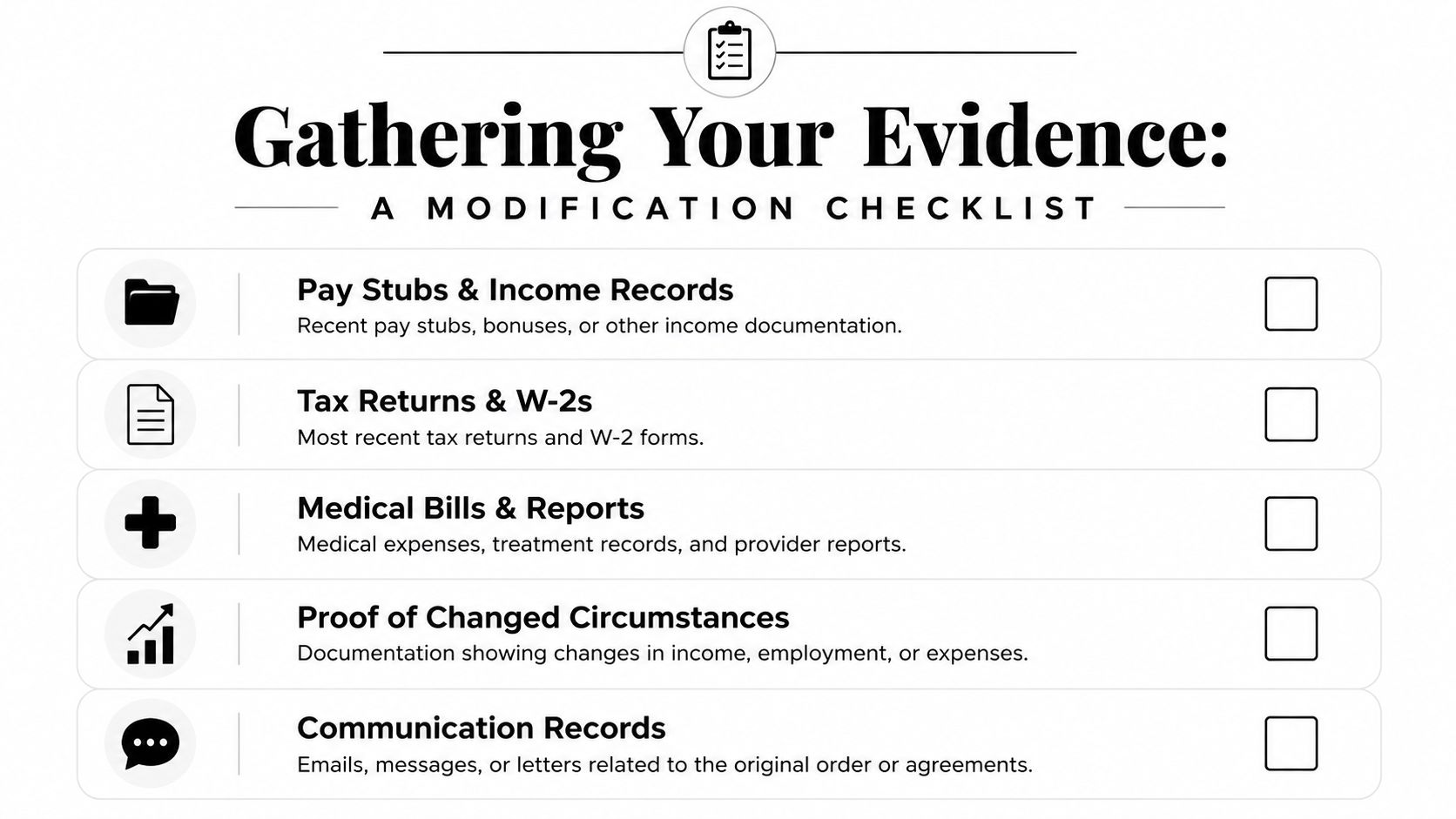
Collect pay stubs, tax returns, W-2s, medical records if disability is part of the case, employer letters about layoffs or retirement, bank statements, and a written timeline showing exactly how things changed after the decree. Put dates on everything. Save it all in one folder, digital and paper if you can.
A judge in Harris County family court wants to see a story that matches the records. If your timeline says the job loss happened in March, the documents better show March. If the recipient spouse got new employment, there should be something concrete showing when that happened and what the new income looks like. That's why a clean file beats a stack of random screenshots every time.
A Paternity Lawyer in Kingwood is obviously focused on establishing legal paternity and related rights in Harris County, but the same discipline about documents applies in family court generally. Texas judges rely on records, and that's true whether the case is about parentage or support.
Vague claims die fast. “My bills are higher” or “my ex makes more now” is not enough without dates, amounts, and proof.
Don't manufacture grounds. Don't quit a job just to force a reduction. Don't hide income and assume it won't show up in discovery. Courts look hard at voluntary reductions in income, and a bad paper trail can wreck a modification before it starts.
The right move is simple. Gather the proof, date it, organize it, and let an attorney review the file before anything gets filed in court.
Filing the Motion With the Kingwood-Area Family Court
A modification has to be filed in the court that originally rendered the maintenance order under Texas Family Code § 8.057 (modification rule). That means venue matters, and it matters a lot. If the original case was handled in Harris County, you're working within that family court system, not shopping around for a friendlier courthouse in Kingwood, Humble, or Porter.
What the paperwork usually looks like
The filing package typically includes the motion to modify, an order to appear or similar setting request, and a financial affidavit or other income statement. Accuracy matters more than volume. A sloppy form with the wrong numbers creates delays. A tight form with clean numbers gives the court something usable.
Service comes next. The other spouse has to be properly notified, and then the case moves into the response phase. Depending on the docket, it may be a while before a hearing date opens up. Harris County scheduling is real life, not a postcard, so clients should expect to wait for a slot that fits the court's calendar.

Temporary relief sometimes comes into play while the case is pending, but don't assume it will. The court still wants enough proof to justify interim action. A Child Support Attorney in Kingwood handles establishing, modifying, and enforcing child support in Harris County, and that same courthouse reality shows up in support cases across the board.
If you're already working with a spousal support attorney in Kingwood TX, ask one blunt question: is this a statutory maintenance motion, or am I trying to force a contract issue into the wrong form? That distinction saves time, money, and influence.
Filing the wrong form, in the wrong court, or without the right attachments can stall a case for months. That's not drama. That's Houston-area family court practice.
Court Orders vs Settlement Agreements
Many people in Kingwood find this confusing. A court-ordered maintenance award is one thing. A settlement-based support promise folded into a divorce decree is another. Texas modification law applies to maintenance orders, but contract-based support may be governed by contract principles instead, which changes the whole fight.
A divorcing couple can write a support deal into a decree and make it binding between themselves. That doesn't automatically mean the judge can later rewrite it through a maintenance modification. Sometimes the right path is a contract claim, not a motion to modify. If you pick the wrong vehicle, you can lose time and weaken your position before the other side even answers.
That's why the original decree matters more than you might think. Pull it out and find the paragraph that created the obligation. Read the exact wording. Look for whether the court “ordered” maintenance, or whether the parties “agreed” to support terms. The language controls the strategy.
Read the decree first. Don't let anyone file a motion until you know whether the support obligation is statutory maintenance or contract support.
For a local comparison, a retired Porter resident dealing with an agreed support clause may need a different strategy than a Humble spouse seeking a statutory reduction after a job loss. The forum, the remedy, and the evidence are not the same. That's also why a high-conflict case often benefits from the kind of case management you'd expect from a Contested Divorce Attorney in Kingwood who handles advocacy for high-conflict divorces in Harris County courts.
If you're trying to organize the bigger financial picture around a support issue, a practical consumer guide like get a Texas sales tax permit can help small business owners think about records and obligations, but it doesn't change the family-court analysis here. The support paragraph in the decree still drives the legal path.
Contract support can sometimes be enforced differently than maintenance, and that can be a problem or a benefit depending on your side of the case. Don't assume every post-divorce payment can be reduced the same way. That assumption is expensive.
Retirement, Inflation, and Other Material Changes
Life changes don't all look the same in court. A job loss is obvious. A retirement date, a rising grocery bill, or a recipient's new paycheck takes more work to prove. Texas courts care about the actual evidence behind the change, not the label you put on it.
The proof usually has to match the event
A retirement claim should show when the retirement happened, whether it was planned, and whether it was reasonable under the circumstances. An involuntary job loss needs termination papers, separation letters, or similar records. If the recipient spouse went back to work in Humble or received a windfall, the court will want proof of that too, especially if the recipient's need has gone down.
Inflation is the hardest argument to sell on its own. Costs can rise, but a Texas judge still wants a concrete link between the increase in living expenses and the ability to pay or the need for support. For broader personal-finance context on inherited money, inheritance planning for your freedom age can help readers think about windfalls, but in court the issue is not general planning, it's evidence of changed finances.
A supported spouse in Humble who lands a new job has to expect discovery around pay, hours, and benefits. A Porter resident who retires after a long career needs to show the court what income remains and whether the retirement is genuine, not a tactic. If the change looks voluntary, the court may look harder at whether the reduction should really count.
Timing is everything. Texas courts can only modify future payments, not go back and refund or reassign past-due amounts.
That timing rule changes strategy. If the facts are strong, don't sit on them. File when the evidence is ready and the change is real. Waiting only makes the arrears side of the case worse.
Preparing for the Hearing and Enforcement Realities
A Kingwood modification hearing is usually less dramatic than people expect and more focused than they hope. The movant testifies first, explains what changed, and walks the judge through the paperwork. The other spouse then gives their side, often with documents of their own, and the judge may ask pointed questions about income, expenses, timing, and credibility.

The court can reduce maintenance, terminate it, leave it in place, or deny the motion. It cannot raise maintenance beyond the original amount or stretch it beyond the remaining time allowed by statute, so the order's original limits still control the result.
Missed payments create their own mess. If maintenance is unpaid, enforcement can come back into the picture, and wage withholding orders often matter when the court needs a steady collection method. That is why a clean compliance record helps. If you ever need to modify again, the judge will look at whether you have been following orders or skipping them.
Court-ordered maintenance and settlement-based support are not treated the same way. If the support comes from a divorce agreement instead of a maintenance order, the hearing may turn on contract language, enforcement terms, and whether the agreement allows changes at all. A lawyer who knows the difference will tell you quickly whether you are fighting a modification issue or a contract problem, and that saves time in a crowded Harris County docket.
A local lawyer who appears regularly in the same Harris County family courts understands how those judges handle evidence, deadlines, and hearing settings. That is not a marketing slogan, it is a real advantage when the court calendar is crowded and the facts need to be presented cleanly. If enforcement is part of the problem too, this guide to finding an enforcement lawyer in Kingwood, TX gives you a useful local benchmark.
The three checkpoints are the ones that matter: confirm the support is court-ordered maintenance, not a contract; identify a real material and substantial change; and gather dated evidence before filing. Miss any one of them and you are probably burning time and money on a motion that will not move.
A hearing also gets harder, not easier, when the other side can show the change was planned, voluntary, or only partly real. Retirement gets scrutinized that way, and so does a claimed drop in income when the pay records tell a different story. Inflation arguments need concrete proof, because Texas judges want to see how the higher costs affect your actual ability to pay or the recipient's actual need. If the recipient's income has improved, that matters too, and it changes the burden in a practical way. You now have to show why the old number no longer fits the current facts.
If you want a low-pressure read on whether your case is even viable, the Law Office of Bryan Fagan – Kingwood TX Lawyers handles family law matters from its Kingwood location and can review the facts before you commit to a filing. For Kingwood, Humble, and Northeast Houston families, that early check is often the smartest move you can make this week.
If you are trying to modify spousal maintenance in Kingwood, do not guess at the law or file the wrong motion. The Law Office of Bryan Fagan – Kingwood TX Lawyers helps clients sort out whether their support order is modifiable, what evidence they need, and what the Harris County court is likely to do. Visit Law Office of Bryan Fagan – Kingwood TX Lawyers to schedule a free consultation and get a straight answer before you spend more time or money.