
Texas does not automatically give a parent a right of first refusal in custody. In Kingwood, Humble, and Northeast Houston, that right exists only if the parents write it into their order or a judge puts it there.
That matters the first time a work trip, hospital shift, or late meeting pushes one parent out of the picture and a grandmother, babysitter, or after-school program steps in. A lot of parents assume Texas family law fills that gap for them. It doesn't. In practice, the whole fight is about what the order says, how clearly it says it, and whether anyone can prove the other parent broke it.
A Tuesday Evening in Kingwood and Why ROFR Comes Up
A parent in Kingwood gets a text at 4:30 p.m. saying the other parent has to stay late in downtown Houston and won't make pickup. The child is already with a sitter, or maybe with a grandparent in Humble, and the question lands fast. Do you get to step in first, or does the other parent get to hand the child to whoever is available?
That's the underlying reason people start searching for right of first refusal custody Kingwood TX. It is not about abstract legal theory. It is about who cares for your child when the parenting plan says one thing but life gets messy.
What families are actually trying to solve
ROFR is usually about avoiding unnecessary third-party care. If one parent is unavailable for a meaningful block of time, the other parent wants the chance to take the child before a sitter, relative, or daycare takes over. Texas family-law guides say that the clause exists only if the parents negotiate it or a court includes it in an order, because the Texas Family Code contains no ROFR statute (Texas guide on ROFR in custody orders).
Practical rule: if it is not written into the order, it is not a right. A parent in Kingwood should never assume a judge will read ROFR into a standard possession order after the fact.
That is why this issue comes up so often in Harris County cases where both parents work unpredictable schedules. In those cases, the clause can either reduce friction or create a new source of conflict, depending on how carefully it is drafted.
If you are trying to read a current order or a proposed one, a Child Custody Lawyer in Kingwood, TX can help you sort out whether the language gives you a usable right or just makes the order sound busy. And if grandparents are already part of the care routine, Grandparents' Rights in Kingwood can matter in Harris County too, because caregiving choices often overlap with visitation disputes.
What a Right of First Refusal Actually Means in Custody
A Kingwood parent gets home late from work, the other parent is already lined up with a babysitter, and the custody order suddenly matters. ROFR says the unavailable parent has to give the other parent the chance to take the child first, before a third party steps in. That is a written care-transfer rule, not a vague parenting courtesy.
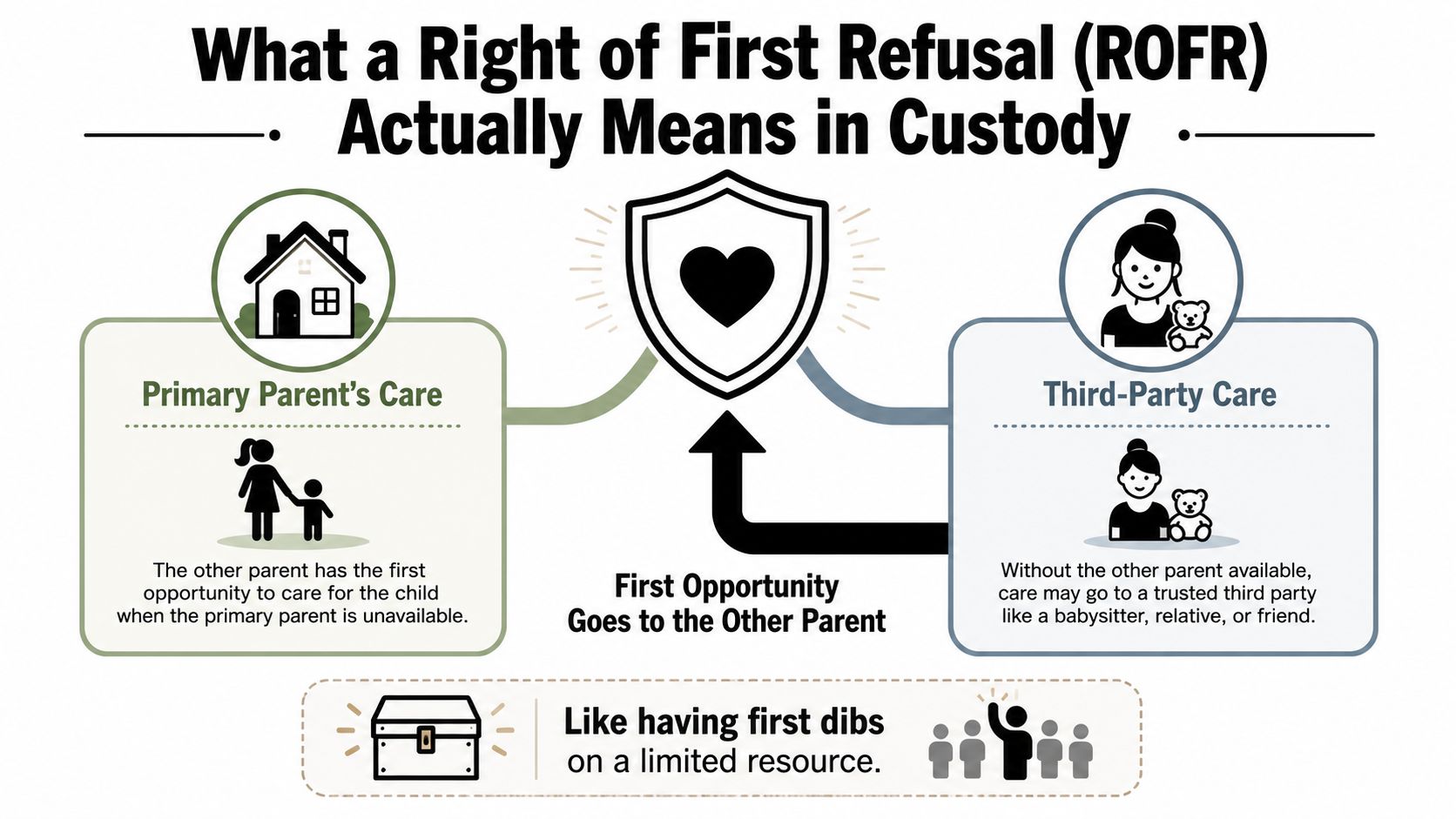
Texas does not create that right on its own. If the order does not say it, the right does not exist. Courts and Texas practice materials treat ROFR as a term that has to be written into the parenting plan or court order before it can be enforced (Texas custody practice on ROFR).
What ROFR does and does not do
ROFR does not change who is the managing conservator. It does not rewrite the possession schedule, and it does not give one parent a general veto over childcare choices. It creates a first-offer duty when one parent cannot personally care for the child during the period the order covers. If the language is missing, Texas courts usually will not read that right into the order after the fact (practical guide for Texas parents).
That is why parents get into trouble when they treat ROFR like a broad visitation tool. It is not grandparent visitation, and it is not a blanket ban on sitters. It is a narrow clause that shifts the caregiving choice only when the order says it shifts.
Kingwood parents should also compare the clause with the rest of the order, especially the standard possession order in Kingwood. If the ROFR language does not fit the rest of the schedule, the parent who wants to use it will spend more time arguing than parenting.
Read the order the way a judge will read it. Clear wording protects you. Vague wording gives the other parent room to bypass you, and in Harris County that is where these disputes usually start.
How Texas Courts Treat ROFR and What Must Be in Writing
Texas custody practice treats ROFR like a drafting problem first and a courtroom problem second. If the clause is sloppy, the judge may not need to guess what you meant. The judge can refuse to enforce language that does not clearly create a duty.
The pieces that need to be spelled out
The order should define the trigger threshold, the notice method, the response window, and what happens if the other parent says no or never answers. Texas practice materials describe common trigger language using 4-8 hours or overnight absences (Texas guide with threshold and modification notes). That is a practical starting point, not a magic number.
A workable clause usually answers these questions:
- When does ROFR start? For example, if a parent will be unavailable for more than a set number of hours or overnight.
- How is notice given? Text, email, or another written method.
- How fast must the other parent respond? A short and specific window.
- What if the other parent declines or stays silent? Then third-party care can go forward.
Bottom line: ambiguity is the enemy. If a clause does not tell a parent exactly when the right begins and how quickly it must be accepted, that clause invites a fight instead of preventing one.
Why Kingwood parents need precision
In real Harris County cases, the dispute usually starts with a normal day. One parent says the absence was long enough to trigger ROFR. The other says it was only a quick errand, a doctor visit, or a school function. That fight is avoidable when the clause uses plain, measurable terms.
A Kingwood order also needs to fit the family's actual life. Shift work, long commutes, and school calendars matter. A clause that works for a 9-to-5 parent in Northeast Houston may fail for a parent who works nights or travels across the region.
When parents want a draft reviewed before it becomes a problem, the local lawyers at Law Office of Bryan Fagan – Kingwood TX Lawyers help turn the broad idea into a clause that a judge can enforce. That kind of drafting is often the difference between a useful custody term and dead paper.
Sample ROFR Clause Language You Can Negotiate
A lot of parents ask for ROFR in the abstract, then freeze when they have to put words on paper. The fix is to keep the clause short, measurable, and practical. If I were redlining a draft for a Kingwood family, I would start with the trigger, then the notice, then the response deadline.
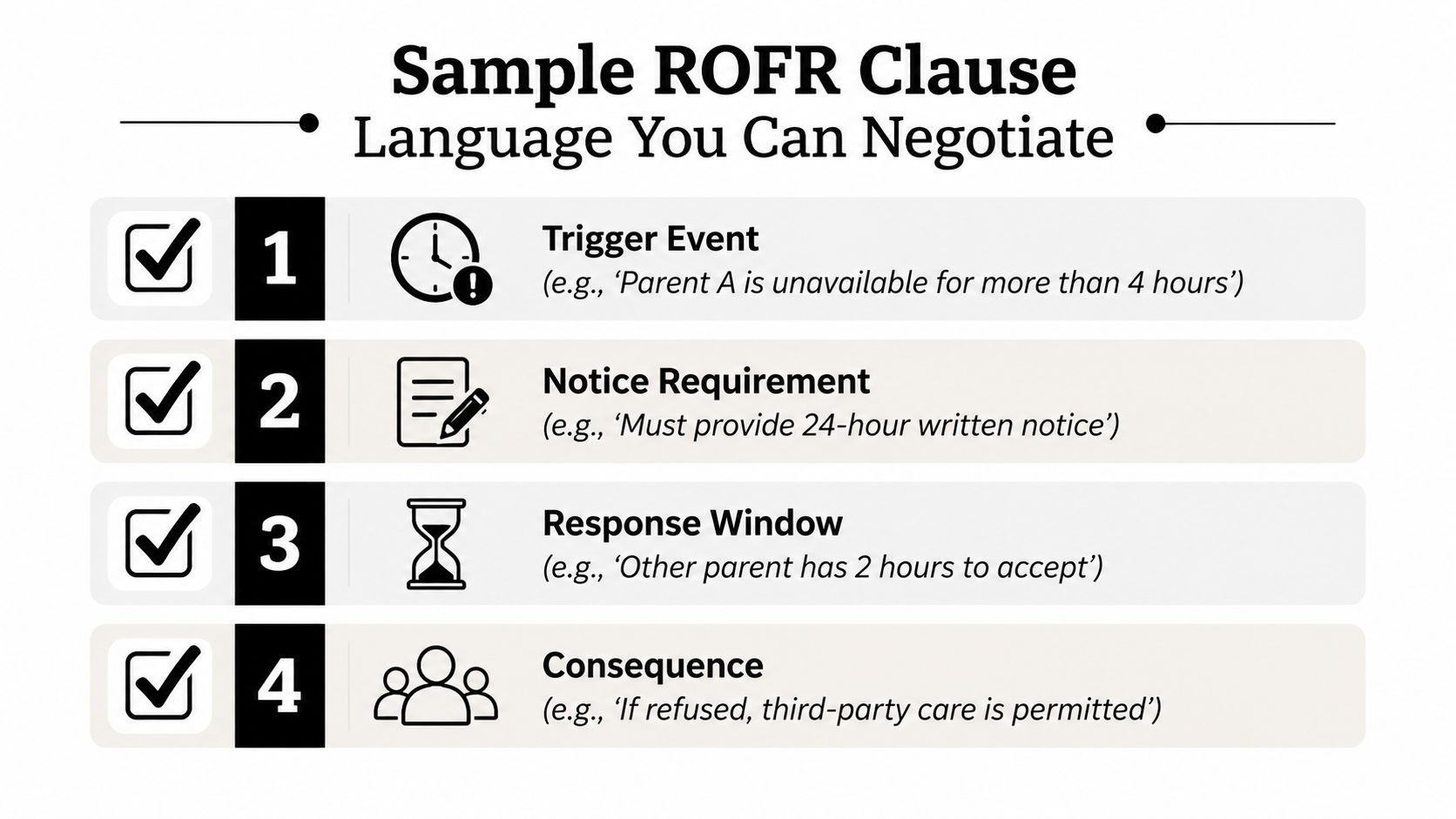
Here is the kind of language parents often negotiate:
If either parent expects to be unable to personally care for the child for more than 4 hours during a scheduled possession period, that parent must first offer the other parent the opportunity to care for the child before using a babysitter, relative, or daycare. Notice must be given by text or email, and the other parent must respond within a stated short period. If the other parent declines or does not respond in time, third-party care may be used.
That is not magic language. It is a framework. The point is to force the order to answer the practical questions that come up on a Tuesday night in Kingwood or after a late shift in Humble.
A simpler version for lower-conflict families
Some families do better with leaner wording:
- Trigger: more than a set number of hours of unexpected absence.
- Notice: one written message by text or email.
- Acceptance: a short response window.
- Fallback: if no response, the original caregiver arrangement stands.
Do not use mushy phrases like “reasonable notice” without defining it. Do not say “whenever possible” if you want a rule that can be enforced. Texas sources are clear that without express wording in the order, courts will not enforce an implied right of first refusal (Texas practical guide on ROFR enforcement).
If a grandparent is likely to be the backup caregiver, that needs to be thought through before the order is signed. A family that expects a grandparent to play a major role should look closely at Grandparents' Rights in Kingwood and make sure the custody terms do not conflict with the bigger caregiving plan.
Requesting or Modifying an ROFR Clause in Harris County
Adding ROFR to an existing order usually means filing a modification. Texas Family Code § 156.101 requires a material and substantial change in circumstances before a court will modify a prior order, so this is not a casual paperwork tweak (Texas guide with modification requirement). If the order is already in place, Harris County judges will want a reason to revisit it.
The local process in plain terms
Start with the current order. Read the possession schedule, the exchange language, and any clause about third-party caregivers. Then decide whether you are asking for a full rewrite or just a limited ROFR addition.
After that, the practical sequence is straightforward:
- Review the current order and identify the missing language.
- Draft the proposed ROFR clause so the trigger and response rules are clear.
- File the modification and serve the other parent.
- Prepare for a hearing if the other side contests the request.
The filing-fee reality in the Texas guide was $300-$375, with Harris County listed at about $350-$365 (Texas ROFR guide with county fee references). That gives parents a realistic starting point for budgeting, even though exact court costs can vary.
What Harris County judges actually care about
Judges in Harris County usually focus on whether the clause will make parenting more stable or just create more friction. Work schedules matter. So does the child's routine with caregivers. If the child has long spent time with a grandparent or sitter, a judge may look carefully at whether the new clause will improve consistency or merely add conflict.
A modification request also needs to make sense in the context of the child's life. If the parents already communicate poorly, ROFR can fail unless the notice and acceptance rules are painfully clear.
Parents often use a local lawyer to prepare the modification package, and a custody-focused attorney can do that without making the issue more dramatic than it needs to be. If you are already in that position, Custody Modification in Kingwood is the kind of service that fits this problem.
Enforcing ROFR When the Other Parent Skips the Step
A ROFR clause only matters if a parent follows it. When the other parent uses a babysitter, relative, or daycare without first offering you the time promised in the order, the fix is evidence, not emotion.

Start by capturing the violation in real time. Save texts, screenshots, calendar entries, and any message showing the other parent's absence. If there were witnesses, write down who saw what and when. The more concrete the record, the stronger the enforcement filing.
What to file and what to ask for
Texas practitioners commonly use enforcement under Chapter 157 when a parent violates an order. In a ROFR case, that usually means a motion to enforce, and sometimes a motion for contempt if the facts support it. The goal is to show the judge a clear breach of a written custody term, not a vague disagreement about parenting style.
One helpful internal resource is Evidence Needed for a Custody Case in Harris County, Texas, because ROFR enforcement lives or dies on documentation. If the proof is weak, the court may see the issue as a minor scheduling argument. If the proof is clean, the violation looks like what it is, a broken order.
You may also see the court order make-up possession time, and in stronger cases, sanctions or attorney's fees. That depends on the wording of the order and the strength of the proof.
The video below is a useful visual reminder of how custody evidence should be organized before you bring it into court.
Do not overfile. Repeated claims that do not match the order can damage your credibility fast. If the clause does not clearly cover the event, you need to fix the language, not force the court to guess.
Practical Tips and Common Misconceptions for Kingwood Parents
ROFR is useful, but only if you treat it like a precision tool. It is not a general parenting weapon, and it is not a substitute for good communication. In Kingwood, Humble, and Northeast Houston, that is where parents most often go wrong.
Common myths that create trouble
- It applies to every school pickup. It doesn't. The clause only applies to the trigger language in your order.
- It forces a text before every errand. Only if the order says it does.
- It gives veto power over a new partner. It doesn't. ROFR is about temporary care, not dating choices.
- It replaces the possession schedule. It doesn't. It sits inside the schedule.
Practical drafting habits that actually help
Keep your communication in one place, ideally a parenting app or a single written thread. Define notice in hours, not in vague language. Build in carve-outs for school functions and medical care if that matches your family's real routine. If one parent travels or works shifts, the clause should say so directly instead of pretending both schedules are predictable.
My advice: write the clause for the life you actually live, not the life you wish you had when the divorce was final.
If you want the order drafted, revised, or enforced without more guesswork, the Law Office of Bryan Fagan – Kingwood TX Lawyers can handle the custody language in a way that fits the local court process and your family's schedule. That matters in Harris County, where the wrong wording can turn a helpful term into another fight.
The safest move is to revisit ROFR any time the possession schedule changes. A clause that made sense last year may be wrong now.
Frequently Asked Questions About ROFR in Kingwood
Can ROFR be added years after a divorce? Yes, but usually only through a modification filing and proof of a material and substantial change in circumstances. It is not automatic.
Does ROFR override grandparents' involvement? Not by itself. Grandparent caregiving and visitation can overlap with custody terms, so the wording has to be read carefully alongside any existing order.
What if the other parent ignores the clause? Document the violation, then talk to a lawyer about enforcement under Chapter 157. Silence usually helps the parent who kept the records.
Can the court refuse to include ROFR? Yes. Texas judges are not required to add it just because one parent wants it. The wording, the family's schedule, and the child's stability all matter.
| Question | Texas Reality |
|---|---|
| Is ROFR automatic? | No, it must be written into the order. |
| Does Texas require it by statute? | No, the Texas Family Code does not mandate it. |
| What does a strong clause need? | A clear trigger, notice method, and response window. |
| Can it be enforced without clear wording? | No, implied ROFR is generally not enforced. |
Kingwood parents do best when they treat ROFR as a drafting issue first and a courtroom issue second. The language has to be precise, the proof has to be organized, and the local procedure has to be followed.
If you're dealing with a custody order in Kingwood, Humble, or Northeast Houston and the right of first refusal is unclear, the Law Office of Bryan Fagan – Kingwood TX Lawyers can review the wording, help you request a modification, or build an enforcement strategy that fits Harris County practice. Schedule a free consultation at the Kingwood office and get direct advice on whether your ROFR language protects your time with your child or leaves too much room for conflict.