Skip to content
If you live in Kingwood and the marriage is ending, the first confusion is usually not about custody or property. It's about geography. One spouse starts looking at courthouse names, another checks a mailing address, and suddenly the question is whether the case belongs in Harris County or Montgomery County, even though both places feel close on the map.
That choice matters more than many expect. It affects where you file, which clerk keeps the record, which courthouse you may have to walk into, and how the case moves from the first petition to the final decree. For families in Kingwood, Humble, Porter, and Northeast Houston, the practical answer is often simpler than the online search results make it seem, but it still needs to be checked carefully before anyone signs papers or pays a filing fee.
| Comparison Point | Montgomery County | Harris County |
|---|---|---|
| Default fit for most Kingwood addresses | Only if the home is actually in Montgomery County | Default venue for most Kingwood-area filings |
| Clerk system | District Clerk's Office in Conroe | Harris County Clerk in Houston |
| Records handling | Divorce records maintained by the district clerk | Divorce records handled by the county clerk |
| Filing logistics | Conroe filing trip | Downtown Houston courthouse logistics |
| Best use case | Kingwood residents who live on the Montgomery County side | Kingwood residents on the Harris County side, which is most of the community |
Why Two Counties Matter for a Kingwood Divorce
A couple in Bear Branch can be looking at one side of Kingwood, while their friends in Kings Lake are on a different county line than they realize. That's not a trivia question. It changes the court system that hears the divorce, the clerk office that keeps the file, and the practical route your case follows from start to finish. Kingwood is a 14,000-acre (57 km²) master-planned community in northeast Houston, and most of it sits in Harris County while only a smaller portion extends into Montgomery County. (Kingwood overview)
County line location changes the legal path
For a divorce, venue is not just a legal word, it's the courthouse your family will deal with. If the residence is on the Harris County side, the case usually belongs in Harris County. If the home is in Montgomery County, then the file goes through the Conroe side of the system. In a neighborhood this close to the county border, that difference can be the whole case setup.
A lot of Kingwood residents assume Montgomery County is the easier option because it's nearby. That can be a mistake if the address is legally in Harris County. The right move is to verify the county before filing, because two homes in the same Kingwood area can end up in different court systems depending on where the line falls. That affects the clerk office, the courthouse trip, and sometimes how smoothly the case moves.
Practical rule: check the county assignment before you sign a petition, because the wrong venue can waste time and create avoidable delays.
For families dealing with divorce, estate issues, or a custody dispute, the county question is the first fork in the road. A local lawyer can help confirm the right filing path, and in many cases that saves more stress than any later negotiation can fix.
Texas Residency and Waiting Period Rules That Apply Everywhere
Texas gives every divorce filer the same starting rules, no matter whether the case lands in Harris County or Montgomery County. You need at least 6 months in Texas and at least 90 days in the filing county before you can file. That matters for Kingwood because your exact side of the county line can determine not only where you file, but whether you can file there at all. For statewide divorce guidance, see Texas divorce waiting period rules.
The basic timeline starts with residency
If you meet the residency rules, the next clock is the waiting period. Texas imposes a mandatory 60-day waiting period from the date the divorce petition is filed before a divorce can be finalized, and this applies even in uncontested cases. (Texas waiting period and answer timing)
That means no county shortcut removes the statutory pause. Even when both spouses agree on everything, the court still has to let that 60-day period run.
The first deadline after filing
Kingwood clients also need a real deadline after service. In a Harris County filing, the responding spouse typically must answer by 10:00 a.m. on the first Monday after 20 days have passed. (Texas waiting period and answer timing) That is the first concrete date many people can track, and it often matters more than the final decree date at the beginning of a case.
If you're reading this while trying to decide whether to file in Harris County or Montgomery County, the answer deadline tells you something useful. The case is not just a paper exercise. Once the petition is filed, the case starts moving on a county court calendar, and deadlines follow even when the spouses want to stay cooperative.
For a Kingwood family, the smartest first step is simple. Confirm residency, confirm venue, and make sure the county choice matches the address on the petition. If the county is wrong, everything else becomes harder.
Where Kingwood Residents Actually File for Divorce
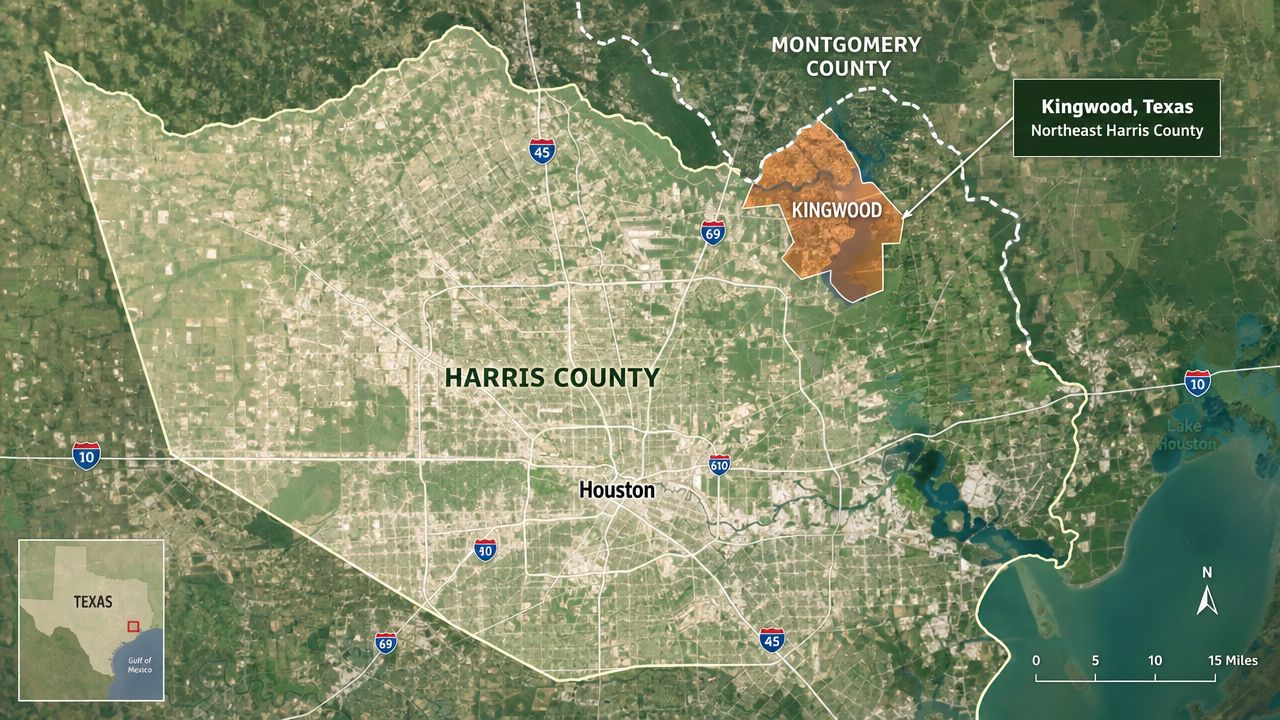
The easiest way to think about a Kingwood divorce is this. If the home is on the Harris County side, the default venue is Harris County family court. If the home is in Montgomery County, the case goes through Conroe. Harris County family courts are the default venue for Kingwood-area filings, while Montgomery County filings go through the Conroe district clerk. Many people miss that because Montgomery County is geographically nearby, but proximity doesn't override venue. (Kingwood filing venue discussion)
The county line is the real issue, not the ZIP code
ZIP codes and neighborhood names can mislead people. A Kingwood address can look like it belongs with Montgomery County from a driving standpoint and still be a Harris County filing. That's why venue should be checked by address and legal county assignment, not by instinct or convenience.
For Kingwood residents in Northeast Houston, Harris County is usually the practical default. The family court system is built around that side of the county line, and the filing process is what most nearby households end up using. If the property sits in Montgomery County, though, the filing path changes completely.
A practical place to verify the filing path
If you're comparing county options while also sorting out other local issues, a resource like the Montgomery County tax protest guide can help you see how county-specific procedures affect everyday property and courthouse decisions. Divorce venue works the same way, local rules matter more than people expect.
For families who want a Harris County filing from Kingwood, the procedural path runs through Houston. For Montgomery County, the path runs through Conroe. That difference affects travel, scheduling, and how quickly you can handle follow-up steps with the clerk or court staff. It's not just a map question, it's a case-management question.
If you're checking your own address, start with the county, then move to the clerk office, then confirm the court location. Skipping that order is how Kingwood spouses end up filing in the wrong place.
Court Locations, Clerk Offices, and Filing Logistics
The two counties do not handle divorce records the same way, and that difference shows up fast once a case is filed. Montgomery County states that divorce records are maintained by the District Clerk's Office in Conroe, while Harris County uses the Harris County Clerk in Houston, with Harris County Clerk office hours Monday through Friday 8:00 AM to 4:30 PM. (Montgomery and Harris County record systems)
The clerk office changes your filing day
A Kingwood spouse filing in Harris County is dealing with the Houston clerk system. A filing in Montgomery County goes through the district clerk in Conroe. That difference matters for certified copies, records requests, and new filings, because the office that keeps the file is different in each county.
| Item | Montgomery County | Harris County |
|---|---|---|
| Clerk office | District Clerk's Office in Conroe | Harris County Clerk in Houston |
| Records maintained by | District Clerk | County Clerk |
| Public access pattern | Weekday public access through district clerk records process | Weekday office hours, Monday through Friday, 8:00 AM to 4:30 PM |
| Practical filing impact | Confirm the exact Conroe office before driving | Local to Houston courthouse workflow |
Montgomery County has address confusion in public materials
Montgomery County public materials list more than one filing reference. One source shows the location at Main Street, Suite 103, Conroe, TX 77301, while another lists 301 N. Main Street, Suite 260, Conroe, TX 77301. That is enough reason to confirm the exact clerk office and suite before you go. The wrong hallway can turn into a wasted morning.
A Kingwood client usually feels this difference right away. Harris County involves Houston courthouse logistics, parking, and downtown timing. Montgomery County involves a Conroe trip and a different clerk workflow. Neither path is impossible, but they are not interchangeable.
If you want a county-specific filing walkthrough, the Harris County family court filing guide for Kingwood spouses can help you match the right courthouse to the right address.
The fastest way to make filing harder is to assume the county name on your mailing address controls venue.
The local court system you enter will hold your record, handle your paperwork, and control the first administrative steps. That is why the clerk office matters almost as much as the judge.
Filing Fees, Forms, and Timeline Benchmarks in Each County
Filing a divorce is never just about the petition. It's about the forms, the clerk window, the service or waiver process, and the timing that follows. For Kingwood residents, the county you choose affects how much coordination you need and how your case gets onto the court calendar. Montgomery County guidance estimates uncontested divorces at roughly 60 to 90 days, negotiated cases at 3 to 6 months, and contested trials at 6 to 18+ months. (Montgomery County divorce timeline guidance)
How the two counties feel in practice
Harris County follows the same general divorce sequence, petition, service or waiver, temporary orders if needed, disclosure, mediation, decree, and prove-up or trial. The difference is the size of the urban docket and the downtown filing logistics, which can add coordination overhead for Kingwood clients. Montgomery County can feel less crowded, and in some uncontested matters that can reduce filing-cost pressure.
That does not mean one county is automatically better. It means the path is different. If the case is simple, a smoother clerk interaction can matter more than a courthouse closer to home. If the case is contested, the larger system may mean more moving parts before you ever see a final hearing.
What to expect at the filing stage
You usually need a petition, supporting forms, and a plan for notice or waiver. After that, the clerk takes the filing, and the case starts on the county's timeline. Once service is complete, the waiting period still controls the earliest possible finalization date.
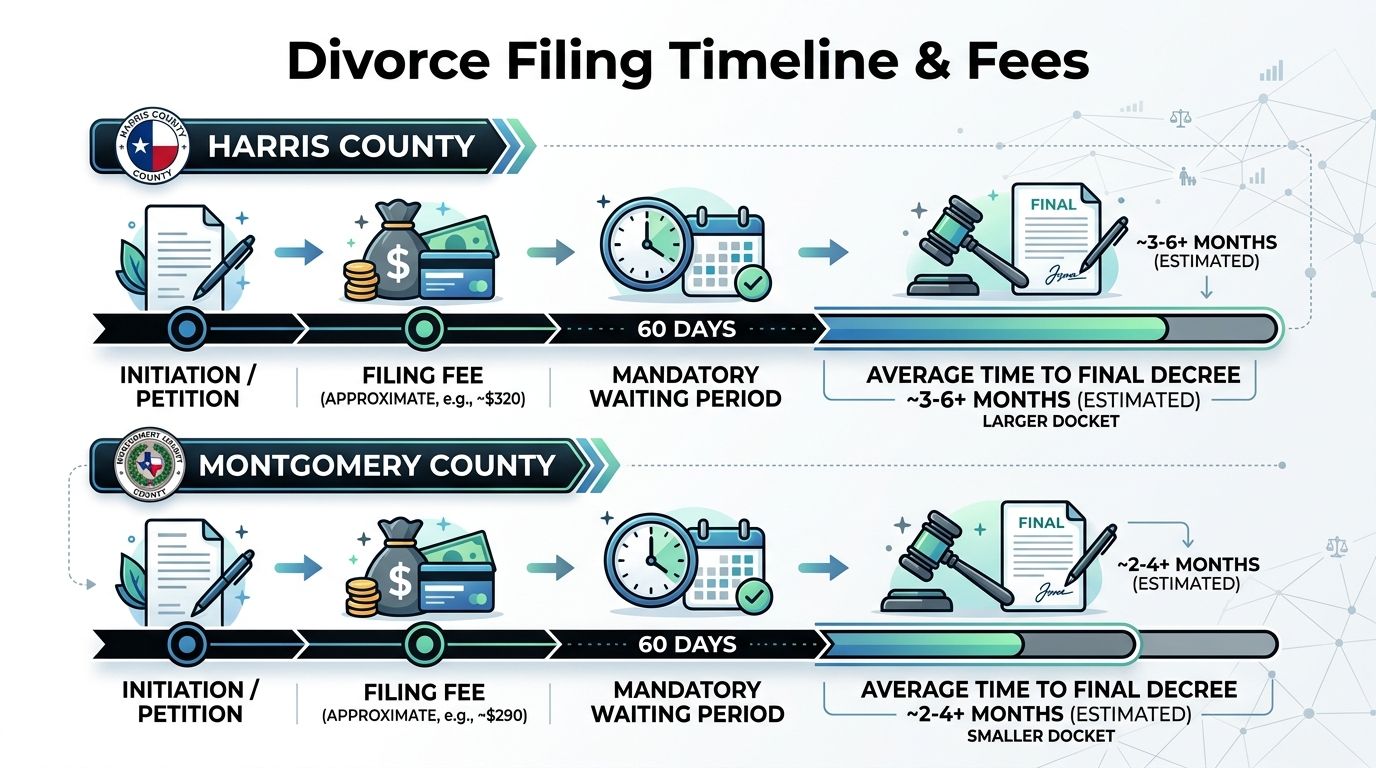
For Kingwood families, the biggest mistake is treating filing as a one-day errand. The county clerk, the service method, and the court calendar all shape the rest of the case. A smooth uncontested matter can still take real coordination if the paperwork is incomplete or the wrong office gets the original filing.
If you need help getting the first set of forms right, Divorce Lawyer in Kingwood, TX is one local service description that matches the type of representation Kingwood and Harris County clients usually need at the outset.
Mediation, Custody Approaches, and Courtroom Pace
Child-related issues change the county analysis fast. A divorce with no children is one thing. A case involving possession schedules, handoffs, school logistics, or communication problems is another. In Harris County, the larger bench and busier family court calendar can mean longer waits between hearings. In Montgomery County, the docket can sometimes feel quicker for routine matters, but the available family-law resources may be less specialized depending on the issue.
The court environment matters when custody is on the table
If both parents cooperate, mediation can resolve a lot before the case ever reaches a judge. If they don't, the court's pace and structure matter more. A family that needs stable interim orders may care less about geography and more about how quickly the court can hear temporary issues.
That's where the county choice becomes strategic rather than theoretical. A smaller docket may move routine settings along faster, while a busier urban court can offer a familiar and well-developed process for contested family matters. The right choice depends on the facts, not on which courthouse sounds easier to drive to.
Decision criteria that actually help
- Cooperation level: If both spouses are willing to negotiate, either county can work, but a simpler docket may feel easier to manage.
- Custody complexity: If exchanges, school zones, or parental conflict are already difficult, the county's pace and courtroom structure matter more.
- Need for continuity: If a related case is already open, keeping the matter in the same court system may avoid duplication.
- Travel tolerance: Kingwood parents who must appear often should think hard about courthouse trips into Houston versus a Conroe route.
For families with a more conflict-heavy case, a firm that handles contested matters in Harris County can matter more than a generic divorce intake. The Contested Divorce Attorney in Kingwood page is a local example of the kind of representation people usually need when the case stops being simple.
Practical rule: choose the court that fits the custody problem, not the courthouse that looks closer on a map.
Kingwood families in Humble or Porter often ask for a simple winner in this comparison. There isn't one. The better county is the one that matches the level of conflict, the child-related issues, and the existing court history.
Choosing the Right County for Your Kingwood Divorce
For most Kingwood addresses, Harris County is the default venue. If the home is inside Montgomery County, then Montgomery County is the right place to file. That's the cleanest rule, and it holds up in ordinary cases. The confusion usually comes from people who live near the county line and assume the closer courthouse is the correct one.
When a different county may make sense
There are cases where the venue analysis goes beyond the home address. If the other spouse has already filed in a county, if a related family case is already open, or if custody logistics make one courthouse more practical than another, the venue question deserves a closer look. Those are the situations where a local attorney can check the file history before anyone makes a move.
If you're weighing where to file and also handling children's activities, the local community calendar can get crowded fast. A nearby resource like Finding competitive tryouts for young athletes may help families coordinate schedules, but it doesn't change the legal venue rules. The courthouse still follows the county line, not the soccer schedule.
The single most important factor for Kingwood families is simple, the county that legally matches the residence controls the default filing path.
Here's the honest recommendation. If you're in Kingwood and you're not sure which side of the line you're on, confirm the county before you do anything else. If the case is simple, the wrong filing can slow the process. If the case is contested, the wrong venue can complicate everything that follows.
The Law Office of Bryan Fagan – Kingwood TX Lawyers works with local divorce cases, including contested matters, and can help you sort out whether Harris County or Montgomery County is the correct place to file. For Kingwood residents who want a practical answer before they spend money at the clerk's office, a free consultation at the Kingwood office is the right next step.
Frequently Asked Questions From Kingwood Divorce Clients
Can I file in Montgomery County if I live in Kingwood? Only if your residence is in Montgomery County. Most Kingwood addresses fall in Harris County, so many people need the Houston filing path instead of Conroe. If you want a county check before you file, the office can help you confirm the right venue and avoid a wrong-court mistake.
What happens after the 60-day waiting period ends? If the paperwork is complete and both sides have resolved the terms, the court can move toward finalization. If the case is contested, unresolved property or custody issues can keep it open well beyond that date. For a broader support resource on stress and family changes, some readers also look at a guide for finding support in Vernon, but the divorce timeline itself still follows Texas court rules.
How does a contested divorce change the timeline in each county? It usually pushes the case far past the minimum waiting period because hearings, disclosure, mediation, and trial settings take time. Montgomery County guidance points to a longer path for contested matters, and Harris County's larger docket can add coordination overhead. The practical difference is not just speed, it's how often you may need to appear.
Do I really need a local attorney for a Harris County divorce if I live in Kingwood? You don't need to live downtown to hire counsel, but you do need someone who knows the Harris County process and the Kingwood venue issue. A local lawyer can also tell you if Montgomery County is off the table, or if a related case changes the filing strategy. For a free consultation, contact Law Office of Bryan Fagan – Kingwood TX Lawyers and ask about divorce and contested divorce representation in Kingwood.
If you're trying to decide between Montgomery County and Harris County for a Kingwood divorce, don't guess based on distance. Reach out to Law Office of Bryan Fagan – Kingwood TX Lawyers for a free consultation at the Kingwood office, and get a clear answer on venue, filing logistics, and the next steps in your divorce or contested divorce case.