Skip to content
You're likely dealing with a practical problem right now. Maybe you need a divorce decree to finish a name change, prove marital status for a lender, or keep a family-law matter moving after the paperwork got buried. In Kingwood, that usually means finding the right office fast, not wasting time calling the wrong clerk.
The good news is that kingwood tx divorce records how to find has a clean answer once you know the workflow. Start with the county that finalized the case, then decide whether you need a statewide verification or the full decree. If you want help from a local family law team that handles divorce matters in Kingwood and Harris County, you can also review divorce representation for Kingwood residents.
Identifying the Correct Court and Record Location
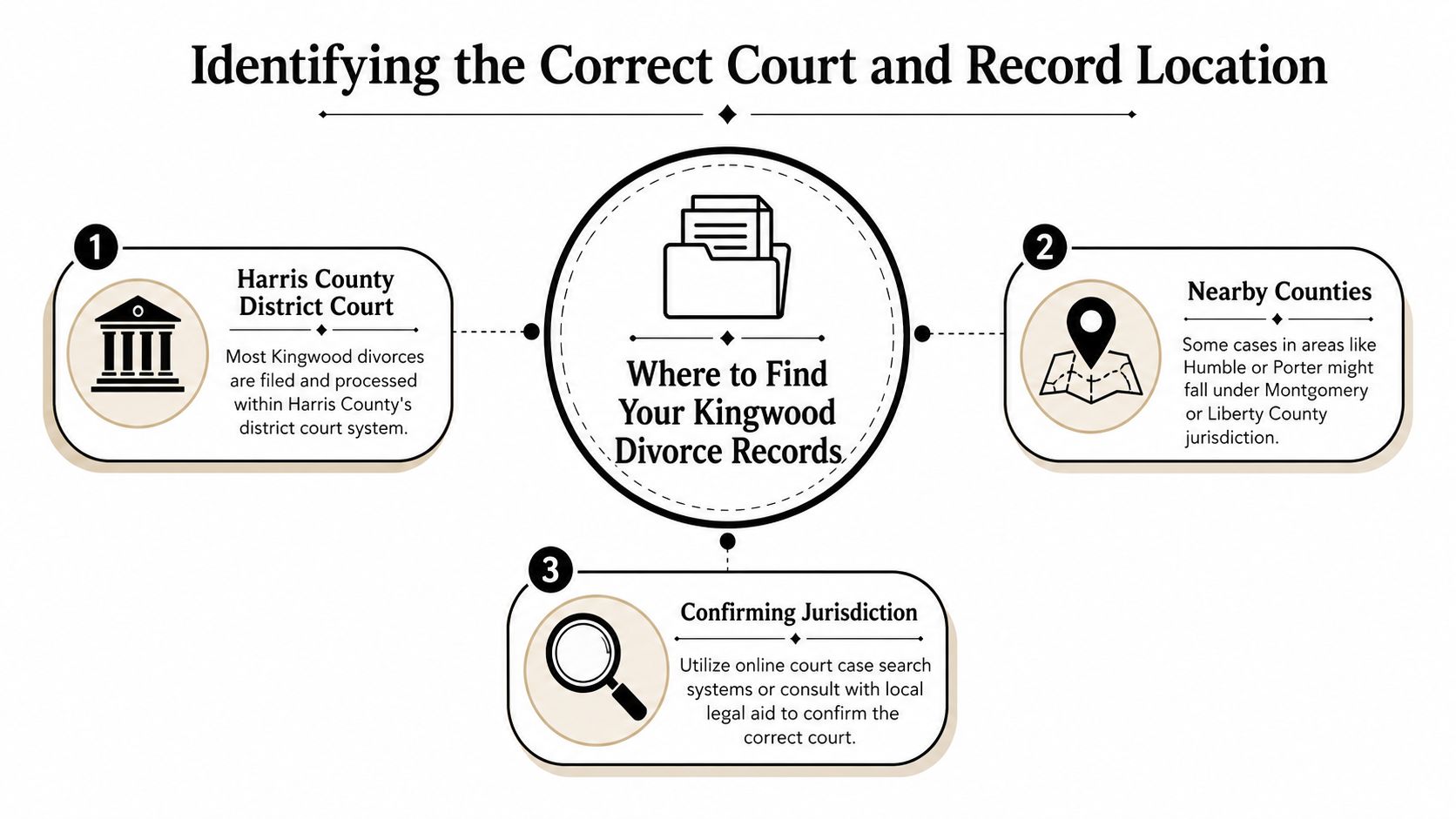
Kingwood residents lose time by starting in the wrong office. Divorce records are typically kept by the district clerk in the county where the divorce was finalized, because that is where the filings and decree are stored. For many people in Kingwood, that means beginning with Harris County records, not a county clerk marriage office. If you need help figuring out which court handled your case, what court handles divorce in Kingwood explains the local court structure in plain terms.
Find the county before you search
If you still have any divorce paperwork, check it for the county name, the court name, or a case number. Those details show you where the file lives and which district clerk can pull it. If the divorce happened near Kingwood but in a nearby area like Humble or Porter, do not guess. Confirm the filing county first.
Practical rule: if you know the county, go straight to that county's district clerk. If you do not, use a statewide verification path first so you are not sending requests to the wrong place.
The Texas State Law Library's guidance is direct, identify the court that handled the case, then contact the district court clerk in that county for copies of the decree or related documents. A common mistake is confusing the district clerk with the county clerk. County clerks generally handle marriage records, while district clerks handle divorce records and certified copies of decrees, which is why the wrong office slows everything down.
What to gather before you call
Gather the spouses' full legal names, the approximate finalization date, and the county of filing. Those three items are usually enough to narrow the search if you do not have the case number. If you do have a court style or cause number, include it, because that speeds things up.
For Kingwood residents, the cleanest approach is simple. Use the county district clerk when the county is known. Use the Texas state index or verification path when the county is unknown. That keeps you from bouncing between offices and puts the request in the right hands the first time.
For local legal support, the firm's Divorce Lawyer in Kingwood, TX page is a useful starting point for people who need more than a record lookup and want family-law guidance tied to Harris County practice.
Searching Online Through the State Portal
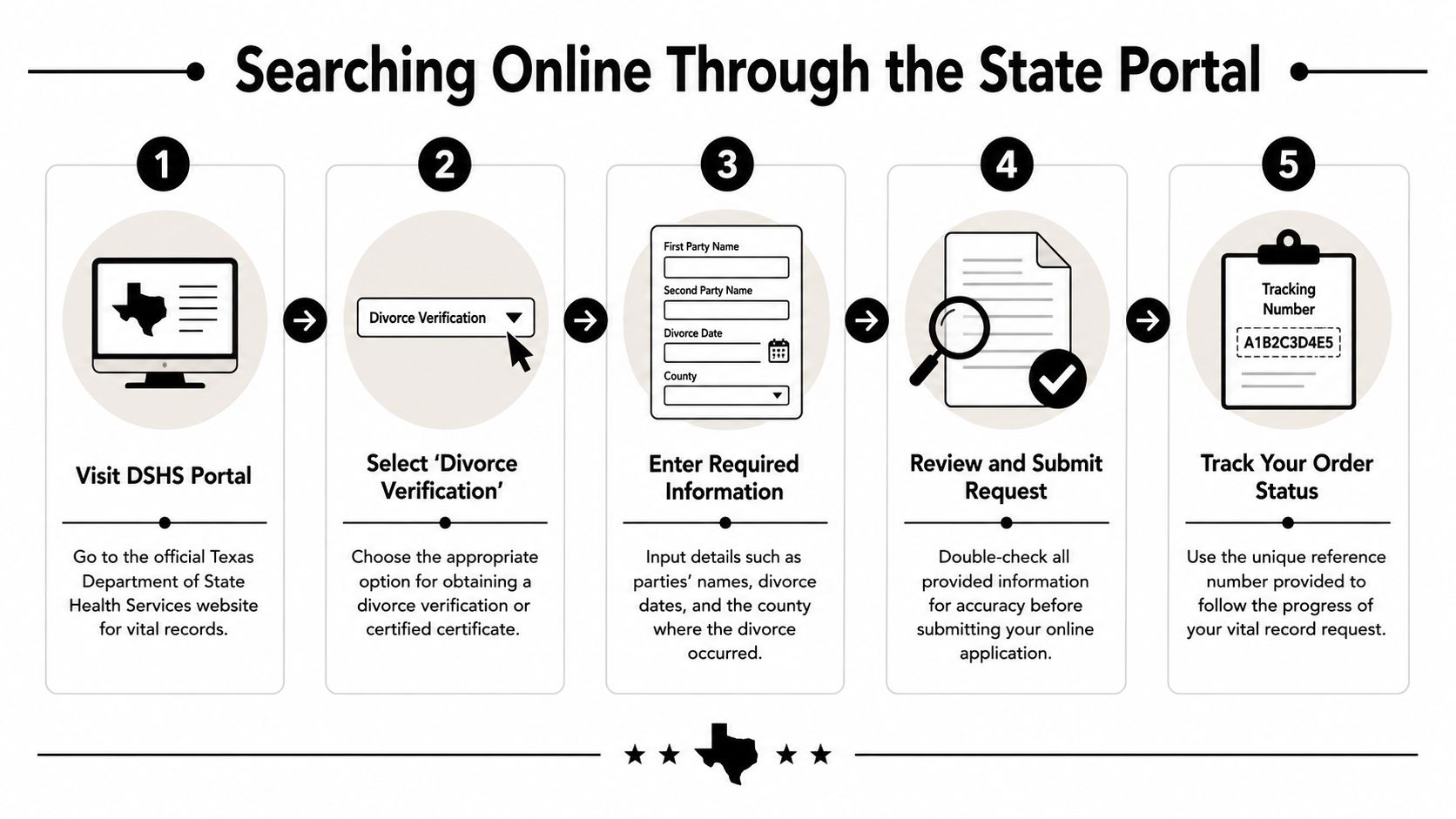
The statewide Texas vital-records system is the right move when you don't know the county or you're trying to confirm that a divorce record exists before ordering a certified copy. Texas maintains an online vital-records system for divorce and marriage records covering 1968 to the present Texas State Law Library guidance, and that makes older searches far easier than piecing together county paper files.
Use the portal for verification first
The state portal is best for a divorce verification search, not for replacing every county record request. Enter both spouses' full names, the county if you know it, and an approximate finalization date. Those are the exact inputs that usually narrow the result set quickly.
A Kingwood example makes this simple. If a resident remembers that the marriage ended in the late 1990s but can't recall the exact court, the statewide search is the smarter first move. Once the portal points you toward the county, you can request the certified decree from that county's district clerk if you need the full record.
The statewide index is a locator tool. The district clerk is the office that usually holds the actual divorce decree.
What the portal can and can't do
The portal is useful for broad verification, but it's not the same thing as a full case file. That distinction matters because people often need different documents for different jobs, a name change, a benefits issue, or proof of status for another case. Texas court-record guidance notes that verifications, public index searches, and certified decrees are often treated as if they're interchangeable, and they're not.
For Kingwood residents, that difference is practical. If you only need to confirm that a divorce happened, the state system may be enough. If you need the actual decree or orders attached to it, go to the district clerk in the county that finalized the case.
The Texas State Law Library also notes that county-level indexing is more precise when the county is known, while the statewide index is more useful when the county is unknown Texas State Law Library copies guide. That's the cleanest way to avoid wasted time.
Requesting Records In Person Mail and Phone
If the online search only gets you part of the way there, use the county district clerk directly. That's the right move when you need a certified decree, a fuller case file, or help matching a record to a specific divorce matter in Harris County.
In person works best when you need speed
An in-person request is usually the most direct option if you already know the county and court. For Kingwood residents, that often means a trip into Houston for Harris County records. Bring the spouses' names, the approximate divorce date, and any cause number you have, because the clerk will use those details to pull the file faster.
If you're visiting in person, make sure you're dealing with the district clerk, not the county clerk. That office distinction matters more than generally anticipated. A marriage-license office won't give you a divorce decree, and that mistake can waste an entire day.
Mail and phone requests still work
Mail is useful if you can't get downtown or you're gathering records for a larger family-law issue from Kingwood, Humble, or Northeast Houston. Include the correct request form, identifying details, and payment authorization exactly as the office requires. If you leave out a spouse's full legal name or the filing county, the request can stall.
Phone contact is helpful for confirming the right office, the required form, or whether your file is sealed. Use it to verify the clerk's process before sending anything. That saves you from mailing an incomplete packet and waiting on a rejection.
For readers dealing with a pending divorce filing or related court issue, the firm's filing-for-divorce-in-Harris-County-Kingwood page can help connect the record search to the bigger divorce process.
If you need the decree for a family-law step, don't guess at the clerk. Confirm the office first, then file the request once.
Understanding Fees ID Requirements and Sealed Records
The cost side is simple if you know the baseline. For mail requests through the Texas Department of State Health Services, the fee structure includes a $20 verification fee, a $5 processing fee, and an $8 delivery fee unless special delivery conditions apply Jefferson County court records page. That gives you a concrete estimate before you send paperwork.
Keep your identification ready
Courts and vital-record offices commonly expect government-issued identification with a request, and a mailed request may require a notarized copy when the office asks for it. A Texas driver's license or passport is a sensible starting point because it clearly ties the requester to the record search. If you're requesting on behalf of someone else, expect the office to ask for more documentation.
| Service | Fee |
|---|---|
| Verification fee | $20 |
| Processing fee for mail requests | $5 |
| Delivery fee | $8 |
Public records are not the same as sealed records
A public divorce index or verification is one thing. A sealed divorce record is different, and access can be restricted. If a decree is sealed, you may need a court order or another legal basis to get it. Don't assume the clerk can hand it over just because you know the names and date.
That's where careful document handling matters. People often send the wrong record request because they don't know whether they need a verification, the public index, or the decree itself. Texas court-record guidance flags this confusion as a common source of delay, and it's right.
The strongest approach is to match the document to the purpose. If you're proving the fact of divorce, a verification may be enough. If you're enforcing terms, changing a name, or reviewing orders, you usually need the decree or case file from the district clerk.
Avoiding Common Mistakes and When to Seek Local Assistance
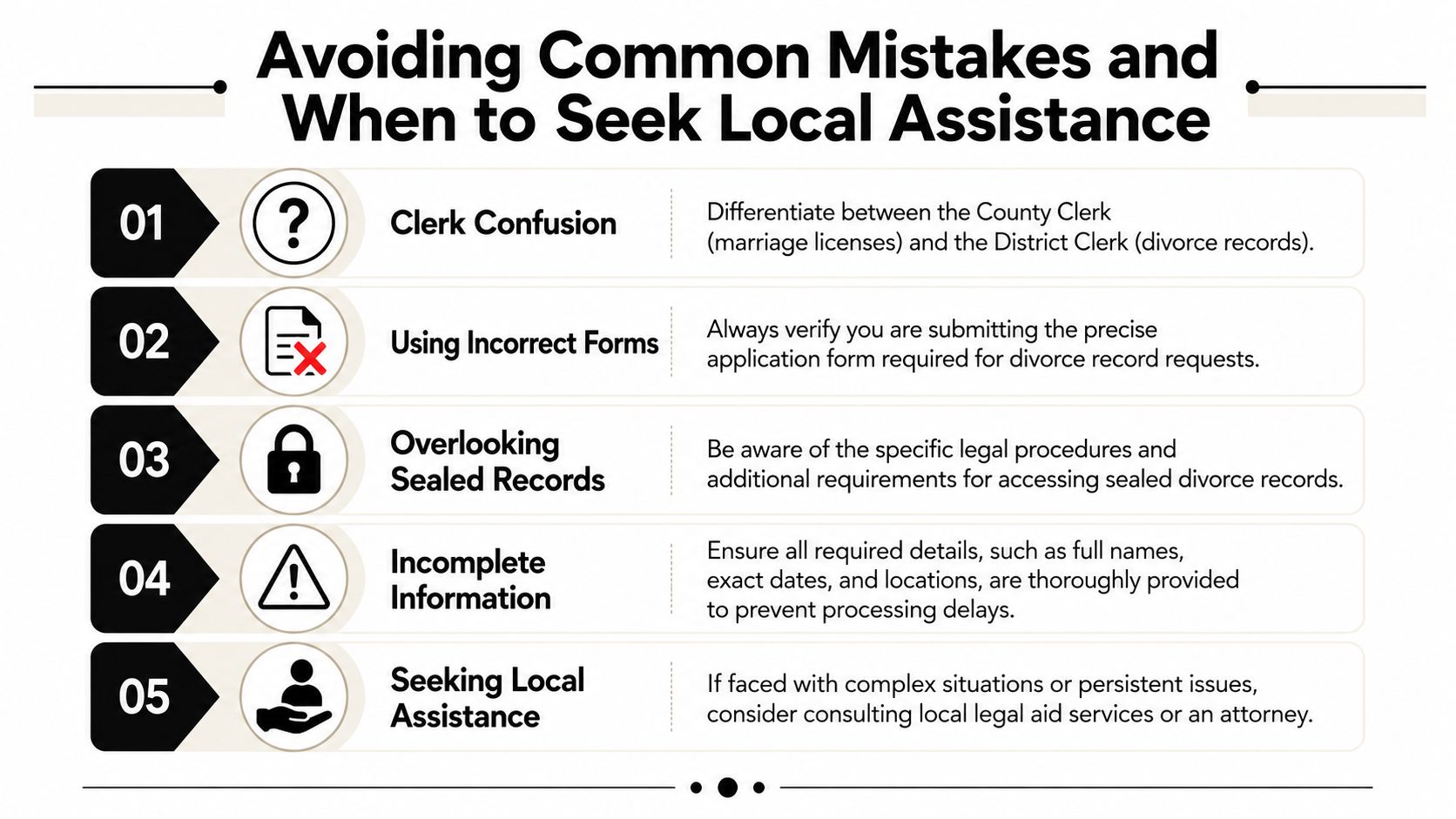
Most delays come from simple errors that are easy to avoid. The biggest one is clerk confusion, followed closely by using the wrong form or leaving out a key detail like the county or finalization date. The result is the same, the request gets pushed back or sent to the wrong office.
The mistakes I'd fix first
- Clerk confusion: district clerk for divorce, county clerk for marriage records.
- Wrong document type: a verification is not a certified decree.
- Incomplete identifiers: full names, county, and approximate date matter.
- Ignoring sealed-record rules: sealed files need a legal basis.
- Waiting too long to ask for help: delays get worse when the file is part of a broader family-law dispute.
Texas court-record coverage often blurs the difference between a verification, a public index search, and a certified divorce decree, and that confusion leads to misdirected requests and delays Texas court records guidance. That's exactly why Kingwood residents should slow down and match the request to the exact need.
If the issue touches enforcement of the decree, a name-change dispute, or a sealed file, it's smart to talk with a local family law attorney instead of trying to solve it by trial and error. For readers who also want to understand how law-firm systems can keep client communication organized, optimizing client interactions for law firms is a useful process resource to compare against the manual back-and-forth many families experience.
The Law Office of Bryan Fagan also serves as a local option for Kingwood residents who want help sorting out a divorce record problem before it turns into a family-law delay. That's especially helpful in Harris County, where one missed detail can slow the whole process.
Conclusion and Next Steps
A Kingwood divorce record search goes faster when you start with the right office. Use the statewide portal for a broad search, then go to the Harris County district clerk when you need the decree itself or a certified copy. Keep the names, dates, and county information in one place before you submit anything, because sloppy details slow the request down.
Do not mix up a verification with a certified divorce record. A verification helps confirm that a divorce exists, but it does not replace the court record you may need for a name change, enforcement issue, or other legal step. If the file is sealed, or if the divorce is tied to a dispute that is already causing problems, stop guessing and get local help.
Kingwood residents also need to know when the county clerk is the wrong target. If the record is part of a family-law matter, the request often belongs with the district clerk, not a general records search. That distinction matters in Harris County, where a request sent to the wrong place can waste time and push the problem back a step.
For a practical local option, review the firm's family-law resources, including uncontested divorce guidance for Kingwood residents. If you live in Kingwood, Humble, Porter, or Northeast Houston and want direct guidance from a local office, schedule a free consultation with The Law Office of Bryan Fagan in Kingwood.