Skip to content
Your spouse is wearing a uniform, the kids are still in school in Humble or Northeast Houston, and the messages about deployment or PCS orders are getting harder to ignore. If you're searching for a military divorce attorney near Kingwood TX, you probably want one thing first, a straight answer about what happens next, not a lecture about family law theory.
The honest answer is that a military divorce is never just a Texas divorce with different paperwork. Federal rules, military pay rules, and Harris County procedure all collide, and if your lawyer doesn't understand that overlap, you can end up with an order that looks fine on paper but falls apart when it matters.
What Military Divorce Looks Like for Kingwood Families
A typical Kingwood case starts with a very ordinary problem. One spouse is still on active duty, maybe stationed somewhere unexpected, the other spouse is trying to keep life stable for the children, and everyone is asking the same question at the same time, who files first, and what happens if the service member can't make court?
That first decision matters because military divorce runs on two clocks. Texas family law has its own timeline, but federal military protections can pause or reshape the case when duty gets in the way. A local family shouldn't have to guess whether a deployment, an overseas posting, or a temporary absence changes the whole case. It often does.
The part most people miss
Military divorce is not just about ending the marriage. It is also about handling service-related rights that Texas courts have to respect, including retirement division and procedural protection for the active-duty spouse. The Servicemembers Civil Relief Act can delay proceedings when military duties materially affect participation, and that can change temporary orders, discovery, and trial timing.
A Kingwood case should be built for the military calendar, not the other way around.
That is why a spouse in Kingwood, Humble, Porter, or Northeast Houston needs more than a generic divorce lawyer. You need someone who knows how to ask the right first questions, whether the member is deployed, whether pay and retirement are at issue, whether children are involved, and whether service of process is likely to become a problem.
If you are comparing options, start with a lawyer who handles both ordinary Texas family law and military-specific issues, such as Divorce Lawyer in Kingwood, TX, which is described as divorce representation for clients in Kingwood and Harris County. That kind of local fit matters because the court case is still a Texas case, even when the federal rules are doing a lot of the heavy lifting.
How Federal and Texas Law Work Together in a Military Divorce
Think of a military divorce as a stack of rules. Texas family law is the base layer, because divorce, custody, support, and property division are still handled in state court. On top of that sits federal military law, which can limit how far the Texas court can go and how fast the case can move.
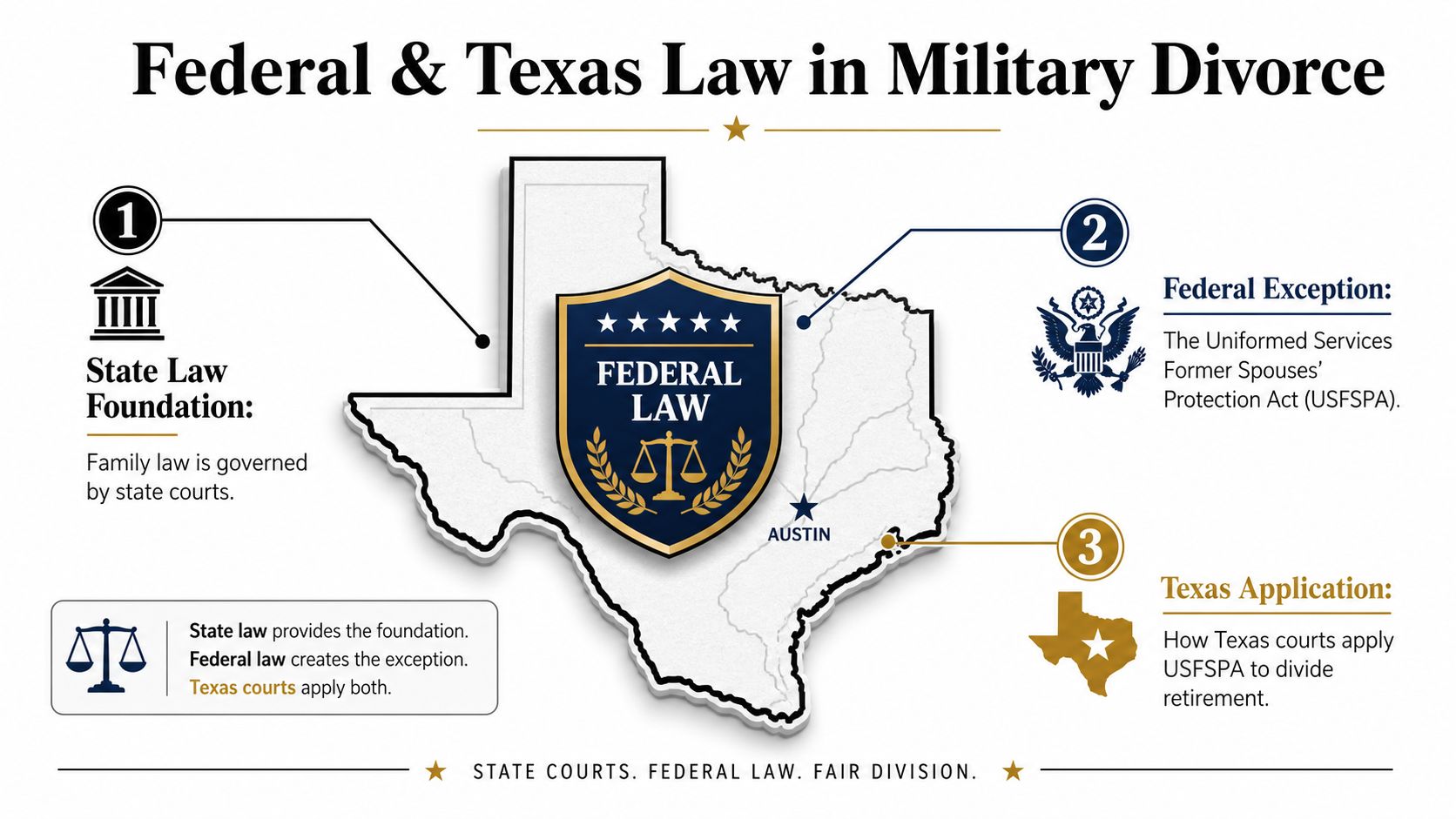
The simplest way to understand it is this. Texas judges decide the divorce, but Congress has already set rules for military pay and for what happens when a service member cannot fully participate. That is why a local lawyer has to know both the Harris County playbook and the federal rule book.
Where the federal rules change the case
Texas can divide disposable military retired pay as community property, but the federal Uniformed Services Former Spouses' Protection Act authorizes, and limits, how state courts reach that pay, and the 10/10 requirement affects direct payment from DFAS rather than the court's underlying power to divide the asset. That means a court order can be valid in Texas and still not be set up correctly for direct payment.
The practical fix is careful drafting. A lawyer needs to confirm marriage overlap, identify the creditable service period, and write retirement language that DFAS can process. If the order is sloppy, the family may end up with a judgment that sounds right but is hard to enforce.
For clients who are trying to compare retirement issues across systems, a useful outside resource is understand military buy back rules, because people often confuse military retirement questions with civilian federal retirement questions. They are related ideas, but not the same.
Why local court experience still matters
A Harris County judge still expects proper Texas filings, proper service, and workable orders. That is where local familiarity matters. A lawyer who only knows military rules may miss the Texas procedure. A lawyer who only knows Texas divorces may miss the federal restrictions.
If you are looking at related property issues too, it helps to review dividing retirement accounts in Kingwood divorce, because military retirement is only one part of the broader property picture. And if you want a basic Texas-law overview for other local disputes, the firm's general Texas law guide at https://kingwoodattorneys.com/general-texas-law-guides/ gives a broader starting point without pretending military cases are ordinary.
Practical rule: if the order touches retired pay, ask whether it is divisible, whether it is payable through DFAS, and whether the language matches both Texas law and federal rules.
Dividing Military Retirement and Benefits in Texas
Military retirement division is where a lot of Kingwood families get tripped up. People hear “pension” and assume the court can just split it like a bank account. That is not how it works. The court can divide the marital portion, but the exact result depends on service overlap, retirement status, and whether the order is written in a way DFAS can process.
What counts and what does not
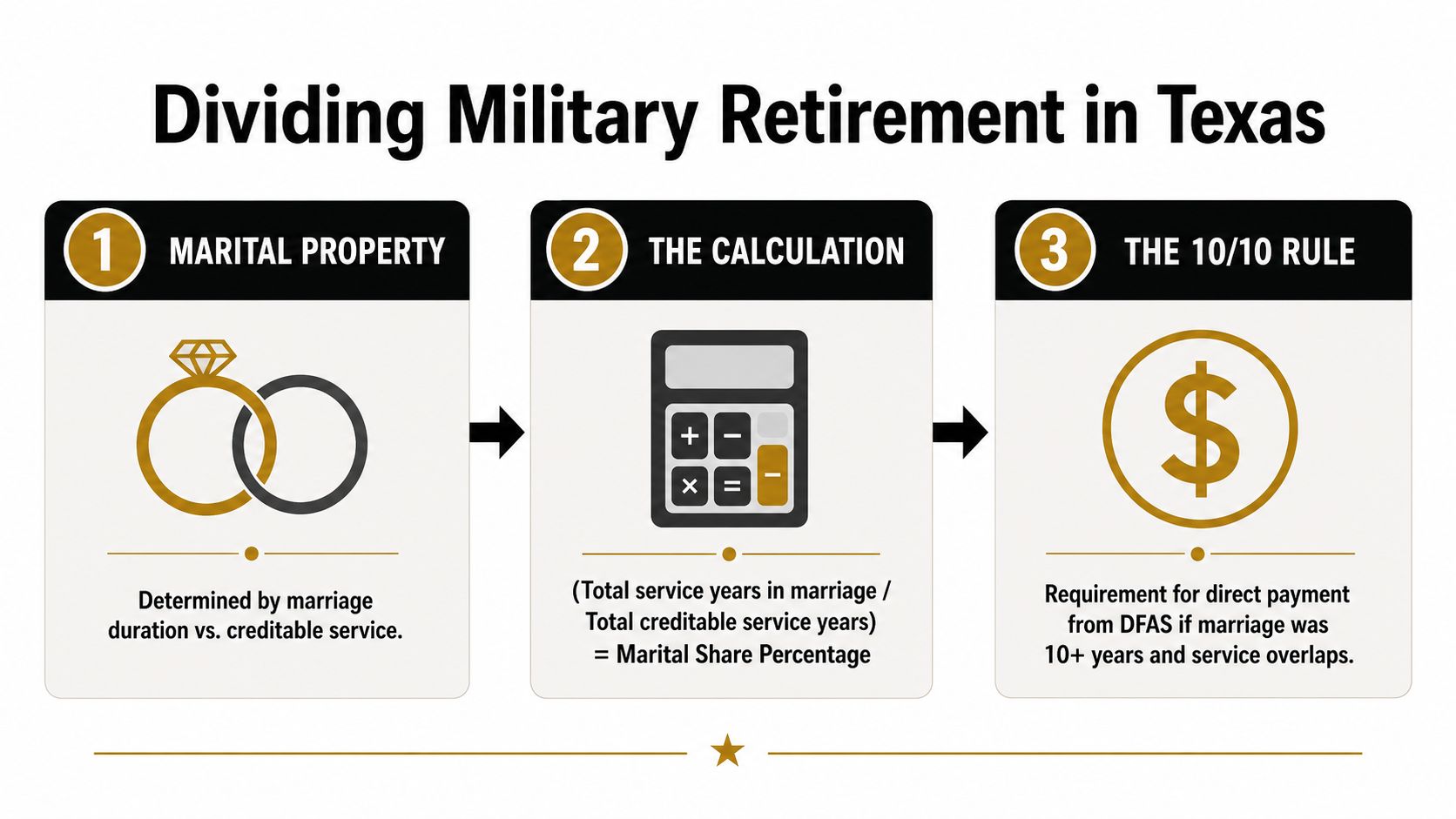
Military retired pay is not automatically divided in divorce under the Former Spouse Protection Act; state law controls whether it is treated as marital property, and DFAS direct payment is available only if the marriage overlapped at least 10 years of creditable service. That 10/10 rule is about direct payment, not about whether the court can divide the asset at all.
So the lawyer's job is not just to say, “You may have a retirement interest.” The job is to calculate the overlap, figure out whether a direct payment path exists, and write the decree correctly. If the service member is still serving, the order has to anticipate a future retirement event instead of pretending the money is already being paid out.
The documents that matter
Bring the papers that show the timeline. A marriage certificate, any prior orders, LES statements, PCS paperwork, and anything that shows service dates all help build the retirement picture. If a spouse has already started planning retirement, Survivor Benefit Plan questions can also matter, because benefit elections can change the long-term value of the award.
A lawyer who understands military paperwork will also watch for the difference between a court-awarded percentage and a DFAS-ready order. That distinction is critical. An order can look fair and still create problems if the language does not fit the federal payment rules.
For readers comparing retirement-related issues in one place, the firm's page on dividing retirement accounts in Kingwood divorce is a sensible companion topic, because military retirement often sits alongside civilian retirement, 401(k)s, and other marital property.
If you are sorting out military retirement in a pending divorce, don't let anyone hand-wave the numbers. The overlap between the marriage and the service matters, the wording matters, and the timing of the order matters.
SCRA Stays and How They Reshape a Kingwood Filing
The Servicemembers Civil Relief Act is the procedure issue that can change everything fast. If one spouse is deployed, on orders, or otherwise unable to meaningfully participate, the court can pause the case. In military-family cases, that pause is often what decides whether a divorce moves forward this month or sits on the docket until the service member can respond.
What the stay does in practice
The SCRA can pause civil proceedings such as divorce by granting a stay that is usually 90 days but can be extended, which directly affects how filings are scheduled for families in Kingwood, Humble, and Northeast Houston when one spouse is deployed or unavailable. That matters because a stay can delay temporary orders, discovery, and final hearing dates.
A good lawyer plans for that from day one. That means checking duty schedules, asking about leave windows, and figuring out whether electronic participation is realistic. It also means serving the papers correctly so the case doesn't get slowed down by a avoidable service defect.
Tactical use versus delay for delay's sake
Not every stay is a stunt. Sometimes the member really cannot appear, and the court needs to give that fact real weight. Other times, the case can still move on narrow issues, especially where children or immediate support needs are involved.
A stay is a scheduling tool, not a magic erase button.
That is why the filing strategy has to be disciplined. If the member is likely to request a stay, counsel should be ready for it and should structure the case so temporary orders are protected and deadlines are not lost. In Kingwood and nearby Harris County courts, that kind of planning saves time and aggravation later.
If your spouse is deployed mid-case, do not assume the divorce is dead. It probably isn't. It is more likely to be delayed, narrowed, and rescheduled around the realities of military duty.
Child Custody and Parenting Plans Across States
Custody is where military divorce gets personal fast. Money matters, but most parents in Kingwood, Humble, and Northeast Houston care more about one thing first, how do we keep the children stable when duty changes the schedule again?
Build for deployment before deployment happens
A Texas order should say what happens if a parent is deployed, shifts to another base, or gets PCS orders with little notice. If the order does not already address those events, the family may spend months fighting about things the court could have handled up front. That means including deployment carve-outs, virtual visitation, and transportation provisions in the original order, not as an afterthought.
Texas can remain the home-state court for custody purposes in many military-family cases, but the order still has to be drafted with mobility in mind. If one parent may suddenly be in another state, the parenting plan should be clear about exchange locations, communication windows, and who handles travel when orders change.
If you need a practical starting point for long-distance parenting language, the page on custody arrangements for long-distance parents Texas Kingwood in 2026 is the kind of local resource that fits this problem. It makes sense to solve the travel and communication language now instead of reopening the same fight every time military life shifts.
The clauses that keep people out of court
Don't leave these issues vague:
- Deployment access: spell out phone, video, and message contact during long absences.
- PCS planning: define what happens if the parent receives transfer orders.
- Exchange logistics: decide who travels, where, and how far.
- School coordination: keep the child's routine centered on one workable plan.
A Texas judge can approve a sensible plan, but the parents have to ask for it. If you wait until the next move, the argument becomes more expensive and more stressful.
The point is not to write the perfect plan for every future possibility. The point is to make the order resilient enough that the next military change does not automatically become a custody emergency.
How Military Divorce Plays Out in the Houston Area
In Harris County, the facts shape the schedule fast. A Kingwood couple with a long marriage and overlapping service may spend most of the case arguing about retirement language. A younger active-duty member with limited property may be dealing more with custody and temporary support. A dual-military couple can end up with competing deployment calendars, which turns ordinary scheduling into a real fight.
Texas requires a divorce cannot be finalized until at least the 61st day after filing, and military cases often run longer because deployment, overseas assignment, or Hague Convention service can extend the process by 3 to 6 months and add $200 to $500 in service costs in some Harris County fact patterns. Those numbers matter because they show the floor, not the ceiling, for a military case in the Houston area. Source
What the local path usually looks like
A Kingwood filing still goes through Harris County procedure, even if one spouse is stationed elsewhere. The petition gets filed, service gets handled, and then the case gets placed on a timeline that may slow down if the service member is unavailable or if a stay is requested.
For a case with children, the court may still move interim issues forward while the divorce itself is delayed. For a case centered on retirement, the paperwork has to be careful enough that the final decree matches the pay rules. For a dual-military couple, the court is often working around two calendars, not one.
If you want to read a related custody example from a military-family perspective, Gonzalez & Waddington's custody insights are worth a look because they show how custody disputes can get more complicated when military facts are part of the record.
The takeaway is simple. The law is one thing. The calendar is another. In Houston-area military divorces, the calendar often decides how fast the case can move.
Choosing the Right Military Divorce Attorney Near Kingwood TX
You do not need a lawyer who just “knows divorce.” You need one who knows what happens when Texas family law meets military pay, service rules, and Harris County practice. That combination is rare enough that you should ask direct questions before you hire anyone.

What to ask at the consultation
Ask whether the lawyer has drafted DFAS-compliant retirement orders. Ask how they handle SCRA stays. Ask whether they understand the difference between Texas authority to divide an asset and federal authority to make direct payment. If the answers are vague, keep looking.
A strong local lawyer should also explain what happens in Harris County courts and how a Kingwood case gets scheduled when military duty is part of the picture. That local familiarity matters as much as federal knowledge.
What to bring with you
Bring the documents that make the consultation productive:
- LES statements: these help show pay structure and service-related details.
- Marriage certificate: this establishes the timeline.
- PCS orders or deployment paperwork: these show mobility and scheduling issues.
- Prior court orders: these matter if there are existing custody or support terms.
You can also compare the firm's Divorce Lawyer in Kingwood, TX offering with its contested-divorce work if your case is already high-conflict. The practical question is not whether a lawyer sounds confident. It is whether they can explain the military overlay without guessing.
The right lawyer should give you a plan, not a performance.
Timeline, Costs, and Your Next Step in Kingwood
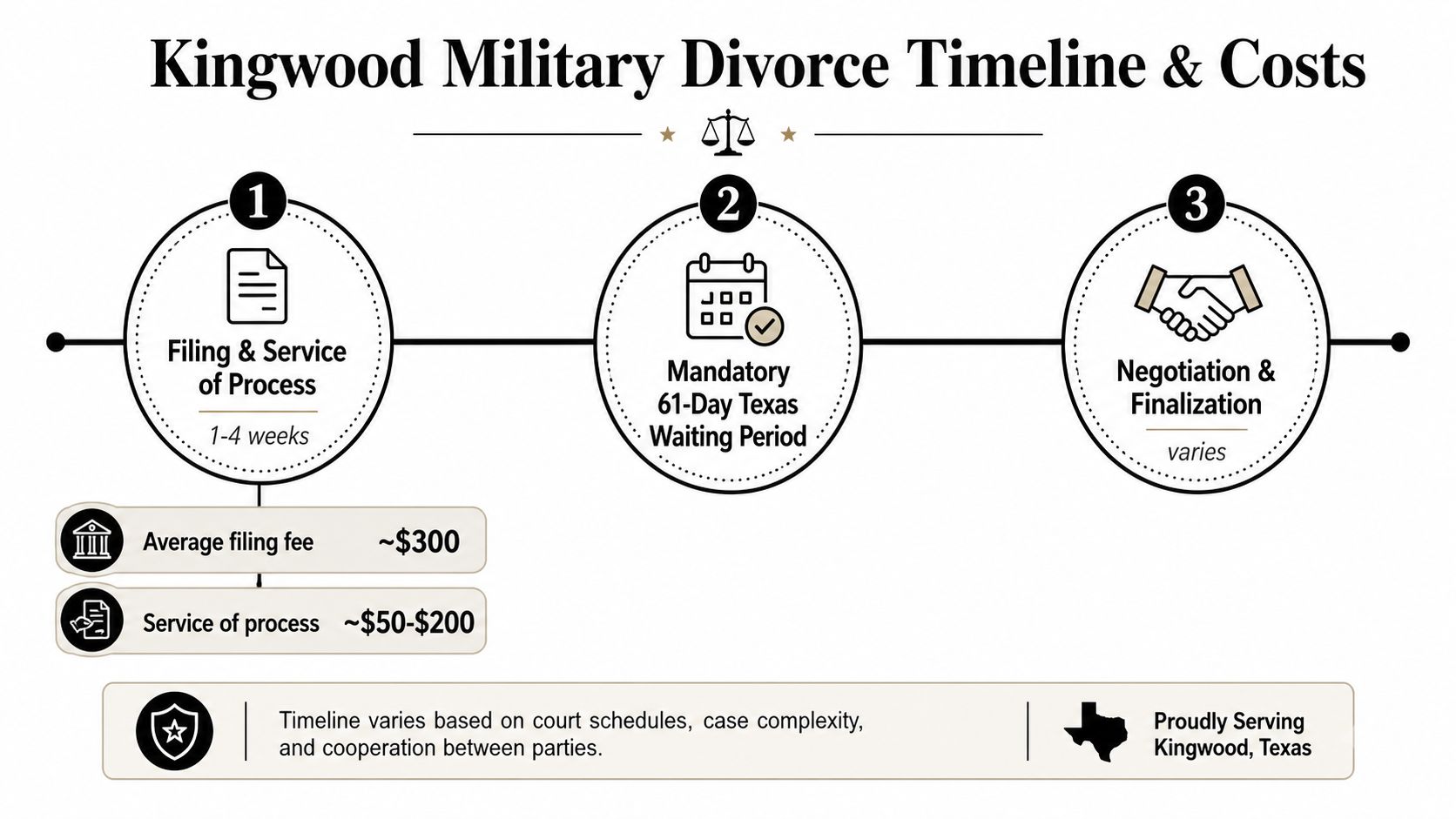
Start with the floor, not the fantasy. In Texas, a divorce cannot be finalized until at least the 61st day after filing, and military issues can push the case longer if service, deployment, or overseas assignment creates a delay. Recent published Texas guides also report filing fees of about $300 to $400, with Harris County listed at $350 to $365, before military-specific service or attorney fees are added. Source
A practical filing path
First comes filing and service. Then comes the waiting period, which is not a guarantee of finalization, just the earliest point a Texas court can finish the case if everything else is ready. After that, negotiation, temporary orders, retirement language, and custody details may still need to be worked out.
The service piece deserves attention in military cases because overseas or out-of-state service can complicate the timeline and cost. That is exactly why Kingwood families should plan early instead of waiting until a deployment creates a scramble.
Your next move
If you live in Kingwood, Humble, Porter, or Northeast Houston, gather your orders, your pay records, and any prior custody paperwork before you call. Then ask a local lawyer whether your case needs retirement drafting, SCRA planning, or a custody order built around PCS and deployment risks.
The firm's divorce and contested-divorce pages are good places to start if your case is already headed toward conflict, because military divorce often turns contested faster than people expect. The goal is to get local answers before the calendar and the federal rules start controlling the case for you.
If you're ready to speak with a local lawyer who handles family law, retirement issues, and military divorce concerns in Kingwood, the Law Office of Bryan Fagan – Kingwood TX Lawyers can help you sort out the next step without pressure. Visit Law Office of Bryan Fagan – Kingwood TX Lawyers to schedule a free consultation and get clear guidance for your situation.