Skip to content
The first June evening after a divorce can feel strangely quiet in a Kingwood house. School is out, backpacks are pushed into a corner, and one parent is trying to figure out whether the kids leave for the summer, stay put, or split time between homes in Kingwood, Humble, or Porter. If that sounds familiar, you're probably asking the same four questions every worried parent asks at the kitchen table, when does summer start, how much time does each parent get, who picks the dates, and what happens if the other parent ignores the plan.
A summer possession schedule Kingwood TX families rely on usually starts with the Texas standard order unless a judge has ordered something different. That default framework gives parents a predictable place to begin, which matters when you're trying to balance work, travel, camps, and two households in Northeast Houston. The details can feel technical at first, but they make more sense once you see how Texas treats summer access in plain English.
A Kingwood Parent's First Summer After Divorce
A father in Kingwood might be packing school clothes into bins while wondering whether he gets the children for a full month or just a few weeks. A mother in Humble may be trying to line up work schedules around pickup and drop-off while the kids ask if they can still go to camp, visit grandparents, or take the usual July trip. Those are ordinary questions, but they become stressful fast when a custody order is involved.
The good news is that Texas does not leave summer parenting to guesswork. The starting point in most Harris County family court cases is the Texas Standard Possession Order, and that order gives families a baseline to follow unless a judge says otherwise. For Kingwood parents, that matters because the court order is not just paperwork, it becomes the rulebook for July planning, summer travel, and weekend coordination.
Practical rule: if you are not sure what your order says, read the summer section first, then check the notice deadlines, then look at the exchange times.
This guide walks through the pieces in the same order a calm attorney would use at a kitchen table. You'll see how Texas defines summer possession, what dates control the process, how the calendar usually works for Kingwood and nearby families in Porter and Northeast Houston, and what to do if the other parent doesn't follow the order. For local families, that often means comparing school calendars, work shifts, and commute patterns before the first suitcase is ever packed. If you need related background on custody terms, a Child Custody Lawyer in Kingwood, TX can help review the order and explain what it means in your specific case.
What the Texas Standard Possession Order Actually Says
A parent in Kingwood often hears the word SPO and assumes it is just another custody term. The Texas Standard Possession Order, or SPO, is the default parenting-time schedule used in many Texas custody cases, including cases heard by Harris County family courts. It gives families a starting point, then the judge, or the parents by agreement, can adjust the details when the facts call for it. For summer, the SPO draws a clear line based on distance between homes, which is why Kingwood families pay close attention when one parent has moved farther away.
Under the Texas standard possession framework, parents who live within 100 miles of each other use a 30-day summer period for the noncustodial parent, while parents who live more than 100 miles apart use 42 days. That distance cut-off matters because a move from Kingwood to another Texas city, or out of state, can change how much summer time the order gives. If you want the broader rulebook in plain English, the Texas Standard Possession Order in Texas explains how the default schedule works before the summer dates are even chosen. The Texas Attorney General's parenting-time guidance also shows that, for families living 50 miles apart or less, the summer block is typically picked up at 6 p.m. on July 1 and dropped off at 6 p.m. on July 31 (Texas Attorney General parenting-time schedule).
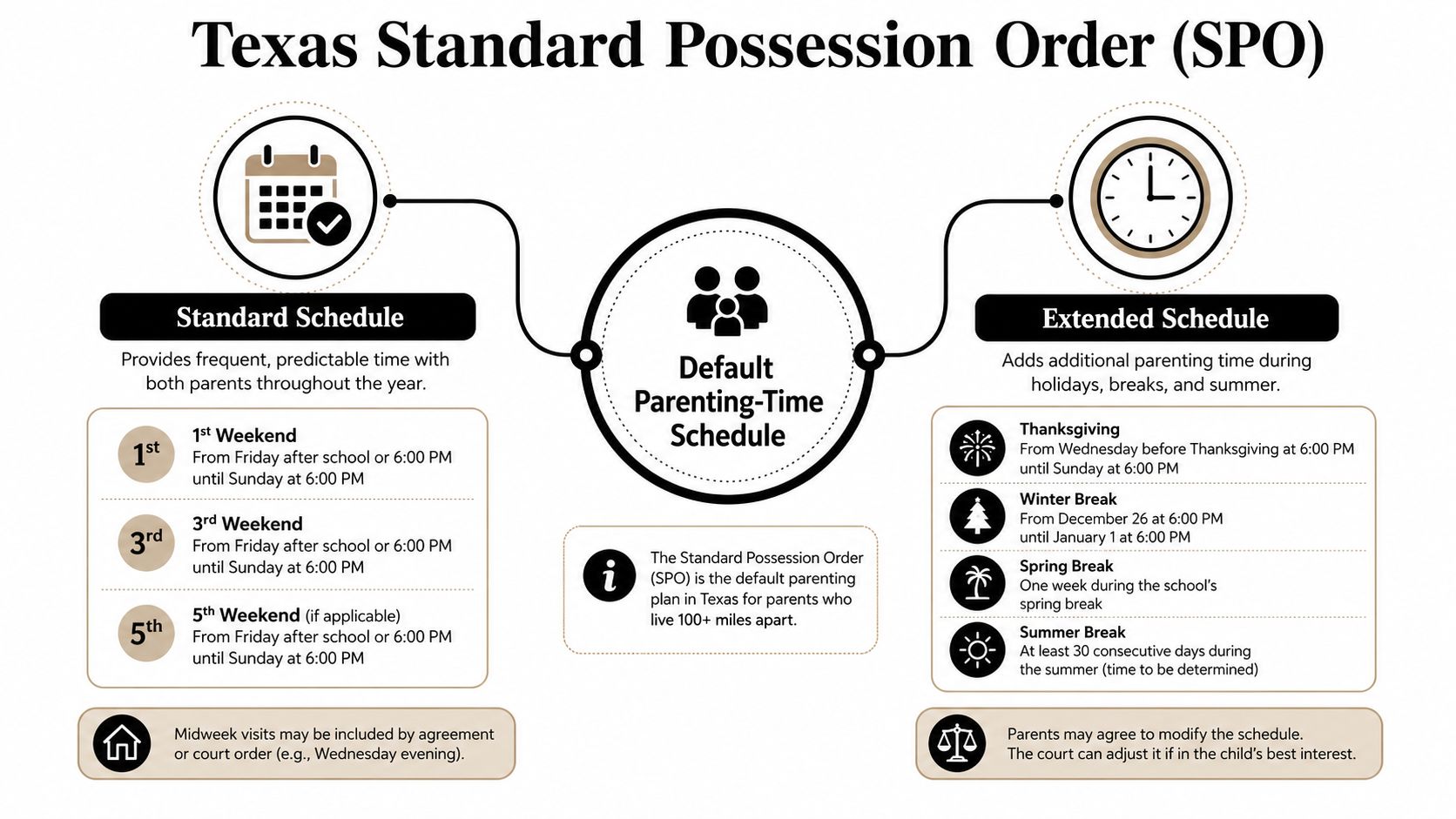
The order is broader than summer alone. It also covers weekends, holidays, and other recurring possession periods, so the summer block has to fit inside the larger schedule rather than replace it. For parents in Kingwood, that can matter when one household is in town and the other is dealing with work in Humble, school pickups near Porter, or a commute that makes midweek exchanges harder than they look on paper. The SPO works like a master calendar that already has the major family rules built in.
Read it as a starting draft, not a permanent life sentence. Parents can agree to different summer dates, and courts can approve different arrangements when the child's needs justify it. The legal baseline still matters because it tells you what happens if nobody makes a special arrangement, and Harris County judges usually expect parents to follow that written baseline unless there is a clear reason to do something different.
A short video overview can also help if you're trying to picture the order in a family-law context.
For parents in Kingwood who also need protection-related guidance, Protective Orders in Kingwood may be relevant in domestic violence and family safety matters. That is a separate issue from summer possession, but it can affect how exchanges happen if safety concerns exist.
Key Dates Every Kingwood Parent Must Know
The Texas summer schedule turns on four dates, and missing one of them can change the whole summer. The first is April 1, which is the deadline for the noncustodial parent to give written notice if they want custom summer dates instead of the default block. The second is April 15, when the other parent may claim one weekend during that summer period by giving notice. The third and fourth are the default summer dates, usually July 1 through July 31 if no custom dates are chosen (Texas Standard Possession Order and parenting time).
How the deadlines work in real life
Suppose a Kingwood father wants the first two weeks of July so he can take the kids to a family place in East Texas. If he gives written notice by April 1, he can choose those dates, as long as they fit the order. If the mother uses her April 15 right, she can reserve one weekend inside that summer block. The rest of the month follows the schedule the parents selected, or the default if they didn't select anything.
If the father misses the April 1 deadline, the legal system doesn't usually pause to wait for a late request. The default July window takes over, and that means the summer block usually runs July 1 through July 31. For Kingwood parents juggling Humble ISD calendars, summer camp pick-ups, and travel plans, that deadline can matter more than almost anything else on the page.
A missed notice deadline often creates avoidable conflict. One parent thinks a date is “close enough,” while the order treats the date as gone.
Many people get tripped up here. They assume a friendly text message is enough, but Texas summer possession is built around written notice. If you want certainty, you want something you can prove later. That's why many local parents save emails, keep screenshots, and confirm the dates in writing before they book a trip or pay for a camp week.
The deadlines also help explain why July can become crowded in practice. Some families plan around school breaks, some around work vacations, and some around travel that's been on the books for months. Kingwood families who understand the April deadlines usually avoid the last-minute scramble that shows up every year in Northeast Houston court dockets.
How the Summer Block Plays Out on a Real Calendar
A family calendar makes the Texas rules easier to understand than any statute does. For parents in Kingwood, the simplest way to think about summer possession is to mark the pickup date, mark the drop-off date, and then check whether the chosen dates fit the order's split-period rules. The Texas Attorney General says that, for families living 50 miles apart or less, the noncustodial parent's extended summer period is picked up at 6 p.m. on July 1 and dropped off at 6 p.m. on July 31, and the time must be used in no more than two separate periods of at least seven consecutive days each (Texas Attorney General parenting-time schedule).
A simple comparison for quick reference
| Distance Between Homes | Summer Days | Default Window | Notice Deadline | Split Rule |
|---|---|---|---|---|
| Within 100 miles | 30 days | Usually July 1 through July 31 | April 1 for custom dates, April 15 for one weekend claim | No more than two separate periods, at least seven consecutive days each |
| More than 100 miles | 42 days | Usually July 1 through July 31 | April 1 for custom dates, April 15 for one weekend claim | Follow the order and any approved custom dates |
A Kingwood father who gives timely April 1 notice might choose the first two weeks of July and then return the children before a camp starts. A mother who claims her April 15 weekend can reserve that window without wiping out the rest of the summer block. That kind of planning works well when both parents cooperate and communicate clearly.
If nobody gives timely custom notice, the default July window usually applies. That can be a relief for the parent who wants predictable dates, but it can also cause problems if one household assumes a different plan was informally agreed to. A parent who books travel before checking the order can end up with a nonrefundable mistake and a fight that could have been avoided.
The page at Expanded Standard Possession Order Texas can help if your order is more detailed than the basic version. That matters for many Kingwood and Humble families because small wording differences can change when the summer block begins and how the exchanges work.
Local parents also sometimes ask whether a custody lawyer can help sort out the schedule before summer starts. A Child Custody Lawyer in Kingwood, TX can review the order, compare it with the school calendar, and flag problems before the first exchange becomes a dispute.
When and How to Modify the Default Schedule
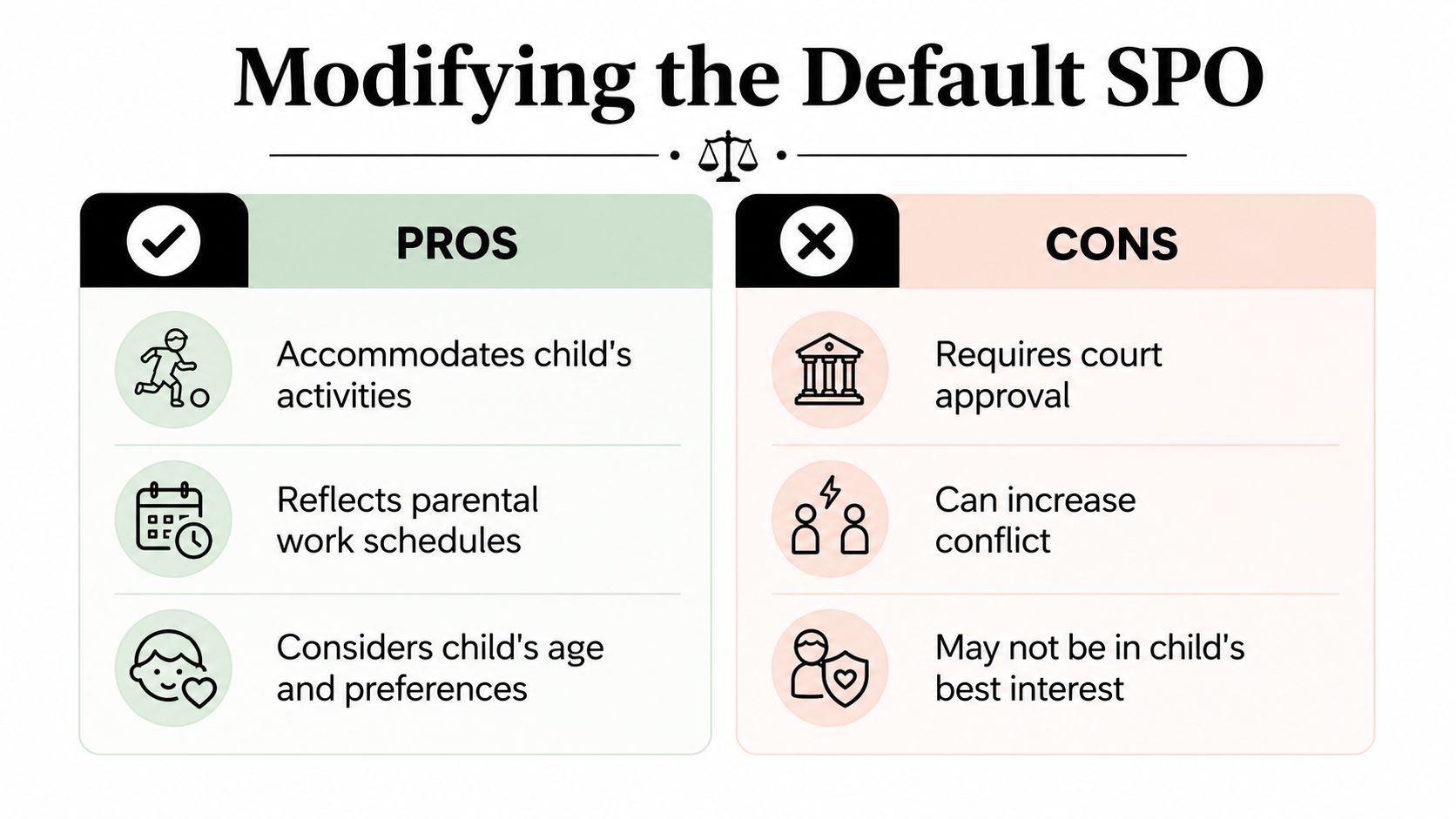
The SPO is the default, not the only possible plan. That distinction matters for Kingwood families with travel sports, long-distance grandparents, shared camp traditions, or a parent who moved beyond the 100-mile line. A standard order can work well for many families, but it doesn't fit every child's summer rhythm.
Agreement first, court second
When both parents agree, the change can often be written into a Rule 11 agreement or folded into a new order. That is usually the cleanest route because it gives everyone one written version to follow. If one parent objects, then the change becomes a contested modification, which means a court process and a closer look at the child's best interest.
Texas law generally requires a material and substantial change in circumstances or a written agreement before a court modifies an existing order. That's why a new work schedule, a move, or a child's changing activities can matter legally, but not automatically. A judge still has to decide whether the proposed summer plan serves the child.
Common reasons local parents revisit summer possession include a teenager's tournament schedule, a family reunion out of state, or a blended-family wedding that falls right in July. Some parents ask for split summers so a child can keep a long-standing camp tradition and still spend real time with the other parent. Others want teen-friendly flexibility because older children often have different activities than younger ones.
Practical takeaway: the right summer schedule is the one that matches the child's real life, not just the old calendar on the wall.
Mediation is often the first place families try to solve this. Collaborative law can also help when parents want a solution without turning every disagreement into a courtroom fight. The Kingwood office of the Law Office of Bryan Fagan – Kingwood TX Lawyers handles family law, criminal defense, estate planning, wills, trusts, probate, and civil litigation, so families can address the custody issue alongside other legal concerns when life is changing in more than one area.
If a parent is relocating outside the usual radius, that change can reshape not only summer possession but also exchange logistics, holiday time, and school-year routines. In those cases, the safest move is to get the new plan in writing before the summer starts.
Documenting the Schedule and Enforcing It When Problems Arise
A summer schedule becomes much easier to enforce when the paper trail is clean. The simplest tool is a written calendar shared by email or through a co-parenting app, with each date confirmed in writing. That way, if a pickup changes, you are not relying on memory or a vague phone call from two weeks ago.
What to do when the other parent won't follow the order
Start with calm written communication. State the date, time, and exchange location, then ask for confirmation. If the other parent withholds the child, refuses to return the child after summer possession ends, or changes the pickup location without agreement, save every message and keep your response short and factual.
A parenting-time journal helps more than people expect. Write down the date, the scheduled exchange time, what happened, and who saw it. Screenshots matter because they capture the message as it was sent, not as someone later remembers it.
If the problem continues, the next step is usually a motion to enforce in Harris County family court. A court can order makeup possession and may award attorney's fees to the prevailing parent, depending on the violation and the facts of the case. If the other parent is talking about taking a child out of state or out of the country without court approval or written consent, that needs immediate legal attention.
For parents who need help preserving digital evidence, virtual court software for law firms is one example of the technology many firms use to keep hearings, meetings, and records organized when cases move quickly. Technology does not replace a court order, but it can make remote communication and document review easier when the family is spread across Kingwood, Humble, and Northeast Houston.
The how to document custody violations Texas Kingwood page is useful if you want a more detailed record-keeping checklist. A clear log often makes the difference between a frustrating story and a provable enforcement case.

Common Questions and Your Next Step in Kingwood
Parents in Kingwood, Humble, Porter, and Northeast Houston usually ask the same follow-up questions once they understand the summer rules. The first is whether they can refuse visitation if child support is unpaid. In Texas, those are separate legal issues, so withholding summer possession because of unpaid support can create a new problem instead of fixing the old one.
The second question is what happens if a parent wants to move out of state with the child. A move can change the summer schedule, the distance calculation, and the exchange logistics, and it can also trigger a request to modify the order if the current plan no longer fits the child's life. The safest move is to review the order before any relocation happens.
Grandparents sometimes ask whether they have summer visitation rights. Texas law treats grandparent access differently from parent possession, so the answer depends on the facts and the legal basis for the request. A family-law review is the right place to sort that out before anyone assumes a right exists.
Parents also ask how soon before summer they should call a lawyer. The answer is simple, as early as possible, because April deadlines and July travel plans come up faster than most families expect. If you're also looking for child-friendly activity ideas while you sort out the schedule, the 2026 summer camps guide can be a useful local planning resource for Humble and Kingwood families.
A summer possession dispute is easier to solve before the calendar fills up. If your order is unclear, if your co-parent is not cooperating, or if you need a summer plan that fits school, travel, and work in Kingwood or nearby communities, a local attorney can review the order and explain your options in plain English. Schedule a free consultation at the Kingwood office so you can protect your children's routine and move into summer with a plan that makes sense.
The Law Office of Bryan Fagan – Kingwood TX Lawyers helps families in Kingwood handle custody orders, summer possession disputes, and other family-law concerns with clear, local guidance. If you need someone to review your order, explain the next step, and help you prepare for a summer schedule that fits your family's needs, visit Law Office of Bryan Fagan – Kingwood TX Lawyers to schedule your free consultation.