Skip to content
Divorce often starts with practical worries, not legal vocabulary. You may be sitting in Kingwood after the kids are asleep, wondering how the mortgage gets paid, whether you can stay in the house, or what happens if one spouse has handled most of the income for years.
That fear is common in Kingwood, Humble, Porter, and Northeast Houston. People aren't just asking whether a marriage is ending. They're asking how daily life will work next month.
Texas law does provide tools that may help. But spousal support in Texas is more limited, more technical, and more case-specific than many people expect. Clear guidance matters, especially when you're trying to make decisions under stress.
Facing Divorce and Financial Uncertainty in Kingwood?
A lot of neighbors walk into a divorce feeling emotionally drained and financially exposed. One spouse may have stepped back from a career to raise children. Another may have managed the bills but now realizes two households cost more than one. In Kingwood and nearby Humble, that's often the moment people start searching for a spousal support attorney in Kingwood, TX.

Take a familiar situation. A husband and wife have lived in the Kingwood area for years. One worked full time. The other handled most of the child care and home responsibilities. When divorce becomes real, the stay-at-home spouse doesn't just worry about the legal case. They worry about groceries, transportation, insurance, and whether they can cover basic needs while rebuilding.
Health coverage is part of that stress too. If you're sorting through divorce and insurance at the same time, this plain-English resource on Pounds Health Insurance divorce guidance can help you think through one of the most overlooked financial issues.
What people usually fear first
In my experience, local families usually want answers to a few immediate questions:
- Can I ask for support: Many people don't know whether Texas even allows it.
- Will a judge make my spouse pay: The answer depends on the kind of support involved.
- How long would support last: Texas doesn't treat support like an open-ended promise.
- What should I do now: Early paperwork and financial records matter more than is generally understood.
Divorce law feels less overwhelming when you break it into the next decision, not every decision.
At a community-focused office serving Kingwood and Northeast Houston, the first job is often simple. Slow things down. Explain the rules in normal language. Help you understand what support may be possible, and what probably isn't, before false expectations make the process harder.
Understanding Spousal Support and Maintenance in Texas
A lot of Kingwood divorce confusion starts with one basic problem. People use spousal support, alimony, and spousal maintenance to mean the same thing, but Texas law treats them differently.
The cleanest way to sort this out is to separate agreement-based support from judge-ordered support. Contractual alimony works like a term in a settlement. The spouses agree to it, put it in writing, and include it in the divorce paperwork. Spousal maintenance is different. It is support a court may order only if Texas law allows it.
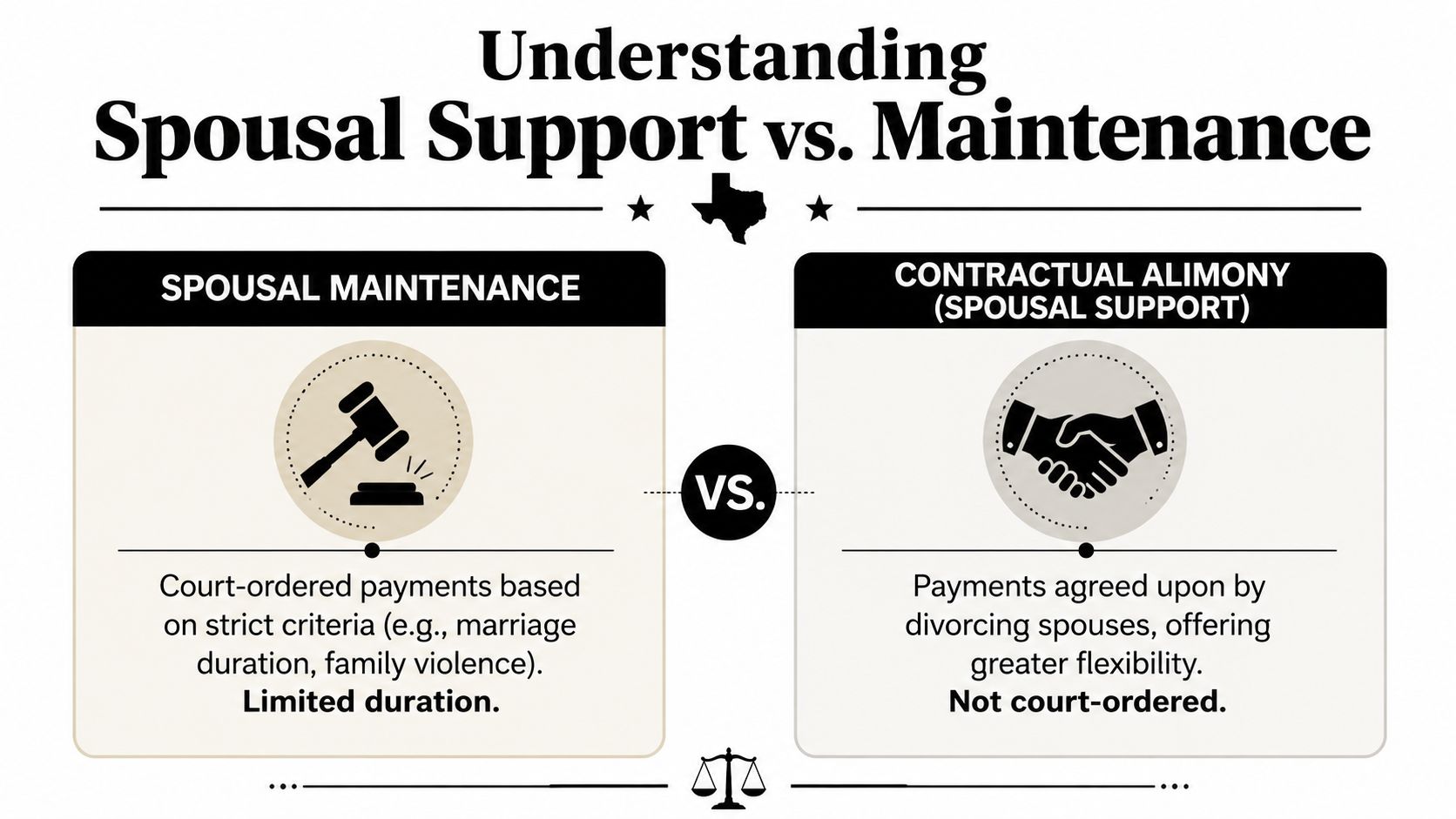
That difference affects almost every practical question a family asks. Can a judge require monthly payments? Are there legal caps? Can the terms be changed later? How do enforcement options work if payments stop? The answer often depends on which type of support you are talking about.
If someone says, "My spouse agreed to support me," that may describe a negotiated term in the divorce decree. If someone says, "The court ordered support," that points to Texas spousal maintenance law, which has narrower rules and specific limits.
Here is the plain-English version:
- Contractual alimony comes from an agreement between spouses.
- Spousal maintenance comes from a judge applying Texas statutes.
- Amount and duration are often more flexible in a negotiated agreement than in court-ordered maintenance.
- Enforcement and modification may look different depending on the source of the obligation.
For a broader explanation of these terms and how they are used in Texas divorces, review this page on alimony in Texas.
This distinction matters even more in Harris County because settlement discussions and court hearings often overlap. A spouse may have a weak claim for court-ordered maintenance under Texas law but still negotiate contractual support as part of a larger property division. That is why families in Kingwood need to identify the category first, before they debate numbers.
A simple rule helps. Before anyone talks about how much support should be paid, ask one question first: Is this a private agreement, or are we asking the court to order maintenance?
That question clears up a lot of confusion and helps Kingwood residents understand what can happen in a Harris County courtroom, versus what can be worked out at the settlement table.
Who Qualifies for Spousal Maintenance in Kingwood
A common Kingwood divorce question sounds like this: “I have been out of the workforce for years, the bills are still coming, and I do not know if a Harris County judge can order support.” That is the right question to ask, because Texas does not award court-ordered spousal maintenance in every divorce.
The starting point is whether the spouse asking for maintenance will have enough property after the divorce to meet minimum reasonable needs. In everyday terms, the court looks at basics. Housing. Food. Utilities. Transportation. Medical care. The standard is not whether life will feel comfortable or whether the lower-earning spouse can keep the same lifestyle as before.
That point trips people up.
A divorce decree can divide retirement accounts, savings, or home equity, but a judge will still look closely at whether those resources cover day-to-day living. A person may receive some property on paper and still struggle to pay monthly expenses in real life.
If that first hurdle is met, the court then looks for a legal basis to award maintenance. In Kingwood cases, the most common paths are:
- Marriage of 10 years or more. A longer marriage may allow a maintenance request if the spouse seeking support cannot earn enough income to meet minimum reasonable needs.
- Family violence. A conviction or deferred adjudication for family violence can create eligibility even if the marriage was shorter.
- Disability of the spouse seeking maintenance. If a physical or mental condition limits earning ability, the court may consider maintenance.
- Care of a child with a disability. If one spouse must provide substantial care to a child of the marriage whose condition makes outside employment difficult, that can support a claim.
Each path has details that matter. Timing matters too. For example, with family violence, the court will examine when the conduct occurred and how it lines up with the divorce filing.
The 10-year marriage rule also causes confusion. Some spouses hear “10 years” and assume maintenance is automatic. It is not. Reaching that point only opens the door. The spouse asking for support still needs to show an inability to meet minimum reasonable needs despite making reasonable efforts to earn income or develop needed job skills.
A simple way to picture it is a two-lock door. One key is financial need after property division. The second key is a qualifying ground under Texas law. Both usually matter.
For Kingwood residents, the local court process matters as much as the legal rule. A claim for maintenance is usually built with pay records, medical information, proof of job history, monthly expense details, and testimony about caregiving duties. In Harris County family court, judges want specifics, not general statements that money feels tight.
Before meeting with a lawyer, it helps to gather clear answers to these questions:
- After the divorce property is divided, what income and assets will I have access to each month?
- How long was the marriage?
- Is there a family violence conviction or deferred adjudication?
- Do health conditions affect my ability to work full time or at all?
- Am I the parent providing substantial care for a child whose condition limits my ability to earn income?
Those answers often reveal whether you may have a court-ordered maintenance claim, or whether contractual support will need to be part of settlement talks instead. As noted earlier, that distinction matters in Kingwood divorces because what spouses can agree to is often broader than what a Harris County judge can order.
Calculating Support Payments and Duration in Texas
A lot of Kingwood spouses reach this stage with the same worry. "Even if I qualify, what will support look like month to month?"
The answer depends first on which kind of support is on the table. Court-ordered spousal maintenance follows Texas limits. Contractual alimony or contractual support is different. That is support spouses agree to in settlement, and the amount or length can be broader than what a judge could order after a trial. That distinction matters in Harris County because settlement talks often start with the court's limits, then shift to what two spouses may agree to if they want more flexibility.
For court-ordered maintenance, Texas sets a clear ceiling. Under Texas Family Code § 8.055, the maximum is the lesser of $5,000 per month or 20% of the paying spouse's average gross monthly income, as summarized by Ramos Family Law's overview of Texas spousal maintenance.
How judges look at the monthly amount
That cap is the top edge of the box, not the automatic result.
If one spouse earns $10,000 per month, the cap would be $2,000 because 20% of gross monthly income is below $5,000. If one spouse earns $40,000 per month or more, the cap becomes $5,000 because the dollar limit controls.
A Harris County judge still has to decide what amount is appropriate within that range. The court may look at each spouse's ability to meet basic monthly needs, the property division, employment history, health, education, and the time needed for the receiving spouse to earn enough to become more self-supporting. In plain terms, the cap tells you the most a judge can order. It does not tell you what the judge will order.
How long maintenance can last
Texas also limits duration for court-ordered maintenance. The schedule usually looks like this:
| Length of Marriage | Maximum Maintenance Duration |
|---|---|
| 10 to 20 years | 5 years |
| 20 to 30 years | 7 years |
| 30 or more years | 10 years |
| Under 10 years with qualifying family violence | 5 years |
The court is supposed to order the shortest period that allows the receiving spouse to meet minimum reasonable needs, if that goal is realistic. That is why maintenance in Texas often works like a temporary bridge. It is meant to give someone time to stabilize, train, return to work, or adjust after divorce.
There are exceptions in some disability-related cases, but the general rule for many families is short-term support tied to a specific need.
Why Kingwood families need to separate "legal maximum" from "practical outcome"
Confusion often starts. A spouse may read the statute and assume support will last for the full maximum term. Another spouse may assume the cap means the judge will automatically award the highest monthly amount. Neither assumption is safe.
In real Harris County cases, support is usually part of a larger financial picture that includes the home, retirement accounts, debt, health insurance, and parenting responsibilities. A spouse who receives more property up front may need less monthly support. A spouse caring for a child with high daily needs may have a stronger argument for ongoing help. The math matters, but the facts around the math matter too.
For a broader picture of the local court system that handles these issues, this guide to Harris County family court procedures for Kingwood divorce cases can help you see where support decisions fit into the process.
Why these limits shape settlement talks
In many Kingwood divorces, the court-ordered maintenance rules act like the floor plan for negotiation. Everyone can see the walls a judge must stay within. From there, spouses can decide whether to settle on terms that fit their real-life needs better.
That is especially important when discussing contractual support. For example, spouses may agree to a payment structure that lasts longer than court-ordered maintenance would, or one that trades monthly support for a different property split. A Harris County judge cannot order any arrangement a spouse wants after trial, but spouses usually have more room to craft a settlement by agreement.
That is often where good planning makes a real difference.
Navigating the Spousal Support Process in Harris County
Knowing the rules is helpful. Knowing what the process looks like in Harris County is what lowers anxiety.
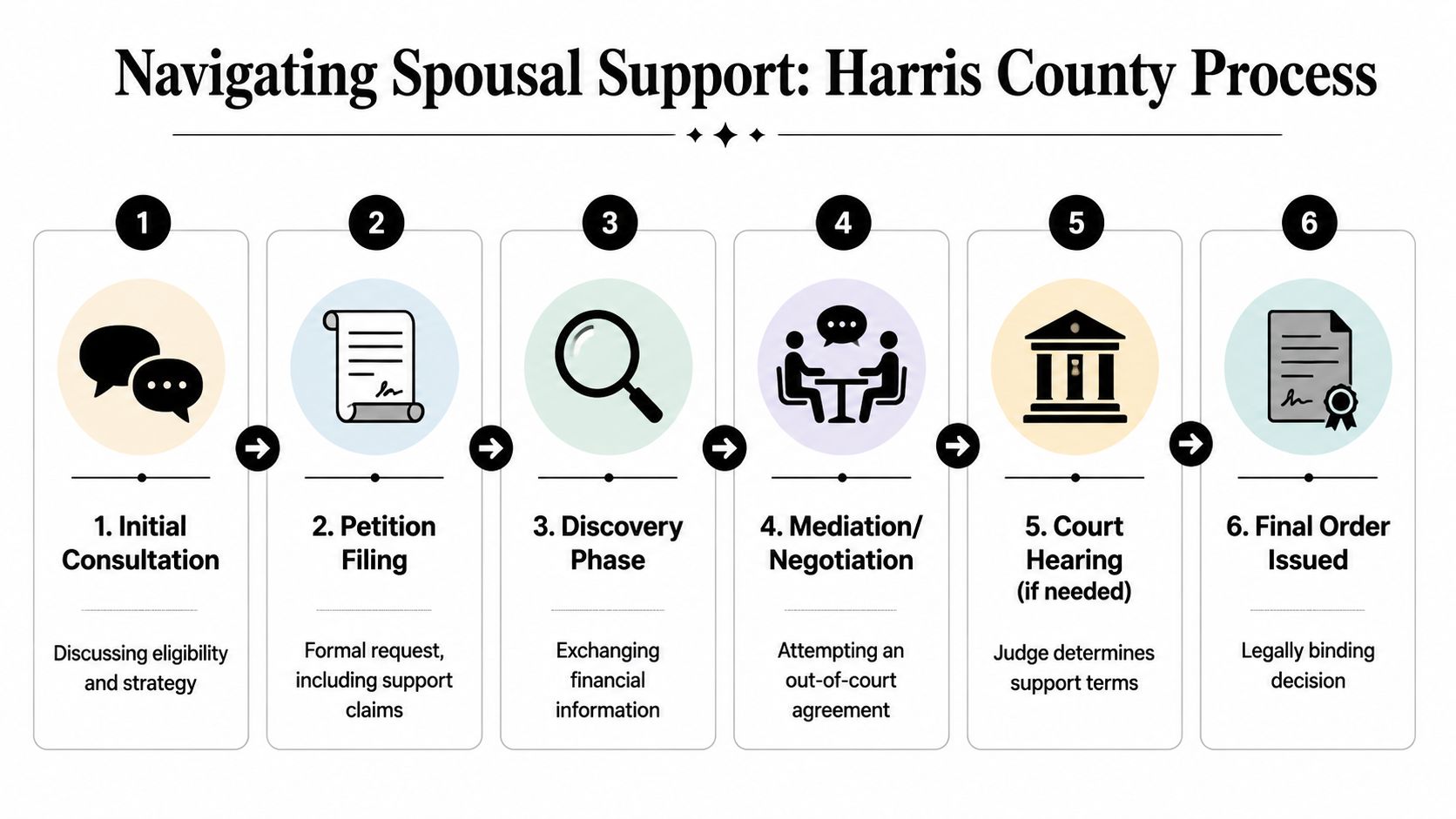
A typical case for a Kingwood resident moves through a sequence of decisions, disclosures, and negotiations. The exact path depends on conflict level, court scheduling, and whether temporary relief is needed early.
What usually happens first
The process often begins with filing for divorce and identifying whether spousal support or maintenance is being requested. Early filings shape the issues the court and the other side will be asked to address.
For families trying to understand the local court structure, this overview of Harris County family court for Kingwood cases can help place the process in context.
After filing, many people want to know whether immediate financial help is available while the case is pending. In some cases, temporary orders become the first major hearing. Those hearings may address who pays which bills, who stays in the home, and how the family handles the short term.
A short video can also make the process feel more concrete:
The middle of the case matters most
The part many people underestimate is discovery. That's the exchange of financial information. Income records, account statements, debts, budgets, and property information all matter here. If support is disputed, accurate records can shape the whole case.
Then comes negotiation or mediation. Many Harris County divorce cases resolve there rather than in a full trial. The terms may cover contractual support, property division, or both. A Divorce Lawyer in Kingwood, TX handles divorce representation for clients in Kingwood and Harris County, which is often where these support issues are negotiated.
A simple roadmap
- Initial review: You and your lawyer evaluate eligibility, risks, and immediate financial concerns.
- Petition and response: The divorce paperwork frames the issues for the court.
- Financial exchange: Each side gathers and produces the records needed to evaluate support.
- Settlement efforts: Mediation or direct negotiation may resolve the issue without trial.
- Court decision if needed: If no agreement is reached, the judge decides based on the evidence and the law.
People usually feel better once they understand the sequence. The process may not be easy, but it becomes more manageable when you know what the next step looks like.
Why You Need a Spousal Support Attorney in Kingwood
Spousal support cases aren't hard because the phrase itself is complicated. They're hard because several moving pieces collide at once. Eligibility, income proof, property division, temporary orders, negotiation strategy, and local court procedure all affect the outcome.
That's why hiring a spousal support attorney in Kingwood, TX isn't just about having someone appear in court. It's about having someone organize the problem correctly from the start.
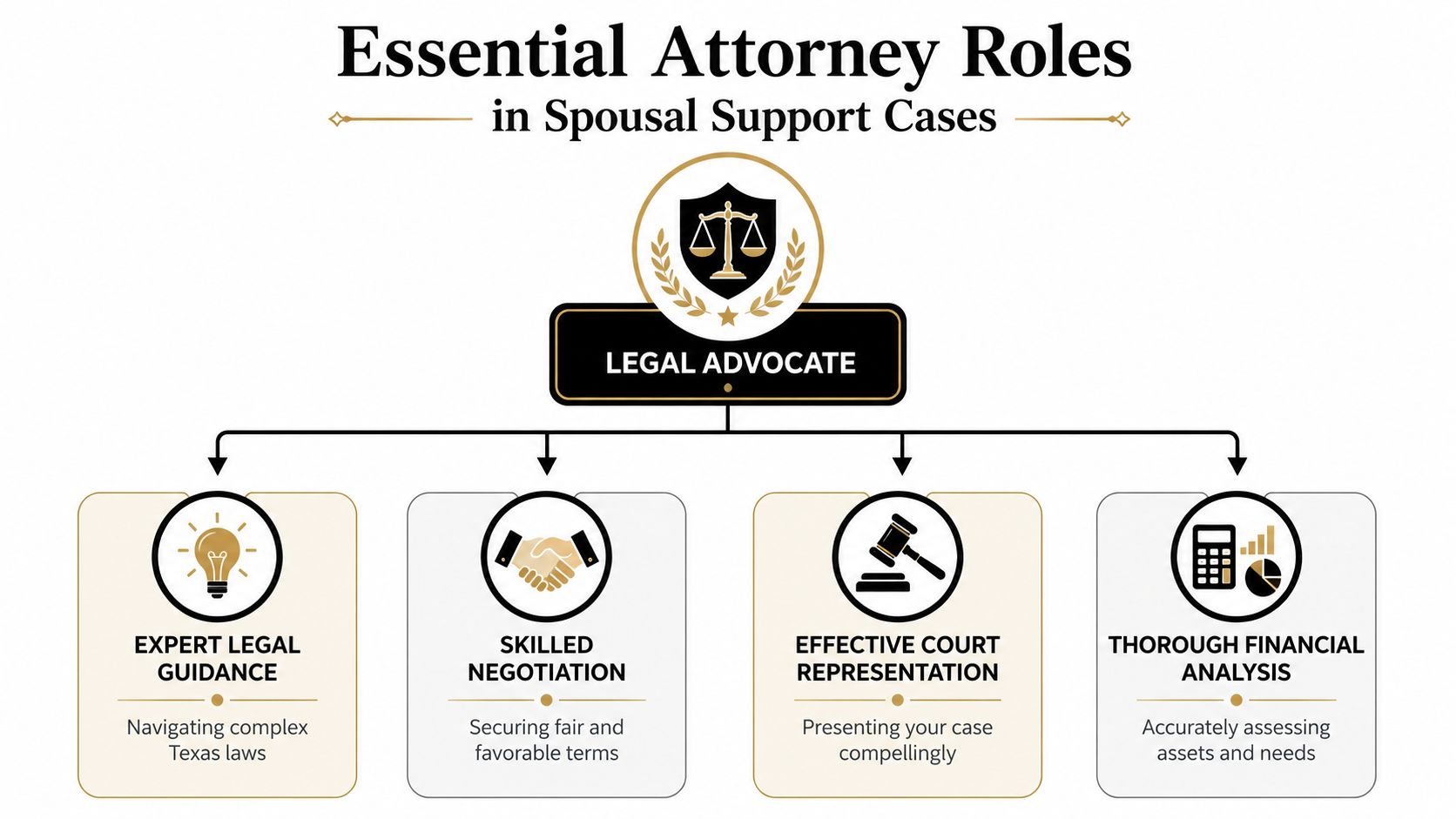
Four jobs your lawyer should be doing
A strong attorney typically adds value in at least four ways.
- Strategic analysis: The lawyer compares your facts to the actual Texas standard instead of what friends, relatives, or online comments say should happen.
- Financial organization: Support claims rise or fall on documentation. Pay records, budgets, account statements, and debt details have to be accurate and usable.
- Negotiation work: Many outcomes are shaped before a judge ever rules. Settlement language matters, especially if the case involves contractual support.
- Court advocacy: When a hearing is necessary, your lawyer should present the facts in a way that fits the statute and answers the judge's practical questions.
Local knowledge helps
Family law is state law, but experience in the Kingwood and Harris County setting still matters. A lawyer who regularly handles these cases knows how timing, paperwork, mediation, and courtroom presentation affect day-to-day progress.
The Law Office of Bryan Fagan – Kingwood TX Lawyers serves Kingwood and surrounding communities in family law matters, along with estate, criminal, and civil cases. For a person facing divorce, that local accessibility can matter just as much as legal analysis.
Good legal advice doesn't just tell you what the law says. It tells you what to gather, what to expect, and what to avoid doing next.
Small mistakes can become expensive problems
People hurt their cases when they guess at income, overlook documents, agree to vague language, or assume every form of support works the same way. Those aren't character flaws. They're normal mistakes from people trying to manage a painful transition without enough guidance.
An attorney's role is to reduce those mistakes and help protect your financial footing while the case moves forward.
Schedule Your Free Spousal Support Consultation in Kingwood
A lot of Kingwood residents reach this point after a long week of worry. One spouse has moved out, bills are still coming, and nobody is sure whether support means a private agreement, a court order, or both. What usually helps first is a calm conversation that turns a confusing topic into a clear plan.
A consultation should answer practical questions in plain English. Does Texas law allow court ordered maintenance in your situation? Would contractual support make more sense during settlement talks? What documents should you gather before anything is filed or set for hearing in Harris County? Those answers can change how you prepare for the next few weeks.
One part many people miss is what happens after support is ordered or agreed to. Court ordered spousal maintenance in Texas can end on specific events, such as remarriage, death, or qualifying cohabitation by the receiving spouse. In some cases, a material and substantial change in circumstances may also justify asking the court to modify the amount or duration. Contractual support can work differently because the ending rules depend on the language the spouses agreed to, which is one reason wording matters so much.
That distinction matters in real life. Court ordered maintenance follows Texas statutes. Contractual alimony works more like a custom agreement built into the divorce settlement. If you do not understand which one you are discussing, it is easy to agree to terms that sound similar but operate very differently later.
If you want to talk through your own facts, you can request a free family law consultation in Kingwood for spousal support questions. The goal is simple. Help you understand where you stand, what the Harris County process may look like, and what steps make sense next.
The Law Office of Bryan Fagan – Kingwood TX Lawyers offers consultations for family law matters, including divorce and spousal support. You do not need every document organized perfectly before you reach out. You just need a starting point.