Skip to content
A lot of grandparents in Kingwood call a lawyer after months of silence. They used to help with school pickup, keep the child on weekends, or spend holidays together. Then a divorce, a remarriage, a death in the family, or a conflict with a parent changes everything. Suddenly, they're blocked from calls, visits, and updates.
That kind of loss feels personal because it is personal. For many families in Kingwood, Humble, Porter, and Northeast Houston, grandparents aren't distant relatives. They're part of a child's daily life. But Texas law doesn't treat love alone as a legal right. A court will look at your situation through specific rules, and those rules can feel harsh if no one has explained them clearly.
If you're searching for a grandparents rights attorney in Kingwood, Texas, you probably want two things right now. You want a straight answer about whether you can file a case, and you want to know what persuades a Harris County judge. Those are not the same question.
A Grandparent's Hope in Kingwood
Margaret lives off Kingwood Drive. For years, her grandson came to her house after school. She kept his favorite snacks on hand, checked homework at the kitchen table, and showed up for school programs when his parents were working. Then a family conflict changed the routine. The visits stopped, the calls stopped, and she was left wondering whether a court could help.
That question comes up often in Kingwood, Humble, and Porter. A divorce can redraw family lines overnight. A death in the family can leave a child in a fragile home. Sometimes a grandparent is less focused on missing visits and more focused on what the child is living through behind closed doors.

Texas law does allow some grandparents to ask the court for visitation or custody under Sections 153.432 through 153.434 of the Texas Family Code. The hard part is what comes after filing. In Harris County, judges usually want more than a painful family story. They want proof that court involvement would protect or benefit the child in a real, specific way.
That point gets missed a lot online. Families often spend all their energy asking, “Can I file?” A better early question is, “What facts can I show the judge?” A case with legal eligibility but weak proof often stalls. A case built around school records, medical concerns, caregiving history, missed parent involvement, or clear signs of instability gives the court something solid to evaluate.
Practical rule: Hope opens the conversation. Evidence carries the case.
A careful approach helps. Harris County judges are not measuring who loves the child more. They are looking for facts that connect your role in the child's life to the child's well-being. If you have been the steady adult who handled pickups, doctor visits, meals, bedtime, or long stretches of care, those details matter because they show function, not just affection.
Kingwood families also face overlap with other legal problems. A child may be living with relatives while a parent deals with criminal charges, substance abuse, housing problems, or disputes after a death. Those facts can change both the legal path and the kind of evidence that matters, which is why clear local advice can make a real difference early.
Can You Legally File a Case in Texas
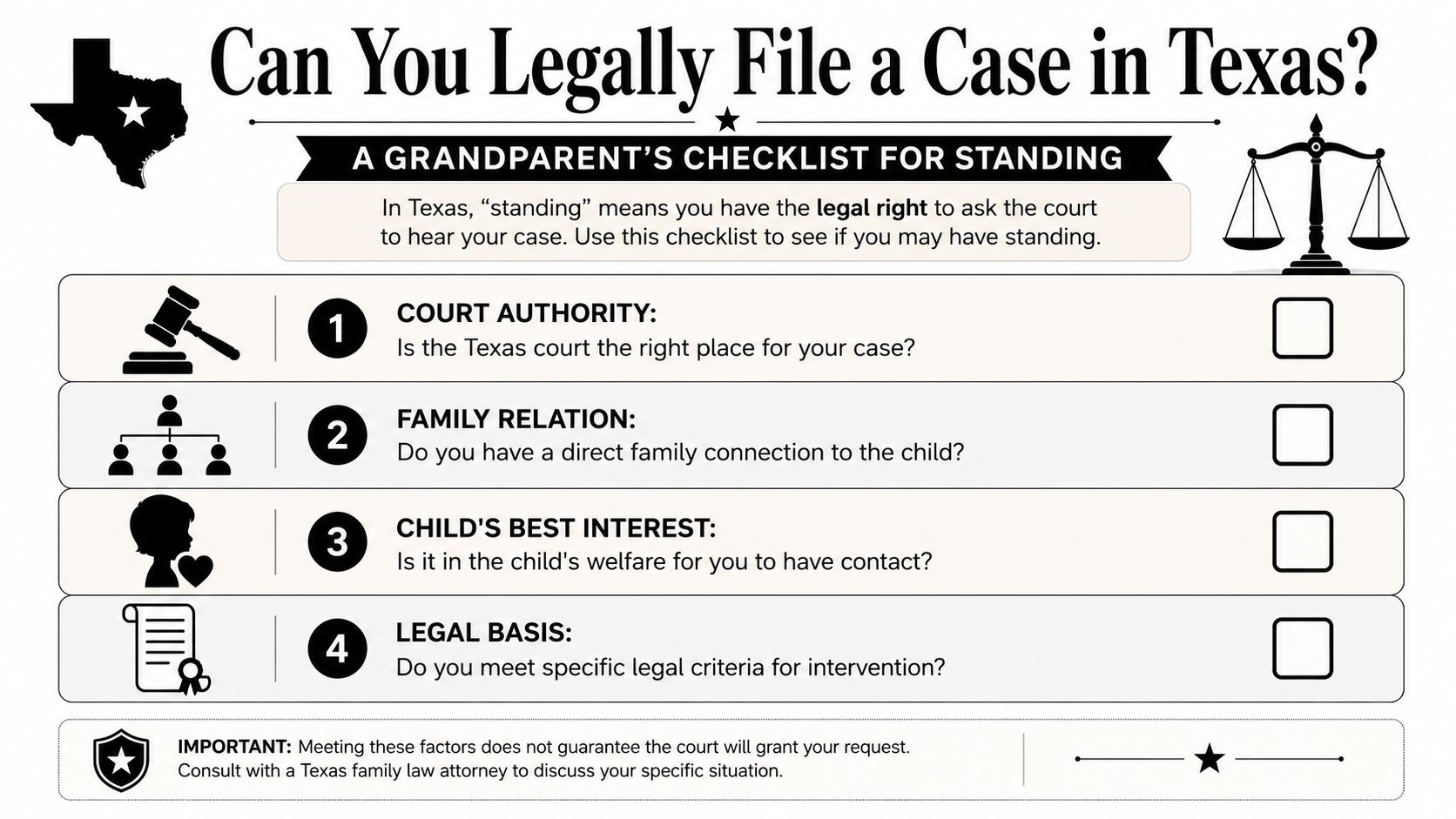
Before a judge can hear your concerns, you need standing. Think of standing as your ticket into court. If you don't meet the legal entry rules, the judge won't reach the deeper question of what would help your grandchild.
In Texas, grandparents don't automatically have a legal right to custody or visitation. To petition for either, they must first establish standing by proving at least one specific condition: the child's parents are divorced, a parent is incarcerated, incompetent, or deceased, the child was abused or neglected, the parent-child relationship was terminated by court order, or the grandparent had actual care, control, and possession of the child for at least 6 months, according to Jason Wright Law's summary of Texas grandparent standing.
Common situations that may create standing
A grandparent in Northeast Houston may have standing if one of these situations applies:
- Family breakdown after divorce: If the child's parents are divorced, Texas law may allow a grandparent to ask the court for access.
- A parent is unavailable: Death, incarceration, or incompetence can change who may legally seek court involvement.
- Serious safety concerns: Abuse or neglect can create a basis for intervention.
- The court already changed parental rights: If a parent-child relationship was terminated by court order, that can matter.
- You were acting like the caregiver: If the child lived with you and you provided actual care, control, and possession for at least 6 months, that may support standing.
For a local overview of custody and visitation rights for grandparents in Harris County, some families start by reviewing Grandparents' Rights in Kingwood.
What standing does not mean
Standing only means you may file. It doesn't mean you'll win. Many grandparents hear that they qualify to bring a case and assume the court will arrange visits. That's where expectations often break down.
A Harris County judge will still ask much harder questions. Is the child better off with court-ordered contact? Is the current situation causing real harm? Is the request supported by facts instead of frustration between adults?
This short video gives a useful overview before you speak with counsel.
If your facts don't fit one of the legal gateways, the court usually won't reach the emotional merits of the case at all.
That's why many Kingwood and Humble grandparents benefit from gathering a timeline before they meet with a lawyer. Dates matter. Who lived where matters. Who provided daily care matters. The law often turns on those details.
The Best Interest of the Child Standard
A lot of grandparents reach this stage feeling hopeful because they can file a case. Then they hear the next question from the court: Why would an order help this child?
That question sits at the center of these cases. Under Texas Family Code Sections 153.432 through 153.434, the judge must focus on the child's best interest. In real life, that means a Harris County court is looking for proof tied to the child's day-to-day well-being, not just proof that you love your grandchild or that you were once very involved.
This is the part many families underestimate. Standing gets you through the courthouse door. Evidence about the child's welfare is what gives the judge a reason to act.
What “best interest” really means in court
Best interest is not a feeling test. It works more like putting together a picture from many small pieces. One fact rarely decides the case. Judges usually look at the child's routine, stability, emotional health, school performance, safety, and the quality of the relationship with the adults involved.
A grandparent's case gets stronger when those pieces fit together in a clear, child-focused story. If you are asking for court-ordered contact, the judge will want to know questions like these:
- How has the child changed since contact stopped?
- What role did you play before the conflict started?
- Do teachers, counselors, doctors, or other adults see signs of stress, decline, or instability?
- Are you offering something steady and healthy for the child, or are you mainly describing conflict with a parent?
- Can you show specific harm to the child, not just heartbreak for the grandparent?
For a fuller explanation of grandparent visitation rights in Texas, it helps to compare the legal rule with the facts you can prove.
What judges usually find persuasive
General statements often fall flat. Specific examples carry weight.
For example, saying, “We have a close bond,” is a start. Saying, “I picked her up from school three days a week for two years, helped with homework, took her to counseling, and her grades dropped after contact was cut off,” gives the court something concrete to evaluate.
The same is true with harm. A judge can do more with school attendance records, therapy notes, text messages about missed medical care, or testimony from a coach than with broad claims that a parent is making poor choices.
The court is asking, “What is happening to this child, and how would your requested order improve that child's life?”
That is a different question from, “Who has been treated unfairly?”
Why many grandparent cases fall short
Some grandparents have serious concerns, but their proof is still too broad or too old. Courts usually care most about current conditions and current effects on the child. A parent's past mistakes may matter if they connect to what the child is experiencing now.
Here is a common problem. A grandparent spends most of the hearing describing the parent's bad decisions. The judge is still waiting to hear the child-centered link. What changed for the child? How do you know? What records, witnesses, or observations support that concern?
That missing link is often the difference between a case that feels compelling and a case that is legally persuasive.
A practical way to build this argument
Start with a timeline. Then fill it with proof.
List the dates you cared for the child, the routines you handled, major changes in the child's living situation, and the point when contact changed or ended. After that, match each concern with supporting evidence. If you believe the child is struggling emotionally, ask what facts show that. If you believe the child lost stability, identify where that appears in school records, attendance, medical follow-up, or witness observations.
Kingwood families often feel this standard is subjective. It can feel that way until the facts are organized. Once the court can see a clear pattern tied to the child's daily life, your argument becomes easier to understand and harder to dismiss.
Sometimes these cases also overlap with support issues. If the child's placement or caregiving arrangement has shifted, families may also need information about Child Support Attorney in Kingwood, which addresses establishing, modifying, and enforcing child support in Harris County.
Seeking Custody Versus Securing Visitation
Some grandparents come into a consultation saying they want “custody” when what they really want is court-ordered time with the child. Others ask for visitation when the facts suggest the child may need a safer home. Those are different goals, and Texas applies different legal standards to each.
For a grandparent to be appointed managing conservator in Texas, they must prove that the child's current circumstances would significantly impair the child's physical health or emotional development, or that both parents consent to the suit, according to Kimbrough Legal's explanation of grandparent managing conservatorship.
Grandparent's Rights Custody vs. Visitation
| Aspect | Seeking Custody (Managing Conservator) | Seeking Visitation (Possessory Conservator) |
|---|---|---|
| Main goal | To become the person with major decision-making authority for the child | To obtain court-ordered access or visitation |
| Core legal burden | Show current circumstances would significantly impair the child's physical health or emotional development, or that both parents consent | Show that court-ordered contact is justified under Texas law and tied to the child's welfare |
| Typical fact pattern | Unsafe home, serious instability, inability of parents to provide a stable environment | Existing bond with the child, followed by harmful loss of contact |
| What the court is weighing | Safety, stability, day-to-day care, and who should make major decisions | Whether denying access is harming the child and whether visits serve the child's interests |
| Result if granted | Grandparent may receive custody-related authority | Grandparent receives a visitation schedule or defined access |
Which path fits your situation
If your concern is, “I miss my grandchild and believe the separation is hurting them,” visitation may be the more realistic request. If your concern is, “The child is not safe where they are,” custody may be the necessary remedy.
That distinction affects how your lawyer prepares the case, what evidence matters most, and what relief the court may consider. Families often find it helpful to review a focused discussion of grandparent visitation rights in Texas before deciding what outcome they should pursue.
A practical way to think about it
Ask yourself one direct question. Are you trying to preserve a relationship, or are you trying to remove a child from danger?
Those are not interchangeable arguments. A Harris County judge will expect the request to match the facts. When grandparents frame the case too broadly, they can weaken it. A narrower, well-supported request often carries more weight than an overstated one.
Navigating the Harris County Legal Process
A lot of grandparents expect the hardest part to be telling the judge what happened. In Harris County, the first hurdle is often much earlier. It is putting the right facts into the right form, at the right time, so the court can even consider your request.
The process starts before anything is filed
Your first meeting with a lawyer is usually less about speeches and more about building a timeline. Judges need a clear sequence. When did your contact with the child change. Who has been caring for the child day to day. What specific events made you believe court involvement became necessary.
Bring the basics: names, addresses, prior court orders, school and medical information, screenshots of important messages, and notes about dates. If there has been a death in the family, a CPS investigation, a parent's incarceration, or another major disruption, that context may affect how the case is framed.
This stage matters because Texas grandparent cases are won or lost on details, not general worry.
Filing the case requires more than a petition
For many grandparents, the most misunderstood document is the sworn affidavit. Texas law often requires more than a simple statement that you love the child or have always been close. The affidavit must lay out concrete facts that, if true, would justify court involvement.
A useful way to think about it is this: the affidavit is the doorway, not the full trial. You do not have to prove every issue at that moment, but you do need enough specific facts to show the court why the case deserves to go forward.
That usually means facts such as:
- what you personally observed
- when the problem occurred
- how the child was affected
- why the situation goes beyond a family disagreement
- what relief you are asking the court to consider
Key point: A vague affidavit can lead to dismissal before the court hears testimony.
What usually happens after filing
Once the petition is filed, the other parties must be formally served. After that, the court may set early hearings, issue deadlines, and require mediation before a final hearing is scheduled. The pace depends on the facts, the court's docket, and whether there are emergency concerns about the child's safety or stability.
Mediation and settlement discussions are often central to the case. Even then, preparation still matters. A parent is more likely to take your request seriously when your evidence is organized and your position stays focused on the child's needs rather than adult conflict.
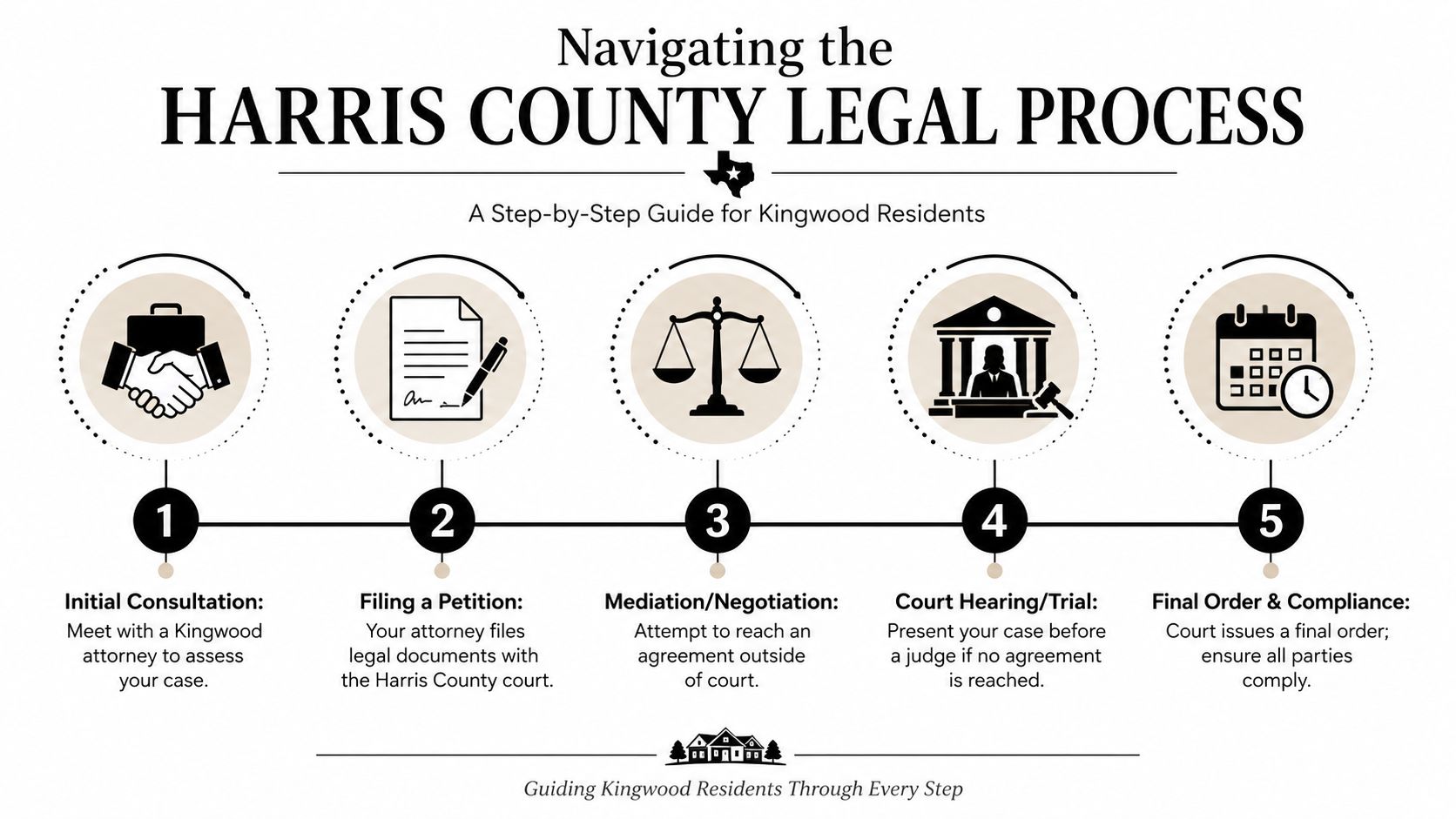
Here is the usual sequence in plain terms:
- Initial case review: your lawyer sorts the facts, timeline, and legal basis for filing.
- Petition and sworn affidavit: the case is drafted with detailed factual statements.
- Service of process: the parents or current conservators receive formal legal notice.
- Early court settings or mediation: the judge manages deadlines, and the parties may try to resolve some issues.
- Final hearing or trial: if no agreement is reached, the court decides based on the evidence.
Families often feel calmer once they can see the Harris County family court process for Kingwood residents in one place.
Procedure matters because it shapes your proof
This is the part many online guides skip. In grandparent cases, procedure and proof work together. If your filings are too broad, your evidence may look scattered. If your request is precise, your evidence becomes easier for a judge to follow.
For example, if you are asking for visitation, the court will want a clear explanation of how continued contact serves the child's best interest. If you are asking for custody-related relief, the court will expect facts showing a serious problem affecting the child's well-being. The legal path changes what facts need to be highlighted and how they should be presented.
A judge in Harris County is not trying to resolve every family hurt. The judge is trying to answer a narrower question: what order, if any, helps this child.
Why local counsel can make the process more manageable
Court procedure can feel technical, but the day-to-day work is practical. Meet deadlines. Keep documents organized. Follow temporary orders. Do not send angry texts that can end up as exhibits. Stay child-focused in every filing and every conversation.
The Law Office of Bryan Fagan – Kingwood TX Lawyers handles family law matters for local residents and also works with Kingwood-area clients when family cases overlap with probate, estate, criminal, or civil issues. Those overlapping issues do not change the legal standard. They often change what records are needed, which witnesses matter, and how the child's best interest should be shown in court.
Gathering Evidence to Build a Compelling Case
Judges decide these cases on proof, not assumptions. If you want the court to understand why your involvement matters, you need evidence that shows the child's real life before and after the separation.
Evidence that often helps
A persuasive file may include several kinds of proof, not just one:
- Records of your daily role: calendars, school pickup records, medical appointment notes, or messages showing regular caregiving
- Proof of the bond: photos, texts, cards, holiday plans, and communication that shows a steady relationship
- Third-party observations: statements or testimony from teachers, neighbors, counselors, coaches, or relatives who saw your role with the child
- Changes in the child: school issues, behavior shifts, or emotional struggles that line up with the loss of contact
- Facts about current instability: if relevant, documentation of unsafe living conditions, untreated problems, or repeated disruptions
A focused checklist can help families gather the right materials before they meet with counsel. This guide on evidence needed for a custody case in Harris County, Texas can provide a useful starting point.
What to avoid
Don't flood the court with every family grievance. Judges don't need a history of every argument at Thanksgiving. They need reliable facts tied to the child.
That means it's usually better to present a short, organized group of meaningful documents than a stack of unrelated complaints. Clear timelines are powerful. Angry opinions are not.
Good evidence answers three questions. What was your role, what changed, and how is the child affected?
If the child may be in immediate danger
If you believe your grandchild is in imminent danger because of the parents' living situation, the proper legal step is to contact Child Protective Services immediately at 1-800-252-5400 before or alongside filing a civil custody petition, according to McCarty Larson's discussion of emergency danger and CPS reporting.
That call serves a different purpose from a visitation lawsuit. CPS addresses immediate safety concerns. A civil family case addresses custody or access through the court. In the right case, both may matter.
Your Next Step with a Kingwood Family Law Attorney
Grandparent cases are difficult because Texas starts from a place of parental authority. That doesn't mean you're powerless. It means your case has to be built carefully, with the right legal basis and the right evidence.
For many grandparents in Kingwood, Humble, Porter, and Northeast Houston, the biggest turning point is understanding that eligibility is only the beginning. The stronger question is whether you can show a Harris County court, in a focused and credible way, that the child is better protected or better supported by the order you're requesting.
That's why choosing counsel matters. Families often look for a lawyer who communicates clearly, listens well, and stays practical under stress. Those priorities line up with LegalRev's insights on attorney qualities, which is a useful read if you're deciding who should help with a sensitive family case.
If you're searching for a grandparents rights attorney in Kingwood, Texas, bring your timeline, your documents, and your questions. A good first meeting should help you understand whether you have standing, what outcome fits your facts, and what proof the court is likely to expect. That kind of clarity can replace panic with a plan.
The path forward may involve visitation. It may involve custody. It may also involve related family, estate, criminal, or civil issues that need to be handled in the right order. What matters now is getting informed advice that matches your family's situation.
If you're worried about losing your relationship with a grandchild in Kingwood, Humble, Porter, or Northeast Houston, schedule a free consultation with Law Office of Bryan Fagan – Kingwood TX Lawyers. You can talk through your situation privately, learn your options under Texas law, and get practical guidance on the next step.