Skip to content
One day you're picking your child up from school in Kingwood like usual. The next day you get served with court papers, hear that the other parent wants to move, or learn there's a dispute about whether you even have enforceable rights. That shift is jarring. Most fathers in Kingwood, Humble, Porter, and Northeast Houston don't come into family court because they wanted a legal fight. They come in because they want to stay present in their child's life.
A lot of fathers also start from the wrong assumption. Some think Texas courts automatically favor mothers. Others think being listed as the biological father is enough. Neither assumption helps when deadlines are moving, school schedules matter, and the other parent is already making decisions without you.
For fathers' rights in Kingwood TX, theory is probably not what you need. You need a practical path. You need to know what rights Texas law gives fathers, what steps protect those rights, what evidence judges care about in Harris County, and what to do right now if your case involves a CPS investigation or a relocation dispute. That's what this guide is for.
A Father's Guide to Navigating Family Law in Kingwood TX
A father in Humble recently described the problem the right way. He didn't say, "I want to win." He said, "I don't want to disappear from my kid's daily life." That is usually the underlying issue. Fathers in Kingwood and Northeast Houston aren't just worried about legal labels. They're worried about school pickups, doctor visits, weekends, holidays, and whether their child will still look to them for stability.
Family law cases usually start in the middle of confusion. You may be married and facing divorce. You may be unmarried and realizing too late that informal parenting isn't the same as legal parenting. You may already have orders and now the other parent isn't following them. Some fathers are also juggling related legal stress, including criminal allegations, protective order claims, or civil disputes that spill into a custody case. In other families, estate planning and probate issues affect who has authority to care for a child after a death or medical emergency.
The fathers who protect their position early usually have more options than the fathers who wait for the conflict to define the case.
In Kingwood, local procedure matters as much as legal principle. A case filed in Harris County moves through a real court system with real expectations about evidence, deadlines, and conduct. Judges want specifics. They want to see who has been caring for the child, who communicates responsibly, and who can put the child's needs ahead of anger with the other parent.
Three early questions usually tell you where you stand:
- Are you legally recognized as the father: If not, the first step is paternity.
- Do you have a court order already: If yes, enforcement or modification may matter more than starting from scratch.
- Is there a crisis issue in play: CPS, relocation, or emergency possession issues require fast action.
The path isn't identical for every father in Porter, Humble, or Kingwood. But the need for a calm, deliberate plan is the same.
The Legal Foundation of Fathers' Rights in Texas
A father in Kingwood often comes into my office assuming one of two things. Either he believes the court will favor the mother no matter what he does, or he believes being the biological father already gives him equal legal footing. Both assumptions cause problems.
Texas law does not start with a preference for mothers. Under Chapter 153 of the Texas Family Code, courts are directed to decide conservatorship and possession issues based on the child's best interest, and public policy favors frequent and continuing contact with parents who act in the child's best interest, as reflected in the Texas Family Code provisions on conservatorship and possession.
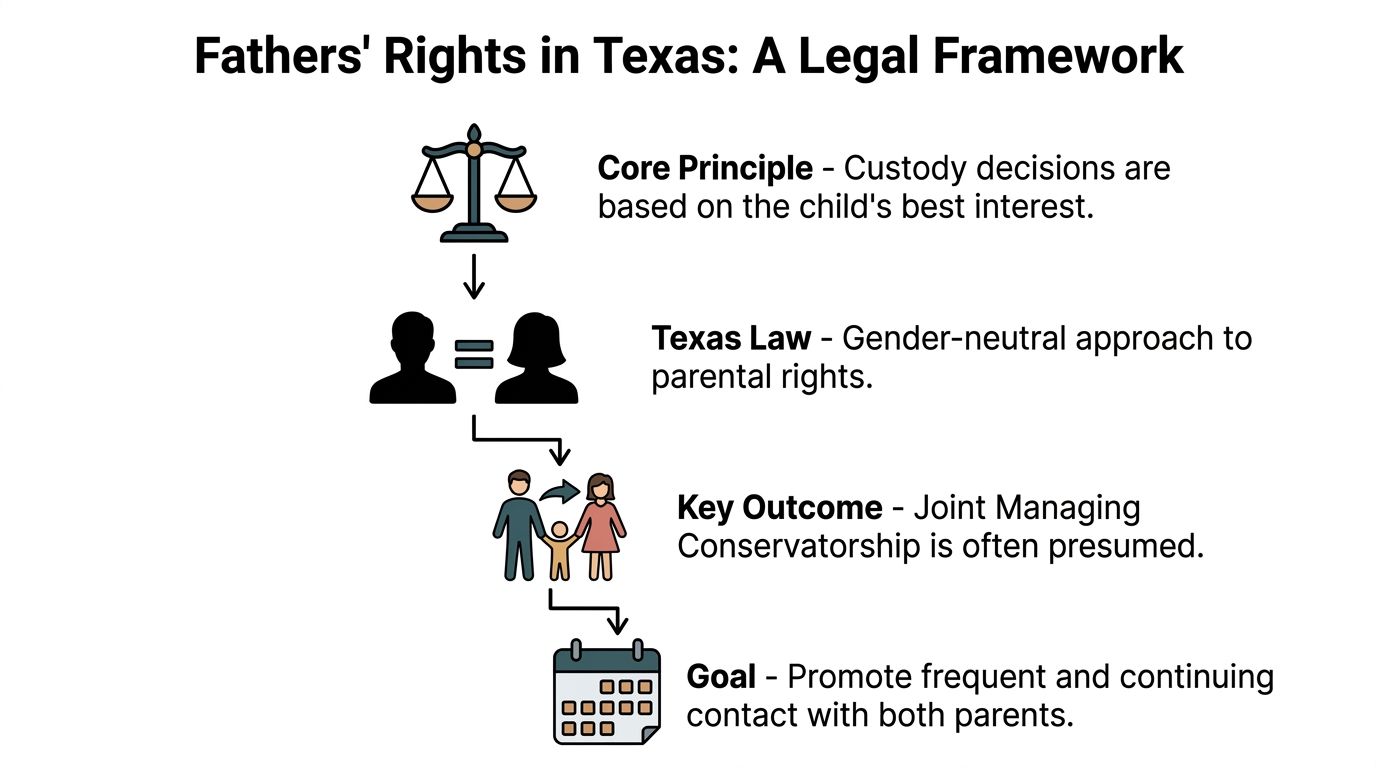
That does not mean every father gets a 50-50 result. It means the court must evaluate facts, not gender.
What the court is actually deciding
In Harris County family courts, "custody" is a shorthand term. The orders themselves usually break the issue into separate parts, and each part affects your daily life with your child in a different way.
| Term | What it means in plain English |
|---|---|
| Conservatorship | Who has the legal right to make important decisions for the child |
| Possession and access | When each parent has time with the child |
| Joint managing conservator | Both parents have parental rights and duties, but some rights may still be exercised by one parent alone |
That distinction matters in real cases. A father may share major decision-making authority yet have a standard possession schedule. In another case, a father may have expanded time but limited say over a specific issue such as the child's primary residence. If you want a useful explanation of how legal fatherhood connects to these rights, review this guide on how to establish paternity in Texas.
What judges in Harris County tend to focus on
Judges want specifics they can put into orders and enforce later. They look closely at who has been handling school communication, medical appointments, therapy, daily transitions, and exchanges between homes. They also pay attention to judgment. A father who stays child-focused during conflict usually presents better than a father who turns every disagreement into a character attack.
This becomes even more important in harder situations. If the mother is talking about moving away, if CPS has contacted the family, or if there is already a temporary order in place, the legal foundation matters because the court will ask who has enforceable rights today, not who intended to work things out informally.
The mistake fathers make early
Many fathers argue fairness before they establish a legal framework for the court to act on. That is backwards. The court needs pleadings, a request that matches Texas procedure, and evidence that supports the order you want.
For example, if you are asking to be named a joint managing conservator, the court will want facts showing consistent involvement and sound decision-making. If you are asking for geographic limits to stop a sudden relocation, the court will look at the child's current ties to Kingwood, school stability, and the practical effect on visitation. If CPS is involved, the court may see your response to the investigation as a test of your judgment and credibility.
If you are sorting through messages, school records, medical notes, or CPS paperwork before meeting counsel, tools that help find legal case insights can make a large file easier to organize. For local families needing factual guidance on conservatorship issues, Child Custody Lawyer in Kingwood, TX addresses custody and conservatorship representation for Kingwood families.
Practical rule: Judges decide parenting cases based on provable facts, workable terms, and the child's stability.
The legal foundation is simple to state and harder to apply well. Fathers are not second-class parents under Texas law. But rights in a Harris County courtroom go to the parent who can prove his position clearly, ask for relief the court can grant, and show that his plan serves the child better than continued conflict.
Establishing Paternity The Non-Negotiable First Step
For unmarried fathers in Kingwood, this is the issue that changes everything. In Texas, establishing paternity is the mandatory legal prerequisite that grants a father standing to petition for custody or visitation; without this, a father has no enforceable rights regardless of biological connection, as custody and decision-making authority remain exclusively with the mother until paternity is adjudicated or acknowledged, as outlined in this explanation of Texas paternity and fathers' standing.
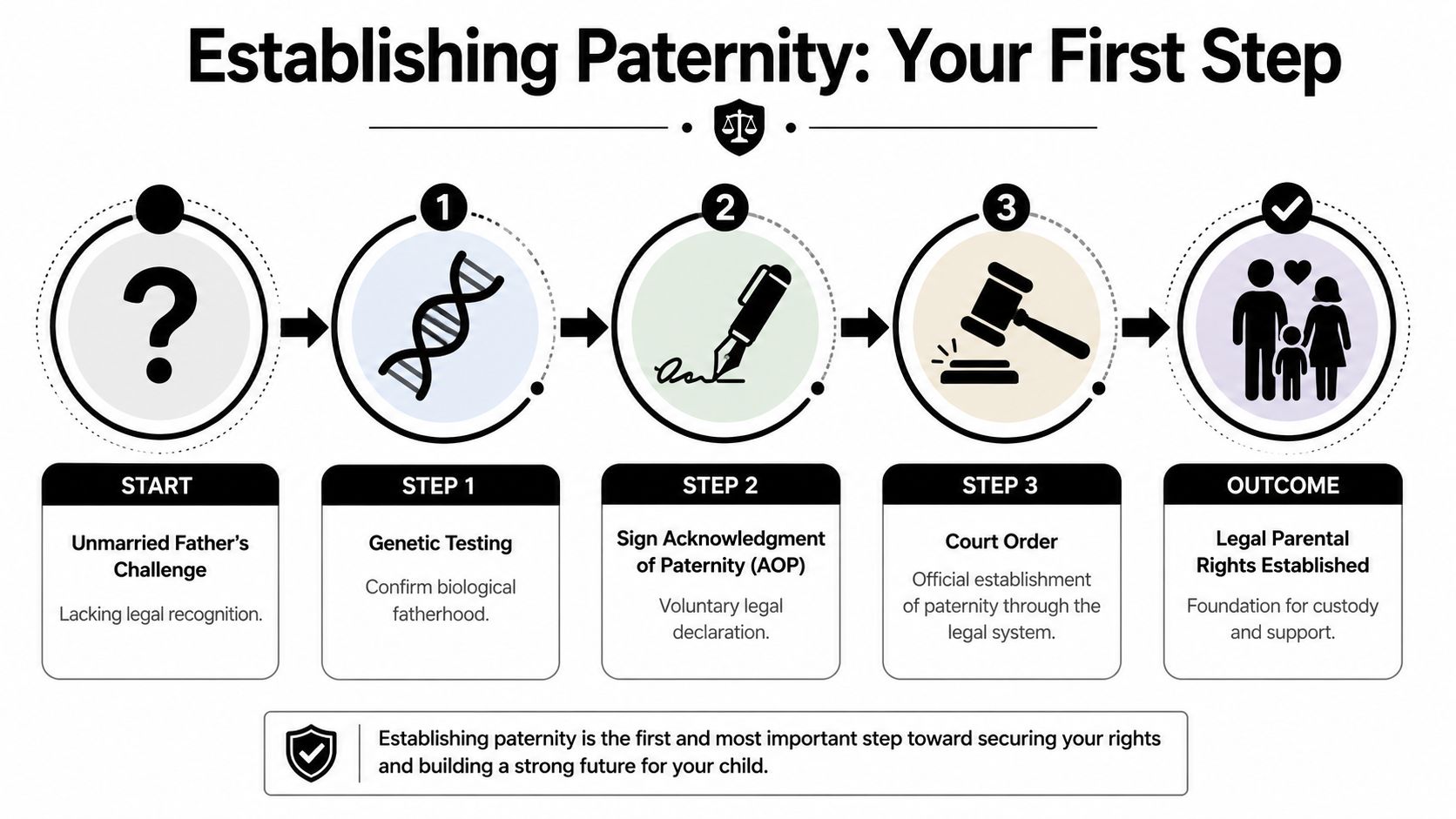
A lot of men learn this too late. They have cared for the child, paid expenses, attended birthdays, and acted like a parent for years. Then conflict starts, and they discover that informal fatherhood is not the same as legal fatherhood. If paternity hasn't been established, the law doesn't treat your position the way you think it should.
The two paths fathers usually consider
There are two common ways to establish paternity in Texas.
Acknowledgment of Paternity
If both parents agree, they can sign an Acknowledgment of Paternity, often called an AOP. This is the simpler route when there is no real dispute about who the father is.Court adjudication
If the mother disputes paternity, won't cooperate, or other legal issues are already in motion, the father may need to file a court case and ask for paternity to be adjudicated.
Each path has trade-offs.
| Option | Usually makes sense when | Main caution |
|---|---|---|
| AOP | Both parents agree and want legal recognition quickly | It still needs to be completed correctly |
| Court case | There is conflict, uncertainty, or a need for enforceable orders | It takes more time and requires formal litigation steps |
Why delay hurts fathers
Delay gives the other parent room to control the narrative. If there is no legal father recognized yet, the mother can continue making decisions alone. In real cases around Northeast Houston, that often means access becomes inconsistent first, then entirely discretionary.
For many fathers, the better move is immediate action. If cooperation is possible, complete the AOP correctly. If cooperation isn't possible, file the case. The middle ground of "we're working it out" often collapses at the worst time.
A practical walkthrough on how to establish paternity in Texas can help you understand the sequence before you file. For local representation focused on establishing legal parentage, Paternity Lawyer in Kingwood covers establishing legal paternity and related rights in Harris County.
If you're unmarried and paternity isn't established, custody arguments are premature. First secure legal standing. Then fight for the schedule and decision-making terms that protect your relationship with your child.
One mistake fathers make early
Some fathers avoid filing because they're afraid a paternity case will automatically become a child support case. That concern is understandable, but avoiding legal recognition usually costs more in the long run. Without paternity, you can't reliably ask the court for possession, access, or conservatorship. Rights and obligations tend to arrive together. Pretending otherwise doesn't preserve your advantage. It usually gives it away.
Understanding Custody Visitation and Child Support
You get served on a Tuesday. By Friday, the other parent is asking for primary custody, child support, and the exclusive right to decide where your child lives. That is the point where many fathers realize "I just want 50/50" is not a legal plan. In Harris County, the court wants specifics. Who makes which decisions. What the exchange schedule is. How expenses and support will be handled. If there is a relocation risk, a school issue, or a CPS concern in the background, those details matter even more.

Conservatorship and decision-making
Texas courts use "conservatorship" for parental rights and duties. That includes educational decisions, medical consent, access to records, mental health treatment, and the right to receive information from schools, doctors, and counselors. A father can have frequent possession and still lose ground if the order gives the other parent exclusive decision-making on the issues that shape the child's daily life.
The trade-off is not always simple. Joint managing conservatorship is common, but joint does not always mean equal on every issue. One parent may keep the exclusive right to choose the child's primary residence. One parent may get the final say on non-emergency medical care after consultation. In some cases, that makes sense. In others, it creates repeated conflict because one parent has all the practical control.
The right question is not "Can I get custody?" The right question is which rights need to be independent, which can be shared, and what language will reduce future fights.
Possession and access in daily life
Possession and access is the calendar you will live under. For many Kingwood fathers, the first mistake is asking for a broad outcome without tying it to distance, school logistics, work hours, and the child's routine. Harris County judges and associate judges see through generic requests quickly.
If the parents live more than 100 miles apart, the schedule usually changes from the pattern used in local same-city cases. TexasLawHelp's explanation of the standard possession order and long-distance parenting time is a good reference for the baseline rules. That baseline can include one weekend a month, alternating holidays, spring break, and an extended summer period, but the exact election language and notice deadlines matter. A father who does not read those details carefully can lose time he thought was automatic.
That is why I tell fathers to start with the practical questions first. Who is doing school pickup. How long is the drive. What happens if the mother moves from Kingwood to another county. What if the child is under three. What if one parent works rotating shifts. Those "what-if" scenarios often decide whether the standard schedule fits or whether you need custom terms.
A useful primer on what judges look for in custody cases in Texas Kingwood helps fathers connect schedule requests to the facts judges weigh.
Child support and the common misunderstanding
Child support does not buy parenting time, and parenting time does not erase child support. Courts treat them as separate parts of the same case. Fathers sometimes hold back from filing because they assume asking for more time will only increase the financial fight. In practice, avoiding a court order usually creates a worse problem. You end up with no enforceable schedule, unclear payment records, and arguments about who paid for what.
Accuracy matters here. Use full income records. Include overtime, self-employment income, bonuses, health insurance costs, and any other figure the court will examine. If support is being discussed informally by text message, stop treating that as a substitute for an order. Informal deals fall apart fast, especially once a new partner, a move, or a CPS report changes the temperature of the case.
Some of the hardest cases come from informal deals. One parent says, "Just pay this amount and we'll keep it simple." Later, there is no clear record and no enforceable structure.
Here is a short video that helps many parents frame the custody discussion in practical terms before mediation or court:
Timing matters more than people expect
If your case is tied to a divorce, don't expect an immediate final order. In Texas, a divorce petition cannot be granted by the court until at least 60 days have passed from the date the petition was filed, which creates a mandatory waiting period for residents of Kingwood, Humble, and Northeast Houston, as noted in this overview of Kingwood Texas divorce timing rules.
Use that time well. Temporary orders often shape the status quo that follows you into mediation or trial. If the mother is threatening to relocate, if school enrollment is being changed without your input, or if support numbers are being thrown around without documentation, address it early. Waiting for the "final hearing" is how fathers lose ground in Harris County cases they could have stabilized at the start.
How to Prepare Your Case Evidence and Local Procedure
The fathers who present the strongest cases in Harris County usually do one thing better than everyone else. They document reality. Not emotion. Not assumptions. Reality.
Courts in Harris and Montgomery Counties generally do not presume that a mother is better suited for caregiving than a father, requiring judges to make custody decisions solely based on the child's best interests without regard for gender. Courts actively evaluate a father's actual involvement as a decisive factor, as discussed in this review of fathers' rights in Harris and Montgomery County courts.

The evidence judges actually care about
A father in Porter may sincerely believe he has always been present. That may be true. But court works on proof. The best evidence usually shows a pattern of hands-on parenting over time.
- School involvement: attendance at conferences, pickups, activity participation, emails with teachers
- Medical involvement: appointment records, prescription coordination, insurance communication
- Daily parenting records: calendars, transportation logs, meal routines, bedtime responsibilities
- Communication history: texts and emails that show calm, child-focused discussion
- Photos and videos: useful when tied to dates and ordinary parenting activities, not staged moments
How to build a record without making yourself look rehearsed
Don't create a dramatic case file full of accusations. Build an organized parenting record.
Try this approach:
| Record type | Best use |
|---|---|
| Calendar | Track actual possession, missed exchanges, school events, and activities |
| Journal | Brief dated notes about major parenting events and concerns |
| Message archive | Preserve communication with the other parent in full context |
| Document folder | Keep report cards, medical forms, notices, and receipts together |
Courtroom reality: A calm father with a clear timeline usually presents better than an angry father with a stack of screenshots and no story tying them together.
Local procedure in practical terms
In Kingwood-area cases, local procedure often rewards preparation more than theatrics. Temporary hearings can shape the rest of the case. Mediation can narrow disputes. Informal conversations with the other parent can help, but only if they don't replace formal court protection when protection is needed.
A few habits help immediately:
- Keep messages readable: If a judge reads your text tomorrow, it should sound responsible today.
- Follow existing orders: Even flawed orders matter until the court changes them.
- Avoid self-help: Don't withhold the child, cancel exchanges, or rewrite the schedule on your own.
- Focus on the child, not punishment: Judges can tell when a father wants parenting time and when he seeks an advantage.
This is also where related legal issues matter. Criminal allegations, civil protective order disputes, and even family estate conflicts can affect how your parenting role is viewed. If any of those issues are in the background, your evidence strategy should account for them early.
Facing Advanced Challenges CPS Investigations and Relocation
It is 6:40 a.m. on a school day. You get a call from a CPS investigator, or a text saying the mother plans to move with your child before the next grading period. Fathers in Kingwood often reach this point after months of tension, then suddenly need to make decisions that can affect possession, school stability, and even who the court sees as the safer parent.
These are the cases where basic advice stops being enough. The question is not just whether you love your child or want more time. The question is what Harris County procedure allows you to do right now, before a bad fact pattern hardens into a temporary order.
When CPS enters a custody conflict
A CPS investigation can begin with a real safety concern, a misunderstanding, or a report made during a custody fight. The source matters, but your response matters more. Fathers get into trouble when they treat the first contact like an informal conversation instead of an event that may affect conservatorship, possession, and future hearings.
Early mistakes are common. A father tries to explain too much. He guesses at dates. He signs a safety plan without understanding how it may be used later. He assumes cooperation means agreeing to everything. Sometimes cooperation helps. Sometimes it creates a record that is hard to unwind.
If CPS contacts you in Kingwood, Humble, or elsewhere in northeast Harris County, start here:
- Find out the exact allegation. General statements like "neglect" or "unsafe conditions" are not enough. You need the conduct being claimed.
- Keep the family case and the CPS case aligned. If there is already a court order, your response should account for it.
- Answer carefully. If you do not know, say you do not know. Do not fill gaps.
- Get legal advice before interviews, affidavits, or safety plans when possible.
For cases involving state intervention and parenting rights, CPS Defense Attorney in Kingwood is one local resource fathers review when trying to understand the overlap between investigations and custody risk.
A practical warning. CPS cases move faster than many fathers expect. If the agency seeks emergency action, you may be dealing with deadlines measured in days, not weeks. In that setting, organized records and a clear timeline matter, but so does having counsel who can tell you which hearing is coming first and what the judge is likely to focus on. If you are comparing lawyers under pressure, this list of questions to ask a family lawyer in Kingwood TX for a CPS or relocation case can help you ask better questions quickly.
Some fathers also underestimate the paperwork side of the problem. Firms that handle urgent family matters well usually have disciplined intake systems because facts need to be collected fast and in order. If you want a sense of how law firms build those systems, this overview of the best CRM for small law firms gives useful background.
When the mother wants to move
Relocation disputes usually begin before any motion is filed. A child is "just visiting" a new area more often. A new job appears. A new school is mentioned. Then the father learns the move has been planned for weeks.
Timing matters here.
In many Texas cases, the answer depends first on the current order. Does it include a geographic restriction. Does it require notice before a move. Does it name the parent with the exclusive right to designate the child's primary residence. Those details control strategy. A father with a clear geographic restriction may need enforcement or emergency relief. A father with a vague order may need to file for modification fast and show why the move would disrupt the child's routine, schooling, or access to both parents.
Harris County judges usually want specifics, not general complaints. How far is the move in actual drive time. Who gets the child ready for school now. What happens to midweek possession. Will the move change doctors, counseling, tutoring, or daycare. A father who can answer those questions with dates and practical consequences is in a better position than one who merely states the move is unfair.
Do not rely on verbal assurances that the move is temporary or that you will work it out later. If the other parent relocates first and the child starts a new routine, the court may be asked to react to a situation that already exists. That is a harder position for a father to litigate from.
The right response is usually prompt review of the order, a realistic assessment of what the court can do on an emergency basis, and a filing plan that matches the facts. Panic does not help. Delay often hurts.
How to Choose the Right Kingwood Attorney for Your Case
When fathers hire the wrong lawyer, they usually regret the same things. Communication was slow. The advice was generic. Nobody explained the local process in a way that matched what was happening in Harris County or Montgomery County. A family law case is personal, but your decision process should still be disciplined.
What to look for
Start with practical criteria.
- Local familiarity: A Kingwood attorney should understand how cases move in nearby courts and how local procedure affects strategy.
- Clarity: You should leave the consultation knowing your next steps, not just hearing broad statements about fighting for you.
- Case fit: A paternity case, a modification, and a CPS-related custody dispute are not the same problem.
- Systems that support communication: Even simple operational tools matter. If you want to understand how firms think about client intake and follow-up, this overview of the best CRM for small law firms gives useful context about the systems clients often notice first.
A smart consultation also goes both ways. The attorney is evaluating facts, and you should be evaluating process. This list of questions to ask a family lawyer in Kingwood TX is a helpful starting point when comparing counsel.
What a good fit usually feels like
A useful lawyer doesn't just recite statutes. The lawyer helps you rank problems. Maybe paternity comes first. Maybe the urgent issue is temporary orders. Maybe your case is really about evidence cleanup before a hearing. The Law Office of Bryan Fagan – Kingwood TX Lawyers handles family law matters for local clients who need that kind of case-specific guidance in Kingwood and nearby communities.
The right attorney should make the situation feel clearer, not louder. If you're dealing with divorce, custody, support, CPS concerns, or related legal stress in Northeast Houston, that clarity matters.
If you're facing a custody fight, a paternity problem, a CPS investigation, or a relocation issue, don't wait for the other parent to define the case for you. Schedule a free consultation with Law Office of Bryan Fagan – Kingwood TX Lawyers to talk through your options with a local team serving Kingwood, Humble, Porter, and Northeast Houston.