Skip to content
You pick up your child in Kingwood, and something feels off. The hugs are shorter. The conversation is clipped. Your son suddenly says things no child would normally say, like you “only care about money” or “never wanted the family.” Your daughter refuses a weekend visit over a vague complaint that doesn't sound like her. Then you look at your phone and realize your calls have gone unanswered, school updates never reached you, and every exchange seems to come with a new obstacle.
If that sounds familiar, you're not overreacting. You may be dealing with parental alienation in Texas, and the worst mistake you can make is treating it like a passing phase.
For parents in Kingwood, Humble, Porter, and Northeast Houston, this issue is both emotional and legal. It causes significant emotional pain, but it also demands strategy. Harris County judges don't act on suspicion alone. They act on patterns, evidence, and a clear showing that a child's relationship with a parent is being damaged.
Is Your Child Pulling Away Understanding Parental Alienation
A lot of parents sit in my office after weeks or months of second-guessing themselves. They'll say, “Maybe my child is just angry,” or “Maybe this is normal after divorce.” Sometimes that's true. Sometimes it isn't.
When a child's attitude shifts suddenly and starts sounding borrowed from the other parent, you need to take that seriously. In Kingwood and Humble custody cases, I often see a pattern. The child becomes cold, repeats adult accusations, resists contact without a clear reason, and starts treating one parent like the enemy.

What parental alienation means in Texas
Under Texas law, parental alienation is defined as a pattern of behavior where one parent manipulates or influences a child to reject, fear, or avoid the other parent, and while not formally classified as a mental health disorder, Texas courts treat it as a serious threat to the child's welfare and the non-alienating parent's custody interest, as discussed in this explanation of what qualifies as parental alienation under Texas law.
That matters because this isn't just bad co-parenting. It can affect conservatorship, visitation, and enforcement in a Texas courtroom.
Practical rule: If your child's rejection appears sudden, scripted, and out of proportion to reality, stop guessing and start documenting.
What this looks like in real life
In Northeast Houston families, alienation often begins subtly. One parent “forgets” to pass along school notices. Phone calls get blocked. The child is told adult details about support disputes or the divorce. The parent doing the alienating may act calm in public while steadily cutting the other parent out of the child's world.
The child usually isn't the problem. The child is caught in the middle.
That's why parents in Porter and Kingwood need a clear plan. Texas law gives you a path forward, but you need facts, not frustration. If your relationship with your child is being undermined, the right response is steady, deliberate, and legally sound.
Recognizing the Signs of Parental Alienation
Texas courts don't decide these cases based on one ugly comment or one missed exchange. They look for a consistent pattern of behavior that harms the child's relationship with a parent. In Texas family courts, parental alienation is adjudicated under the best interest of the child standard, and courts look for evidentiary markers such as systematic interference with communication, disparaging remarks, and emotional manipulation. Texas courts also distinguish alienation from estrangement, which is a child's legitimate response to abuse, as explained in this discussion of proving parental alienation in a Texas custody case.
Red flags judges take seriously
Here are the signs that should get your attention in Kingwood, Humble, or Northeast Houston:
- Blocked communication: Your calls go unanswered, messages aren't delivered, or the other parent interferes with routine contact.
- Adult language from a child: Your child repeats accusations about finances, legal issues, or the divorce in a way that sounds rehearsed.
- Guilt for loving you: The child seems anxious or ashamed after enjoying time with you.
- Scheduling sabotage: Activities keep getting placed during your court-ordered time.
- Information control: You stop receiving school, medical, or extracurricular updates.
- Disparagement in front of the child: The other parent blames you for the breakup or attacks your character.
A related issue can arise with extended family. In some Harris County disputes, grandparents also get cut off when one side of the family is being erased. Questions about Grandparents' Rights in Kingwood can overlap with custody and visitation rights for grandparents in Harris County.
Alienation versus estrangement versus normal behavior
Not every strained relationship is alienation. Some children pull back because they're angry, embarrassed, or they are growing up. Some children resist contact because there has been real abuse or neglect. That distinction matters.
| Behavior | Parental Alienation Sign | Possible Estrangement/Typical Behavior |
|---|---|---|
| Child refuses visits | Refusal is vague, sudden, or mirrors the other parent's words | Refusal is tied to specific incidents or age-appropriate independence |
| Child criticizes parent | Complaints sound adult, rehearsed, and one-sided | Complaints are concrete, childlike, and tied to real experiences |
| Missed communication | One parent blocks calls, texts, or updates | Child forgets to call occasionally, or scheduling problems are isolated |
| Emotional reaction | Child shows rigid hostility and guilt about enjoying time with you | Child shows mixed feelings, sadness, or normal adjustment stress |
| View of parents | One parent is all bad and the other is all good | Child sees flaws in both parents, which is more realistic |
A child who can explain specific events is different from a child who delivers a speech.
Don't accuse too early
Parents in Porter sometimes make a damaging mistake. They label every conflict “alienation” before they've looked carefully at the full picture. Don't do that.
If there's been abuse, neglect, or frightening conduct, the court may view the child's resistance as estrangement, not manipulation. But if there's no legitimate safety basis and the other parent is poisoning the relationship, you need to act before the pattern hardens.
Building Your Case How to Document Evidence for a Texas Court
Suspicion won't move a Harris County judge. Documentation might.
Texas courts accept several kinds of evidence in parental alienation cases, including witness testimony from teachers or coaches, communication records like emails and texts presented in full under the Texas Rule of Optimal Completeness, mental-health evaluations, and detailed missed-visit logs with dates, times, and reasons for cancellations, as outlined in this Texas parental alienation guide.
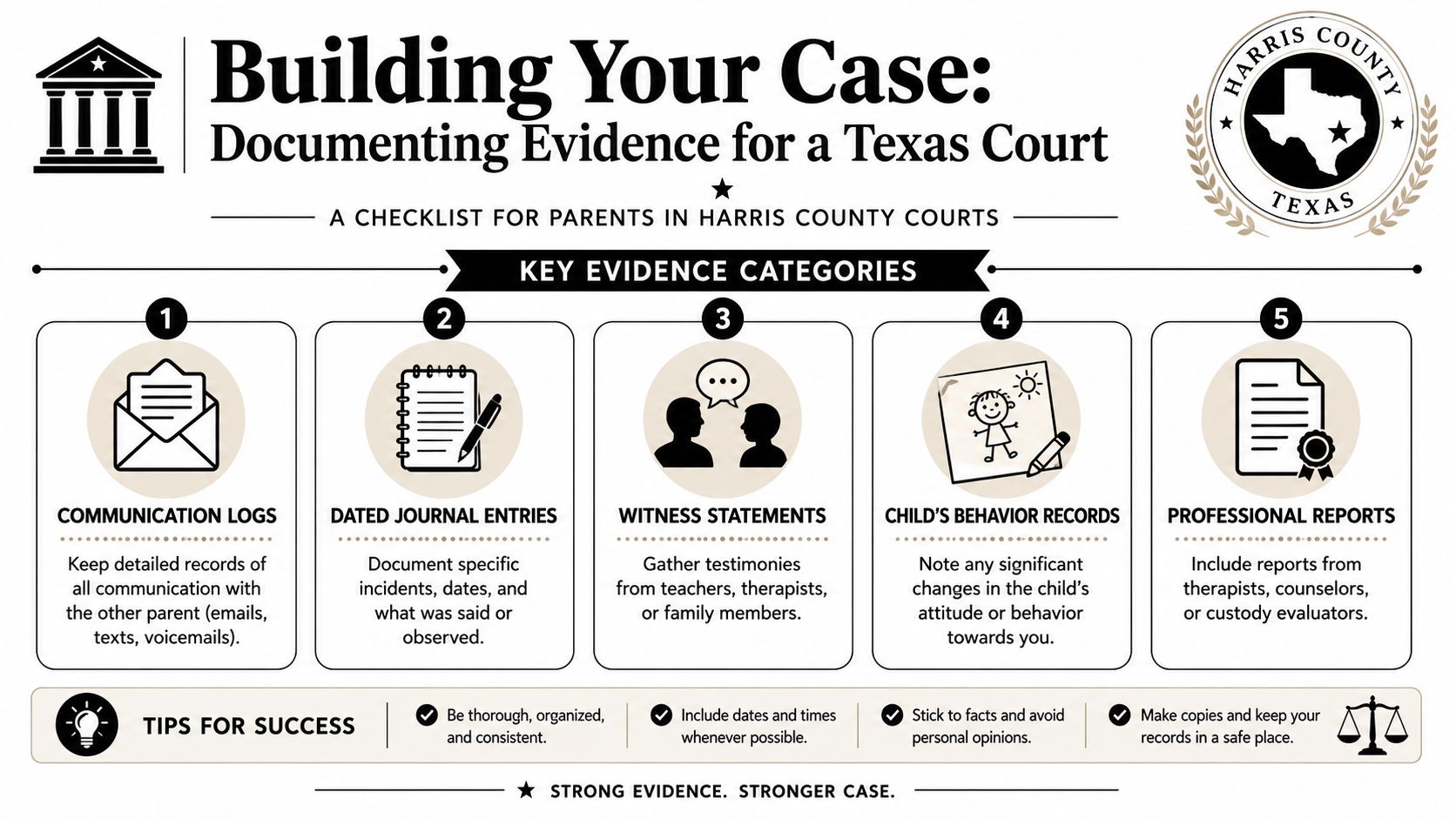
What to document every single time
If you live in Kingwood or Northeast Houston, build your file like you expect a judge to read it.
Record dates and times.
Write down the exact day, pickup time, missed call time, or exchange problem.Capture the actual words used.
If your child says, “Mom said you abandoned us,” write that exact sentence. Don't clean it up.Note what happened before and after.
Was there a denied FaceTime call? A last-minute cancellation? A school event you weren't told about?Stay factual.
“Other parent refused to answer the door at 6:00 p.m.” is useful. “She's evil and trying to destroy me” is not.Preserve the full thread.
Don't submit cropped screenshots that hide context. Courts want complete communications, not selected snippets.
Evidence that carries weight in Harris County
Useful evidence often includes:
- Communication records: Emails, texts, parent-app messages, voicemails, and social media posts.
- Missed possession logs: Keep a running chart of denied visits, late exchanges, and excuses given.
- Third-party observations: Teachers, coaches, counselors, relatives, and childcare providers can notice sudden changes.
- Professional records: Therapy notes, evaluations, and custody-related assessments when properly obtained.
- Behavior notes: Record when your child's attitude changes sharply after time with the other parent.
If you're thinking about making audio recordings, learn the legal limits first. A practical starting point is this resource on is it illegal to record audio, because gathering evidence the wrong way can create new problems.
Keep an emotion-free log. Judges trust records that read like a timeline, not a rant.
Local strategy for Kingwood parents
In Harris County, details matter. A teacher from Kingwood ISD, a coach in Humble, or a childcare provider who observed a sudden shift can become an important witness. So can records showing you repeatedly asked for school information and got ignored.
For a deeper look at the proof courts want, review this guide on how to prove parental alienation. If the issue also involves repeated violations of an existing order, Enforcement of Court Orders in Kingwood addresses enforcing divorce decree and custody order provisions in Harris County.
Legal Remedies to Protect Your Parental Rights
You followed the order, showed up for your time, and kept records. Your child still starts pulling away because the other parent keeps interfering. At that point, you need more than patience. You need a court order that stops the conduct and protects your relationship before more damage is done.
Texas judges do have tools to address parental alienation. The remedy depends on two things. What the current order requires, and what admissible evidence shows is happening. In Harris County, that distinction matters. Judges do not act on suspicion or angry accusations. They act on missed exchanges, blocked communication, school interference, witness testimony, counseling records that were properly obtained, and a clear pattern tied to the child's change in behavior.
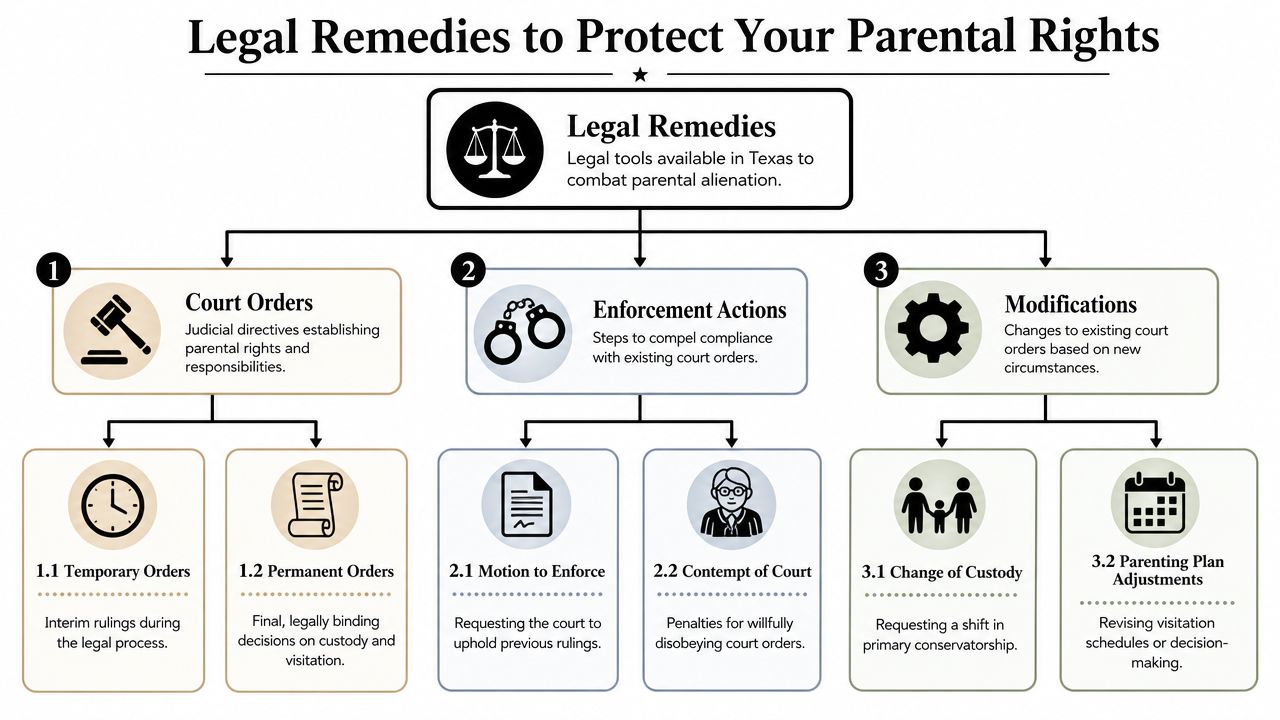
The main tools Texas courts use
Motion to modify custody or visitation
If the current order is no longer protecting your parent-child relationship, a modification may be the right move. A judge can change possession terms, add detailed communication rules, require exchange conditions, or change who decides educational or medical issues. In serious cases, the court can change primary conservatorship.
This remedy fits cases where the problem is persistent and harming the child, not just frustrating you. If your evidence shows a repeated pattern and not a single bad weekend, ask for relief that matches the pattern.
Contempt and enforcement
If the other parent is violating an existing court order, enforcement may be faster and more effective than asking for a full modification first. Courts can hold a parent in contempt for denying possession, withholding the child, refusing required notice, or blocking court-ordered communication.
If that is your situation, review what to do if the other parent violates a custody order in Kingwood, Texas. Then gather the exact proof the judge will expect. Date-specific violations, the language of the order, screenshots, police event numbers if any, and witnesses who saw the exchange problem.
Therapy and child-focused intervention
Some cases need more than punishment. They need repair. A judge can order reunification therapy, counseling, or other services aimed at restoring healthy contact and reducing pressure on the child.
The court may also appoint a guardian ad litem to investigate the child's best interests. That can help when one parent is presenting a polished story and the records tell a different one. In Harris County courtrooms, neutral professionals often carry more weight than either parent's opinion.
To see how these remedies fit into a real custody dispute, this video gives helpful context.
Severe cases call for stronger action
When the alienating conduct is sustained and well documented, judges can impose stronger restrictions. That may include supervised visitation for the offending parent, limits on contact that undermines the child's relationship with you, or a transfer of primary custody. Courts use those remedies to protect the child, not to reward either parent.
The goal is to stop the conduct, stabilize the child, and rebuild trust.
A practical point matters here. Ask for orders the court can enforce. Vague requests like “make the other parent cooperate” are weak. Specific requests work better. Daily call windows, school access provisions, counseling requirements, exchange terms, makeup time, and clear non-disparagement language give the judge something concrete to sign and enforce.
Law Office of Bryan Fagan – Kingwood TX Lawyers handles family law matters involving custody, support, divorce, and enforcement for local families who need a court-based solution.
Navigating the Court Process Step by Step
The court process feels intimidating because most parents haven't been through it before. But it's easier to handle when you know what's coming.
If a child is over 12, Texas courts must interview the child upon request to assess their reasoning for rejecting a parent. For younger children, the interview is discretionary. Judges often rely on expert testimony to distinguish rehearsed complaints that suggest alienation from verifiable incidents that suggest estrangement, and proven alienation can lead to reduced visitation, supervised visits, or court-ordered reunification therapy, as described in this Texas custody answer about parental alienation.
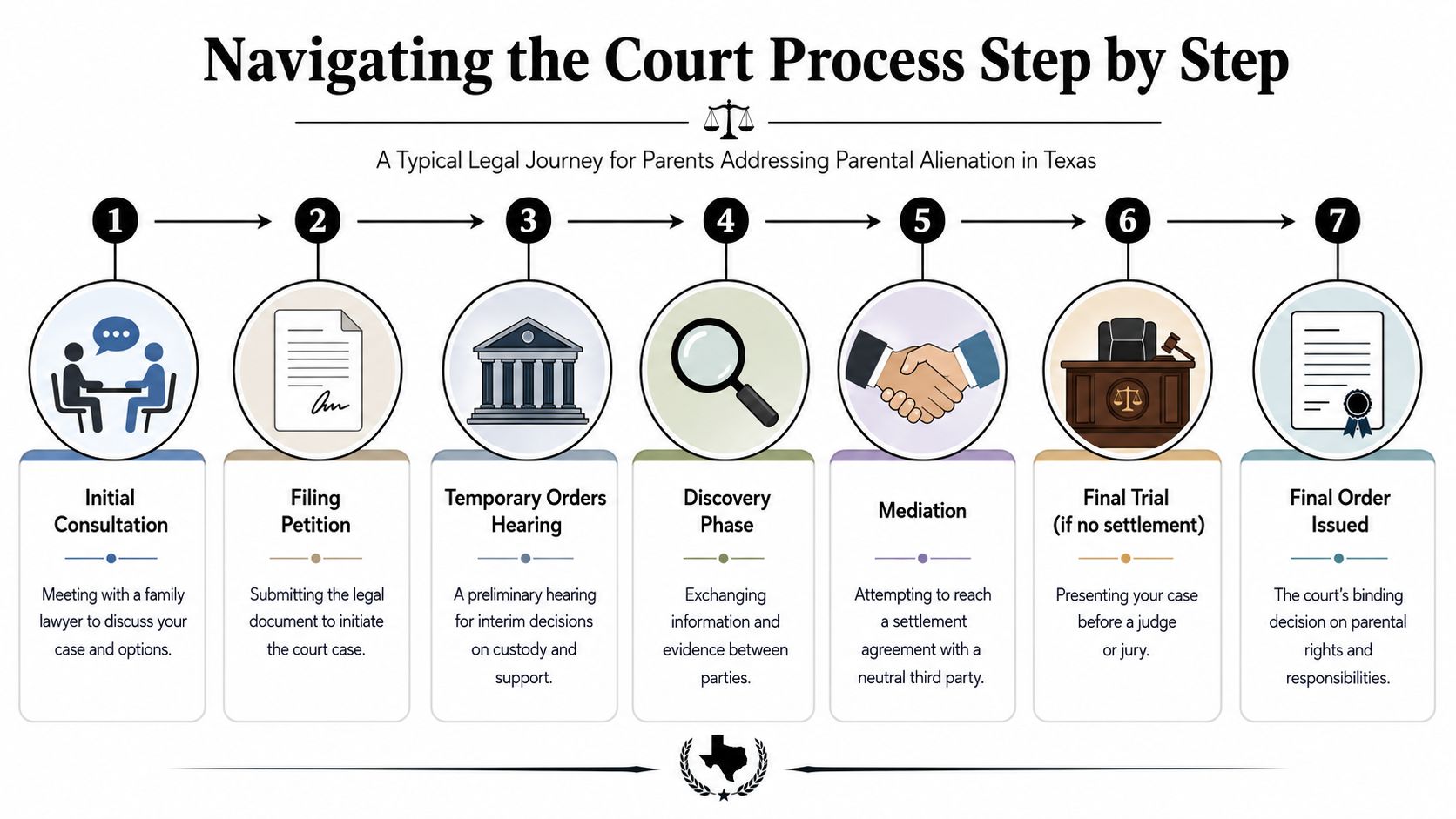
What usually happens
- Initial consultation: You bring your timeline, court orders, communications, and concerns.
- Filing the case: Your attorney files the motion that matches the problem. Usually that's modification, enforcement, or both.
- Temporary orders hearing: If the situation is urgent, the court can address short-term issues while the case continues.
- Discovery: Each side gathers records, messages, witness information, and professional opinions.
- Mediation: Many Harris County courts require an effort to resolve some issues before trial.
- Final hearing or trial: The judge hears evidence, listens to witnesses, and decides what orders will protect the child.
Child interviews and experts
Parents in Humble and Northeast Houston often worry most about one thing. “Will the judge talk to my child?”
Sometimes, yes. For children over 12, that request carries legal weight. For younger children, the judge decides whether an interview is appropriate. The child doesn't get to unilaterally choose the outcome, but the child's reasoning can matter a great deal.
Mental health professionals also matter. A therapist, evaluator, or other qualified expert may help the court separate manipulation from legitimate fear or resentment.
How to prepare without making it worse
Your job during the case is to stay steady.
- Follow the current order: Don't retaliate by withholding the child.
- Keep communicating calmly: Angry texts become exhibits.
- Protect the child from the conflict: Don't interrogate your child after visits.
- Organize your file: Judges appreciate clean timelines and complete records.
If you're heading toward a hearing in Kingwood or Harris County, this guide on how to prepare for a custody hearing in Kingwood, TX can help you get ready.
When to Contact Our Kingwood Family Law Attorneys
If you're seeing a pattern, don't wait for it to fix itself. Alienation usually gets worse when nobody confronts it. The longer it continues, the harder it can be to repair the relationship.
Call a lawyer when your child starts rejecting you without a clear reason, when court-ordered contact keeps getting blocked, when you're being cut out of school or medical information, or when your child repeats adult accusations that clearly came from the other parent. Those are not minor co-parenting annoyances. They're warning signs.
For families in Kingwood, Humble, Porter, and Northeast Houston, local support matters. A family lawyer can help with court filings and evidence strategy. A counselor or child therapist in the Kingwood area may help your child process the conflict in a healthier setting. In some cases, school staff can also become part of the factual picture if they've observed a sudden change.
A free consultation gives you a place to sort out what's real, what the court will care about, and what steps make sense next. You don't need to arrive with a perfect case file. You do need to stop waiting and start protecting your relationship with your child.
Frequently Asked Questions About Parental Alienation in Texas
Can my child refuse to see me during my court-ordered visitation
Usually, no. A child doesn't override a court order because they say they don't want to go. If the order gives you possession, the other parent is expected to comply. If there are real safety concerns, those belong in court, not in unilateral decisions at the curb.
What if the other parent badmouths me in private and I have no witnesses
You build the case through patterns. Save messages. Keep a dated log. Note the child's exact words when they suddenly repeat adult themes. Look for third-party observations from teachers, coaches, counselors, or relatives who saw the child's behavior change.
Will a judge believe me without hard proof
Not just because you're upset. Judges hear accusations every day. They respond to documentation, consistent facts, complete communication records, and credible witnesses.
Can the court order counseling
Yes. Texas courts can order therapeutic interventions in the right case. That can include counseling or reunification-focused work when the facts support it.
Can the alienating parent be forced to pay my attorney's fees
The court may order attorney's fees or other penalties in enforcement and contempt situations, depending on the facts and the orders violated. But don't build your case around punishment. Build it around protection of your child and your parent-child bond.
What if my child is repeating things that sound coached
Write down the exact statements, the date, the setting, and what happened around the conversation. Don't coach your child back. Don't argue with them. Keep your reaction calm and put the incident in your record.
Do I need a lawyer if I already have evidence
Yes, if you want that evidence turned into a clear legal strategy. Good evidence can still be presented badly. The court process is too important to wing it.
If your relationship with your child is changing and you believe parental alienation may be happening, talk with Law Office of Bryan Fagan – Kingwood TX Lawyers. Our Kingwood office serves families in Kingwood, Humble, Porter, and Northeast Houston, and a free consultation can help you understand your options, protect your rights, and build a practical plan for your next step.