Skip to content
A police stop, an arrest, a court date, then a flood of questions. If you live in Kingwood, Humble, Porter, or Northeast Houston, you may be lying awake wondering whether one charge is going to follow you for years. You might be thinking about your job, your professional license, your apartment application, or even how this looks in a close community where people know your name.
Many people in that position assume there are only two outcomes. A conviction or a dismissal. Texas law can be more nuanced than that. In some cases, there's a middle path that gives a person a real chance to avoid a final conviction if they follow strict court rules.
That path is called deferred adjudication. It isn't available in every case, and it isn't automatic. But for the right person, it can function like a legal second chance.
If you're trying to understand whether that option might apply in your situation, a local criminal defense attorney near me in Kingwood can help you look at the charge, the court, and the long-term effect on your record.
An Introduction for Kingwood Residents Facing Charges
A lot of clients come in carrying the same fear. They aren't only worried about the next court date. They're worried about the rest of their life.
A Kingwood parent may be asking whether a background check will affect school volunteering. A worker in Humble may be worried that one mistake could cost a promotion. Someone in Porter may be wondering how to explain a pending case to family members who already feel stressed. Those worries are normal.
Texas criminal cases often move fast at the beginning, but the consequences can last much longer. That's why it helps to slow down and understand the actual options in front of you before making any plea decision. Deferred adjudication is one of those options. For some first-time offenders and some lower-risk cases, it can offer a structured way to move forward without ending with a final conviction.
A criminal charge feels personal because it is personal. Your record affects work, housing, family life, and peace of mind.
People across Northeast Houston also run into confusion because the phrase sounds technical and distant. It isn't. Deferred adjudication involves whether the court will hold back a finding of guilt while you prove, through compliance, that this charge shouldn't become a final conviction.
That possibility can matter just as much to a construction worker, nurse, student, or parent as it does to anyone else in Harris County.
What Deferred Adjudication Means Under Texas Law
What is deferred adjudication? Under Texas law, it's a sentencing alternative where a defendant pleads guilty or no contest, but the finding of guilt is deferred. If the person successfully completes community supervision, the judge dismisses the charges, and there is no final conviction. Misdemeanor supervision can last up to 2 years, and felony supervision can last up to 10 years, according to Texas deferred adjudication rules explained here.
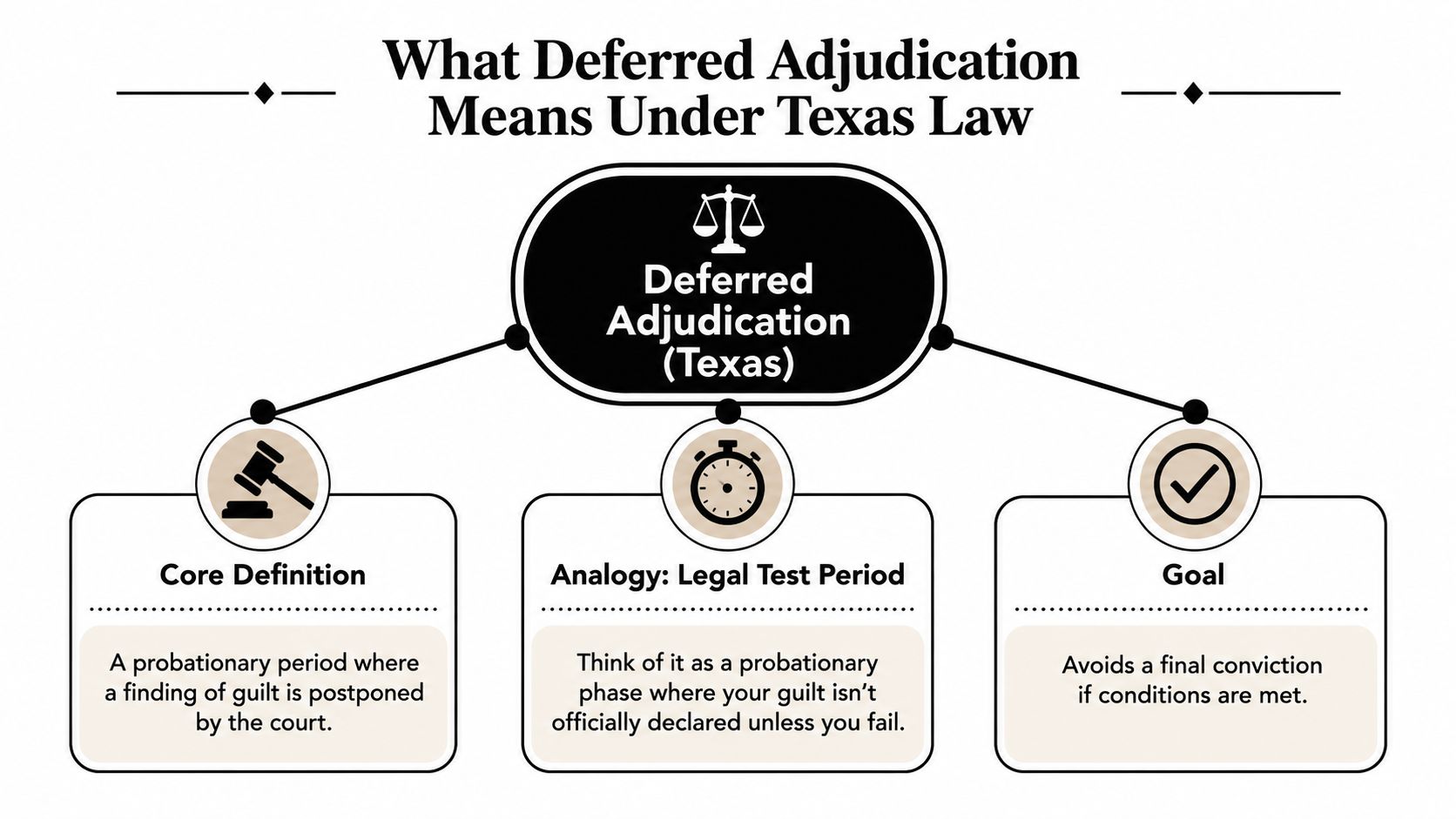
A simple way to think about it
Think of deferred adjudication like a probationary period before a final grade is entered. The court doesn't say, "You passed with no issue." It also doesn't immediately enter the failing mark. Instead, the court says, "Follow these conditions, and you can finish without a final conviction."
That difference is huge.
With a normal conviction, the finding of guilt is already on the record. With deferred adjudication, the court delays that finding. If you complete the terms, the case ends in dismissal rather than conviction.
What a judge usually requires
Deferred adjudication still comes with real obligations. Depending on the case, the court may require community service, fines, reporting, proof of income, and avoiding alcohol or controlled substances, with compliance sometimes checked through random testing, as summarized in this Texas deferred adjudication overview.
Typical conditions may include:
- Court supervision: You must report and follow all rules set by the court or supervision officer.
- Financial obligations: Courts often require payment of fines, fees, or restitution when applicable.
- Behavioral requirements: Counseling, classes, or sobriety conditions may be part of the deal.
- No new trouble: A new arrest or violation can put the entire outcome at risk.
Not everyone qualifies. Some offenses are excluded, and this option must be addressed before trial. In Texas, a jury can't grant deferred adjudication. The request has to be presented to the judge in the right procedural posture.
For local readers who also deal with family-law-related court systems, Harris County Family Courts: A Kingwood Resident's Guide explains how family law cases proceed in the Harris County courts serving Kingwood. Criminal and family matters are different systems, but both can feel less overwhelming when you understand which court is making which decisions.
Practical rule: Deferred adjudication is not a free pass. It's a chance to earn a dismissal by doing exactly what the court orders.
Deferred Adjudication vs Regular Probation and Conviction
The biggest misunderstanding I hear from people in Kingwood and Humble is this: they think probation and deferred adjudication mean the same thing. They don't.
This visual helps frame the difference.
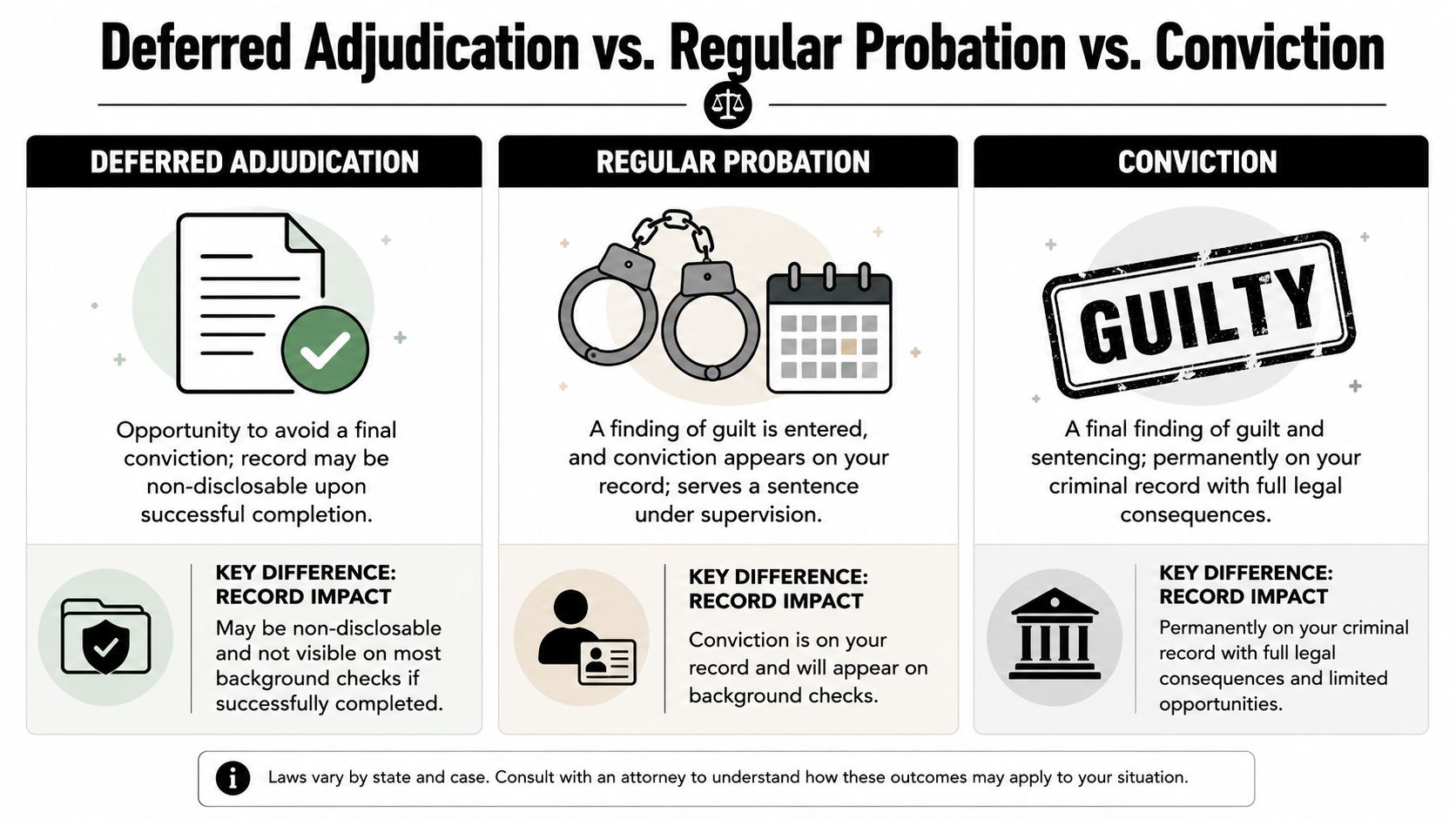
With regular probation, the court first finds you guilty and enters a conviction, then lets you serve the sentence under supervision instead of going straight to jail. With deferred adjudication, the court holds off on that finding of guilt. With a final conviction, the case ends with guilt entered and sentence imposed.
Side by side comparison
| Feature | Deferred Adjudication | Regular Probation | Final Conviction |
|---|---|---|---|
| Initial plea or finding | Plea of guilty or no contest, but guilt is deferred | Guilty finding or conviction entered first | Guilty finding entered |
| Conviction on record at that point | No final conviction if successfully completed | Yes | Yes |
| Court supervision | Yes | Yes | May include probation, jail, fines, or other sentence |
| If completed successfully | Charges dismissed | Sentence completed, but conviction remains | Conviction remains |
| Main long-term difference | Chance to avoid final conviction | Conviction stays on record | Conviction stays on record |
Why the distinction matters
For a resident in Porter applying for work, this distinction can affect how a criminal history looks. For someone in Humble renting an apartment, it can affect what shows up during screening. For a parent in Northeast Houston involved in any court matter, protecting the record can reduce future stress.
That doesn't mean deferred adjudication is risk-free. You still give a plea. You still accept conditions. You still answer to the court. But if your goal is to avoid a final conviction, deferred adjudication usually puts you in a better position than regular probation.
A simple way to remember it:
- Deferred adjudication: "I have a chance to finish without a final conviction."
- Regular probation: "I was convicted, but I serve the sentence under supervision."
- Final conviction: "The case ended with guilt formally entered."
This is why people asking what is deferred adjudication are usually asking a deeper question. They're really asking how to protect the rest of their future.
The Process for Seeking Deferred Adjudication in Harris County
The process in Harris County doesn't start with walking into court and asking for mercy. It starts much earlier, with strategy.
For Kingwood-area residents, the path usually depends on the charge, your history, the prosecutor's position, and the judge's willingness to approve the arrangement. Deferred adjudication is commonly considered for people with cleaner records, especially where the facts suggest a mistake rather than an ongoing danger to the community.
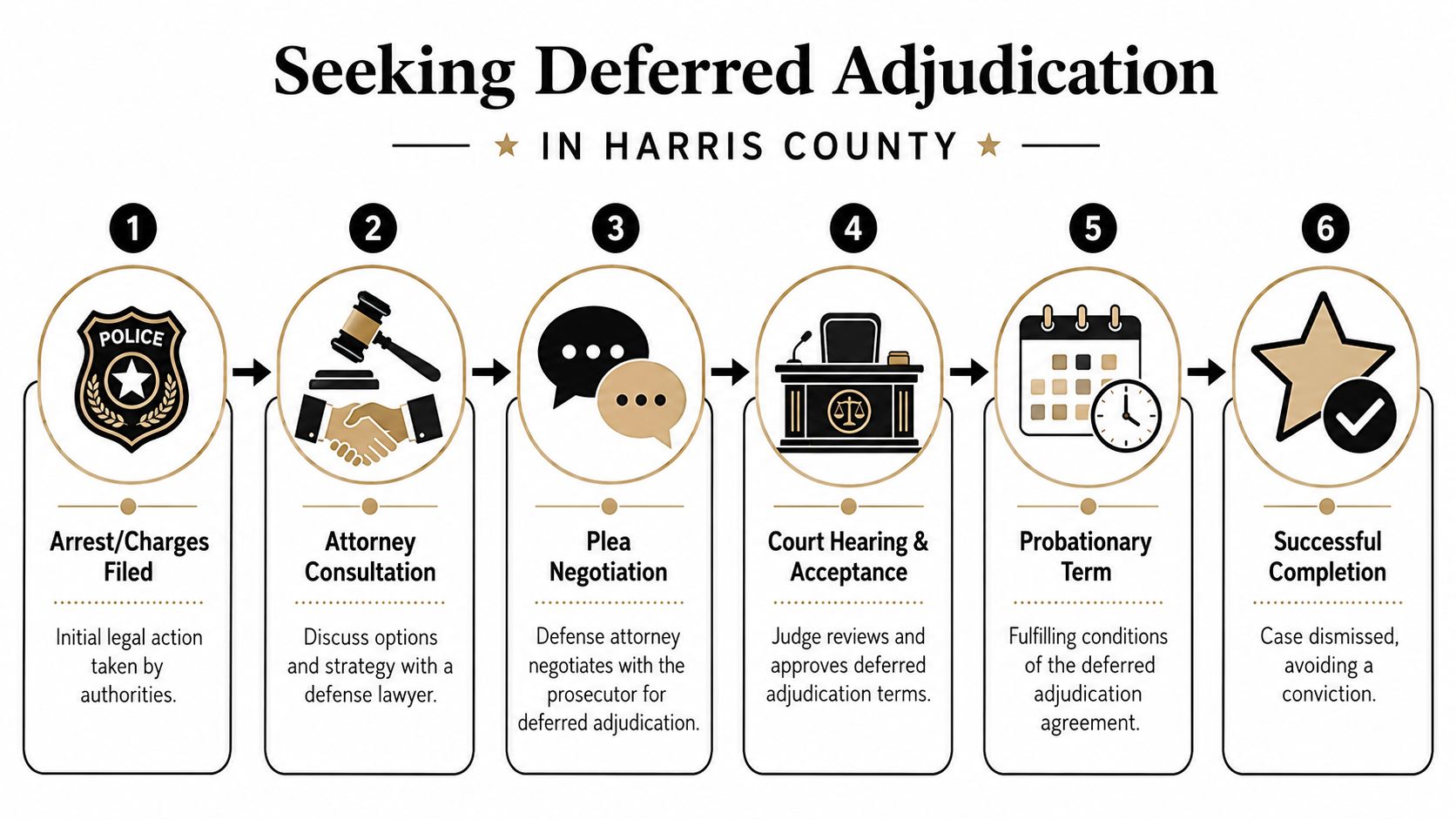
How the process usually unfolds
The case begins
An arrest is made or charges are filed. Early paperwork matters, and so does what you say and do next.
Your lawyer evaluates eligibility
The defense reviews the offense, your background, and whether the charge falls into a category that may be excluded.
Negotiation happens with the prosecutor
Deferred adjudication often comes through plea negotiation. It isn't something you merely claim as a right.
A plea is prepared for court
In Texas, deferred adjudication requires a guilty or no contest plea. It also must be considered by the judge, not a jury.
The judge decides
Only a judge can grant deferred adjudication, which means the defendant and prosecutor must agree to waive a jury trial before the court can consider it, as explained in this discussion of judge-only deferred adjudication procedure.
Supervision begins
If approved, you enter community supervision under the court's terms.
For many readers, the first court appearance is confusing. If you want a simple overview of that stage, this guide on what happens at an arraignment hearing can help you understand the basics.
What can block this outcome
Some charges are permanently ineligible. Texas also excludes certain intoxication-related and repeat offenses from deferred adjudication in specific circumstances. Eligibility can turn on facts that look minor to a non-lawyer but matter greatly in court.
A few practical points matter right away:
- Timing matters: Deferred adjudication must be addressed before trial.
- Your history matters: A clean record often helps.
- The charge matters: Some offenses are excluded no matter how persuasive your personal story is.
- Local practice matters: Harris County procedures and courtroom expectations shape negotiations.
For parents balancing criminal issues with family obligations, related legal needs can continue moving at the same time. A Child Support Attorney in Kingwood handles establishing, modifying, and enforcing child support in Harris County. Criminal and family cases are separate, but they often overlap in real life because one court problem can affect work schedules, payments, and parenting stress.
If you're evaluating options locally, the Law Office of Bryan Fagan – Kingwood TX Lawyers provides criminal defense representation in Kingwood and surrounding Northeast Houston communities.
Life After Successfully Completing Deferred Adjudication
Finishing deferred adjudication is a serious accomplishment. It means you followed the rules, met the conditions, and avoided a final conviction. That's not a technical victory. It's a meaningful legal and personal result.

For first-time offenders, the program can support long-term rehabilitation. One Texas source states that deferred adjudication led to a 75% reduction in future convictions over a decade for defendants without prior felony records, according to this review of deferred adjudication outcomes in Texas.
What gets better after completion
The biggest benefit is straightforward. The judge dismisses the charge instead of entering a final conviction.
That can help with:
- Employment conversations: A dismissed case is different from a conviction when an employer reviews your history.
- Housing applications: Avoiding a conviction can put you in a stronger position with landlords.
- Professional reputation: In close communities like Kingwood and Humble, protecting your record often protects your standing.
- Personal recovery: Many people can finally begin moving forward once the case is resolved.
What still remains a problem
Success doesn't mean the case disappears from every record system. The arrest and court history may still exist unless you take another legal step to seal access to the record.
That's the part many people don't learn until later, often after a background check surprises them.
Completing deferred adjudication is a win. It just isn't the end of the record-clearing process.
Some practical frustration often arises. A person may tell an employer, "My case was dismissed," and still find that an arrest or deferred outcome appears in screening records. That doesn't erase the value of deferred adjudication. It means you need to understand the next step before assuming the matter is fully behind you.
For people in Kingwood, Porter, and Northeast Houston, that practical distinction matters more than legal vocabulary. It affects interviews, leases, and confidence when someone asks about your history.
The Most Important Step Sealing Your Criminal Record
The most common mistake people make after finishing deferred adjudication is assuming the record clears itself. It doesn't.
Texas law requires a separate Petition for Non-Disclosure to seal the record from public view in eligible cases. It is not automatic. It is not bundled into the dismissal. It is a separate request, and for some offenses, it isn't available at all. A Texas defense resource explains that family violence offenses are ineligible for non-disclosure, and felonies require a five-year waiting period before filing in eligible situations, in this explanation of deferred adjudication and non-disclosure limits.
Why this step matters so much
If you stop after completing supervision, you may still have a public-facing record that shows the arrest and case history. For many people in Harris County, that's the difference between "I finished my case" and "I protected my future."
Non-disclosure can matter when you're dealing with:
- Background checks for work
- Apartment and rental screening
- Professional licensing reviews
- General online visibility of court-related information
Some misdemeanor cases allow filing after a waiting period, and some require no wait depending on the offense category. Some misdemeanor offenses mentioned in Texas materials require a two-year waiting period. Eligible felonies require a five-year wait. Family violence cases cannot be sealed through non-disclosure.
A practical way to think about it
Deferred adjudication helps you avoid the final conviction. A petition for non-disclosure helps you limit who can see the record.
Those are related steps, but they are not the same step.
If you're also trying to understand the difference between sealing and removing a record entirely, this page on how to expunge a criminal record in Texas can help clarify the distinction. Expunction and non-disclosure solve different problems.
Key takeaway: Deferred adjudication is often the first half of record protection. Non-disclosure is often the second half.
This is especially important for Kingwood and Humble residents who thought the word "dismissed" meant invisible. In everyday conversation, people hear dismissal and assume the matter vanished. In court records, that assumption can be costly.
If you've already completed deferred adjudication, it may be time to look at eligibility, waiting periods, and whether a non-disclosure petition should be filed.
Common Questions and When to Call a Kingwood Lawyer
Is deferred adjudication the same as pretrial diversion
No. Deferred adjudication requires a plea of guilty or no contest before the court defers a finding of guilt. If the program is violated, that plea allows immediate sentencing without a new trial, as explained in this comparison of deferred adjudication and pretrial diversion.
Pretrial diversion is different because it doesn't require that same plea-first structure.
Can I get deferred adjudication for any criminal charge
No. Some offenses are excluded under Texas law. Eligibility depends on the charge, the facts, your history, and whether the prosecutor and judge will agree. That's why a quick internet search usually isn't enough to answer the question for a real Harris County case.
If my case was dismissed after deferred adjudication, will employers still see it
They may see parts of the record unless you also pursue non-disclosure, if your case qualifies. That's one reason people who care about long-term privacy often look beyond the courtroom result and also think about safeguarding digital privacy from court records when old case information continues circulating online.
When should I call a lawyer
Call early. The best time is before you enter a plea, before you assume you're ineligible, and before you rely on advice from friends or online forums. Timing affects negotiation, eligibility review, and long-term strategy.
If you're in Kingwood, Humble, Porter, or nearby Northeast Houston, you don't have to sort through this alone. Deferred adjudication can be a valuable second chance, but only if it's handled carefully from the start and followed through after completion.
If you're worried about a charge, your record, or whether deferred adjudication could protect your future, schedule a free consultation with Law Office of Bryan Fagan – Kingwood TX Lawyers. Our Kingwood office works with local residents who need clear answers about criminal defense, family law, estate planning, and civil matters under Texas law, and we can help you understand your options in plain English.