Many families in Kingwood reach the same point at about the same time. They've paid off a home, built savings, maybe own a business interest or investment account, and now they're asking a harder question: how do we protect what we've built for our children and grandchildren?
For some, the worry is a future lawsuit. For others in Humble, Porter, and Northeast Houston, it's the rising fear of long-term care costs and what that could do to a lifetime of work. Estate planning gets emotional fast because it isn't just about property. It's about independence, fairness, and making sure your family isn't left cleaning up avoidable problems later.
That's where an irrevocable trust often enters the conversation. It's one of the strongest planning tools available under Texas law, but it's also one of the most misunderstood. People hear the word “irrevocable” and assume it's only for the ultra-wealthy, or that it means losing everything overnight. Neither assumption is right.
A better way to think about it is this: an irrevocable trust can protect part of your legacy when flexibility is no longer the top priority. If you're starting to organize your estate planning papers, this practical overview from Family Caregiving Kit's estate planning resource is a useful companion for families trying to sort through the big-picture decisions at home.
Planning Your Family's Future in Kingwood
A couple in Kingwood might own their home, have retirement accounts, and want to leave something meaningful behind. Their main concern may not be probate. It may be making sure a health crisis, creditor issue, or later-life care expense doesn't wipe out assets they hoped would stay in the family.
That concern is common in Humble and Porter too. Families work for decades to build stability, and then one legal or medical issue can force fast decisions. An irrevocable trust can help, but only when it fits the family's goals and is set up the right way.
Why this feels overwhelming
The average person doesn't spend their weekends reading the Texas Property Code. They're trying to decide practical things like:
- Should we protect the house now or wait?
- Will we still be able to use our assets?
- Could this help with future Medicaid planning?
- What happens if family circumstances change later?
Those are the right questions.
A good estate plan should make your family's next step clearer, not more confusing.
Why local guidance matters
Texas trust law has its own rules, and local families in Northeast Houston often run into online articles that speak in broad national terms. That's where people get tripped up. A generic article may explain what an irrevocable trust is, but it often misses the local legal details that matter when you sign documents and transfer assets.
For Kingwood residents, the goal isn't to collect legal vocabulary. The goal is to make a calm, informed decision about whether an irrevocable trust belongs in the larger estate plan.
What Is an Irrevocable Trust in Texas
An irrevocable trust is a legal arrangement where a person transfers assets into a trust and gives a trustee the authority to manage them for named beneficiaries. In plain English, it's a lot like placing assets into a locked safe and handing the key to someone you trust to manage it under written rules.
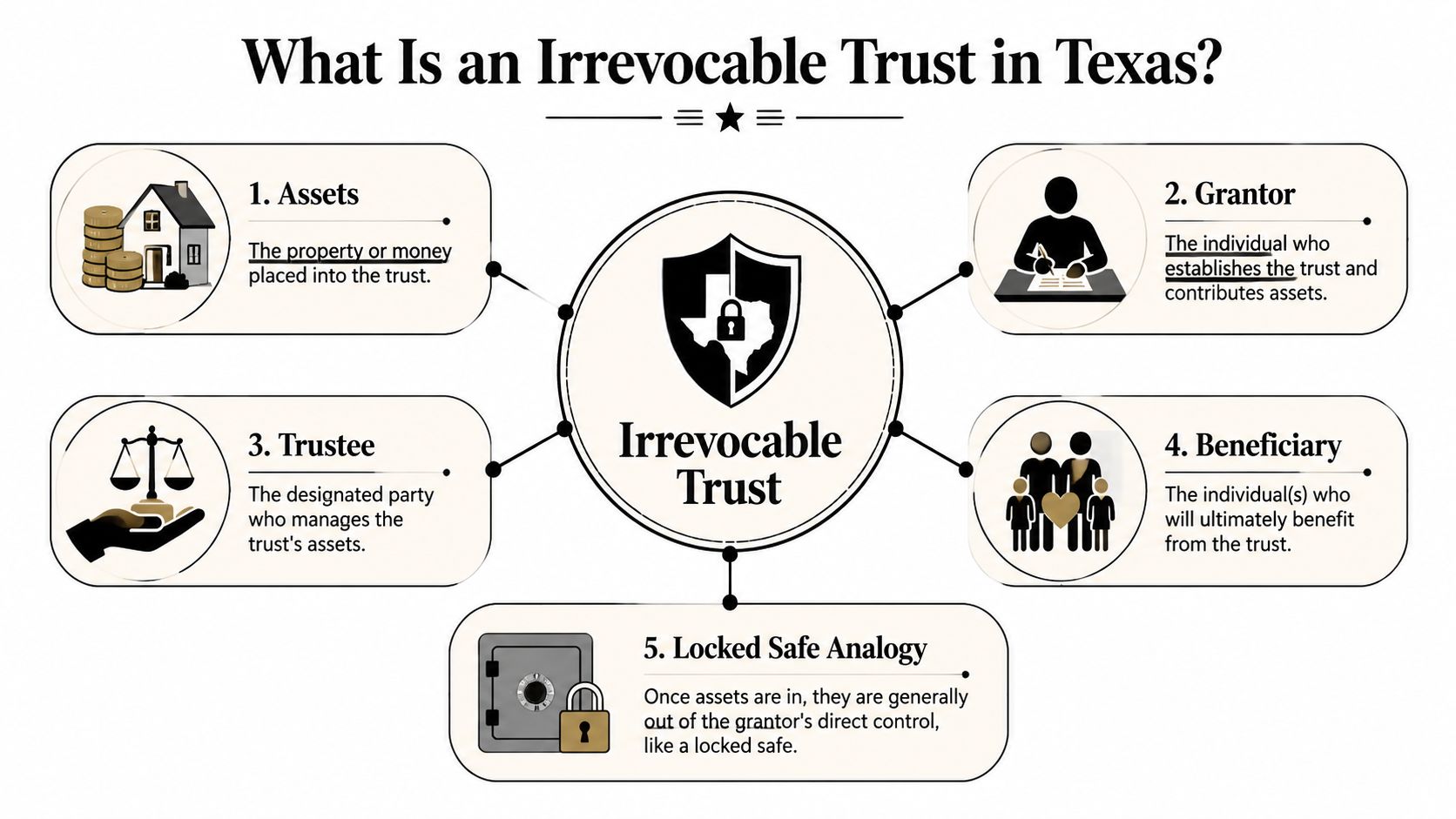
The locked safe idea
The safe analogy helps because it explains the tradeoff. Once property goes into the trust, it's generally no longer under the grantor's direct personal control. That loss of control is exactly why the trust may offer stronger protection than a revocable trust.
A revocable trust works differently. The person who creates it usually keeps the power to change it, amend it, or end it. That flexibility is useful, but it doesn't create the same separation between the person and the assets.
If you want a side-by-side explanation, this guide on revocable trust vs irrevocable trust helps show how the two tools serve different purposes for Texas families.
The Texas rule that surprises people
Texas has a rule that catches many people off guard. Under Chapter 112 of the Texas Property Code, specifically Section 112.051, the default legal status of every trust created in Texas is revocable unless the document explicitly states it is irrevocable (Texas Property Code Section 112.051).
That means no one should assume a trust is irrevocable just because that was the family's intention. The document has to say so clearly.
Practical rule: In Texas, “close enough” drafting isn't enough. If the trust instrument doesn't expressly make the trust irrevocable, the law treats it as revocable.
Why drafting matters so much
This is why legal wording matters for Kingwood and Northeast Houston families. The entire benefit of an irrevocable trust depends on the trust being irrevocable under Texas law. If that point is missed, the document may fail to provide the protection the family expected.
For families looking at broader planning options, an Estate Planning Attorney in Kingwood handles wills, trusts, and estate plans for Kingwood families. That kind of planning often starts with a simple question: what are you trying to protect, and from what?
The Benefits and Risks of an Irrevocable Trust
An irrevocable trust can be powerful. It can also be the wrong fit if you need flexibility more than protection. Families in Kingwood should look at both sides before moving assets.
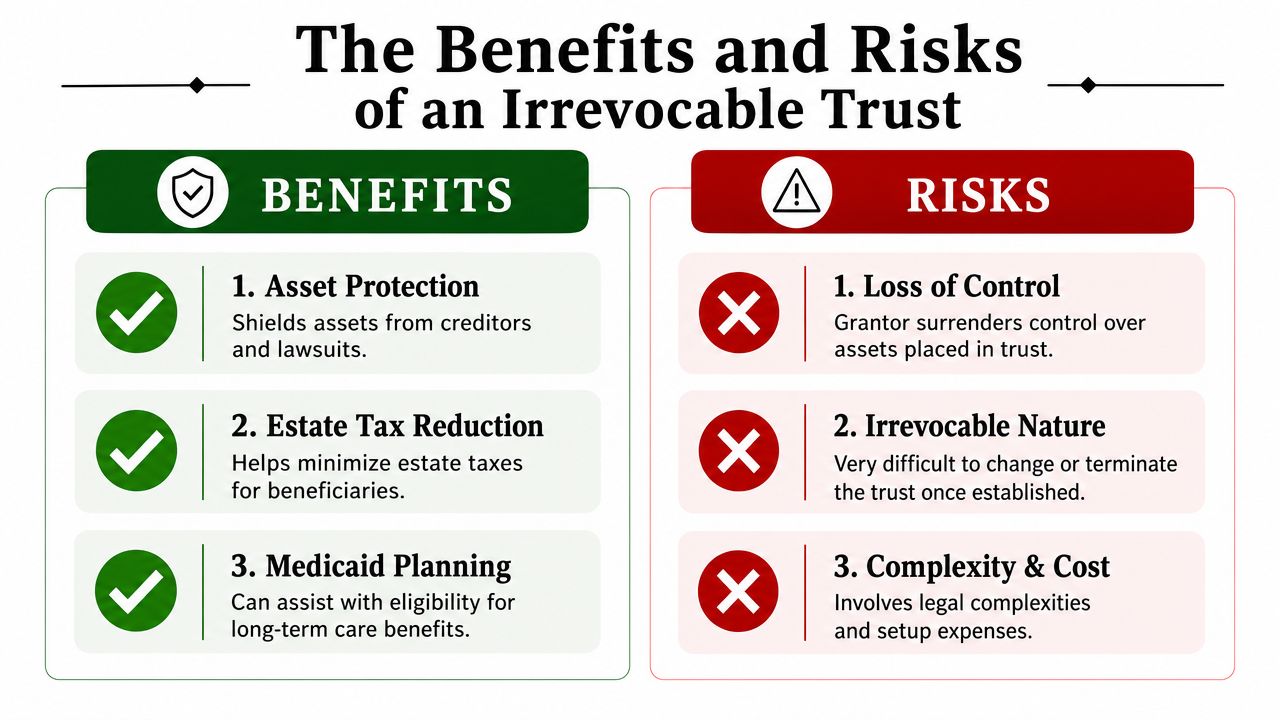
To make that easier, start with the big picture below.
Where the benefits come from
The biggest advantage is separation. When assets are no longer personally owned in the same way, they may be harder for creditors to reach and may be treated differently for estate and long-term care planning purposes.
One important tax point is established in Texas planning guidance. When assets are transferred into an irrevocable trust in Texas, they are legally removed from the grantor's taxable estate entirely, meaning their value is not counted when calculating estate taxes owed to the government upon the grantor's death; this mechanism provides significant tax advantages for Kingwood residents with substantial assets (discussion of irrevocable vs revocable trust treatment in Texas).
Here are the benefits families often care about most:
- Asset protection: A properly structured trust may help shield assets from some creditor claims and lawsuits.
- Estate tax planning: Removing assets from the taxable estate can help preserve more for heirs.
- Long-term care strategy: Some families use irrevocable trusts as part of Medicaid planning, if they plan far enough in advance.
Later in life, these issues can overlap with family transitions too. For example, a family handling divorce and inherited property may also need guidance from a Property Division Lawyer in Kingwood for division of community property and complex assets for Kingwood divorces.
A short overview can help if you want another format before reading further.
The costs people don't always see coming
The strongest benefit of an irrevocable trust comes from the fact that you usually can't control the assets the same way anymore. That's also the hardest part emotionally.
A few risks deserve an honest look:
| Concern | Why it matters |
|---|---|
| Loss of control | You usually can't take assets back for personal use whenever you want. |
| Reduced flexibility | Family needs can change, but the trust may not adapt easily. |
| Administrative work | The trust has to be drafted, funded, and managed correctly. |
If a trust solves the wrong problem, the family pays for complexity without getting meaningful protection.
For many people in Humble and Porter, the right answer isn't “yes” or “no” to an irrevocable trust. It's whether one should hold a specific asset, for a specific reason, under a larger estate plan.
Common Types of Irrevocable Trusts Used in Texas
Not every irrevocable trust does the same job. The name may stay the same, but the purpose changes depending on what the family needs to protect.
Irrevocable life insurance trust
A common example is an Irrevocable Life Insurance Trust, often called an ILIT. This type of trust is used when a family wants life insurance proceeds handled outside the grantor's taxable estate and distributed under clear rules.
A Kingwood parent might use one because they want insurance money managed for children over time instead of paid outright in one lump sum. In that setting, the trust isn't just holding a policy. It's creating structure around how the proceeds are used.
Medicaid asset protection planning
Another common example is a trust used for future long-term care planning. For this type of trust, timing matters more than people expect.
In Texas, the implementation of an irrevocable trust for Medicaid planning is governed by a strict 60-month (five-year) look-back rule. Any assets transferred into an irrevocable trust are subject to this five-year penalty period before they are considered "shielded" from the grantor's estate for Medicaid eligibility determinations (Texas Health and Human Services Medicaid handbook).
That means a Porter family can't wait for a medical emergency and expect immediate protection. If the transfer happens too late, those assets may still count against eligibility.
For Medicaid planning, timing isn't a detail. It's the heart of the strategy.
Many families often feel frustrated. They hear that an irrevocable trust can help, but they aren't told that the planning must happen well before care is needed. For retirees in Kingwood and Humble, this often turns an abstract idea into a time-sensitive discussion.
Dynasty trust planning
A Dynasty Trust is aimed at multi-generation planning. The goal isn't just protecting one person's assets. It's preserving family wealth and controlling how it passes over time.
A Northeast Houston grandparent may like this structure if they want funds used for education, health, housing support, or staggered distributions to future generations. The value here is less about immediate crisis planning and more about long-term family stewardship.
Three broad uses tend to stand out:
- Insurance planning: Keep life insurance proceeds under trust management.
- Long-term care planning: Prepare early for future Medicaid-related concerns.
- Generational planning: Preserve and direct family assets beyond one generation.
The right choice depends on what problem you're trying to solve. A trust designed for taxes won't necessarily solve a Medicaid issue, and a Medicaid-focused trust won't always be the best option for passing values and assets to grandchildren.
How to Establish and Fund Your Trust in Kingwood
An irrevocable trust doesn't become useful just because someone signs a document. It has to be designed carefully and then funded correctly.
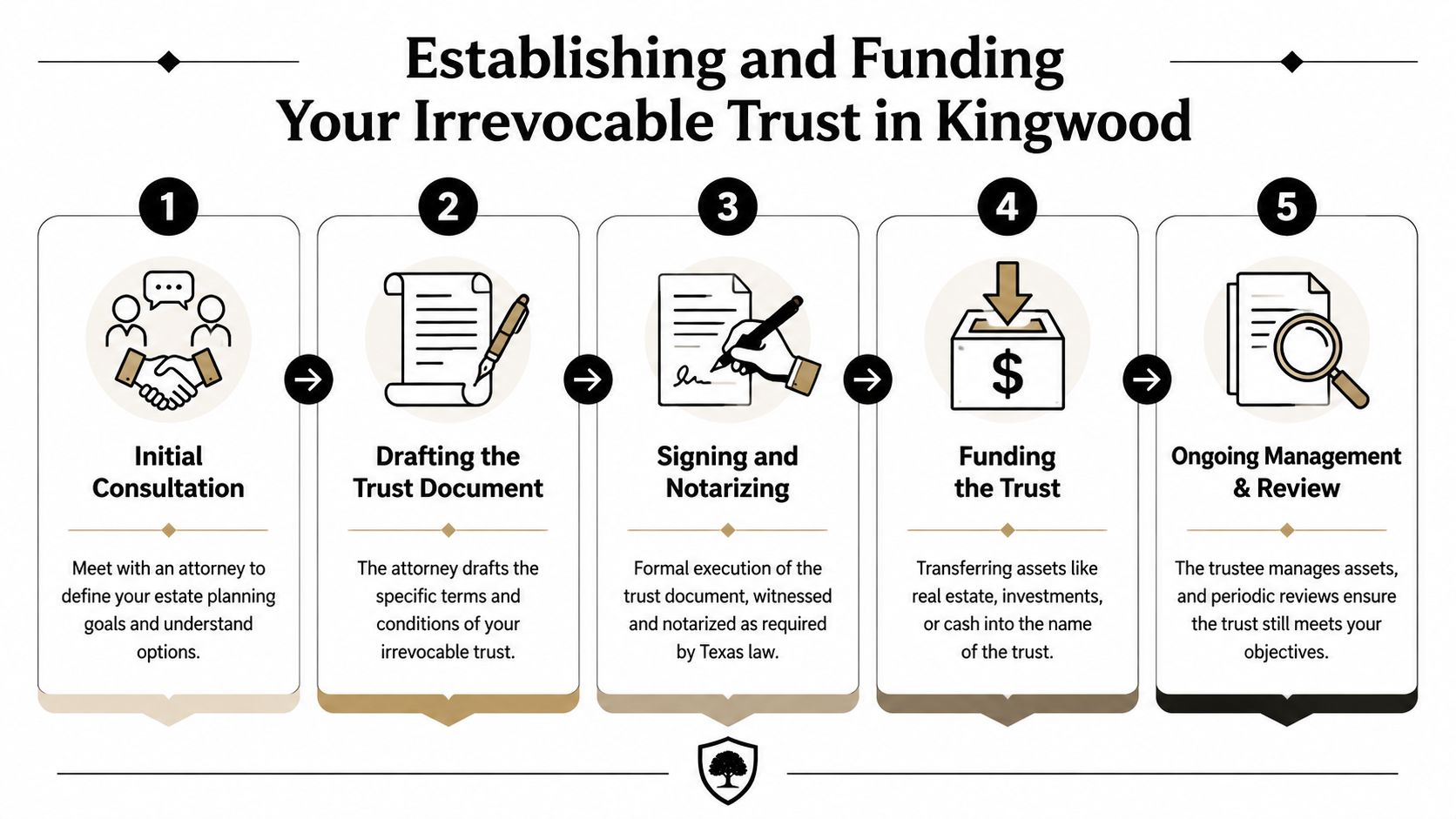
Step one and step two
Most Kingwood families start with goals, not forms. They sit down and identify what they want the trust to do. Protect a home? Support children? Plan ahead for long-term care? Reduce estate exposure? Those answers shape every later choice.
Then comes trustee selection. This step matters more than many people expect. The trustee is the person or institution that manages the assets and follows the trust instructions. If the trust is supposed to show that the grantor gave up meaningful control, choosing the wrong trustee can undermine the whole plan.
Step three and step four
Drafting comes next. Exact language is paramount, especially in Texas. The trust terms need to fit the purpose, define the beneficiaries, identify the trustee's powers, and coordinate with the larger estate plan.
After the document is signed, the most important practical step arrives: funding.
The operational mechanics of a Texas irrevocable trust hinge on "funding," where the grantor must legally transfer ownership of assets (e.g., real estate deeds, brokerage accounts) into the trust. Without this transfer, the trust remains a "shell" with no legal shield, as legal precedents confirm an unfunded irrevocable trust offers zero asset protection (Forbes Advisor discussion of funding a trust).
What funding looks like in real life
Funding means changing legal title or ownership. A few examples help:
- House in Kingwood or Humble: A new deed is prepared and recorded so the trust becomes the owner.
- Brokerage account: The account is retitled into the trust's name.
- Business interest: Assignment documents may be needed to transfer the ownership interest to the trust.
- Cash accounts: The bank may require trust paperwork before retitling or opening an account in the trust's name.
If you want a practical overview of the setup process, this page on how to set up a trust gives a useful starting point.
Signing a trust without funding it is like buying a safe and never putting anything inside.
Step five and ongoing review
After funding, the trustee manages the assets according to the written terms. Some trusts also need tax administration, recordkeeping, and periodic legal review if family circumstances shift.
One local option families may consider is the Law Office of Bryan Fagan – Kingwood TX Lawyers, which handles estate planning, wills, trusts, probate, and related legal matters for Kingwood and Northeast Houston residents. The important point isn't the name on the door. It's making sure the attorney understands Texas trust language and the funding steps needed to make the trust actually work.
Can You Ever Change an Irrevocable Trust
People often hear “irrevocable” and assume that means untouchable forever. In practice, Texas law allows some paths for change, but they're limited and usually technical.
Court-approved changes
One route is judicial modification. That means asking a court to approve changes to the trust when circumstances justify it. This isn't casual editing. The family has to show a legal basis for changing the trust terms.
For some families, that's reassuring. Life changes. Beneficiaries develop new needs. Trustees move, age, or become unable to serve. A court process can sometimes address those problems.
Agreements outside the courtroom
Another route may be a non-judicial settlement agreement. In the right setting, interested parties can agree to certain trust-related changes without asking a judge to decide every issue.
This idea tends to make more sense when people think of it in everyday terms. Families modify legal arrangements in other areas too, though each field has its own rules and limits. For example, Custody & Support Modifications in Kingwood involve modifying existing custody, visitation, and support orders in Harris County. Trust changes are different, but the larger point is familiar: some legal orders can be adjusted when circumstances shift.
Decanting
The most useful analogy is decanting. Think of pouring assets from an older trust into a newer trust with improved terms, while following Texas law. The assets move, but the overall protective structure stays in place.
That doesn't mean every trust can be rewritten freely. It means “irrevocable” usually signals difficulty, not impossibility.
An irrevocable trust is hard to change by design. That's part of what gives it strength.
For families in Kingwood, Humble, and Northeast Houston, this is one more reason to plan carefully at the front end. A trust may sometimes be adjusted later, but no one should rely on future fixes to repair poor drafting today.
Frequently Asked Questions About Irrevocable Trusts
How much does setting up an irrevocable trust cost
It depends on the trust's purpose, the number and type of assets involved, and how much custom drafting is required. A simple trust and a Medicaid-focused trust are not the same project.
It helps to think of the cost as part legal drafting, part coordination work, and part long-term planning. If real estate, investment accounts, or business interests need to be moved, the funding process adds work beyond signing papers.
Can I be the trustee of my own irrevocable trust
Usually, that defeats the point if your goal is strong asset protection or Medicaid planning. The reason is simple. If you still control the assets as though they are fully yours, the trust may not create the separation needed for the planning to work.
That's why many irrevocable trust structures use an independent trustee or another trusted third party. Control matters in trust law, and families in Kingwood often underestimate how important that issue is.
What happens to the assets when I die
The trust doesn't disappear just because the grantor dies. The trustee or successor trustee follows the instructions in the trust document. That may include continuing to manage assets for children, distributing property at certain ages, or keeping a family home or investments in trust for a longer period.
This is one reason trusts can be helpful for families who want more direction than a simple outright gift. The trust can continue operating according to the rules already set in place.
Will the trust need its own tax return
Sometimes yes, sometimes no. If the trust holds only non-income-producing assets like a personal residence, the trust may use the grantor's Social Security Number as its taxpayer identification. If the trust holds income-producing assets, it may need a separate Employer Identification Number and annual Form 1041 filings. The administrative side depends on what the trust owns and how it is structured.
Is an irrevocable trust always better than a will
No. A will, revocable trust, and irrevocable trust each solve different problems. A will may be perfectly suitable for one family. Another family may want a revocable trust for management and probate planning. Someone else may need an irrevocable trust because creditor protection or long-term care planning is the priority.
A useful way to approach it is with three questions:
- What asset are you trying to protect
- What risk are you planning against
- How much control are you willing to give up
Those questions usually narrow the options quickly.
Protect Your Legacy with a Trusted Kingwood Attorney
An irrevocable trust in Texas can do important work for the right family. It can help protect assets, support long-term care planning, and preserve a legacy for children and grandchildren. But it only works when the trust is drafted for a clear purpose and funded correctly.
For many Kingwood, Humble, Porter, and Northeast Houston families, the hardest part isn't deciding whether protection sounds appealing. It's deciding whether this specific tool fits their life, their assets, and their comfort with giving up control.
That's why personal legal advice matters. A trust should match the family's goals, not just a checklist pulled from the internet. Some people need a simple will-based plan. Others need a revocable trust. Some really do need the structure and protection an irrevocable trust can provide.
If you're comparing options, a Kingwood trust attorney can help you look at trustee choices, funding steps, family dynamics, and whether this strategy belongs in your plan.

A careful estate plan can bring real peace of mind. It can also spare your family confusion during a difficult season. If you're ready to talk through your options in plain language, this is a good time to take the next step.
If you're considering an irrevocable trust or want to understand whether it fits your broader estate plan, schedule a free consultation with Law Office of Bryan Fagan – Kingwood TX Lawyers. The Kingwood office works with local families in Kingwood, Humble, Porter, and Northeast Houston who want practical guidance on wills, trusts, probate, family law, civil matters, and protecting what matters most.