To get full custody in Texas, you have to convince a judge that making you the Sole Managing Conservator is what’s truly best for your child. This is a high bar to clear. Texas law strongly prefers to keep both parents involved, so this path is usually reserved for cases where there are serious concerns about the other parent's stability or behavior. For parents in Kingwood, this means building a strong, evidence-based case from day one.
What Full Custody Actually Means in Texas
When parents in Kingwood, Humble, or Northeast Houston talk about "full custody," they're almost always referring to what the Texas Family Code calls Sole Managing Conservatorship (SMC). It's a common phrase, but the legal definition is very specific and often misunderstood. Grasping this distinction is the essential first step if you believe this is the right course for your family.

The starting point—the default arrangement—in any Texas custody case is Joint Managing Conservatorship (JMC). In a JMC, both parents share the rights and responsibilities of raising their child. Courts operate on the presumption that a child benefits most from having both parents actively involved in their life.
This is exactly why seeking SMC feels like an uphill battle. You have to present clear, compelling evidence to overcome that legal presumption. Our guide on shared custody in Texas dives deeper into how a typical JMC works.
Sole vs. Joint Managing Conservatorship: Key Differences
The table below breaks down the fundamental differences in parental rights between these two arrangements.
| Right/Responsibility | Sole Managing Conservator (SMC) | Joint Managing Conservator (JMC) |
|---|---|---|
| Primary Residence | Has the exclusive right to decide where the child lives. | One parent is designated to establish the child's residence, usually within a specific geographic area. |
| Major Decisions | Makes all key decisions (medical, educational, psychological) independently. | Parents share decision-making rights, often with one parent having the final say in case of a tie. |
| Child Support | Receives child support from the other parent (the Possessory Conservator). | The parent who doesn't designate the primary residence typically pays child support to the other. |
| Emergency Decisions | Can consent to all medical treatments, including invasive procedures, alone. | Either parent can consent to emergency medical treatment when the child is in their care. |
As you can see, an SMC holds nearly all the decision-making power, which is a significant departure from the standard shared-parenting model favored by Texas courts.
Is Sole Managing Conservatorship Realistic for Your Situation?
Let's be clear: pursuing SMC isn't a strategy for punishing your ex or "winning" a contentious divorce. It's a protective measure intended for situations where a child’s physical safety or emotional well-being is genuinely at risk.
A Texas court isn’t trying to decide who is the "better" parent. The judge is laser-focused on one thing: What specific arrangement serves the absolute best interest of the child? Every piece of evidence you present must connect back to that single, guiding principle.
The legal preference for joint conservatorship is powerful. Statistics show that in Texas custody outcomes, fathers receive roughly 33% of parenting time. While this reflects a move toward more equitable arrangements, it also highlights the challenge in deviating from a standard possession schedule, let alone securing sole custody. You have to build an incredibly strong, evidence-based case to convince a judge to make such a drastic decision.
If you are a parent in the Kingwood area and believe that sole managing conservatorship is necessary to protect your child, the road ahead requires meticulous preparation and skilled legal guidance. The team at The Law Office of Bryan Fagan is here to listen to your story and give you an honest assessment of your options. We are a local firm that understands the concerns of our community, and we invite you to schedule a free, confidential consultation at our Kingwood office to discuss your family’s future.
Proving What's Truly in Your Child's Best Interest
In every custody hearing across Texas, from a courthouse in downtown Houston to a family court serving Kingwood, one question towers above all others: What is in the best interest of the child? This isn't just legal jargon; it's the standard every judge uses to weigh the evidence and make a final decision. If you're seeking sole managing conservatorship, your entire case must be built on proving that your request is the only one that meets this critical standard.
So, what does that actually mean in a courtroom? The Texas Supreme Court gave us a roadmap years ago in a case called Holley v. Adams. That decision laid out a set of factors—now famously known as the "Holley Factors"—that judges must consider. They are the absolute foundation of any custody dispute, and understanding them is non-negotiable for any Kingwood parent facing this challenge.
The Holley Factors: What Kingwood Parents Need to Know
A judge won't just look at one or two isolated incidents. They are tasked with piecing together a complete picture of your child's world to determine which parent can provide the most stable, supportive, and safe home. While no two cases are identical, here’s what the court will be looking at:
- The Child’s Needs: What does your child need to thrive, emotionally and physically? This goes beyond basic food and shelter. Think about a child with special medical needs who requires a parent capable of managing complex care, or a shy child who needs a calm, predictable environment.
- Each Parent's Abilities: The court evaluates your capacity to be a good parent. This has less to do with who has a bigger house or a higher salary and more to do with who can provide consistency, emotional support, and sound guidance.
- Home Stability: A stable home environment is paramount. A parent in Humble with a consistent job and a long-term home might have an edge over a parent who frequently moves or has an unstable employment history. The court is looking for predictability for the child.
- Any Potential Dangers: This is a big one. The judge will scrutinize any evidence of physical or emotional danger, now or in the future. A history of substance abuse, family violence, or even severe neglect by one parent will weigh heavily in the other's favor.
- The Child's Wishes: Once a child is 12 or older, the judge can meet with them privately to hear their preference. It’s important to remember this is just one piece of the puzzle. The court's job is to protect the child, and that duty can sometimes override the child's stated wishes.
At the end of the day, the judge's mission is to craft an arrangement that promotes the child's long-term happiness and security. You have to show, with concrete proof, why granting you sole custody is the only way to achieve that.
Connecting Your Evidence to the "Best Interest" Standard
Knowing the Holley Factors is the first step. The real work lies in connecting every piece of your evidence back to them. It's not enough to just tell the judge you're the "better parent"—that's a meaningless statement in court. You have to show them.
Let’s take a real-world example from the Porter area. Say one parent works unpredictable overnight shifts and frequently leaves the kids with different neighbors. The other parent works a standard 9-to-5 and has a consistent after-school care plan. The argument isn't about which job is "better." It's about demonstrating that one parent provides more stability and predictability—a key Holley Factor.
Or, consider a parent who constantly bad-mouths you in front of your child or has explosive angry outbursts. That isn't just a personal spat. From a legal standpoint, that behavior directly impacts the child's emotional well-being and points to potential emotional danger, another critical factor. Your job, and your attorney's, is to frame every fact within this legal context.
Building a powerful case around your child's best interest requires a smart, focused strategy. You need to know what a local judge is looking for. The attorneys at The Law Office of Bryan Fagan are skilled at translating a family's reality into a compelling legal argument. If you're in the Kingwood area and facing a custody battle, contact us for a free consultation to see how we can help protect your child’s future.
Gathering the Proof You Need to Win Your Custody Case
When you're fighting for sole custody in Texas, your word alone isn't enough. A judge needs to see cold, hard facts. You have to show them, not just tell them, why giving you sole decision-making authority is what’s truly best for your child. For parents in communities like Kingwood and Porter, this means methodically gathering the kind of proof that paints a clear, undeniable picture for the court.
Winning a custody battle isn't about creating courtroom drama; it's about disciplined documentation. Every single claim you make has to be backed up by something tangible. It can feel like a mountain of work, but strategically collecting the right evidence gives your case the muscle it needs to overcome the state's strong preference for joint custody.
Your Texts and Emails Are Court Exhibits in Waiting
In a custody fight, your phone is an evidence goldmine—for both sides. Those text messages, emails, and even social media posts can be incredibly powerful, but only if you handle them the right way. A single nasty text message pulled out of context probably won't move the needle. What a judge is looking for is a consistent pattern of behavior over time.
- Don't Delete Anything: Resist the urge to delete angry or frustrating messages from the other parent. Use an app or software to download and back up the entire conversation history. A screenshot is okay in a pinch, but a complete, timestamped export is far more credible.
- Focus on the Facts, Not the Drama: Your goal is to highlight messages that prove your point. Look for examples of the other parent being uncooperative, making threats, admitting to drug or alcohol use, or just showing they can't effectively co-parent.
- Keep Your Side of the Street Clean: This is critical. Remember that everything you write can and will be used against you. No matter how much you're provoked, keep your communication calm, focused on the child, and strictly business-like. This shows the judge you're the mature, stable parent.
Family law has caught up with technology. With courts using virtual conferences more and more, having properly saved and timestamped digital evidence, like clean PDFs of text exchanges, is more important than ever. You can learn more about how the law is adapting by reading this in-depth look at recent Texas family code changes.
The Simple Power of a Parenting Journal
I tell every client this: a detailed parenting journal is one of the most important things you can do for your case. It becomes your real-time record, allowing you to recall specific dates, times, and events with perfect accuracy when you're on the witness stand months later. Simply saying the other parent is "always late" is flimsy. But a journal entry that says, "2 hours late for pickup on October 15th, no call or explanation," is a powerful piece of evidence.
Think of your journal as a factual logbook, not an emotional diary. Stick to the facts and include details like:
- Every missed or late pickup and drop-off.
- Any concerns about your child's condition when they return from a visit (e.g., dirty clothes, hungry, unusually upset).
- Times the other parent failed to give medication or ignored doctor's instructions.
- Direct quotes of concerning things the other parent or your child said.
Essential Evidence Checklist for Your Custody Case
Building a strong case means pulling together documents from different parts of your life to back up what you're saying in your journal and in court. Here’s a quick checklist of the essential items you should start organizing right away.
| Evidence Category | Specific Examples | Why It's Important |
|---|---|---|
| Child's Records | Report cards, school attendance sheets, notes from teachers, medical and therapy records. | This shows the child's life in black and white. It can highlight stability and success during your time or reveal neglect if grades plummet or appointments are missed on the other parent's watch. |
| Financial Records | Pay stubs, tax returns, bank statements. | This proves you can provide a stable home and meet your child's needs. It can also expose a co-parent's financial irresponsibility or show they're spending money on themselves instead of the kids. |
| Proof of Misconduct | Police reports, CPS investigation records, criminal background checks, photos/videos showing substance abuse. | This is the hard evidence of behavior that could endanger a child. It's often the most compelling reason a judge will move away from a 50/50 arrangement and grant sole custody. |
| Witness Testimony | Written statements or live testimony from teachers, neighbors, counselors, or family members with firsthand knowledge. | Witnesses provide a neutral, third-party perspective. They can validate your claims and give the court a more objective look at your parenting versus the other parent's actions. |
The whole point of gathering evidence is to tell a story. Each document, text message, and journal entry is a piece of a puzzle. When you put them all together, they should show the court exactly why your child's best interest is served by making you the sole managing conservator.
This takes time and careful organization, and getting it right from the beginning can be the difference between winning and losing. For families across Northeast Houston, our team at The Law Office of Bryan Fagan in Kingwood has spent years helping parents build these strong, evidence-based cases. If you're not sure what you need or how to present it effectively, we're here to help. Schedule a free consultation with us today.
Navigating the Texas Court Process in Kingwood
The thought of heading into a Texas family court can be daunting, especially when your child's future hangs in the balance. But if you're a parent in Kingwood, understanding the basic roadmap of a custody case can make the whole experience feel less like a maze and more like a manageable journey. Knowing what's coming helps you stay prepared, focused, and in control.
It all kicks off when you file what’s called an Original Petition in a Suit Affecting the Parent-Child Relationship. This is the formal document that officially starts your case with the court, whether you’re in Harris or Montgomery County. It clearly states what you're asking the judge to order—in this situation, to name you the Sole Managing Conservator.
Securing Stability with Temporary Orders
Once the petition is filed, the first major milestone is usually the hearing for Temporary Orders. Real life doesn't stop just because a lawsuit has started, and this hearing is all about putting a stable, predictable routine in place for your child while the case moves forward. Since a final resolution can take months, these initial orders are incredibly important.
During this hearing, a judge will make several key temporary decisions:
- Where the child will primarily live while the case is pending.
- What the visitation schedule will look like for the other parent.
- How much temporary child support and medical support will be paid.
- Whether a geographic restriction is needed to keep the child in the local area, like Northeast Houston.
This hearing is your first real chance to present evidence and make your case. From our experience representing local families, the judge's decisions here can often set the tone for the rest of the entire process. You can find more detailed advice on our blog about how to prepare for a custody hearing.
Building a strong case starts from day one. As the guide below shows, it's all about documenting everything, keeping detailed notes, and organizing your proof so it's ready when you need it.
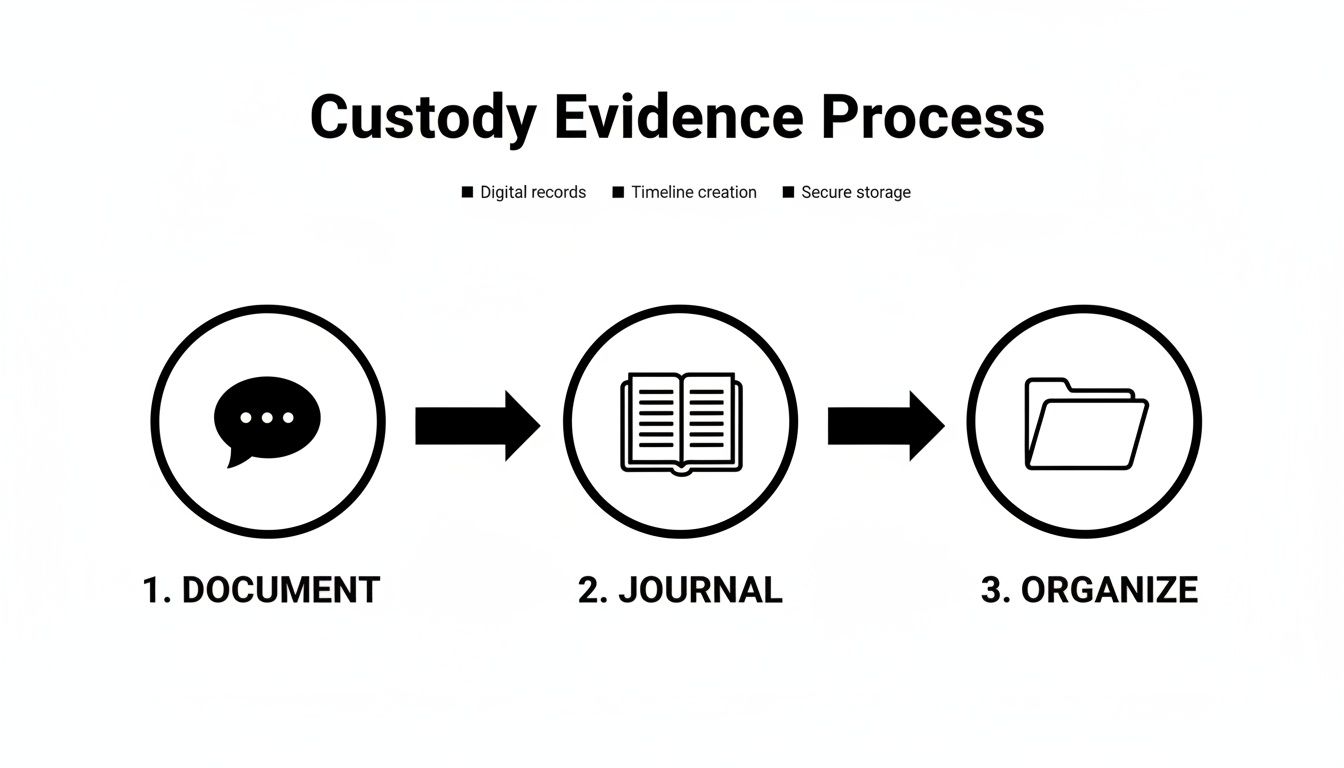
This simple visual really drives home the point: a successful case is built on a foundation of consistent, well-organized evidence.
The Discovery and Mediation Phases
After those initial orders are in place, the case transitions into the discovery phase. Think of this as the formal fact-finding stage where both sides exchange information. It usually involves written questions (Interrogatories), requests for documents (Requests for Production), and sometimes depositions—sworn testimony given outside of the courtroom. The whole point is to make sure there are no surprises and that everyone has all the relevant facts.
Before you can ever set foot in a courtroom for a final trial, Texas law requires parents to try to resolve things through mediation. This is a confidential meeting where you, your lawyers, and a neutral mediator sit down to negotiate a settlement.
Mediation puts the power back in your hands. It's a chance for you and the other parent to create a custom-fit solution for your family, rather than having a judge who doesn't know you make the final call. A huge number of Kingwood cases get resolved right here.
If you reach an agreement, your lawyers will draft a Mediated Settlement Agreement. Once signed, this is a legally binding contract that gets presented to the judge, who will turn it into a final order. It’s often the best way forward, saving everyone a great deal of time, money, and emotional stress.
What Happens if Your Case Goes to Trial
Sometimes, an agreement just isn't possible. If mediation doesn't work out, the last resort is a trial. This is where you and the other parent will present all your evidence, question witnesses, and make your final arguments directly to the judge. After hearing everything, the judge will issue a final, binding ruling based on what they believe is in the child’s best interest.
A trial is a serious, formal process that follows strict rules of evidence and procedure. Honestly, this is where having an experienced local attorney who knows the Harris and Montgomery County judges isn't just a good idea—it's essential.
The path to getting full custody is layered with specific legal hurdles. For parents in Kingwood, Humble, and the surrounding areas, it’s a path you should never have to walk alone. The Law Office of Bryan Fagan is here to guide you through every single step. Call our Kingwood office today for a free, no-obligation consultation to talk about your family's situation.
Common Mistakes That Can Harm Your Custody Case
When you're fighting for custody, it feels like every single thing you do is being scrutinized. And frankly, it is. We've spent years in Northeast Houston family courts, and we've seen good parents in places like Kingwood make simple mistakes under pressure that ended up costing them dearly. A moment of anger or a frustrated text can unravel a strong case.

The key is to protect your case so you can protect your child. It demands a level of self-control that can feel almost impossible when you’re stressed, but knowing what not to do is half the battle. If you can steer clear of these common pitfalls, you’ll be in a much stronger position to focus on what truly matters: your child's well-being.
Speaking Poorly of the Other Parent
This is probably the most frequent—and most damaging—mistake we see. When you bad-mouth the other parent in front of your kids, a judge doesn't just see it as venting. They see it as an attempt at parental alienation and a red flag that you aren't putting your child's emotional health first.
A Texas court wants to see that a child can have a healthy relationship with both parents, assuming it's safe. If you position yourself as a roadblock to that relationship, you're directly contradicting your claim that you're the one best suited to act in your child's best interest.
We had a case where a parent in Humble kept telling their child things like, "We can't afford that because your Dad won't pay his child support." The financial struggle was real, but using the child as a pawn put them squarely in the middle of an adult fight. That exact behavior was brought up in court to call the parent's judgment into question.
Ignoring Court Orders and Agreements
Let's be clear: court orders aren't suggestions. They are legally binding commands, and that includes any temporary orders for visitation or communication. If you ignore them, even for what feels like a perfectly good reason, you torch your credibility with the judge.
This is critical when it comes to the visitation schedule. Unless you have a documented, legitimate reason to believe your child is in immediate danger, you must follow the possession order. Refusing to hand over your child for a scheduled visit is a violation, and the other parent can—and likely will—file an enforcement action against you.
Other common violations that sink custody cases include:
- Withholding visitation: Just deciding on your own that the other parent can't see the kids.
- Making unilateral decisions: Enrolling your child in a new school or scheduling a medical procedure without consulting the other parent, if the order requires joint decisions.
- Failing to pay support: Not keeping up with your court-ordered financial obligations.
Mishandling Social Media and Digital Communication
Everything you type can become evidence. Every text message, every email, every social media rant—it's all fair game in court. A moment of anger vented on Facebook can be printed out and handed to a judge as Exhibit A for your supposed instability. You have to treat every digital interaction as if it will be read aloud in a courtroom.
Think about the parent in Porter who posted photos from a late-night party just a few days before their custody hearing. The other side’s attorney had a field day with those pictures, using them to paint a picture of a questionable lifestyle unfit for raising a child. Keep your communications professional and be hyper-aware of the image you’re projecting online.
Navigating a Texas custody battle requires careful strategy and discipline. These mistakes are easy to make in the heat of the moment but incredibly difficult to undo. If you are a parent in the Kingwood area and need to build a strong case while avoiding these pitfalls, don't wait. Contact The Law Office of Bryan Fagan for a free, confidential consultation at our Kingwood office. We can help you protect your rights and your child’s future.
Why Partnering with a Kingwood Custody Lawyer Matters
Knowing the basics of Texas custody law is one thing, but actually winning a high-stakes case is a completely different ballgame. The fight for full custody is an emotionally draining and legally tangled journey. Even a small mistake can create ripple effects that impact your child's life for years to come.
When so much is on the line, having a seasoned professional in your corner isn't a luxury—it's a necessity. For families here in Kingwood and Humble, local representation means you’re more than just another case file. It means you have a team that truly understands the local courts in Harris and Montgomery County and is invested in our community.
Local Insight is Your Strategic Advantage
A good Kingwood lawyer brings much more to the table than just a law degree. They bring deep-seated local knowledge. We know the judges, we're familiar with the opposing counsel, and we understand the specific nuances of how our local family court system operates. This kind of insider perspective is what allows us to craft a sharper, more effective strategy for your specific situation.
After deciding to fight for your child, the most critical decision you'll make is choosing the right legal partner. Your attorney is your strategist, your advocate, and your guide through one of the toughest challenges you’ll ever face.
Our firm is deeply embedded in the Northeast Houston community. We're not just lawyers; we're your neighbors. We're committed to protecting local families because this is our home, too. We understand that this is more than just a legal battle—it's about securing your family's future and finding peace of mind.
If you’re not sure what your next move should be, you don't have to navigate this alone. A great first step is to learn more about how to choose the right family law attorney.
The Law Office of Bryan Fagan is here to provide the skilled and compassionate guidance you deserve. Contact our Kingwood office today to schedule a confidential, no-obligation consultation. Let's talk about your situation and start building a plan to protect what matters most.
Your Texas Custody Questions, Answered
Even with a solid game plan, you're bound to have questions as you navigate the Texas custody process. It's completely normal. Let’s tackle some of the most common concerns we hear from parents in the Kingwood area.
How Long Does a Custody Case Take in Kingwood?
The honest answer? It depends. The timeline for a custody case in Harris or Montgomery County can vary wildly.
If you and the other parent see eye-to-eye on everything, you might wrap things up in just a few months. That’s an uncontested case, and it’s the fastest route.
But if you’re aiming for sole custody and the other parent is fighting it, you need to prepare for a longer haul. A contested case can easily take anywhere from six months to well over a year. The court's calendar, the need for psychological evaluations, and the possibility of a trial all add to the timeline. Our job as your local Kingwood attorneys is to keep your case moving forward without cutting any corners.
Can My Child Tell the Judge Who They Want to Live With?
This is a question we get all the time from parents in Humble and Porter. In Texas, once a child is 12 years old, the law requires the judge to interview them in private to hear their wishes.
Key Takeaway: The child gets a voice, but the judge gets the final say.
The child’s preference is just one piece of a much larger puzzle. The judge is not bound by what the child wants; their decision must always serve the child’s overall best interest.
What Exactly Is a Standard Possession Order?
Think of the Standard Possession Order (SPO) as Texas's default visitation schedule. The law automatically assumes this schedule is in the child's best interest.
Even if you win sole managing conservatorship, the other parent (the Possessory Conservator) will typically still get visitation rights under an SPO. The only time this doesn't happen is if a judge finds that giving them this access would endanger the child. Of course, the SPO is just a starting point and can be customized to better fit your family's real-life needs.
Going through a custody battle is tough, but you don’t have to do it by yourself. The experienced team at The Law Office of Bryan Fagan – Kingwood TX Lawyers brings the local knowledge and dedicated support your family needs. We are proud to serve our community and are here to help you understand your legal options. We invite you to book a free, confidential consultation at our Kingwood office to go over your options and map out a strategy to protect your child's future. Visit us at https://kingwoodattorneys.com to take the first step.