Skip to content
When it comes to child custody in Texas, the single biggest difference between a custodial parent and a non-custodial parent boils down to one critical right: who gets to decide where the child lives. While both parents share a host of rights and responsibilities, this one legal distinction sets the foundation for the entire custody arrangement and shapes daily life for families in Kingwood and across Northeast Houston.
Custodial vs. Non-Custodial: What Texas Law Actually Says
If you're heading into a Kingwood family court, you’ll quickly notice that judges don't use the terms "custodial" and "non-custodial." Instead, Texas law uses more formal language that’s crucial for local families to understand:
- The Primary Managing Conservator is what most people in Kingwood think of as the custodial parent.
- The Possessory Conservator is what we commonly call the non-custodial parent.
Let's cut through the legalese. The Primary Managing Conservator is the parent who has the exclusive right to establish the child's primary home. This is the parent the child lives with most of the time, and they are typically the one who receives child support payments to help with day-to-day costs.
The Possessory Conservator, on the other hand, has the legal right to have the child for specific periods under a court-approved visitation schedule, often called a "possession order."
A Quick Guide to Parental Roles Under Texas Law
For families in Kingwood, Humble, and Northeast Houston, seeing these roles laid out side-by-side can make things much clearer. A judge’s top priority is always the "best interest of the child," a legal standard that steers every decision they make about your family.
This table breaks down how the key responsibilities are typically divided in a standard Texas custody order.
| Key Responsibility | Custodial Parent (Primary Managing Conservator) | Non-Custodial Parent (Possessory Conservator) |
|---|---|---|
| Child's Residence | Has the exclusive right to determine the child's primary residence, often within a specific geographic area like the Kingwood area. | Does not determine the child's primary residence but has a right to visitation at their own residence. |
| Decision-Making | Typically holds the right to make key decisions about education and non-emergency medical care. | Shares the right to access school/medical records and consult with professionals but often defers to the custodial parent for final decisions. |
| Child Support | Generally receives monthly child support payments to help cover the child's living expenses. | Generally has a legal obligation to pay monthly child support according to state guidelines. |
| Possession & Access | Has possession of the child at all times not designated for the non-custodial parent. | Has possession of the child according to a court-ordered schedule (e.g., Standard Possession Order). |
As you can see, the core difference really is the power to decide where the child puts down roots.
The most significant power the court grants the custodial parent is the right to establish the child's primary home. This single authority influences school enrollment in Kingwood, daily routines, and the overall structure of a child's life post-separation.
Understanding these legal definitions is the first step for anyone facing a custody case. It’s why so many Kingwood residents reach out for initial advice, and why busy family law firms often rely on tools like AI phone answering services designed for family lawyers to manage calls and provide immediate information.
If you are a Kingwood resident navigating this, you are not alone. As of 2022, about one in four children in the U.S. lived with a single parent, making these arrangements a common reality. You can discover more insights about these national trends from the U.S. Census Bureau.
Whether you are going through a divorce or were never married to your child's other parent, getting a firm grip on these terms is vital. For more specifics, you can learn more about child custody laws in Texas for unmarried parents in our dedicated article.
Here at The Law Office of Bryan Fagan, our job is to translate complex legal jargon into practical, real-world advice for your family. If you're in Kingwood, Porter, or nearby communities and have questions about your rights, schedule a free, no-obligation consultation with our local attorneys today.
A Practical Comparison of Parental Rights and Duties
Once a Texas family court names one parent the Primary Managing Conservator (the custodial parent) and the other the Possessory Conservator (the non-custodial parent), each gets a specific set of rights and duties. These aren't just legal labels; they are court-ordered responsibilities that will shape your daily life and your child’s future. For parents here in Kingwood, understanding these practical differences is the key to co-parenting effectively and protecting your relationship with your child.
This summary breaks down the key roles assigned to each parent once a custody order is in place.
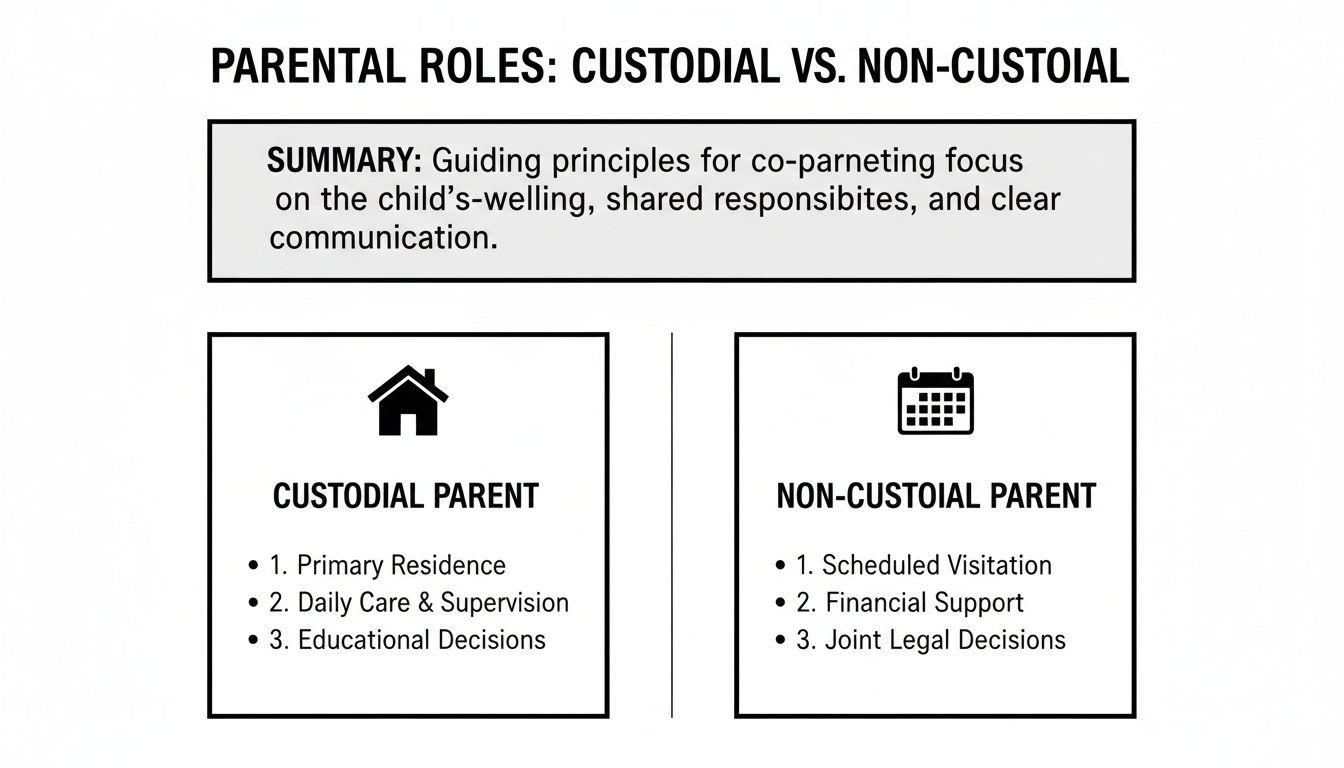
As you can see, while the custodial parent manages the child's home base, the non-custodial parent's role is just as important, with legally protected time and access to ensure they remain a central figure in their child's life.
The Custodial Parent’s Primary Rights
For the parent named the Primary Managing Conservator in a Kingwood court, the most significant right is the exclusive power to decide where the child lives. This isn't a blank check to move anywhere, though. The decision is almost always limited by a geographic restriction—like Harris County and its surrounding counties—to keep the child close to the other parent and their Humble or Porter home.
Beyond establishing the home, the custodial parent usually holds several other key decision-making powers:
- Educational Decisions: They typically have the final say on where the child goes to school, whether in Kingwood ISD or elsewhere.
- Non-Emergency Medical Care: They can consent to medical, dental, and surgical treatments that aren't life-threatening.
- Receiving Child Support: They have the right to receive monthly child support payments from the other parent to help with the costs of raising the child.
- Representing the Child in Legal Actions: They can act on the child's behalf in legal matters.
These rights are designed to centralize the child's daily stability with one parent, creating a consistent home base and reducing potential conflict over routine decisions.
The whole point of granting the custodial parent these specific rights is to create a stable, predictable environment for the child. A court's goal is to empower one parent to handle the day-to-day logistics, from doctor's appointments in Humble to school enrollment right here in Kingwood.
This arrangement, however, doesn't grant the custodial parent unlimited authority. The non-custodial parent keeps a strong set of rights designed to guarantee their continued and meaningful involvement.
The Non-Custodial Parent’s Core Rights and Duties
Being the Possessory Conservator, or non-custodial parent, doesn't mean you've lost your parental authority. Far from it. Your role is clearly defined and protected by the court order, with a sharp focus on maintaining an active and strong presence in your child's life.
For families in Porter and across Northeast Houston, the non-custodial parent’s rights almost always include:
- Possession and Access: The right to have the child during the specific times laid out in the possession schedule, which is most often the Texas Standard Possession Order.
- Access to Information: The right to get all school records, medical reports, and dental information. You can speak directly with teachers and doctors about your child's well-being.
- Consultation on Major Decisions: The right to be consulted before the custodial parent makes a major decision about the child's health or education.
- Attending School Activities: The right to show up for school plays, sporting events, and other extracurriculars in Kingwood or wherever they take place.
- Duty of Financial Support: A legal obligation to pay monthly child support, which is critical for the child’s financial stability.
Unfortunately, ensuring this financial support is paid consistently can be a major challenge. One of the most glaring disparities in the American child support system involves the gender gap. According to recent statistics, while over 79 percent of custodial mothers have a child support award, a staggering 65 percent of them receive no child support from the non-custodial parent. This reality creates a massive financial burden. You can read the full research about these divorce statistics to see the broader picture.
While the financial duty is essential, the non-custodial parent's most valued right is often the possession schedule. This legally-binding schedule guarantees you dedicated time with your child and prevents the custodial parent from unfairly withholding visitation.
At The Law Office of Bryan Fagan, we help Kingwood parents make sense of every detail in their court orders. Whether you are fighting to be the custodial parent or working to secure your rights as a non-custodial parent, our team provides the clear, practical guidance you need. Schedule a free consultation at our Kingwood office to talk about your case and learn how we can protect what matters most.
How Kingwood Courts Determine Custody Arrangements
For families in Kingwood and the surrounding Northeast Houston area, walking into a courtroom to decide your child's future is one of the most stressful things you can imagine. The whole process can feel like a mystery. But Texas judges don't make these life-altering decisions based on a gut feeling.
Every single choice they make is guided by one powerful legal standard: the best interest of the child.
This isn't just a vague idea; it's a principle woven into the Texas Family Code. It forces judges in Harris and Montgomery County courts to look past what the parents want and focus completely on what will create the safest, most stable, and most nurturing home for the child. It’s never about rewarding one parent or punishing the other. The child's well-being is the only thing that matters.
The Holcomb Factors: What Kingwood Judges Actually Look At
So, how does a judge figure out what's in a child's best interest? They use a specific set of criteria known as the "Holcomb factors." A Kingwood judge will carefully weigh the evidence for each of these points when deciding who becomes the custodial parent (Primary Managing Conservator) and who becomes the non-custodial parent (Possessory Conservator).
Here is a step-by-step look at what they’re evaluating:
- Step 1: The Child’s Needs: The judge needs to understand the child's emotional, physical, and developmental needs, both now and in the future. Strong evidence showing you can meet those specific needs is absolutely critical.
- Step 2: Parental Abilities: This is a close look at each parent’s ability to provide a loving and stable home. The court often considers who has historically been the primary caregiver and who seems better equipped to manage the day-to-day routines of raising a child in the Kingwood area.
- Step 3: Stability of the Home: A judge will always favor a stable, consistent, and predictable home environment. They'll compare what each parent can offer in this regard.
- Step 4: Acts or Omissions: The court has a duty to examine any parental behavior, past or present, that might put the child at risk. This includes any history of neglect, family violence, or substance abuse.
- Step 5: The Child's Wishes: If a child is 12 or older, the judge can interview them privately to hear their preference directly. While their opinion is taken seriously, it's important to remember it's just one factor among many and not the final word.
Knowing how to build your case around these factors is everything. If you want a deeper dive, our guide on how to prepare for a custody hearing in Texas offers some really practical steps for Kingwood parents.
Proving Your Case in a Local Court
In a Kingwood courtroom, real proof is what matters, not just accusations or emotional pleas. The judge needs to see a clear, tangible picture of your parenting and the environment you provide. You have to be ready to show them, not just tell them.
For example, proving you’ve always been an involved parent is incredibly powerful. You can do this with things like:
- Records of your attendance at parent-teacher conferences at a local Kingwood school.
- Email chains showing you’re the one who coordinates doctor’s appointments.
- Photos or even testimony from others that you coached your child's soccer team in Humble or volunteered at their school in Porter.
This kind of evidence helps build a compelling story that you are a stable, engaged, and essential figure in your child’s life.
A judge’s decision often comes down to which parent can provide the most consistency and stability for the child. Documented proof of your past involvement is the best way to show you can provide that stability in the future.
The court process in Kingwood ultimately results in a formal order that spells out everyone's rights and responsibilities. This document becomes the legal blueprint for your co-parenting relationship. To get an idea of how detailed these can be, you can review a general child custody agreement template.
Facing the court system can feel completely overwhelming, but you don't have to do it by yourself. At The Law Office of Bryan Fagan, our Kingwood attorneys know the local Harris and Montgomery county courts inside and out. We help our clients find the right evidence and present a clear, persuasive case that always focuses on their child's best interest.
If you’re heading into a custody battle, let us help you turn that uncertainty into a clear strategy. Contact our Kingwood office today for a free, confidential consultation to talk about your family and how we can help protect your future.
The Impact on Child Support and Visitation Schedules

Once a Kingwood court finalizes your custody order, the labels "custodial" and "non-custodial" parent become very real. They have an immediate impact on your bank account and your family’s calendar. These aren’t just legal terms on a piece of paper; they form the very framework that dictates who pays child support and when each parent gets to see the children.
For any parent in Northeast Houston, getting a firm handle on these two issues is the key to planning for the future. The court’s orders are meant to create a predictable structure, ensuring your child gets consistent financial and emotional support from both of you.
How Child Support is Calculated in Texas
In Texas, it’s almost a given that the non-custodial parent (the Possessory Conservator) will have a legal duty to pay monthly child support to the custodial parent (the Primary Managing Conservator). This money is considered a right of the child, designed to help the primary parent cover essential costs like housing, food, clothes, and all the other day-to-day expenses.
The calculation itself is usually pretty straightforward, following state guidelines.
First, the court looks at the non-custodial parent’s net monthly resources—that’s their income after taxes and other required deductions. Then, a specific percentage of that income is applied based on how many children you have.
Texas Child Support Guideline Percentages:
- 1 Child: 20% of net monthly resources
- 2 Children: 25% of net monthly resources
- 3 Children: 30% of net monthly resources
- 4 Children: 35% of net monthly resources
- 5 or More Children: 40% of net monthly resources
So, let's say a non-custodial parent in Porter has two kids and their net monthly income is $5,000. Under the guidelines, their child support payment would be $1,250 a month (which is 25% of $5,000).
But these guidelines aren't absolute. A Kingwood judge has the discretion to order a different amount if there's solid proof that it’s in the child's best interest. Things like a child's extraordinary medical needs, private school tuition, or other unique circumstances can all be reasons to adjust the standard calculation.
While the Texas guidelines provide a baseline, they aren't set in stone. The final child support amount must always serve the child's best interest, which sometimes means looking beyond a simple percentage calculation to address the unique realities of your family's situation in Northeast Houston.
Understanding the Texas Standard Possession Order
Just as important as the money is the schedule that lays out when the non-custodial parent has the kids. In the vast majority of cases, Texas courts put a Standard Possession Order (SPO) in place. Think of the SPO as a detailed, year-round calendar built to give children consistency and parents predictability.
For families living within 100 miles of each other, a typical SPO gives the non-custodial parent time with the children on:
- The first, third, and fifth weekends of the month.
- Alternating major holidays, like Thanksgiving and Christmas.
- An extended block of time in the summer, usually 30 days.
This schedule is the default because Texas law presumes it's what’s best for the child. It’s designed to make sure the non-custodial parent stays deeply involved in the child’s life, from weekend routines in Humble to summer vacations. While you and the other parent can always agree to a custom schedule, the SPO is the reliable plan the court will enforce if you can’t.
Historically, family law has revolved around a single primary parent, but that mindset is changing. A trend in Europe toward more joint parenting arrangements shows a shift in thinking about what truly benefits kids, and this perspective is gaining ground here. More Kingwood families are exploring creative plans that emphasize both parents' active involvement. You can read the full research about these changing family structures.
This is exactly why it's so important to understand all your options. If a more balanced arrangement sounds right for your family, you can learn more about shared custody in Texas in our in-depth guide.
Whether you're trying to figure out potential child support payments or just want to picture what your new family schedule might look like, our team at The Law Office of Bryan Fagan is ready to help. We give Kingwood families clear, practical advice rooted in Texas law. Schedule a free consultation today to talk about your specific situation.
Modifying or Enforcing Your Custody Order

Life doesn't stand still, and family circumstances certainly don't either. For parents in Kingwood, a custody order that was a perfect fit two years ago might feel completely unworkable today. Thankfully, Texas law anticipates this. It provides clear legal pathways for both the custodial parent and non custodial parent to either change their court orders or enforce the ones they already have.
Whether you need to adjust the terms because your life has changed or you need to hold the other parent accountable for not following the rules, understanding the right legal process is everything. It’s how you protect your child’s stability and your own parental rights.
When Can You Modify a Custody Order?
You can't just march back to a Kingwood courthouse because you had a minor disagreement. To even get your foot in the door, you first have to prove that there’s been a “material and substantial change in circumstances” since the judge signed your last order.
That's a pretty high legal bar to clear. It means the change isn’t just minor—it has to be significant enough to directly impact the child's well-being and make the current arrangement unsuitable or no longer in their best interest.
The real question a judge asks isn't just "Has something changed?" but "Is this change so important that we must rewrite a legal order to protect the child?" This standard prevents the courts from getting bogged down with every little co-parenting dispute and ensures changes are only made when truly necessary.
So, what counts as a material and substantial change? Here are the practical steps to consider:
- Identify the Change: Has a parent relocated for a job in Northeast Houston? Has a parent's income changed dramatically? Have the child's needs evolved?
- Assess the Impact: Does this change make the current custody or visitation schedule unworkable or harmful for the child?
- Gather Evidence: Collect documents like new job offers, medical records, or school reports that prove the change and its effect.
Common examples we see across the Kingwood area include a parent's long-distance relocation, a major shift in income requiring a child support adjustment, or a child over 12 expressing a strong preference to live with the other parent.
If you're facing one of these scenarios, you may have strong grounds to file a Petition to Modify the Parent-Child Relationship. An experienced Kingwood attorney can help you organize the evidence needed to make a compelling case.
How to Enforce a Custody Order
Sometimes, the problem isn't that the order is out of date—it's that one parent is simply ignoring it. That can be incredibly frustrating and disruptive for both you and your child. When the other parent consistently violates the possession schedule, stops paying child support, or oversteps their legal rights, you have the power to take action.
The legal tool for this situation is a Motion for Enforcement. This is a formal request asking the court to step in and compel the other parent to comply with the existing order.
If a judge finds that the other parent knowingly violated a clear and specific part of the order, the consequences can be quite serious. Potential penalties include:
- Ordering Make-Up Visitation Time: The non-compliant parent might be ordered to give you the exact amount of parenting time you were denied.
- Requiring Payment of Attorney's Fees: The parent who broke the rules may have to pay for the legal costs you incurred bringing the enforcement action.
- Imposing Fines or Jail Time: For repeated or especially serious violations, a judge can impose community supervision (probation) or even sentence the parent to jail for contempt of court.
Whether you're a custodial parent in Kingwood whose child wasn't returned on time or a non-custodial parent in Humble being denied your rightful weekends, you don't have to just tolerate these violations. The team at The Law Office of Bryan Fagan is here to help families in Kingwood, Humble, and Porter protect the integrity of their court orders.
If your circumstances have changed or you need to hold the other parent accountable, contact our Kingwood office today for a free consultation to discuss your next steps.
Answering Your Kingwood Custody Questions
When you're trying to make sense of a custody order, it's natural for questions to pop up, especially as your family starts living with the new arrangement. As lawyers right here in the Kingwood community, we see parents wrestling with the same core concerns—all driven by the desire to do what's best for their kids.
Here are some straightforward answers to the questions we hear most often about being a custodial vs. a non-custodial parent in Texas.
Can a Non-Custodial Parent Make Decisions About My Child’s School in Texas?
In most cases, no. The standard Texas custody order gives the custodial parent, known legally as the Primary Managing Conservator, the exclusive right to make crucial educational decisions. This power specifically includes choosing which school the child will attend.
That said, the non-custodial parent (the Possessory Conservator) almost always keeps the right to stay informed. This means they can access school records, talk to teachers, and attend parent-teacher conferences. Every court order is unique, though, so having a Kingwood attorney review the precise wording is the only way to be certain about each parent's authority and avoid future conflicts.
What if the Custodial Parent Wants to Move Out of Kingwood?
This is a huge issue for families all over Northeast Houston. Nearly every Texas custody order contains a geographic restriction that dictates where the custodial parent and child can live. Typically, this area is defined as the current county (like Harris or Montgomery) and any counties directly bordering it.
If the custodial parent wants to move the child outside this zone, they have two options: get written, notarized permission from the other parent, or go back to court and get a judge’s approval. A move without permission is a serious violation and can have drastic consequences, including the possibility of losing primary custody.
A geographic restriction isn't meant to punish anyone; it's there to protect the child's access to both parents. A judge won't typically approve a move that makes it hard for the non-custodial parent in Humble or Porter to maintain a meaningful relationship with their child unless there's an incredibly good reason for it.
Does a 50/50 Schedule Mean No One Pays Child Support?
Not always. This is probably one of the biggest myths we have to bust for our Kingwood clients. Even with a true 50/50 possession schedule, a Texas court still has to look at each parent’s income. The goal is to make sure the child’s financial needs are met consistently, no matter which home they're in.
Remember, child support is seen as the child's right, not the parent's. If one parent earns significantly more than the other, the higher-earning parent will likely still be ordered to pay some amount of child support. The formula gets adjusted to account for the equal time, but the fundamental duty to support the child doesn't just disappear.
How Can Your Kingwood Lawyers Help Me with My Custody Case?
Whether you're fighting to be named the primary parent or you need to make sure your rights as the non-custodial parent are fully protected, our Kingwood family law attorneys are ready to step in. We help families in Kingwood, Humble, and Porter build solid cases centered on what truly is in the best interest of the children involved.
We'll be your advocate in settlement talks or in the courtroom, always pushing for final orders that are clear, workable, and enforceable. We know the local Northeast Houston courts and are committed to helping you and your child secure the best possible future.
Child custody law can feel overwhelming, but you don’t have to go through it on your own. The dedicated team at The Law Office of Bryan Fagan – Kingwood TX Lawyers is here to give you the local knowledge and trusted guidance you need. We're proud to help our neighbors in the Kingwood community protect what matters most. For a free, no-obligation consultation to talk about your situation, contact us today at https://kingwoodattorneys.com.