Skip to content
When you're facing criminal charges in Kingwood, one of the first and most confusing questions is, "What does pleading not guilty actually mean?" It sounds simple, but it's a powerful legal move that protects your future. Pleading not guilty is your formal declaration to the court that you are asserting your innocence, forcing the prosecution to prove every single element of their case against you beyond a reasonable doubt.
This isn't about arguing facts on the spot. It's about activating the full protection of your constitutional rights and officially starting your defense. At The Law Office of Bryan Fagan, we want our neighbors in Kingwood to feel understood and supported, not overwhelmed by legal jargon.
Your First Step: Pleading Not Guilty in a Texas Court
If you've been arrested in Kingwood, Humble, or anywhere in Northeast Houston, your first time in front of a judge will be at a hearing called an arraignment. During the arraignment, the judge will formally read the charges filed against you and ask for your plea. In that moment, your answer sets the entire trajectory of your case.
Pleading "not guilty" is almost always the single most important action you can take. Think of it as hitting the pause button on the entire process. This plea keeps every one of your legal options open, from negotiating a better deal down the road to fighting the charges tooth and nail at trial.
Why It's the Essential Starting Point
For anyone in our Kingwood community caught up in the legal system, understanding the power of this initial plea is absolutely vital. It’s the key that unlocks the door to a proper defense. Pleading not guilty accomplishes several critical goals right out of the gate.
A "not guilty" plea is the standard, strategic first move in nearly every criminal case. Here's a quick look at why it's so important for Kingwood residents.
| Three Key Reasons to Plead Not Guilty Initially | Why It Matters for Your Case |
|---|---|
| 1. Makes the Prosecution Prove Their Case | The entire burden of proof rests on the State of Texas, not you. Your plea forces them to do the hard work of gathering evidence and building a case strong enough to stand up in court. If they can't, the case fails. |
| 2. Buys Critical Time for Your Defense | A "not guilty" plea gives your legal team the time needed to thoroughly investigate the charges, file for and review all the evidence (a process called "discovery"), and pinpoint weaknesses in the prosecutor's story. Hasty decisions rarely lead to good outcomes. |
| 3. Preserves Your Bargaining Power | Pleading guilty right away surrenders all of your leverage. By pleading not guilty, your attorney can negotiate from a position of strength, which can lead to reduced charges, alternative resolutions, or even a complete dismissal of the case. You keep your options open. |
As you can see, this initial plea is less about making a final declaration and more about giving your defense the space it needs to operate effectively.
The arraignment can feel like a whirlwind, often happening right after an arrest and mixing in with conversations about bail. It's a good idea to also get a handle on what happens at a bond hearing to be fully prepared.
Pleading not guilty isn't an act of defiance; it's a strategic legal maneuver that tells the court you are exercising your constitutional right to a defense. It’s the foundation upon which every successful case is built.
Ultimately, this plea is your formal reminder to the system that you are presumed innocent until proven guilty. For our clients here in Kingwood and across Northeast Houston, it’s the first piece of advice we almost always give. It’s the essential starting point for protecting your rights, your good name, and your future. If you are facing criminal charges, don't try to figure this out alone. Our Kingwood office is here to help.
Navigating Your First Court Appearance in Kingwood
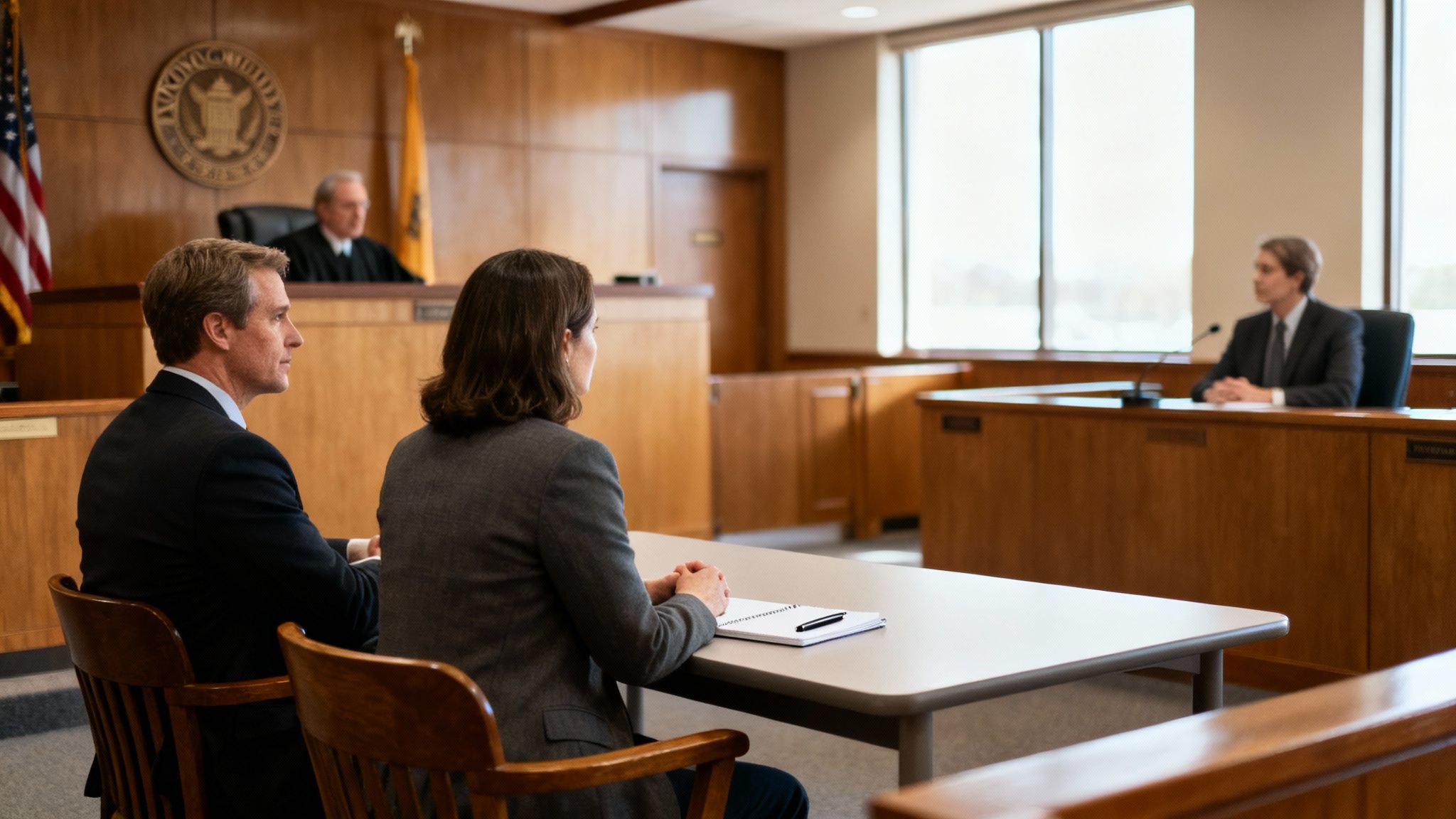
Walking into a Harris County or Montgomery County courtroom for the first time is a daunting experience. The air is formal, the stakes feel incredibly high, and for most people in our Kingwood community, the whole process is a mystery. This initial, formal court date is called an arraignment, and our job is to pull back the curtain and show you what to expect.
An arraignment is usually a brief, but absolutely critical, hearing. The judge will formally read the criminal charges filed against you and then ask for your plea. This is your first official chance to answer the allegations. For many folks in Humble and Porter, this is their very first brush with the criminal justice system, and feeling overwhelmed is completely normal.
This is exactly why having an experienced Kingwood criminal defense attorney from our firm with you is so important. We stand right beside you, making sure your rights are protected from the moment you step into that courtroom.
The Key Players in the Courtroom
Just knowing who’s who can go a long way in easing the anxiety of that first court date. While the specifics can vary, you'll almost always see three key figures, each with a distinct role.
- The Judge: The judge is the neutral referee. They run the hearing, make sure all the rules are followed, read the charges aloud, and officially accept your plea.
- The Prosecutor: This is the lawyer for the other side—the State of Texas. Their one and only job is to try and prove the case against you.
- Your Defense Attorney: This is your champion and your guide. Our job is to protect you, advise you on the right plea, and prepare to challenge every piece of the prosecutor's case.
When you work with The Law Office of Bryan Fagan, your attorney does the talking. We make sure the arraignment goes as it should and that your interests are protected. If you want to dive deeper into the nuts and bolts, check out our guide on what happens at an arraignment hearing.
At this early stage, pleading "not guilty" isn't you getting on a soapbox to argue your innocence. It's a formal, procedural step. It tells the court, "I am using my constitutional right to a defense, and I'm making the prosecution prove their case."
Why Your Plea Is So Important
Pleading not guilty at your arraignment is like turning the key in the ignition for your defense. As soon as you enter that plea, the case moves forward, and it allows your attorney to formally demand all the evidence the prosecutor has. This crucial step is known as the discovery process, and it’s the foundation for building your defense strategy.
Without that "not guilty" plea, we can't get our hands on the police reports, witness statements, lab results, or anything else the state has. This plea is what gives us the time and the legal footing to dig into the prosecution's case and start searching for its weaknesses.
If you have an upcoming arraignment in Northeast Houston, you don't have to go through it by yourself. Contact our Kingwood office to schedule a free, confidential consultation. We'll give you a clear roadmap for what's ahead and be right there with you, every step of the way.
Understanding Your Plea Options in Texas
When you find yourself standing in a Texas courtroom, the judge will ask how you plead. This is a critical moment. You have three choices, and the one you make will set the course for your entire case. For folks in Kingwood and Humble, knowing what these pleas actually mean is the first step toward protecting your future.
The three pleas available are guilty, nolo contendere (no contest), and not guilty. It's easy to think "guilty" and "no contest" are basically the same, and in one major way, they are: both pleas mean you are giving up your right to a trial. You accept a conviction and move straight to the sentencing phase.
But a not guilty plea? That’s something else entirely.
What Does It Mean to Plead Guilty or No Contest?
A guilty plea is a straightforward admission. You are telling the court, officially and for the record, "I did what the prosecution says I did." There's no ambiguity.
A no contest plea, or nolo contendere, is a bit more nuanced. You're not admitting you committed the crime, but you are agreeing to accept the punishment. In Texas, the main practical difference comes up in misdemeanor cases; a no contest plea generally can't be used as an admission of guilt if someone later sues you in a civil court over the same incident. For felonies, though, it’s treated just like a guilty plea.
Don't miss the most important point: A guilty or no contest plea ends the fight before it even starts. You're convicted, you lose your right to challenge the evidence, and you're at the mercy of the court for sentencing. This is why it's almost always a mistake to take the first deal offered.
Why Pleading Not Guilty is Your Strongest Move
The not guilty plea is the only one that keeps your constitutional rights intact. When you plead not guilty, you aren't necessarily saying, "I have proof I'm innocent."
What you are actually saying is far more powerful. You are looking at the State of Texas and declaring: "You've accused me of a crime. Now, prove it."
This simple act forces the prosecutor to carry their legal burden, which is the highest standard in our justice system—they must prove their case beyond a reasonable doubt. Pleading not guilty unlocks the entire legal process. It gives your defense attorney the power to demand all the evidence the state has, to investigate for weaknesses in their case, and to file motions to throw out evidence that was collected illegally.
Ultimately, pleading not guilty is the essential first step that puts you in a position of strength. It keeps every option—from a case dismissal to a favorable plea bargain or a full trial—on the table.
Understanding Your Plea Options in Texas
Navigating the plea process can feel overwhelming. To make it clearer, let's break down exactly what each plea means and what happens the moment you enter it.
| Plea Type | What It Means Legally | Immediate Consequence |
|---|---|---|
| Guilty | A formal, on-the-record admission that you committed the alleged crime. | You waive your right to a trial. The case moves directly to the sentencing phase. |
| No Contest | You are not admitting guilt but accept the punishment as if you were guilty. | You waive your right to a trial. The case moves to sentencing. It may offer limited protection in a later civil lawsuit. |
| Not Guilty | A formal denial of the charges. You are asserting your constitutional right to make the prosecution prove its case. | The legal process begins. Your attorney can access evidence (discovery), negotiate, and prepare for a potential trial. |
This table shows why the initial plea is so crucial. A "not guilty" plea isn't just a denial; it's the key that unlocks your right to a proper defense and holds the prosecution accountable.
How a Not Guilty Plea Activates Your Constitutional Rights
When you stand up in a Kingwood courtroom and plead not guilty, you're doing much more than just saying "I didn't do it." You are turning the key that unlocks the full force of your constitutional rights. This plea is the legal embodiment of a core American principle: you are presumed innocent until the state can prove otherwise.
Entering a "not guilty" plea isn't about you proving your innocence. It's about legally challenging the State of Texas to meet its massive burden. The responsibility to prove every single element of the crime now falls squarely on the prosecution's shoulders, and it's an incredibly high bar to clear.
This one simple act immediately brings powerful protections from the Fifth and Sixth Amendments to the forefront of your case.
Putting the Constitution to Work for You
Pleading not guilty sends a clear message to the court and the prosecutor: you intend to use every right the law provides. For our clients in Kingwood, Humble, and across Northeast Houston, this is the exact moment their defense strategy kicks into high gear.
Here’s what that really means in practice:
- The Right to a Jury Trial: Your case won't be decided by a single judge. You have the right to be judged by a jury of your peers from right here in the community.
- The Right to Confront Your Accusers: This is a big one. It means your attorney gets to cross-examine every witness the state brings forward, testing their credibility and challenging their version of events.
- The Right to Remain Silent: Your decision not to testify cannot be held against you. You can never be forced to take the stand in your own defense.
- The Right to an Attorney: The legal system is a maze. This guarantees you have a legal professional by your side to navigate it and fight for you.
Pleading not guilty formally denies the charges and puts the prosecution to the test of proving guilt beyond a reasonable doubt. It is your constitutional right, and it triggers the full trial process where evidence is presented and your fate is decided.
Nationally, a staggering number of federal cases end in guilty pleas, often through plea bargains. This leaves only a small percentage of people who actually exercise their right to a trial. You can explore more data on federal court sentencing trends to see just how crucial it is to assert your rights from the very beginning.
At The Law Office of Bryan Fagan, we use these fundamental principles to meticulously take apart the prosecution's case. By holding the state to its high burden of proof, we build the leverage needed to protect your freedom and your future. Don't face this alone; call our Kingwood office for a free consultation.
The Legal Journey After a Not Guilty Plea
So, you’ve entered a "not guilty" plea. What happens next? For our clients here in Kingwood, this is the moment the real work begins. Pleading not guilty doesn't just put things on hold; it kicks off a strategic legal process where we systematically dismantle the prosecution's case and build a powerful defense for you.
This path has several critical stages, all designed to safeguard your rights and ensure a just outcome. It’s rarely a straight shot to a jury trial. In fact, most of our cases are resolved favorably long before we ever see the inside of a courtroom.
Discovery: The Foundation of Your Defense
Right out of the gate, we initiate a process called discovery. Think of it as demanding the prosecution lay all their cards on the table. They have a file with everything they think proves their case against you, and discovery is our non-negotiable right to get a complete copy of that entire file.
This isn't just a summary; we get our hands on everything they have, including:
- The official police reports from the incident
- Every witness statement they've collected
- All lab results, whether from a breath, blood, or other chemical test
- Any body camera or dashcam video footage that exists
For our clients in Humble and Porter, this is where we start poking holes in the state's argument. We pour over every single document, every second of video, looking for procedural errors, inconsistencies, and any violation of your constitutional rights.
This simple visual breaks down how your plea is the key that unlocks your rights and forces the prosecution to do its job.
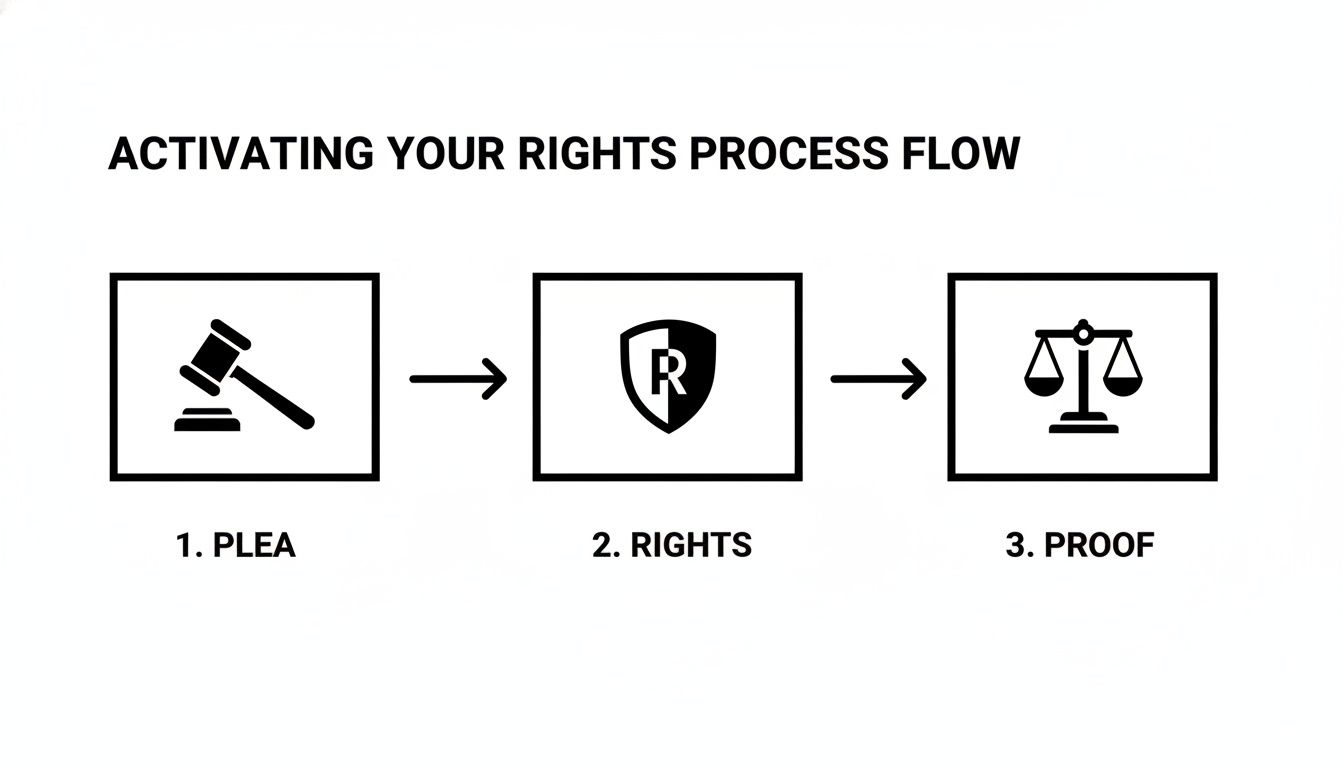
As you can see, that "not guilty" plea is the catalyst. It activates your constitutional shield and puts the entire burden of proof squarely on the prosecutor’s shoulders.
Pretrial Motions and Plea Bargaining
Once we've dissected all the evidence from discovery, we move into the pretrial motions phase. This is where we go on the offensive. If we find that the police obtained evidence illegally—say, through an unconstitutional traffic stop in Northeast Houston or a defective search warrant—we file a motion to suppress, demanding the judge throw that evidence out.
Winning one of these motions can completely gut the prosecutor’s case, often leading directly to a dismissal. It's also at this point that serious plea bargaining gets underway. Armed with a deep understanding of the state's evidence and its weaknesses, we can negotiate for a better outcome, like reduced charges, from a true position of strength.
Pleading not guilty is your chance to fight back against potential injustice. The devastating reality of wrongful convictions shows just how crucial a vigorous defense is. According to the Innocence Project, many exonerated individuals lost years of their lives, with a staggering 9% having been sentenced to death. You can explore more of the sobering statistics on the flaws in our plea system and the fight for justice in this in-depth analysis.
It's important to understand that most cases never reach a jury. They are resolved during these pretrial stages precisely because the 'not guilty' plea gave us the power to challenge the evidence and negotiate effectively.
Finally, if a fair agreement can't be reached, we prepare for trial. Your "not guilty" plea preserved this fundamental right, guaranteeing you get your day in court. At The Law Office of Bryan Fagan, we are always prepared to take that step to protect our Kingwood clients. If you have questions about this process, contact our Kingwood office for a free consultation.
Why You Need a Kingwood Defense Attorney on Your Side
Facing criminal charges in Northeast Houston is a heavy weight to carry. It's easy to feel lost and overwhelmed, but you absolutely do not have to go through this experience alone.
The plea you enter is just the first domino to fall in a long line of decisions that will shape your future. This is precisely why having an experienced Kingwood lawyer in your corner isn't a luxury—it's a necessity.
At The Law Office of Bryan Fagan, we're not just lawyers; we're your neighbors. We've built our practice right here in Kingwood, serving our community and understanding the unique dynamics of the Harris and Montgomery County courts. Knowing how modern law practices work can also be beneficial, as many are enhancing client service by understanding virtual receptionists for law firms.
Your Local Advocate and Defender
A good defense attorney does far more than just stand next to you in court. Our job is to meticulously tear apart the prosecutor's case, find the weak spots in their evidence, and build a powerful defense strategy with one goal: protecting your future.
We will stand with you every step of the way, cutting through the confusing legal jargon to explain your options clearly. Our deep roots in the local justice system—knowing the prosecutors, the judges, and the procedures—give you a critical edge.
We handle a wide spectrum of legal issues. You can take a look at our full range of Kingwood criminal defense services to see exactly how we can fight for you.
Your reputation, your freedom, and your future are all on the line. Trying to navigate this system without a skilled advocate is a gamble you simply can't afford to take. Let us carry that burden for you.
Don't put off getting the help you deserve. The earlier you bring us in, the more options we have to protect your rights and build a strong defense. Contact our Kingwood office today for a free, completely confidential consultation to talk about your case and find out how we can help.
Your Questions Answered: Pleading Not Guilty in Texas
When you're facing criminal charges, your head is probably swimming with questions. It’s completely normal. Let's tackle some of the most common concerns we hear from folks here in Kingwood, Humble, and the surrounding Houston area.
Can I Change My "Not Guilty" Plea Later On?
Absolutely. Think of the "not guilty" plea at your arraignment as a strategic first move, not a permanent vow. It's the legal equivalent of saying, "Hold on, I need to see the evidence before I make any decisions."
This initial plea buys you and your attorney crucial time. If, after digging into the prosecutor's case, a favorable plea bargain is put on the table, you can always change your plea to "guilty" or "no contest" as part of that deal. This is standard practice and a cornerstone of effective criminal defense in Texas.
If I Plead Not Guilty, Am I Headed for a Jury Trial?
Not at all. In reality, very few criminal cases ever make it to a full-blown trial. Pleading "not guilty" is what kicks off the entire legal process. It’s the starting gun, not the finish line.
This plea is your ticket to the discovery process. It forces the prosecution to open up their files and show your attorney every piece of evidence they have. It's during this phase—challenging evidence, filing motions, and negotiating—that most cases are resolved through dismissal or a carefully negotiated plea agreement.
What’s the Harm in Just Pleading Guilty at My First Court Date?
Pleading guilty right out of the gate is one of the biggest mistakes you can make. It's like folding your hand in poker before you've even seen your cards.
When you plead guilty immediately, you instantly waive your constitutional rights. This includes your right to a trial, your right to review the evidence against you, and your right to question how the police conducted their investigation. The judge moves straight to sentencing, and that conviction is stamped on your record forever, no questions asked.
You should always consult an attorney before entering any plea. For anyone curious about the business side of law and how firms connect with people who need help, there's a lot to learn about marketing strategies for criminal defense lawyers.
Trying to navigate the justice system on your own is an overwhelming task, but you don’t have to go it alone. The dedicated team at The Law Office of Bryan Fagan – Kingwood TX Lawyers is here to stand up for your rights and secure the best possible outcome for your case.
Schedule your free, confidential consultation today by visiting https://kingwoodattorneys.com.