Skip to content
Losing a loved one is overwhelming, and the thought of a complicated court process is the last thing any family needs. For many of our neighbors right here in Kingwood, Humble, and Northeast Houston, there's a much simpler and faster way to transfer property called the Small Estate Affidavit (SEA). It's a practical legal tool designed to help you avoid formal probate, saving precious time, money, and stress during a difficult period.
A Simpler Path for Kingwood Families
When a family member passes away, the legal aftermath can feel daunting. The traditional Texas probate process often seems expensive and confusing. This is exactly why the Small Estate Affidavit exists—it's a helpful option for situations where the person who died didn't have a will and their estate was relatively modest.
Think of it as a legal shortcut. Instead of going through multiple court hearings to appoint an executor, the SEA allows heirs to simply present a sworn statement to the court. This document clearly lists the deceased's assets, any outstanding debts, and the family history to identify the rightful heirs.
If the affidavit meets all of Texas's legal requirements, a judge can approve it. That approval gives you the green light to legally collect and distribute the property.
For families in our Kingwood community, the advantages are clear and significant:
- Saves Time: You're often looking at a matter of weeks, a stark contrast to the months or even years that a formal probate can drag on.
- Reduces Costs: This process helps you sidestep many of the court fees and legal expenses tied to a full probate administration.
- Minimizes Stress: The SEA is mostly a paperwork process, which means you can avoid the stress and formality of a traditional court proceeding.
This streamlined approach is specifically designed to help families settle affairs efficiently when an estate is uncomplicated. It provides a legal shortcut that honors your loved one's legacy without creating unnecessary hardship for the family left behind.
Of course, the SEA isn’t a fit for every situation. Texas law has very specific rules you must meet, especially regarding the total value of the estate's assets. Figuring out if your family qualifies is the crucial first step.
As you weigh your options, you might find it helpful to learn more about other ways to manage an estate in our guide on how to avoid probate in Texas. Here at The Law Office of Bryan Fagan in Kingwood, we're focused on giving our neighbors clear, practical advice. Schedule a free consultation with us today, and let's talk through your situation with a local attorney who understands and is here to support you.
Decoding the $75,000 Asset Limit in Texas
The first hurdle to clear when considering a small estate affidavit in Texas is the strict $75,000 asset limit. For many Kingwood families we work with, this number is the make-or-break factor for using this simplified process. But here’s where people often get tripped up: figuring out what actually counts toward that total.
The law is clear—the total value of the estate's non-exempt assets can't top $75,000. The good news? This doesn't include the value of the family home (the homestead) and certain other exempt property. This $75,000 threshold was actually increased a few years back, which was a huge help for more Texas families looking to avoid the time and expense of a full probate.
What Counts Toward the Limit?
When you start adding things up, you’re looking at what the law calls "non-exempt" assets. Think of these as the deceased's personal property that has a clear cash value.
For a typical Kingwood or Humble family, this list might include:
- Bank Accounts: Any checking or savings accounts that were only in the deceased person's name.
- Vehicles: The value of a car, truck, or maybe even a boat used on Lake Houston.
- Investments: Stocks, bonds, or mutual funds held outside of a designated retirement account.
- Cash: Physical money found at home or in a safe deposit box.
- Other Real Estate: A vacation property, a rental home in a nearby area like Porter, or an empty lot would count.
To do this right, you'll need to determine each asset's Fair Market Value. This is essentially what someone would be willing to pay for the item today, and it's the figure the Harris County probate court will expect to see.
Why Your Homestead and Other Property Are Excluded
This is probably the most important piece of information for homeowners in our area: the value of the primary residence, the homestead, is not counted in that $75,000 total. This is a game-changer. It means a family could live in a beautiful home in Kingwood and still easily qualify for a Small Estate Affidavit if their other assets are below the limit.
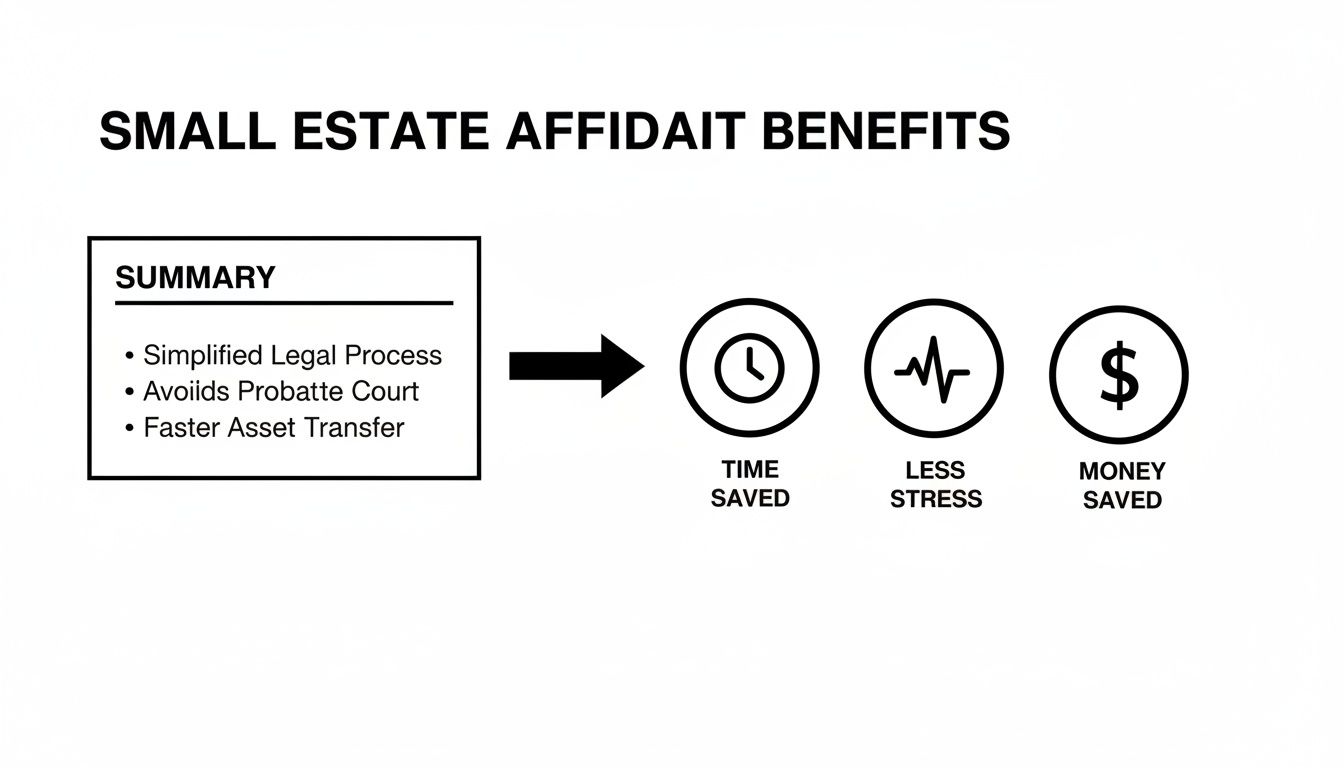
As you can see, getting this right saves your family a significant amount of time, money, and the emotional strain that often comes with settling an estate.
Besides the homestead, other "exempt" property is also excluded from the count. This can include certain furniture, some family heirlooms (up to a specific value), and even specific tools or equipment if they were used for a trade. Understanding the fine line between what’s in and what’s out is crucial.
To make this even clearer, we've created a simple table to help you quickly see what generally counts towards the limit.
Included vs Excluded Assets for the $75,000 Calculation
This table is a quick reference guide to help Kingwood families determine which assets count towards the Small Estate Affidavit limit.
| Asset Type | Typically Included in $75,000 Limit? | Example for a Kingwood Resident |
|---|---|---|
| Primary Home (Homestead) | No | The family home in the Trailwood Village neighborhood. |
| Checking/Savings Account | Yes (if solely owned) | A savings account at a local bank with a $15,000 balance. |
| Retirement Accounts (401k, IRA) | No (if a beneficiary is named) | A 401(k) from a previous employer that names a spouse as beneficiary. |
| Vehicle | Yes | A 2018 Ford F-150 with a fair market value of $25,000. |
| Household Furnishings | No (up to a certain value) | Standard living room furniture, beds, kitchen appliances. |
| Life Insurance Policy | No (if a beneficiary is named) | A term life policy that pays out directly to the children. |
| Rental Property | Yes | A small rental house in Atascocita valued at $60,000. |
| Stocks/Bonds | Yes (if not in a retirement account) | $10,000 worth of stock shares held in a personal brokerage account. |
Remember, this is a general guide. Every family's situation has its own unique details.
Trying to sort through these rules on your own can feel overwhelming, especially when you're grieving. At The Law Office of Bryan Fagan, we're here to bring clarity to this process for families right here in Kingwood. Just give our local office a call to schedule a free, no-pressure consultation, and we can talk through your specific situation to see if a Small Estate Affidavit is the best path forward for you.
Getting Your Paperwork in Order for the Affidavit
Filing a small estate affidavit form texas in Harris County is all about preparation. From our experience helping local families, we know that getting your documents lined up before you even look at the form is the single best thing you can do to make this go smoothly. It prevents those frustrating back-and-forths with the clerk's office. Think of it as gathering all your ingredients before you start cooking—it just makes everything easier.
The first and most critical piece of the puzzle is the certified death certificate. A regular photocopy won't cut it. You need the official, certified version from the vital statistics office where the death occurred. For most families here in the Kingwood area, that means getting in touch with the Harris County Clerk's office.
Creating a Clear Financial Snapshot: Assets and Debts
Next, you need to create a complete and honest picture of the deceased's financial situation. This means making two separate lists: one for all the assets and another for all the debts.
Your asset list needs to be detailed. The court needs specifics, not just general categories. Break it down like this:
- Bank Accounts: Name the bank, provide the last four digits of the account number, and list the exact balance as of the date of death.
- Vehicles: Jot down the year, make, model, and the full Vehicle Identification Number (VIN). You'll also need a good-faith estimate of its fair market value.
- Other Valuables: List any other personal property of value and what you believe it's currently worth.
At the same time, you'll compile a list of every known debt. This includes any outstanding credit card bills, lingering medical expenses, and even the funeral costs. Being transparent here is crucial; remember, the affidavit is a legal document you're signing under oath.
Key Takeaway: A detailed and accurate inventory of assets and a complete list of debts are non-negotiable. The court uses this information to verify that the estate qualifies. Any mistakes or omissions could get your affidavit rejected outright.
How to Value Personal Property Realistically
We often see clients from Kingwood and Porter get stuck on valuing personal items. It can feel a bit like guesswork. While you don't need a professional appraisal for every piece of furniture, the values you list must be realistic and reflect the current market.
For a car, a tool like Kelley Blue Book is your best friend for getting a reliable estimate. For other things, just ask yourself: "What would someone in Northeast Houston reasonably pay for this today?"
Putting all this together is a lot to handle, especially while you're grieving. If you’re feeling overwhelmed or just aren't sure where to start, you don't have to figure it out alone. At The Law Office of Bryan Fagan, we're here to help our Kingwood neighbors. Schedule a free consultation, and we can walk you through the steps to prepare a solid and compliant affidavit.
Meeting the Signature and Witness Requirements
Finalizing a small estate affidavit form in Texas isn't a solo task. From our experience helping families in the Kingwood area, we know that getting the signatures and witnesses right is often the biggest hurdle. The Harris County probate court has very specific rules, and if you don't follow them to the letter, your affidavit will be rejected.

Let's break down exactly who needs to sign and why. You'll need signatures from two key groups: the estate's heirs and two particular types of witnesses.
The Role of Disinterested Witnesses
Texas law is crystal clear on this point: the affidavit needs to be sworn to by two disinterested witnesses. These aren't just any two people. A "disinterested" witness is someone who stands to gain nothing from the estate—they cannot be an heir or a beneficiary.
Think of them as neutral, third-party verifiers. Their signature tells the court that an impartial person who knew the deceased has reviewed the family history and asset details and confirms they're accurate. For a deeper dive into why this is so crucial, you can find more about witness rules and other alternatives to Texas probate.
So, who makes a good witness? It could be a close family friend, a trusted neighbor from Humble, or even a long-time colleague from a job in Northeast Houston. The key is that they have personal knowledge of the facts in the affidavit and no financial stake in the outcome.
Securing Signatures from All Heirs
This is another non-negotiable requirement. Every single legal heir has to sign the affidavit. If the person who passed away had three adult children, all three must sign. This unanimous consent is critical because it signals to the court that all inheritors are in agreement and there are no family disputes.
This is where logistics can get complicated, especially for families spread out across the country. We often help our Kingwood clients coordinate getting signatures from relatives living out of state. It's perfectly acceptable for each heir to sign in front of a different notary where they live. The important thing is that every required signature is on the final document before you file it.
Practical Tip: We always recommend sending a final draft of the completed affidavit to every heir for a quick review before anyone starts signing. This simple step can prevent a world of headaches by making sure everyone is on the same page and avoiding last-minute disagreements that could stall the entire process.
What to Do When an Heir Cannot Sign
Life is complicated, and sometimes an heir simply can't sign for themselves. Fortunately, Texas law anticipates these scenarios:
- Minor Heirs: If an heir is under the age of 18, their natural parent or legal guardian must sign on their behalf. The signature would look something like, "Jane Doe, as mother and natural guardian of John Doe, a minor."
- Incapacitated Heirs: For an adult heir who is legally incapacitated and has a court-appointed guardian, that guardian is the person who must sign for them.
Getting these signature requirements right demands precision. One missing signature or an improper witness will cause the court to reject your filing, sending you back to square one. If you're dealing with a complex family dynamic or just want the peace of mind that it's done correctly the first time, our team at The Law Office of Bryan Fagan is ready to assist. Schedule a free consultation at our Kingwood office, and let us guide you through it.
Getting the Affidavit Filed in Harris County
You’ve done the hard work. The Texas small estate affidavit is filled out, you've collected all the supporting documents, and every last signature is in place. Now it's time to make it official.
If you're in Kingwood, Humble, or anywhere in the Northeast Houston area, your destination is the Harris County Clerk’s probate division. Filing the paperwork is the step that brings your request to the court's attention.
You'll need to hand over the original, signed affidavit, the certified death certificate, and any other documentation you've gathered. The staff at the Harris County Clerk's office are meticulous, so double-checking that your packet is 100% complete before you file can save you from the headache of having it rejected.
The Nuts and Bolts of Filing (and the Fees)
Filing is pretty straightforward. You can usually do it in person at a Harris County Civil Courthouse location or mail it in.
When you file, you'll also have to pay the required filing fee. These costs are subject to change, so it's smart to confirm the current amount on the Harris County Clerk's official website or by giving their office a quick call.
Once that fee is paid, your case is officially on the court's radar. The clerk will give your affidavit a case number and pass it along to a probate judge for review.
Pro Tip: Keep that receipt and case number somewhere safe. You'll need that number for any and all communication with the court. It’s how you track your affidavit's journey through the system.
So, What Happens Next?
Once you’ve filed, you can take a breath. The ball is now in the court's hands, literally. A probate judge will go through your affidavit with a fine-toothed comb, making sure it ticks all the legal boxes required by Texas law.
The judge is specifically looking to confirm a few key things:
- The estate's value is truly under the $75,000 threshold (not counting the homestead).
- All the right people—heirs and two disinterested witnesses—have signed it properly.
- The lists of what the person owned and what they owed are complete and seem accurate.
If everything checks out, the judge will sign a court order approving the affidavit. This is the moment you've been working towards. That signed order transforms your stack of papers into a legally recognized document.
The clerk's office will then prepare certified copies of both the affidavit and the judge's order. These certified copies are your golden ticket. They're what you'll show to banks, the DMV, and anyone else holding the estate's assets to prove you have the legal right to take possession and distribute them as planned.
When You Should Speak with a Kingwood Probate Attorney
The Texas small estate affidavit is an incredibly useful shortcut, but it's built for simple, straightforward situations. The moment things get complicated, trying to handle it yourself can backfire, leading to family stress, expensive mistakes, and even legal disputes down the road.
If you’re in Kingwood or anywhere in Northeast Houston, there are a few clear signals that it’s time to pause and talk to a local probate attorney. Pushing forward on your own in these scenarios often creates more problems than it solves.
Complex Family Dynamics and Disputes
Family conflict is probably the biggest roadblock to using a small estate affidavit. This process is designed for situations where everyone is on the same page and agrees completely. If there's even a hint of a disagreement, the affidavit won't work.
Consider these common family issues:
- Disputes Among Heirs: One heir flat-out refuses to sign the affidavit or disagrees about which assets should be included.
- Unknown Heirs: You aren't 100% certain you've found every single legal heir as defined by Texas law. This happens more often than you'd think.
- Uncooperative Relatives: An heir might be impossible to find, or they simply won't respond to your calls or emails, making it impossible to get their signature.
When you're facing these family hurdles, a small estate affidavit just isn't the right tool for the job. An attorney can walk you through other options, like a determination of heirship proceeding, which is the formal court process for identifying heirs when there isn't a will.
Issues with Wills and Real Estate
Another major red flag is finding a will. The small estate affidavit is exclusively for "intestate" estates, meaning those where the person died without a will. If a will turns up, no matter how old or simple it seems, you have to shift gears. For a deeper dive on this, you can learn about how to probate a will in Texas in our guide.
Real estate can also be a sticking point. While the homestead doesn't count toward the $75,000 asset limit, any other piece of property does. If the person who passed away owned a rental property in Humble or a vacant lot out in Porter, its value will be counted. That can easily push the estate over the limit and make it ineligible for the affidavit.
An experienced Kingwood attorney can help you accurately value those assets and figure out the proper legal path for transferring ownership.
Navigating these kinds of complexities requires a sound legal strategy. Here at The Law Office of Bryan Fagan, our Kingwood attorneys are ready to provide the clarity and direction your family needs. Schedule your free, no-obligation consultation with us to make sure you're taking the right steps to protect everyone's interests.
Frequently Asked Questions About the Texas Small Estate Affidavit
Even with the clearest instructions, we know that when Kingwood families are dealing with a loved one's estate, specific questions always pop up. It's completely normal. Let’s tackle some of the most common ones we hear in our Kingwood office.
What Happens If I Find Another Asset After Filing the Affidavit?
This is a scenario that comes up more often than you might think. If you discover a new asset after filing and it pushes the total value of non-exempt property over $75,000, your Small Estate Affidavit (SEA) could become invalid.
At that point, you'd likely have to pivot to a more formal probate process. This is precisely why we always stress the importance of a meticulous, upfront search for all assets. For our clients here in Northeast Houston, taking that extra time at the beginning saves a world of trouble later.
Can I Use an SEA If the Person Died Without a Will in Texas?
Yes, you absolutely can. In fact, the Small Estate Affidavit was specifically created for this exact situation—when someone passes away "intestate" (the legal term for dying without a will).
The form is structured to guide you through identifying and listing all the legal heirs based on Texas's succession laws. If there is a valid will, you'll need to go through a different probate path to ensure the will's instructions are followed correctly.
How Long Does the SEA Process Take in Harris County?
While an SEA is significantly faster than a full probate, it isn't instantaneous. Once you've filed all the paperwork with the Harris County Clerk, you can generally expect it to take a few weeks for a judge to review and sign off on it.
The real variable in the timeline isn't the court; it's the prep work. How quickly you can track down all the asset details, get accurate valuations, and collect signatures from every heir and witness is what truly dictates the pace. For families we work with in Humble and Porter, being highly organized from day one is the single best way to speed things up.
Walking through the specifics of a small estate affidavit can feel like a maze, but it's not a path you have to navigate by yourself. The team at The Law Office of Bryan Fagan – Kingwood TX Lawyers is here to offer the straightforward, local guidance you deserve. We're dedicated to helping our neighbors in Kingwood and the surrounding Northeast Houston area handle these matters with clarity and confidence.
To get the peace of mind you need, schedule your free, no-obligation consultation with us today.