Skip to content
For many families here in the Kingwood and Humble areas, the benefits of a revocable living trust boil down to a few critical things: avoiding the public probate process, keeping your family's affairs private, and making sure your assets are handled without a court's permission if you can no longer manage them yourself. It's a powerful estate planning tool that puts you, not the Texas courts, in the driver's seat of your legacy.
Securing Your Family's Future in Kingwood

Planning for the future is one of the most profound things you can do for the people you love. For most of us in the Kingwood community, the goal is pretty straightforward: we want the assets we’ve worked a lifetime to build to pass smoothly and privately to our loved ones. While a simple will is a familiar first step, a revocable living trust offers a layer of control and protection that a will just can't provide under Texas law.
Think of a will as a set of instructions for the probate court. After you pass away, that will becomes a public document, and the court supervises a process that can be both long and expensive before your assets get to your family.
A revocable living trust, however, acts more like a private, comprehensive rulebook for your property. It lets your chosen successor step in and manage everything according to your wishes, allowing your family to bypass the Harris County probate court system entirely. This saves them an incredible amount of time, money, and emotional strain during an already difficult period.
What This Guide Covers for Northeast Houston Families
We've designed this guide to cut through the legal jargon and give Northeast Houston families a clear, practical understanding of how a revocable living trust works. We want to show you exactly how this tool can help you achieve your specific estate planning goals right here in our community.
Here’s a glimpse of what you'll learn:
- Avoid Probate Court: We'll show you how to keep your family's affairs out of the public record and sidestep the delays and costs baked into the Texas probate system.
- Plan for Incapacity: You'll see how a trust ensures someone you've handpicked can manage your finances if you're ever unable to.
- Maintain Total Control: The "revocable" part is key. It means you can change, update, or even dissolve the trust anytime you want. You don't lose an ounce of control over your assets.
- Protect Your Beneficiaries: A trust lets you set up guardrails to protect an inheritance from your heir's future creditors, lawsuits, or a divorce.
At The Law Office of Bryan Fagan, we're your local Kingwood attorneys, committed to giving every resident the peace of mind that comes with a solid plan. Let’s dive into how a revocable living trust can provide that for you and your family.
What Is a Revocable Living Trust in Texas?
Think of a revocable living trust as a private rulebook for everything you own. It's a detailed guide you write and control completely while you're alive, which then follows your exact instructions after you’re gone. For families here in Kingwood, this is the core idea behind a living trust—it’s a legal arrangement that holds your property for you during your life, then passes it to your loved ones privately and efficiently, according to Texas law.
Unlike a will, which only kicks in after you pass away and has to go through the court system (probate), a trust is up and running the moment you create and fund it. It’s like creating a secure box for your assets. You place your home, bank accounts, and investments inside, and you get to write all the rules for how that box is managed.
The Key Players in Your Trust
Every trust has three main roles, and with a revocable living trust, you typically start out playing two of them yourself. This is what gives you total, hands-on control.
- The Grantor (or Settlor): That’s you. You're the one creating the trust, setting the rules, and deciding which of your assets go into it.
- The Trustee: This is the manager. Initially, you’ll almost always name yourself as the trustee. This gives you the power to manage, buy, sell, or spend the assets just as you always have.
- The Beneficiary: This is the person who gets to benefit from the trust. During your lifetime, you are the primary beneficiary. After you pass away, the people you choose—like your children or grandchildren—become the new beneficiaries.
You’ll also name a successor trustee. This is a crucial role for a trusted person or institution who will step in to manage the trust if you become incapacitated or pass away. This is a game-changer for Kingwood families, as it ensures a seamless transition of control without any court intervention.
Understanding "Revocable" and "Living"
The name itself gives you a great sense of its power and flexibility. The term "living" simply means you create it during your lifetime, not after death through a will (which is called a testamentary trust).
The word "revocable" is perhaps the most important feature. It means you have the complete freedom to change your mind. At any time, for any reason, you can amend the trust, add or remove beneficiaries, swap out your successor trustee, or even cancel the entire thing and take your assets back.
This flexibility is key for our clients in Humble and Porter. Life changes—families grow, financial situations shift—and a revocable living trust is designed to adapt with you, ensuring your estate plan always reflects your current wishes. As your local Kingwood law firm, we help you make these adjustments.
Funding Your Trust Is the Final Step
Just signing the trust document isn't enough. For the trust to actually do its job, you have to "fund" it by formally transferring ownership of your assets into its name. This might sound intimidating, but it's a practical, step-by-step process we guide our Kingwood clients through.
For example, you would update the deed to your Kingwood home from "John and Jane Doe" to "John and Jane Doe, Trustees of the Doe Family Trust." You’d do the same for bank accounts and other titled assets. You still have 100% control, but legally speaking, the trust now owns the property. It’s this simple change in title that allows your assets to skip probate later on.
Getting these fundamentals down is the first step toward seeing the powerful revocable living trust benefits available to you. While it offers incredible flexibility, it’s also important to know how it stacks up against other options. For those curious about more permanent structures, you can learn about the differences between a revocable trust vs irrevocable trust in our detailed guide.
Avoiding the Costs and Delays of Probate Court
One of the single biggest reasons people create a revocable living trust is to sidestep the Texas probate process. For most families here in Kingwood and Northeast Houston, probate is a bit of a mystery—until they’re forced to deal with it. At its core, probate is the formal, court-supervised process for validating a will, settling debts, and distributing everything you own after you die.
While it has a legal purpose, the process is notoriously slow, public, and expensive. Every detail of your family's finances becomes a public record at the county courthouse. For a grieving family, it’s often a long and frustrating ordeal that adds a layer of stress when they least need it.
A revocable living trust lets your family skip all of that. Because your assets are technically owned by the trust, not you, there’s nothing for the probate court to administer. The person you name as your successor trustee can step in immediately to manage and distribute your assets just as you instructed, without ever needing a judge’s approval.
The Real Cost of Probate for Kingwood Families
The financial and emotional weight of probate can be immense. The process can easily take eight months to several years, and the court costs and attorney fees typically eat up 3% to 7% of the estate's total value. Think about that for a moment. For a Kingwood family with a $500,000 estate, that’s $15,000 to $35,000 lost to administrative expenses alone.
This immediate access is more than a convenience; it's a necessity. When a homeowner passes away, the bills don't stop. The mortgage, utilities, and property taxes still need to be paid. A trust gives your successor trustee the authority to handle these responsibilities right away, without being frozen out while waiting for a court order.
A revocable living trust isn't just about moving assets around. It’s about giving your family a seamless, private, and dignified way to handle your affairs. It shields them from the public eye and the financial drain of the court system.
This diagram helps visualize the key players in a trust and how they interact. The Grantor (you) creates the trust, the Trustee manages it, and the Beneficiary receives the assets.
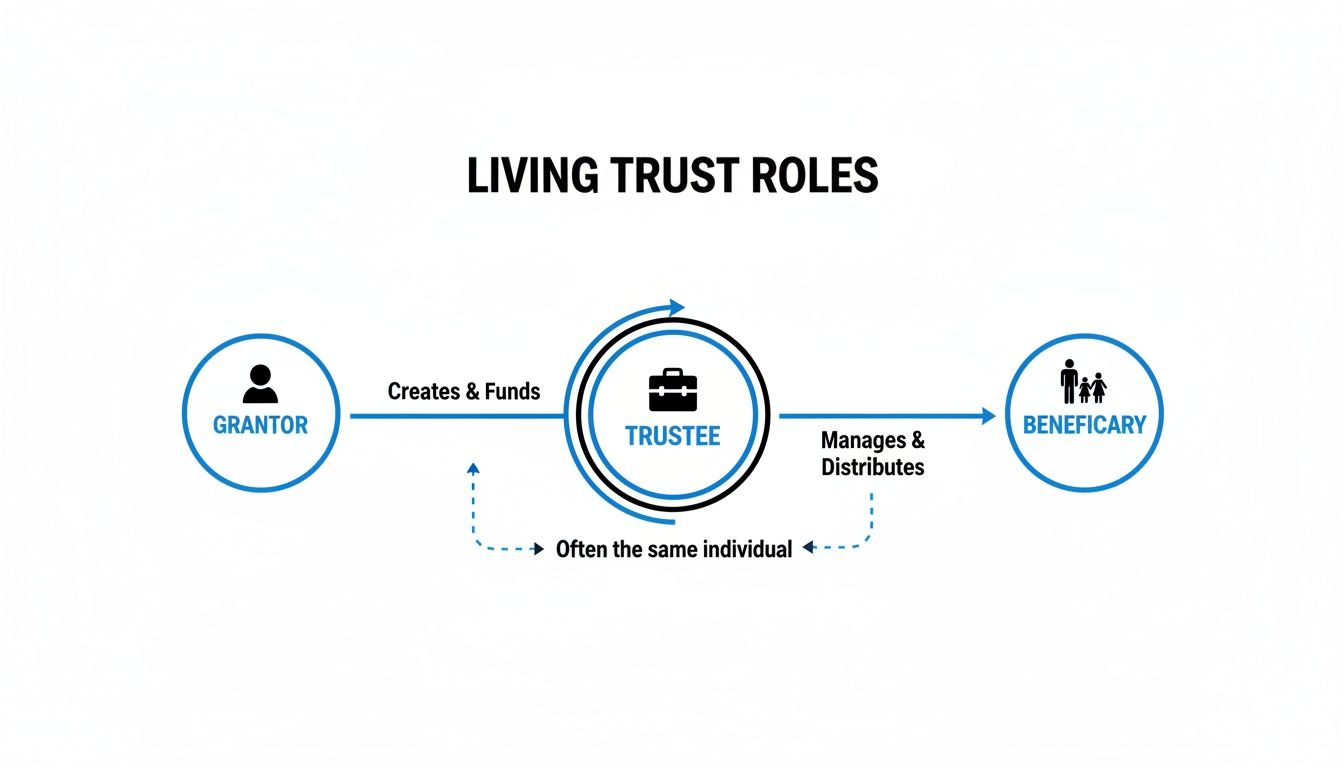
It’s this simple structure that allows a trust to function outside the probate system, making sure your wishes are followed quickly and efficiently.
A Practical Scenario in Humble
Let's imagine a family in Humble whose biggest asset is their home. If their estate plan is just a will, their kids will have to open a probate case to get the legal right to sell or even manage the property. That could drag on for months, leaving the house sitting empty while bills pile up and its value is at risk.
Now, picture the same scenario with a revocable living trust. The successor trustee could put the house on the market the very next day. They have the immediate power to pay the mortgage, handle upkeep, and eventually distribute the sale proceeds exactly as you laid out in the trust documents. The difference in time, money, and stress is night and day.
This level of efficiency is one of the most powerful arguments for a trust. Here at The Law Office of Bryan Fagan, we've seen the relief this brings to local families time and time again. You can learn more about how to avoid probate in Texas in our detailed guide.
If you’re ready to see how a trust can protect your own family from this process, we’re here to help. Schedule a free, no-obligation consultation with our Kingwood office today to discuss your specific needs.
Protecting Your Heirs from Creditors and Divorce
Beyond simply sidestepping probate, a revocable living trust has a powerful, often overlooked, benefit: it can act as a financial shield for your loved ones long after you're gone. While you’re alive, your trust is completely flexible—you can change it, add to it, or even dissolve it. But the moment you pass away, it becomes irrevocable. This transition is what locks in your wishes and creates a protective barrier around the inheritance you leave behind.
This is a game-changer for families here in Kingwood and Northeast Houston who want to be certain their hard-earned assets are used as intended. It gives you a way to safeguard an inheritance from future unknowns—things like a beneficiary’s unexpected financial troubles, a messy divorce, or simply a lack of money management skills.
Creating a Protective Shield for Beneficiaries
Think about what happens when you leave assets to someone through a simple will. That inheritance becomes their personal property, plain and simple. It’s now completely exposed to their life's risks. If your daughter inherits the family home and later gets divorced, that house could be considered marital property and get tangled up in the settlement. If your son runs into business debt, his creditors could go after the money you left him.
A trust completely changes that dynamic. Instead of giving the assets to your beneficiary outright, the trust continues to hold them for your beneficiary. This seemingly small distinction makes all the difference. You can instruct your chosen successor trustee to manage and distribute the funds according to your precise rules, keeping the core inheritance safe from outside claims.
Here is a practical, step-by-step example of what you could do:
- Provide a steady monthly payment to help with living expenses.
- Release a specific sum for a major life event, like a down payment on a home in Humble.
- Pay for college or trade school tuition directly, ensuring the money is used for education.
- Keep the assets protected until your beneficiary reaches a more mature age, say 30 or 35.
This level of detailed control is often called spendthrift protection, and it's a primary reason why so many local families opt for a trust. It’s about making sure your legacy actually helps your loved ones without becoming vulnerable to life's curveballs.
Real-World Scenarios in Northeast Houston
Let's make this real. Imagine you leave a sizable inheritance to your son in Porter through your will. A few years down the road, he finds himself in a contentious divorce. The money you wanted to be his safety net could easily become a central point of conflict in the legal battle, with a large chunk potentially going to his ex-spouse.
Now, let's rewind. What if you had placed that same inheritance inside a trust? The assets are legally owned by the trust, not by your son personally. His spouse would have an incredibly difficult, if not impossible, time laying claim to those funds. The inheritance stays secure, continuing to support your son exactly as you had envisioned.
This concept represents one of the most powerful but underutilized benefits of revocable living trusts, especially in a state like Texas with strong creditor protection laws. When your trust becomes irrevocable upon your death, it creates that protective shield. If you leave $250,000 to your adult child in a trust, and that child later faces a business lawsuit, the trust assets can remain protected from seizure in ways they wouldn't if inherited directly.
This foresight provides an incredible amount of peace of mind. To really get a handle on how these distributions work, it helps to dive into the details of understanding beneficiaries in estate planning. Knowing the roles and rules clarifies how a trust keeps your assets with the right people under the right protections.
At The Law Office of Bryan Fagan, we specialize in helping Kingwood families structure their trusts to build in this critical layer of security. If you want to make sure your legacy is safeguarded for the next generation, we invite you to schedule a free consultation with us.
Planning for Incapacity and Maintaining Control

So far, most of the revocable living trust benefits we've covered kick in after you pass away. But one of its most powerful features is designed to protect you, right now, during your lifetime. Think of it as a critical safety net for one of life’s most difficult “what-ifs.”
What would happen if an unexpected illness or a serious accident left you unable to manage your own finances? Without the right plan in place, Kingwood families often find themselves in a public, expensive, and stressful court proceeding called a guardianship.
In a guardianship, your loved ones would have to petition a Harris County court just for the authority to pay your mortgage, access your bank accounts, or handle your medical bills. The process isn't just slow and costly; it’s deeply invasive, forcing your private financial and medical details into the public record.
How a Trust Avoids Guardianship Entirely
This is where a revocable living trust shines. It allows you to completely sidestep that painful and intrusive court process.
Inside your trust document, you’ll name a successor trustee. This is the person you’ve handpicked to step in and manage your affairs if you ever become incapacitated. The transition is seamless and, most importantly, private.
If you’re unable to make decisions, your chosen trustee can immediately start managing the trust assets for your benefit. There are no court filings to deal with, no public hearings to attend, and no frustrating delays. Your financial life continues without disruption.
This is a key difference from other planning tools. Even a durable power of attorney, while very useful, can sometimes be questioned or rejected by financial institutions, leading to delays when you can least afford them. A trust provides the most robust and widely accepted authority. You can learn more about how these documents fit together by reading about what a power of attorney is and its role in a comprehensive plan.
The Peace of Mind This Provides
For our clients in Humble, Porter, and across Northeast Houston, this incapacity planning is the cornerstone of real peace of mind. Knowing you have a clear, private plan for a potential medical crisis is invaluable. It protects you from the indignity of a public guardianship and spares your family the emotional and financial toll of a court fight during an already stressful time.
A revocable living trust ensures that you maintain control even when you can’t express it. You decide ahead of time who takes charge, what they can do, and how your assets should be used for your care.
Here’s a simple, step-by-step look at how this protection works:
- Defining Incapacity: First, your trust document will clearly define what "incapacity" means, usually requiring a written opinion from one or two physicians.
- The Successor Trustee Steps In: Once that condition is met, your successor trustee simply presents the necessary documents to financial institutions and takes over management.
- Managing Assets for Your Benefit: The trustee has a legal "fiduciary duty" to act only in your best interest, using trust funds to pay for your care and maintain your lifestyle as you intended.
This structured plan ensures your legacy is protected not just for your heirs, but for you, no matter what the future holds. At The Law Office of Bryan Fagan, we help you build this vital protection into your estate plan. Schedule a free consultation at our Kingwood office to learn more.
How a Trust Fits into Your Tax Planning Strategy
One of the first questions we get from families in Kingwood is about taxes. "Will a revocable living trust help me save on taxes?" It's a great question, and the answer has a bit of nuance under Texas and federal law.
During your lifetime, a revocable trust is what we call "tax neutral." It doesn’t really change a thing on your income taxes. You’ll just keep reporting all the income from the trust's assets on your personal tax return, using your own Social Security number. Simple as that.
The real tax-planning muscle of a trust shows up when we start talking about your estate. While a basic trust doesn't automatically slash your tax bill, it creates the perfect vehicle for more advanced strategies designed to protect your family’s wealth for generations to come.
Building a Foundation for Tax Efficiency
Think of your trust as the foundation and framing of a custom-built home. By itself, it’s a strong, necessary structure. But its true potential is realized when you start adding the high-end features—the things that make it truly work for your family.
For married couples in Northeast Houston, one of the most powerful features we can build into a trust is a plan to maximize both spouses' tax exemptions when the first one passes away. This often involves creating what are known as marital or bypass trusts (sometimes called AB trusts). These are essentially sub-trusts that allow a couple to use both of their individual federal estate tax exemptions, which can shield millions of dollars from ever being touched by estate taxes.
Even if your estate doesn't seem large enough to worry about federal taxes today, a trust gives you the flexibility to adapt. Tax laws change. A trust puts you in a proactive position, not a reactive one.
The federal estate tax exemption for 2025 is a hefty $13.99 million per person. That number might seem out of reach, but when you add up the value of a Kingwood home, retirement funds, life insurance policies, and maybe a family business, you'd be surprised how quickly it can grow.
This is where a trust becomes so valuable. It’s not just a document; it's a strategic tool. By setting up this framework now, you're building a multi-generational plan to preserve what you've worked so hard for. It's a thoughtful approach that ensures your legacy is passed on efficiently, with as little lost to taxes as possible. To get the most out of your estate plan, it’s also smart to explore other effective tax-saving strategies that can work alongside your trust.
If you're a Kingwood resident and want to make sure your assets are protected from unnecessary taxes, The Law Office of Bryan Fagan is here to help. Schedule a free consultation with our team, and let's talk about how a custom-designed trust can become the cornerstone of your family's financial security.
Answering Your Questions About Revocable Living Trusts
Deciding to create a revocable living trust is a major step in protecting your family's future, so it's completely natural to have questions. To give you the clarity you need to move forward with confidence, we’ve put together answers to some of the most common questions we hear from our neighbors right here in Kingwood and Humble.
Our goal is to give you straightforward, practical answers that address your real-world concerns. We want to demystify the process and help you see exactly how a trust can fit into your family's unique situation. Let's dive into the details.
Do I Still Need a Will If I Have a Trust in Texas?
Yes, you absolutely do. This is a simple explanation of Texas law that is crucial for every Kingwood family to understand. Think of a will as the essential safety net for your trust. Even with a perfectly funded trust, a special type of will called a "pour-over will" works alongside it to complete your estate plan.
Its job is simple but critical: it catches any assets you may have forgotten to transfer into your trust and "pours" them in after you pass away. This ensures everything is ultimately handled under the private, efficient terms of your trust. More importantly, in Texas, a will is the only legal document where you can name a guardian for your minor children—a responsibility a trust simply cannot handle.
Is a Living Trust Expensive to Set Up?
A revocable living trust does have a higher upfront investment than a simple will, but it almost always saves your family a significant amount of money down the road. That initial cost is a one-time investment to avoid the lengthy and expensive probate court process, which can easily run into thousands or even tens of thousands of dollars in legal fees and court costs.
Think of it this way: you're pre-paying for a streamlined, private process for your loved ones, so they don't have to pay a much higher price—both financially and emotionally—while navigating the court system later. The long-term savings and peace of mind are some of the biggest revocable living trust benefits you can provide.
During a free consultation at our Kingwood office, we can give you a clear picture of the costs and show you the incredible value a trust provides by keeping your estate out of the public court system.
Can I Sell My House If I Put It in My Trust?
Absolutely. This is a great question, and the answer brings a lot of relief to our clients throughout Northeast Houston. Putting your home into a revocable living trust has no effect on your ability to sell it or any other asset.
Since you are the trustee, you keep 100% control over all the property inside the trust. The process of selling your home is practically identical. You'll simply sign the sale documents as "Trustee of your trust," and the money from the sale can go directly into a trust bank account. From there, you can use those funds however you like, including buying a new home that would then be titled in the name of the trust. Your control over your assets doesn't change one bit.
Creating an estate plan is a profound act of care for your family. If you have more questions or you're ready to see how a revocable living trust can bring security and peace of mind to your life, our team at The Law Office of Bryan Fagan – Kingwood TX Lawyers is here to help. Schedule your free, no-obligation consultation with our experienced Kingwood attorneys today. We're proud to serve our community with practical advice and trusted representation you can count on.