Skip to content
Picture your most valuable assets getting a non-stop ticket directly to your loved ones, completely bypassing the long, often frustrating, layover at the Texas probate court. That's essentially what a non-probate asset accomplishes. For families here in Kingwood, it’s a crucial estate planning tool that allows property to pass directly to a chosen person when you die, all without court involvement.
Understanding How Non-Probate Assets Work in Texas
When someone in Kingwood passes away, their estate usually has to go through a court process called probate. This is where a judge confirms the will is valid, ensures all debts are paid, and gives the green light to distribute the remaining property. While probate is sometimes necessary, it can be a public, lengthy, and expensive ordeal for families in Northeast Houston. At The Law Office of Bryan Fagan, we help our clients navigate this process with compassion and expertise.
A non-probate asset, on the other hand, sidesteps this entire process. It relies on a simple legal mechanism, like a beneficiary designation or a trust, which acts as a direct command for where that asset goes. Think of it like pre-filled, pre-approved paperwork that triggers an immediate transfer of ownership to the person you've named.
The Core Benefits for Your Family
For families in places like Humble and Porter, strategically using non-probate assets can make a world of difference. The main advantages are clear and practical:
- Speed: Your beneficiaries can often get access to funds or property within days or weeks, instead of being stuck waiting months for a judge to sign off.
- Privacy: Because the transfer happens outside of court, the details—what the asset is, its value, and who gets it—remain a private family affair, not a public record in Harris or Montgomery County.
- Reduced Costs: Skipping the formal probate process means your estate can save a significant amount on court filing fees, administrative expenses, and even attorney's fees.
At its heart, a non-probate asset is about maintaining control and ensuring efficiency. It lets you make certain your specific wishes are honored quickly and privately, giving your loved ones financial stability right when they need it most.
To help you see the difference more clearly, here’s a straightforward comparison of the two main types of assets under Texas law.
Probate vs. Non-Probate Assets at a Glance
This table offers a clear side-by-side comparison, helping you quickly understand the fundamental differences and why they matter for your estate plan in Kingwood.
| Characteristic | Probate Assets | Non-Probate Assets |
|---|---|---|
| Transfer Method | Through a will or state law (intestacy) | Directly via beneficiary designation or trust |
| Court Involvement | Required; supervised by probate court | Not required; bypasses the court system |
| Privacy | Public record; anyone can see the details | Private; details are not part of a public file |
| Speed of Transfer | Slow; can take months or even years | Fast; often just a matter of days or weeks |
| Associated Costs | Higher; includes court fees, legal fees, etc. | Lower; avoids most court-related expenses |
| Control | Dictated by the will and court approval | Controlled by the pre-set beneficiary designation |
Understanding these distinctions is the first step toward building a plan that truly protects your family and your legacy.
Why This Distinction Matters
The real difference comes down to ownership and instructions. Probate assets are things you own in your name alone, with no co-owner or named beneficiary. These assets are essentially "stuck" until a will (or state law, if there's no will) tells the court who should inherit them. It’s critical to understand the consequences of this; for instance, you can learn more about what happens if you don't have a will and how your assets are handled through the standard probate process.
A non-probate asset, however, already has its transfer instructions built right in. This simple yet powerful distinction is the cornerstone of effective, modern estate planning.
Taking the time now to properly structure your assets can give you and your family incredible peace of mind. If you're a Kingwood resident looking to secure your family’s future, The Law Office of Bryan Fagan is here to guide you. We are a local firm that understands the needs of our community. We invite you to schedule a free consultation with our experienced team to talk about your estate planning goals.
Common Non-Probate Assets You May Already Own
It might surprise you to learn that you probably already have several powerful estate planning tools in your financial portfolio. You just might not think of them that way. These are your non-probate assets, and understanding what they are and how they work is the first step toward making sure they protect your family as you intend.
Think of it like this: your assets will follow one of two paths after you're gone. This simple chart shows the fork in the road.
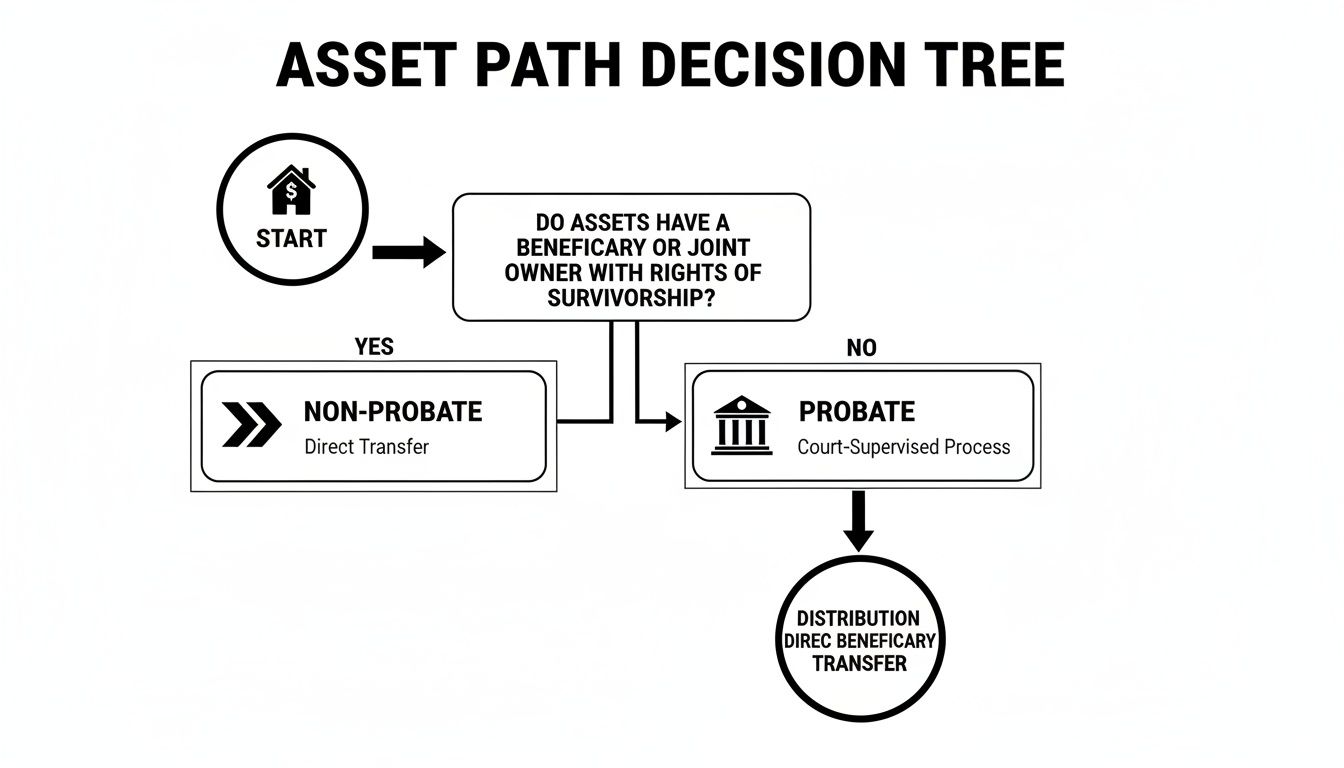
As you can see, a non-probate asset takes a direct route to your loved ones. Everything else has to make a detour through the court system first.
Life Insurance Policies
A life insurance policy is one of the most classic examples of a non-probate asset. When you take out the policy, the insurance company has you name a beneficiary—that's the person who gets the payout.
When you pass away, that person simply provides the insurance company with a death certificate to claim the funds. The money is paid directly to them, never touching your estate or getting tied up in court. If you have a life insurance policy through your job in Houston, the person you named on that form gets the money, plain and simple.
Retirement Accounts (401(k)s, IRAs)
Your retirement accounts work just like life insurance. Whether it's a 401(k) from your employer in Northeast Houston or a personal IRA you set up yourself, you designated a beneficiary when you opened the account.
That beneficiary designation is a direct command. It tells the financial institution exactly who gets the money, allowing your loved ones to access those funds without waiting for a judge's permission. This is an incredibly effective way to provide immediate financial stability for your family.
Key Takeaway: Beneficiary designations are legally binding contracts. In almost every case, they will override whatever your will says. This makes them fast and efficient, but it also means you absolutely must keep them updated.
Bank Accounts with Payable-on-Death (POD) Designations
Did you know you can turn a standard bank account into a non-probate asset? Many folks in Humble and Porter do this by adding a Payable-on-Death (POD) designation. It’s usually just a simple form you fill out at your bank.
With a POD in place, you name someone to inherit the account balance automatically. While you're alive, they have no access to your money. But after you're gone, they can claim the funds directly from the bank with a death certificate and proper ID, completely bypassing the probate process.
Real Estate with a Transfer-on-Death Deed (TODD)
In Texas, we have a fantastic tool for keeping real estate out of probate: the Transfer-on-Death Deed (TODD). By filing this legal document, you can name a beneficiary who will automatically receive the title to your property upon your death.
The best part? You keep total control of your Kingwood home during your lifetime. You can sell it, mortgage it, or do whatever you want with it. The TODD only kicks in when you pass away, making it a flexible and powerful way to transfer what is often a family's most valuable asset.
Considering the probate process in Texas can easily drag on for 9 to 18 months and devour up to 5% of an estate's value in fees, using a TODD is a no-brainer for many. These tools are becoming more popular as families seek to protect their legacy, a trend expected to grow as the number of ultra-wealthy individuals is forecast to rise by 31% by 2030. You can explore more data on trusts and estates to see how planning strategies are evolving.
Knowing which of your assets can skip probate is a great start. The crucial next step is ensuring they are set up correctly and actually align with your overall wishes. The experienced attorneys at The Law Office of Bryan Fagan are here to help Kingwood families review their assets and build a plan that truly protects their legacy. Call us today for a free consultation to talk about your situation.
The Power of Your Beneficiary Designations
If your will is a general roadmap for the probate court, think of a beneficiary designation as a direct, legally binding command tied to a specific asset. It's a powerful instruction that tells a bank or insurance company exactly who gets that money when you're gone. In Texas, this instruction almost always trumps whatever your will might say.
This simple piece of paperwork is the engine that drives most non-probate transfers, making them so efficient. For folks here in Kingwood and the surrounding Northeast Houston area, getting this distinction right is absolutely critical. Your will handles the assets that need to go through probate, but for things like your 401(k), life insurance, or a Payable-on-Death bank account, the beneficiary form you filled out is the final word.
Why a Beneficiary Designation Overrides Your Will
Let's walk through a common scenario we see with families from Humble or Porter. Imagine a father writes a will leaving his entire estate to his three children in equal shares. That seems fair enough. But years ago, when he first got his life insurance policy at work, he named only his oldest child as the beneficiary and simply never thought to update it.
When he passes away, the insurance company has a legal duty to pay 100% of the policy proceeds directly to that one child. The will's instruction to divide everything equally doesn't apply to that policy. The beneficiary designation is a non-probate tool, and it completely bypasses both the will and the court system. You can learn more about how this works in our guide on how to avoid probate in Texas.
This is precisely why we tell our Kingwood clients that beneficiary designations aren't just a box to check—they are a core part of your estate plan that needs regular attention.
You Must Review Your Designations Regularly
Life happens. People get married, divorced, have kids, and relationships change. Your estate plan has to keep up. A beneficiary you named a decade ago might not reflect who you want to receive that asset today. Honestly, failing to update these forms is one of the most common and gut-wrenching mistakes we encounter in our Kingwood practice.
A beneficiary designation is a living document in spirit, if not in law. It should evolve as your life does. An outdated form can accidentally disinherit someone you love or, worse, send a significant asset to an ex-spouse.
Here is a step-by-step list of life events that should be an immediate red flag, signaling it's time to review every single one of your beneficiary forms:
- Getting Married: You’ll almost certainly want to add your new spouse, likely as the primary beneficiary on key accounts.
- Getting Divorced: This one is urgent. If you forget to remove your ex-spouse from a retirement account, they could inherit it, no matter what your divorce decree says.
- Having a Child (or Grandchild): You need to decide how to provide for your new family member, maybe by naming them as a secondary (contingent) beneficiary.
- A Beneficiary Passes Away: If your primary beneficiary dies and you haven't named a backup, that asset could end up right back in your probate estate, completely defeating the purpose of the designation.
- A Major Financial Shift: A big inheritance or a significant change in your own assets might change how you want your non-probate funds distributed.
Keeping these forms up to date is a simple but vital chore. At The Law Office of Bryan Fagan, we can help you do a full review to make sure every account and policy is perfectly aligned with your final wishes. Schedule a free consultation with us here in Kingwood, and let's get your family's future secured.
Using a Living Trust to Avoid Probate
While naming beneficiaries on individual accounts is a smart move, a revocable living trust offers a far more comprehensive and flexible strategy for managing your entire estate. It’s best to think of a living trust as a private legal entity—almost like a personal treasure chest—that you create to hold title to your most valuable assets, such as your Kingwood home, investment accounts, or family business.

During your lifetime, you typically serve as the trustee. This means you keep full control over everything in the trust. You can buy, sell, and manage your assets just like you always have. Nothing really changes in your day-to-day life.
But here’s where the magic happens: after you pass away, the successor trustee you’ve chosen steps in. They follow the private instructions you left in the trust document and distribute your assets directly to your heirs, completely bypassing the probate court. This is a practical, step-by-step process we guide our Kingwood clients through every day.
How a Trust Provides Privacy and Control
A will, once filed, becomes a public record. Anyone can walk into the courthouse and see the details of your estate—what you owned, who you owed, and who got what. A trust, on the other hand, remains a completely private document. For many families in Northeast Houston, keeping their financial affairs out of the public eye is a major advantage.
Beyond privacy, a trust gives you much more sophisticated control over how and when your assets are passed on. You aren't limited to giving a lump-sum inheritance. Instead, you can set specific conditions. For example, you could structure the trust to distribute funds to a grandchild only when they enroll in college, or ensure a beneficiary receives their inheritance in stages once they reach a certain age. This level of customized planning simply isn't possible with a basic will.
A living trust is more than just a way to avoid probate; it's a comprehensive plan for managing your legacy. It ensures your assets are handled exactly as you wish, with efficiency and complete privacy.
The use of trusts has exploded in popularity as more people grasp their power. In fact, the US Trusts & Estates industry has grown at a compound rate of 8.8% over the last five years, with its revenue projected to hit $290.1 billion by 2025. This isn’t just a trend for the ultra-wealthy; it reflects everyday families and retirees, including many right here in the Kingwood area, looking for smarter ways to transfer their assets.
Key Steps to Creating an Effective Trust
Setting up a trust that actually works involves more than signing a piece of paper. It’s a process that requires careful planning and, more importantly, proper execution.
Here are the essential steps we walk our clients through:
- Drafting the Trust Document: First, you work with an attorney to create a legally sound document. This is where you’ll name your successor trustee, your beneficiaries, and lay out all your specific instructions for how things should be handled.
- Funding the Trust: This is the most crucial—and most often overlooked—step. You have to legally transfer ownership of your assets into the trust. For your home in Humble, this means recording a new deed that names the trust as the owner. For a bank account, it means retitling the account in the trust's name.
- Maintaining the Trust: A trust isn't a "set it and forget it" tool. Just like your beneficiary forms, it should be reviewed every few years or after any major life event to make sure it still aligns with your wishes. You can learn more about the benefits of a revocable living trust in our detailed guide.
If assets aren't properly "funded" into the trust, they will almost certainly have to go through probate, which defeats one of the main reasons for creating the trust in the first place. This is why working with an experienced Kingwood attorney is so important—to ensure the job is done right from start to finish.
If you’re ready to explore how a living trust can protect your family and secure your legacy, The Law Office of Bryan Fagan is here to help. We invite you to schedule a free, no-obligation consultation at our Kingwood office to talk about your estate planning goals.
Costly Mistakes Kingwood Families Make
Even with the best intentions, a small oversight in your estate plan can lead to significant and heartbreaking problems for your family. A non-probate asset is a powerful tool precisely because it’s direct and bypasses the courts, but that same feature can cause major issues if it's not managed carefully. Believe me, many families right here in Kingwood and Northeast Houston have learned this the hard way.
Understanding these common pitfalls is the first step toward avoiding them. These aren't just theoretical legal problems; they are real-world scenarios that can create lasting financial and emotional damage.

Forgetting to Name a Beneficiary
The most basic mistake is simply failing to name a beneficiary at all. When you open a retirement account or buy a life insurance policy, you're given a form to designate who should receive it. If you leave that line blank, the asset loses its non-probate status.
What happens then? Instead of passing directly to your loved ones, the asset gets kicked back into your estate. This means it has to go through the lengthy and public probate process, completely defeating the purpose of having a non-probate asset in the first place.
Failing to Update Beneficiaries After a Divorce
Life changes, and your estate plan absolutely must change with it. One of the most devastating mistakes we see involves outdated beneficiary forms after a divorce.
Consider this cautionary tale: a Humble resident had a significant 401(k) account from his job and had named his wife as the beneficiary years ago. After a contentious divorce, he updated his will to leave everything to his children but completely forgot about that 401(k) beneficiary form. When he passed away, his ex-wife—not his children—was legally entitled to the entire retirement account. Under Texas law, that beneficiary designation is a binding contract that his will could not override.
Crucial Reminder: A divorce decree does not automatically remove an ex-spouse as a beneficiary on your accounts. You must proactively contact each financial institution and submit new paperwork to make the change official.
Naming a Minor Directly as a Beneficiary
It’s completely natural to want to provide for your children or grandchildren. But naming a minor directly on a life insurance policy or an IRA can create a huge legal headache. Financial institutions simply cannot transfer large sums of money directly to a child.
This mistake often forces the surviving family members to go to court to get a legal guardian of the estate appointed to manage the funds until the child turns 18. The process is costly, time-consuming, and puts the inheritance under strict court supervision—the very things you were trying to avoid. A much better approach is to set up a trust for the minor's benefit and name that trust as the beneficiary.
Despite the apparent simplicity of these tools, national statistics show a concerning gap in estate planning. In 2025, only 24% of Americans have a will and just 13% have a living trust, leaving a staggering 55% with no estate documents whatsoever. This lack of preparation can turn a simple oversight into a major crisis for families. You can discover more about these estate planning trends and statistics and see why proactive planning is so vital.
These mistakes are entirely preventable with careful, professional guidance. At The Law Office of Bryan Fagan, we help Kingwood families review their entire estate plan—including those often-forgotten beneficiary forms—to catch these potential issues before they become problems. Schedule a free consultation with us today to ensure your assets are truly protected and your wishes will be honored.
How a Kingwood Attorney Can Secure Your Legacy
Navigating the ins and outs of Texas estate law can feel like a maze, but securing your family's future doesn't have to be a stressful journey. As we've discussed, a non probate asset is one of the most powerful tools in your estate planning toolkit. These are the assets—like retirement accounts, life insurance policies, and even your home if you use a Transfer-on-Death Deed—that bypass the courts and go straight to your loved ones.
The whole point is to spare them the time, expense, and headaches of the Texas probate system.
But here’s the catch: these powerful tools aren't something you can just set up and forget about. They need to be handled with care and reviewed regularly to make sure they still do what you want them to do. A simple mistake, like an outdated beneficiary form or a trust that was never properly funded, can derail your entire plan. Suddenly, the very court process you wanted to avoid is exactly where your family ends up.
Partnering with a Local Attorney
This is why sitting down with a local Kingwood estate planning attorney is so critical. A good lawyer does far more than just fill out forms; they look at your entire financial and family situation from a bird's-eye view. They help you connect the dots between your will, your various beneficiary designations, and any trusts you have, ensuring they all work together as one cohesive, legally-solid strategy.
At The Law Office of Bryan Fagan, we make sure every piece of your plan is perfectly aligned with your goals. We help families right here in Kingwood and across Northeast Houston with the crucial details:
- Auditing all beneficiary forms to confirm they are up-to-date and name the right people.
- Properly funding a living trust by making sure assets are correctly re-titled in the trust's name.
- Planning for life's "what-ifs," like what should happen if a beneficiary passes away before you do.
- Working to minimize potential tax burdens and protect your hard-earned assets for future generations.
Peace of mind isn’t just about having a plan; it’s about knowing your plan is correct. A skilled attorney acts as your safety net, catching any gaps or oversights that could jeopardize your family’s security.
When you work with a local firm, you get advice that’s specifically tailored to Texas law and the practical realities of our community. We know the concerns that families in Humble, Porter, and the greater Kingwood area face. Our job is to translate your wishes into a rock-solid legal framework that gives your loved ones the protection they deserve. You can learn more by exploring our full range of estate planning services in Kingwood, Texas.
Don't leave something as important as your legacy to chance. Let us help you build a plan that truly honors your life's work and protects the people you love.
Your family’s future is too important to leave to uncertainty. At The Law Office of Bryan Fagan – Kingwood TX Lawyers, we are dedicated to helping our neighbors create strong, effective estate plans. We understand that this can be a sensitive topic, and we are here to provide supportive, client-focused guidance. We invite you to schedule a free, no-obligation consultation at our Kingwood office to discuss your assets and create a strategy that provides true peace of mind. Visit us at https://kingwoodattorneys.com to get started.