Skip to content
Life doesn't stand still after a divorce or custody case, and neither should your child support order. It’s a common myth that once a judge signs off, the amount is set in stone. The truth is, Texas law is built to adapt to life's changes.
For families in Kingwood, Humble, and Northeast Houston, a child support modification in Kingwood isn't just possible—it's a necessary tool when life throws you a curveball. You’re not stuck with an old order that no longer fits your family's financial reality, and our local firm is here to help you understand your options.

Do You Qualify for a Child Support Modification?
So, how do you know if you have a case? For parents in Kingwood, Porter, and the surrounding Harris County communities, the first step is understanding when you can ask the court for a change.
The good news is that you don't always need a life-shattering event to qualify. While a major change certainly counts, sometimes the simple passage of time is enough. Texas law gives local parents two main avenues to pursue a modification.
The Two Legal Grounds for Changing Your Order
A Harris County court will hear your case if you meet one of two specific legal standards. These rules exist to keep the courthouse doors from revolving with minor disputes while still giving families in our community a clear path to make necessary updates.
Here are the two primary reasons a court will consider a modification, explained in simple terms:
- A Material and Substantial Change of Circumstances: This is the most common path. It means something significant has happened in the life of the child or one of the parents since your last order was finalized.
- The Three-Year Rule: This is a simpler route that doesn't require a major life event. If it has been at least three years since your order was set, you can ask for a review. If the new guideline calculation differs from your current order by 20% or $100, the court can modify it.
To help you see how these standards play out in the real world, let's break down what they mean for parents in the Kingwood area.
Quick Guide To Child Support Modification Eligibility
This table summarizes the two main legal reasons you can use to ask a court to change your child support amount.
| Reason For Modification | What It Means For Kingwood Parents | Example Scenario |
|---|---|---|
| Material & Substantial Change | Something significant and ongoing has changed for you, the other parent, or your child. This change must have occurred after your current order was signed. | A parent paying support is laid off from their job at a local Humble-area company. Or, a child develops a medical condition that requires expensive new treatments. |
| The Three-Year Review Rule | At least three years have passed, and the new guideline amount is significantly different—either 20% or $100 more or less than the current amount. | A parent has received several small raises over three years. While no single raise was "substantial," their income is now high enough that the guideline support amount has increased by more than $100. |
As you can see, Texas law provides flexibility. Whether you're dealing with a sudden job loss in Northeast Houston or the slow creep of inflation and income changes over time, there's a potential path forward.
For some local families, questions about child support are tied to legal parentage. If you're also navigating that process, you can find helpful information on how to establish paternity in Texas.
One of the biggest mistakes we see parents in our community make is waiting too long. They assume a "temporary" layoff won't matter or that a small pay bump isn't enough. The court can only modify support going forward from the date you file, so acting quickly is key to protecting your financial stability.
Figuring out if your situation meets these standards can feel confusing. But you don't have to do it alone. The Law Office of Bryan Fagan is a local Kingwood firm committed to helping our neighbors. We can sit down with you, review your circumstances, and give you an honest assessment of whether you have a strong case for modification.
Proving a Material and Substantial Change
When life throws a curveball, your existing child support order might not make sense anymore. In Texas, the legal key to changing that order is proving a "material and substantial change in circumstances."
That’s just legal-speak for a simple concept: something significant and ongoing has changed for you, the other parent, or your child since a judge signed the last order. A Harris County judge needs to see that this isn't just a temporary hiccup, but a real shift that affects either the ability to pay support or the child's financial needs.
This is where the law meets real life for families all over Kingwood, Humble, and Northeast Houston.

What Counts as a Significant Change?
The change has to be big enough and lasting enough to justify a whole new child support calculation. For instance, a small dip in one month’s commission check probably won't cut it. But a permanent shift in your financial reality almost certainly will.
From our experience helping Kingwood families, here are some of the most common situations Harris County judges recognize:
- Involuntary Job Loss: Getting laid off is a classic example. This is especially true in our area, where a downturn in the energy sector can lead to widespread job losses.
- A Major Shift in Income: This can go either way. If the parent paying support lands a big promotion with a hefty raise, the other parent can ask for an increase. On the flip side, if their income is permanently cut, they can petition for a reduction.
- The Child's Needs Have Changed: This is a big one. A child might be diagnosed with a medical condition that requires expensive therapies, special equipment, or ongoing treatments not covered by insurance.
- Health Insurance Costs Spike: Sometimes, the cost of the child's health insurance premium goes up dramatically. If that increase is significant, it can be grounds for a modification.
Here’s a critical piece of advice: act fast. A judge can only modify support payments back to the date you officially filed the paperwork and served the other parent. If you lose your job in Kingwood and wait six months to file, you could be on the hook for that higher child support amount for all six of those months.
The New Texas Child Support Cap
Sometimes, the change doesn't come from your personal life but from a change in the law itself.
As of September 1, 2023, Texas law increased the "cap" on the monthly net resources used to calculate child support. It went from $9,200 to $11,700—a 27% increase that directly affects support calculations for higher-earning parents in Kingwood and across the state.
Under Texas Family Code § 156.401, this update to the law is, by itself, considered a material and substantial change. This means you don't have to wait for a job change or the usual three-year review period to ask for a new calculation.
So, even if nothing else has changed, this new law could be your reason to seek a child support modification in Kingwood. If the paying parent's income is over the old cap, a new calculation using the $11,700 figure could lead to a higher support payment. It's worth seeing how the numbers shake out, and you can get a clearer picture by reviewing our guide on how to calculate child support in Texas.
Figuring out if your situation meets this legal standard is the first and most important step. Our attorneys at The Law Office of Bryan Fagan work with Harris County judges and understand how they view these cases. We invite you to Schedule a free consultation at our Kingwood office to talk through what’s changed in your life and get straightforward advice on your next steps.
Using The Three-Year Review Rule To Your Advantage
Most people think you need a major life event—like a job loss or a huge promotion—to change a child support order. But that’s not always the case in Texas. Sometimes, the path to a fair support amount is much simpler, thanks to a powerful but often overlooked provision in the law.
This is what we call the “three-year review rule.” It’s a straightforward opportunity for parents in Kingwood, Porter, and the surrounding areas to re-evaluate child support without having to prove a dramatic change in circumstances. If it’s been at least three years since your last child support order was put in place, the door is open for a review.
How The Three-Year Rule Works: A Practical Guide
Essentially, after 36 months have passed, you can ask the court to recalculate child support based on both parents' current incomes. If the new calculation results in a payment that’s significantly different from the old one, a judge can modify the order.
This rule is so useful because it acknowledges a simple reality: life doesn't stand still. Even small, annual cost-of-living raises, changes in health insurance costs, or shifts in income can really add up over three years.
The whole point is to keep child support orders from becoming stale. A parent’s ability to provide for their child can change quite a bit in three years, and the support amount should reflect that current reality.
The Magic Numbers: 20% or $100
So, what counts as a “significant” difference? Under Texas Family Code § 156.401, a judge can modify the order if the new, recalculated child support amount differs from the current payment by either 20% or $100 per month, whichever is less.
This specific threshold prevents the courts from getting bogged down with tiny fluctuations while ensuring meaningful changes are addressed. You can get more insight into the specifics of this statute by reading about how often child support can be modified in Texas.
Let's look at how this plays out for local families:
Example 1: Requesting an Increase. A parent in Humble receives $500 per month in support. Three years later, the paying parent has received a few promotions. A new calculation shows they should now be paying $610 per month. Since that $110 difference is more than the $100 minimum, the parent receiving support has a strong case for a modification.
Example 2: Requesting a Decrease. A parent in Porter pays $1,800 per month. Their income has dipped slightly over the last three years. A new calculation shows the guideline support amount should be $1,500. This $300 decrease easily clears the $100 hurdle, giving the paying parent grounds to request a reduction. The 20% rule (which would be $360) doesn't come into play here because the $100 threshold was met first.
The best part about this rule is that you can often do the initial math yourself. By gathering current income information for both parents, you can run the numbers and get a pretty clear idea of whether you qualify for a child support modification in Kingwood before ever stepping into a courthouse.
Life changes, and your court orders should be able to change, too. At The Law Office of Bryan Fagan, our client-focused team helps our Kingwood neighbors use these rules to ensure their support orders are fair and up-to-date. If it’s been more than three years since your last order, give us a call for a free consultation to see if this powerful rule could work for you.
How to File Your Modification Case in Harris County
So, you’ve run the numbers and reviewed your situation. It looks like you have a solid case for a child support modification in Kingwood. That’s the first hurdle. But knowing you qualify and actually starting the legal process are two very different things. Let's walk through the practical, step-by-step guidance of filing your case in Harris County, so you can feel less overwhelmed and more in control.
The process doesn't begin in a grand courtroom. It starts with careful preparation. Think of it as building the foundation of your case—the stronger it is, the better your chances.
You'll need to gather documents that create a crystal-clear financial snapshot for the judge. This information is what the court uses to apply the Texas child support guidelines, so getting it right is non-negotiable.
Step 1: Gathering Your Essential Documents
Before you can file a single form, you need to collect your financial records. A little organization now will save you a massive headache later. We always advise our Kingwood clients to create a dedicated folder, whether it’s a physical one or a digital one on their computer, to keep everything in one spot.
Here’s a practical checklist of what you should start pulling together:
- Proof of Income: This means your last two years of tax returns and at least three months of recent pay stubs. If you’re self-employed or your income fluctuates, you’ll need to provide profit and loss statements.
- Child-Related Expenses: Dig up receipts and bank statements showing what you pay for the child's health insurance, out-of-pocket medical bills, dental costs, and any specialized needs like therapy or tutoring.
- The Current Child Support Order: You absolutely must have a copy of the existing court order you want to change. This document is the legal starting point for your entire case.
Having all this on hand before you even speak with an attorney allows them to give you a much more accurate assessment of your case from the get-go.
Step 2: Filing the Petition and Serving the Other Parent
The official legal process kicks off when you file a document called a "Petition to Modify the Parent-Child Relationship" with the Harris County District Clerk. This petition is your formal request to the court, and it lays out why you're asking for the change—whether it's because of a significant life event or simply because it's been over three years.
This infographic gives a great, simplified look at the three-year rule, which is one of the most common reasons people file for a modification.
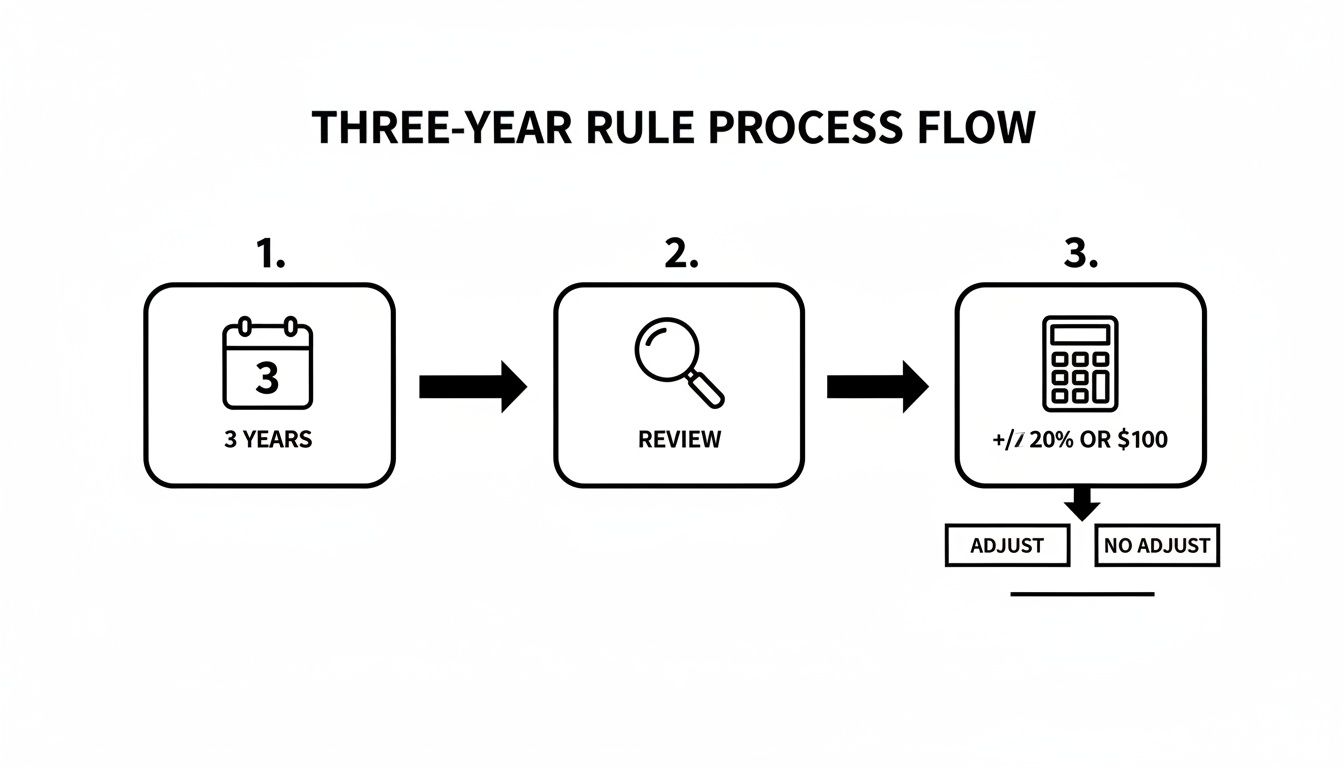
As you can see, the three-year review is fairly straightforward. If it's been 36 months since your last order and the new calculation would be off by at least 20% or $100, the court will likely grant a modification.
After the petition is filed, the other parent needs to be formally notified. This critical legal step is called "service." You can't just hand them the papers or shoot them a text; a certified process server or a sheriff's deputy must deliver the documents.
A common mistake we see is when parents try to handle service themselves to cut costs. This almost always backfires, causing delays or even getting the case thrown out. Using a professional ensures this vital step is done by the book.
Once served, the other parent has a set deadline to file a formal answer with the court. From that point on, your case is officially underway. It will typically move toward mediation or an initial hearing to see if an agreement can be reached.
Taking legal action can feel like a monumental task, but you don't have to figure it all out on your own. As a local firm, our attorneys at The Law Office of Bryan Fagan have guided countless families in Kingwood, Porter, and Humble through this exact process. Schedule a free consultation, and we can help you get organized and file your case with confidence.
Navigating Mediation And Court Hearings
So, you’ve filed your petition to modify child support and the other parent has been officially served. What happens next? Your case is now on one of two tracks: settlement or a court decision. Most parents are relieved to hear that the vast majority of these cases are settled out of court, often through a process called mediation.
The truth is, Harris County judges strongly prefer that parents work out these issues themselves. They will almost always order you and the other parent to attend mediation before they’ll even consider giving you a trial date.
The Mediation Process in Kingwood: A Path to Agreement
Mediation is essentially a guided negotiation. You, the other parent, and your respective attorneys meet with a neutral third-party mediator whose only job is to help you find a resolution. The mediator doesn't take sides or issue rulings; they facilitate a conversation to help you reach a compromise on a new child support amount.
For Kingwood families, going this route has some powerful benefits:
- You Keep Control: You and the other parent get to decide what the new support order looks like. A judge doesn't know your kids or your unique situation, but you do.
- It Saves Money: A full-blown court trial is expensive. Mediation is almost always the more cost-effective path, saving you significant legal fees and court costs.
- It's Faster: You can resolve your entire case in a single day of mediation. Waiting for a final hearing on a judge’s crowded docket can take months.
From our experience, mediation is usually the most productive way to handle a child support modification in Kingwood. It gives you the flexibility to find creative solutions a judge simply can't order. The principles are very similar to what's used in divorce cases, and you can learn more by reading our guide on divorce mediation in Texas.
What to Expect in a Court Hearing
But what if you just can't find common ground in mediation? If you and the other parent are at a complete impasse, your case will be set for a final court hearing. This is where you hand over the decision-making power entirely to a judge.
Once you're in court, you lose the control you had in mediation. The judge’s decision is final. This is why it’s absolutely critical to have an experienced Kingwood attorney who can present your evidence effectively and argue your case.
During the hearing, your lawyer will present all the documentation you've gathered—pay stubs, tax returns, receipts for the child's expenses—to prove the change in circumstances. You’ll likely have to testify and answer questions from the judge and the other parent’s attorney. The judge will listen to both sides, apply the Texas child support guidelines to the facts, and issue a final, binding order.
Whether your case is resolved around a negotiating table or in a courtroom, you don't have to face it alone. Our firm is dedicated to serving our neighbors in Kingwood, Humble, and Porter. Call us to schedule a free consultation at our Kingwood office so we can talk through the best strategy for your family.
Common Questions About Modifying Child Support In Kingwood
When life throws you a curveball, your first thoughts often turn to your finances and your family. If you're thinking about a child support modification in Kingwood, you probably have a lot of urgent questions. Let’s walk through some of the most common ones we hear from parents right here in our community.
Can I Stop Paying Child Support If I Lose My Job In Kingwood?
No. This is the single most important thing to understand: you cannot just stop paying child support, even if you were laid off. The court order is legally binding, and your obligation continues until a judge formally changes it.
Simply stopping payments can have devastating consequences, from wage garnishment once you find a new job to license suspensions and even potential jail time. Your best move is to immediately file a Petition for Modification with the court. A judge might make the new, lower payment retroactive to the date you filed and notified the other parent, but that's not a guarantee. Acting fast is the best way to protect yourself.
How Long Does A Child Support Modification Take In Harris County?
This is the classic "it depends" answer, but we can give you a realistic picture based on our experience in local courts.
- An uncontested modification, where you and the other parent agree on the new amount, can be wrapped up fairly quickly, often in a matter of a few months.
- A contested modification, however, is a different story. If you disagree on the new payment, the process will involve formal discovery, mediation, and potentially court hearings. These cases can easily take six months to over a year to finalize.
The timeline is also at the mercy of the court's schedule and how complicated your financial picture is.
What If The Other Parent Hides Income To Avoid Paying More?
This is a frustrating situation we see frequently in the Kingwood and Northeast Houston area. If you're certain the other parent is hiding income or deliberately working a lower-paying job to keep their support payments down, you have options. We don't just have to take their word for it.
We can use a legal process called "discovery" to formally demand financial proof—things like bank statements, tax returns, and business records. If the evidence shows they could be earning more, a judge has the power to impute income. This means the court calculates child support based on what that parent should be earning, not just their reported income.
Trying to change a child support order can feel overwhelming, but you shouldn't have to navigate it alone. The legal team at the Law Office of Bryan Fagan – Kingwood TX Lawyers is right here in your community, providing the trusted, client-focused representation you deserve. Our experienced attorneys have the local knowledge to guide you through this process. Schedule a free consultation at our Kingwood office to talk about your specific case and get clear answers about your options.