
You drive to the exchange spot in Kingwood. You're on time. Your child's bag is packed. Then the other parent doesn't show, or sends a last-minute text saying they're keeping the child “until things calm down.” Your stomach drops because you know this isn't just rude. It disrupts your child's routine, puts you in a defensive position, and leaves you wondering what to do next without making things worse.
That's the moment many parents start searching for what to do if an ex violates a custody order in Kingwood, Texas. The right response usually isn't loud or dramatic. It's controlled, documented, and built around what a Harris County or Montgomery County judge can use.
Parents in Kingwood, Humble, Porter, and Northeast Houston often think the first step is to argue, threaten, or “even the score” at the next exchange. That usually backfires. What helps is knowing the difference between a frustrating co-parenting conflict and a legal enforcement issue, then acting in a way that protects both your child and your credibility.
When Your Ex Violates the Custody Order
A custody order isn't a parenting suggestion. It's a court order. If your ex ignores it, the problem is legal as much as personal.
A common example looks simple on the surface. Friday pickup is set for after school or at a specific public location in Kingwood. You arrive. The child never comes. You get a text that says your ex decided the child “doesn't want to go,” or that the weekend “isn't good.” Many parents freeze right there because they don't want to upset the child or trigger a bigger fight.
That reaction is understandable. It's also where mistakes start.
What worried parents usually get wrong
The first mistake is treating the event like a one-time misunderstanding when there's already a pattern. The second is reacting emotionally in a way a judge may later view as noncompliance on your side too. If you respond by withholding the child later, refusing communication, or making threats, you may weaken your own position.
Practical rule: The court wants facts tied to the written order, not a running summary of who has been more difficult.
In Kingwood-area cases, that practical difference matters. Some families file in Harris County. Others are in Montgomery County. Either way, the court will care far more about what the order says, where the exchange was supposed to happen, and what proof you kept than about general complaints that your ex is impossible.
Regain control by getting structured
When parents are overwhelmed, I often tell them to narrow the problem down to three questions:
- What did the order require
- What exactly happened
- What proof do you have
That shift changes everything. It turns panic into a plan.
For some parents, that also means reducing digital chaos and keeping communication quieter and more secure. If you need tools that focus on calmer, lower-noise connection, Safety that runs along. No noise, no control, just Safe. may be useful as part of your broader communication habits, especially if your co-parenting dynamic is tense.
If the order is being violated, you don't need to guess your way through it. You need a response that is calm enough to protect your child and precise enough to stand up in court.
Immediate Steps to Take at a Missed Custody Exchange
When an exchange is missed, your job is simple. Show up, stay calm, document your compliance, and avoid retaliation. Texas family-law guidance uses that practical workflow because courts look closely at whether the parent asking for enforcement followed the order exactly and preserved proof of the failed exchange, while retaliation can create a separate problem and weaken contempt relief, as explained in this Texas custody violation guidance.

What to do right there at the exchange
If your order says to meet at a school, daycare, parking lot, police station, or another specific location, go there exactly as written. Don't substitute a different place because it's more convenient. Don't assume a text changed the order.
Then do the following:
Arrive on time
Be early if possible. That removes any later argument that you missed the exchange.Wait calmly
Don't leave immediately if the other parent is late. A brief, reasonable wait helps show you made the exchange possible.Create time-stamped proof
Take a photo of your car at the location, a short video, or a screenshot showing your location and time. Keep it factual.Send one polite written message
A short text is enough: “I'm at the exchange location listed in the order.” That's better than a heated phone call.Do not argue in person or by text
Angry messages feel satisfying in the moment and often look bad later.
What not to do next weekend
Parents in Humble and Northeast Houston often ask the same question after a denied exchange. “Can I just keep the child next time to make it even?” No. That usually creates a fresh violation and muddies your case.
If you want the court to enforce the order, act like the parent who respects the order.
That means no self-help punishments, no social media commentary, and no threats about “calling the judge.” If your situation involves repeated denial of parenting time, this guide on what to do when your ex won't let you see your child in Kingwood can help you think through the next move.
Keep the child out of the conflict
Your child shouldn't become the messenger, investigator, or emotional referee. If the child is with you and upset, reassure them without blaming the other parent. If the child isn't there, keep your messages centered on the exchange, not on personal accusations.
Use short written communication like this:
- Neutral: “I was present for pickup at the ordered time and place.”
- Child-focused: “Please confirm when makeup time will be offered.”
- Court-safe: “I'll continue following the current order.”
Those messages preserve your position. What's more, they reduce the chance that one bad exchange turns into a long weekend of conflict.
How to Document Custody Violations for a Texas Court
Documentation wins enforcement cases far more often than emotion does. In Texas, that isn't just good practice. It matches what the law requires. Texas Family Code § 157.002 requires an enforcement motion to identify the exact order provision violated, the manner of noncompliance, and the relief requested, and it must state the date, place, and, if applicable, the time of each missed exchange or denial, as described in TexasLawHelp's enforcement guidance.
That requirement is why vague statements like “my ex always interferes” usually don't carry enough weight. A court in Harris County or Montgomery County needs a usable record.
Build a violation log that a judge can follow
Keep one running log. Don't scatter details across your notes app, random screenshots, and memory.
A practical log should include:
| Date | Exchange time | Location | Order provision violated | What happened | Proof saved | Witnesses |
|---|---|---|---|---|---|---|
| [fill in] | [fill in] | [fill in] | [quote or identify section] | [brief factual summary] | [texts, photo, video] | [name if any] |
The key is precision. Write what happened, not what you think the other parent meant.
For example:
- Useful entry: “Arrived at the designated pickup location at 6:00 p.m. Received text at 6:12 p.m. stating child would not be produced.”
- Less useful entry: “Ex was manipulative again and ruined my weekend.”
Save communication in a stable format
Texts, emails, and parenting-app messages often become the backbone of an enforcement file. Save screenshots. Export message threads when possible. Back them up somewhere secure.
Written communication is also becoming more important in practice because it helps show repeated noncompliance in a cleaner way, especially when tied directly to the order's exchange terms. If you need help organizing spoken notes, dictated timelines, or recorded reminders into cleaner records, HyperWhisper's legal software recommendations may give you ideas for handling transcription and documentation more efficiently.
Courts don't enforce frustration. They enforce orders proven to have been violated on specific dates and terms.
What evidence tends to help most
Some proof is consistently useful because it answers the court's main question. Did you comply, and did the other parent not comply?
Consider gathering:
The signed order
Keep a clean copy of the current order and highlight the sections about possession, exchange times, and locations.Screenshots of texts and emails
Preserve full threads where possible so context is visible.Photos or short videos from exchange attempts
These help show that you appeared.School or daycare records
If the exchange involved pickup from school or care, those records may matter.Witness names
If a grandparent, spouse, or friend was with you, note that.
One warning. Don't edit screenshots, crop out context, or rewrite your log after the fact in a way that looks polished but artificial. Judges and opposing counsel notice inconsistencies quickly.
Tie every event back to the order
The strongest documentation has a simple pattern. Each violation connects to one section of the order, one date, one place, and one clear failure to comply.
If you need a more detailed framework, this page on how to document custody violations in Texas from Kingwood is a useful companion to the steps here.
Parents often think documentation is busywork. It isn't. In a Texas enforcement case, it's the actual structure of your case. Without it, you may have a real grievance but not a strong filing.
Should You Call the Police or CPS
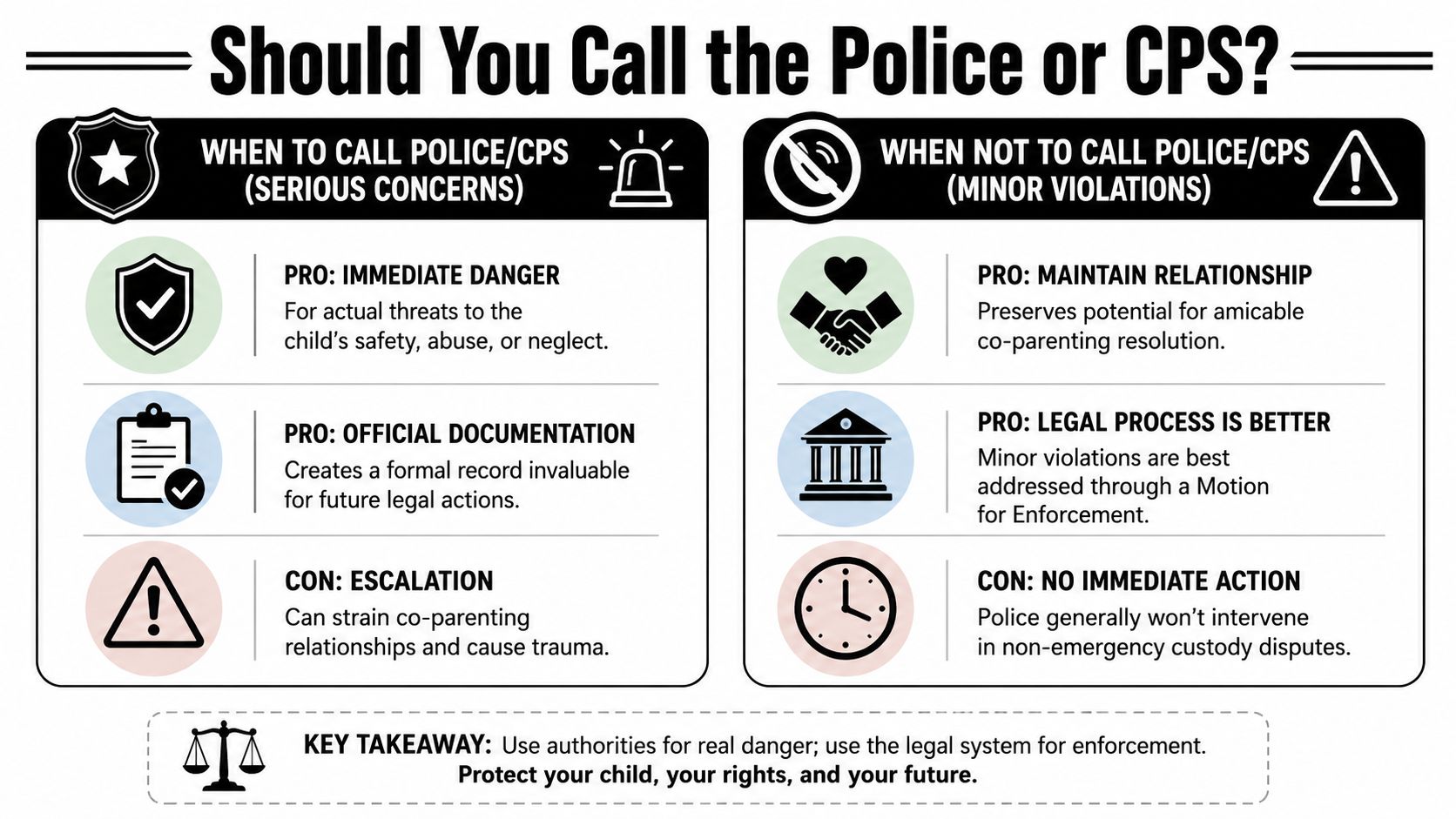
Not every custody violation should trigger a police call. Not every parenting concern belongs in a CPS report either. If you use those systems for ordinary schedule disputes, you may escalate the conflict without solving the legal problem.
The better question is this. Is this a civil enforcement issue, or is there a real safety issue?
When police may make sense
Police are usually not there to referee a routine possession dispute. But they can matter when there is immediate danger or a serious refusal connected to safety.
Situations that may justify calling law enforcement include:
A credible threat of violence
If the other parent threatens harm to you or the child, treat that differently than a scheduling conflict.Refusal to return the child combined with concealment or flight concerns
If the child's location is unknown or the circumstances suggest more than an ordinary denial, get legal advice quickly and consider law enforcement.Danger at the exchange location
If the other parent arrives intoxicated, aggressive, or physically confrontational, safety comes first.
When CPS may be appropriate
CPS is for abuse, neglect, and child safety concerns. It is not a pressure tool for missed weekends or chronic lateness.
A report may be appropriate if you have a genuine basis to believe the child faces:
- Abuse
- Neglect
- Unsafe living conditions
- Serious impairment from substance abuse or violence in the home
When neither is the best first move
If your ex is late, difficult, rude, or denying scheduled time without a clear emergency, the cleaner solution is often documentation plus family-court action. Police often won't force an exchange in a standard civil dispute, and unsupported CPS reports can create credibility problems.
Here's a practical comparison:
| Situation | Best first response |
|---|---|
| Parent is late to pickup | Document and communicate in writing |
| Weekend possession denied by text | Preserve proof and prepare for enforcement |
| Child reports abuse or dangerous neglect | Consider CPS and get legal help immediately |
| Parent makes threats at exchange | Prioritize safety and consider police |
A strong enforcement case is usually built in writing, not in the back seat of a patrol car.
For Kingwood parents, that distinction matters. The court will want to see that you acted proportionally. You addressed danger as danger. You addressed noncompliance as noncompliance.
Filing for Enforcement in Harris or Montgomery County
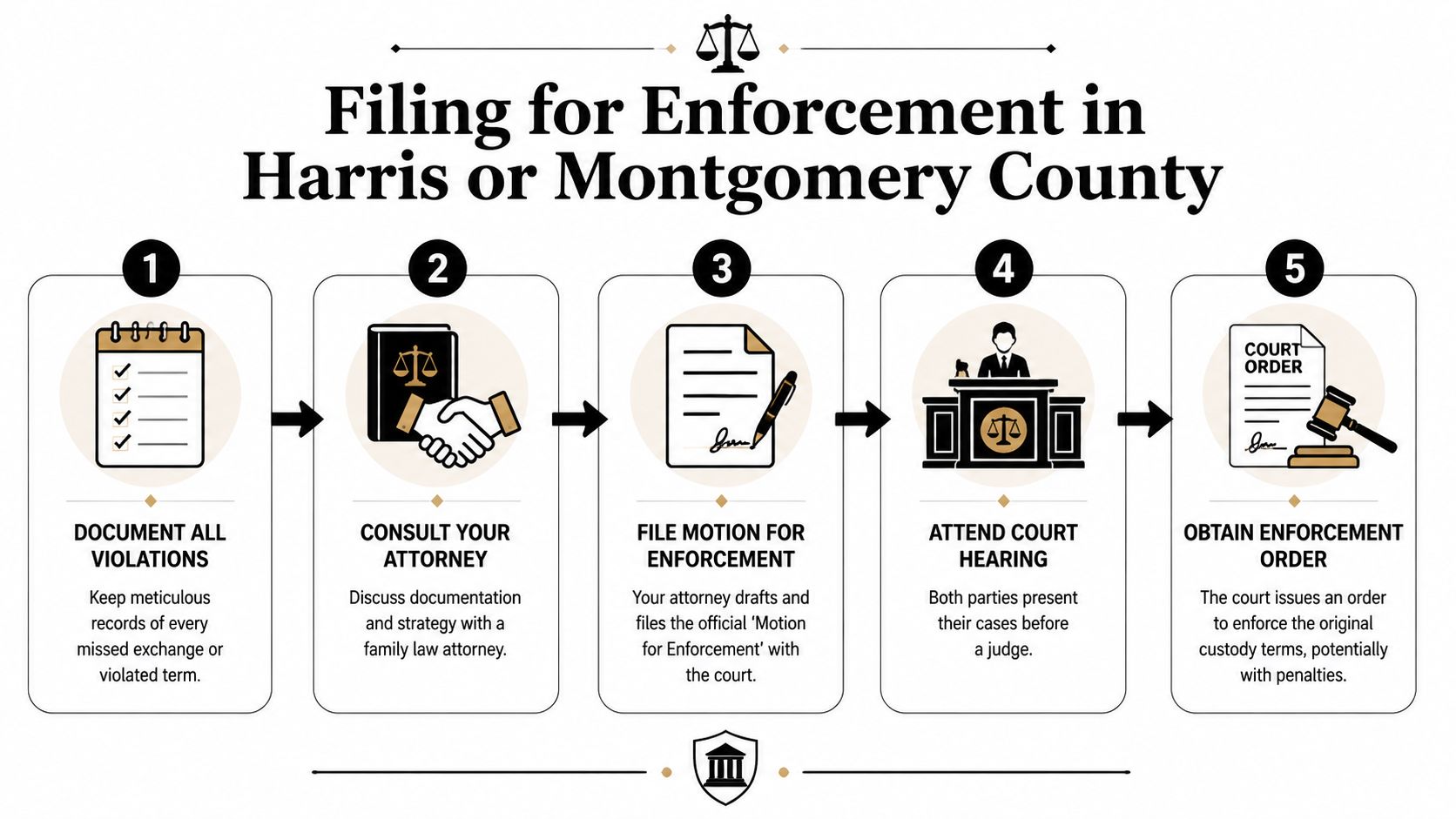
Once the violations are documented, the issue moves from frustration to formal court action. For many Kingwood families, that means filing in Harris County or Montgomery County, depending on where the case is pending.
Texas enforcement tools are designed to escalate when violations continue. A parent may document the violation and file a Motion for Enforcement, and possible remedies can include make-up visitation, fines, contempt findings, custody modifications, supervised visitation, and in severe cases jail time. A documented pattern of violations can also support a request to change custody, not just punish the other parent, as discussed in this Texas enforcement overview.
What a Motion for Enforcement asks the court to do
A Motion for Enforcement tells the judge that the other parent violated a specific court order and asks for relief. That relief may focus on correcting the past violation, pressuring future compliance, or both.
Depending on the facts, the request may involve:
- Make-up visitation for denied periods of possession
- Contempt findings if the violations were clear and willful
- Fines or other sanctions
- Orders clarifying exchange logistics
- Supervised visitation or tighter restrictions when the pattern supports that result
This is why your earlier documentation matters. The motion has to be built around real events, not broad conclusions.
Enforcement and modification are different tools
Many parents focus only on punishment. Sometimes that's too narrow.
If the other parent keeps violating the order, the bigger issue may be that the current setup is no longer workable or safe for the child. In those cases, the legal strategy may include a request to modify custody, not just enforce the old terms.
That can matter when the pattern shows:
- ongoing denial of possession
- repeated disruption of the child's routine
- refusal to follow exchange terms
- conduct that affects the child's stability
A modification request looks forward. It asks the court to create a structure that works better and is more likely to be followed. That may include tighter exchange terms, supervised periods, or a broader change in conservatorship or possession if the facts support it.
The best result isn't always punishing the last violation. Sometimes it's preventing the next ten.
Where Kingwood families usually file
Kingwood sits in an area where families may deal with either Harris County or Montgomery County courts, depending on where the order was entered and where the case has continuing jurisdiction.
If you're unsure which court controls your case, start by checking the original order and cause number. This page on Harris County family court issues for Kingwood residents can help you orient yourself if your case is in Harris County.
How the process usually unfolds
The filing process is technical, but the practical flow is straightforward:
Review the order carefully
Confirm the exact language that was violated.Organize the evidence
Put the log, screenshots, and exchange proof in date order.Draft the motion with specific allegations
Each violation should be stated clearly and separately.Set the case for hearing
The court will give both sides a chance to appear.Present admissible proof
The judge will compare the written order to the documented noncompliance.
Parents in Northeast Houston sometimes wait too long because they think they need one dramatic event. Usually, what matters more is a documented pattern and a filing that is detailed enough to let the court act.
The Law Office of Bryan Fagan – Kingwood TX Lawyers is one local option parents use when they need help evaluating enforceability, organizing records, and preparing enforcement or modification pleadings tied to Texas custody orders.
Your Kingwood Legal Partner for Custody Enforcement
The most effective response to a custody-order violation is usually the least dramatic one. Show up. Keep records. Stay child-focused. Use the court system when the pattern is clear.
For parents in Kingwood, Humble, Porter, and Northeast Houston, local knowledge matters too. Court procedures, filing expectations, and practical hearing preparation can feel different when you're dealing with a Harris County case versus a Montgomery County one.
A quick look at the firm's local online presence can help you get oriented before making contact.

Local court contacts for Kingwood-area families
If you're trying to figure out where to start, keep this simple reference list handy:
| County | Office | Website/Contact Information |
|---|---|---|
| Harris County | Harris County District Clerk and Family Courts | Harris County District Clerk |
| Montgomery County | Montgomery County District Clerk and Family Court Offices | Montgomery County District Clerk |
Before you file anything, make sure you know which county has your case and whether the current order is the most recent one. That alone prevents many avoidable mistakes.
When it's time to get legal help
You should strongly consider speaking with a family-law attorney if:
- The violations are repeated
- Your child's routine is being disrupted
- You're considering contempt or modification
- The other parent is accusing you of violating the order too
- Safety concerns are mixed in with possession issues
Here's a short video that may help you think through the next step with a clearer head.
A good consultation should leave you with a plan. Not more confusion. You should know whether your facts support enforcement, whether modification should be part of the strategy, what records still need to be gathered, and what not to do while the case is pending.
If you've been searching for what to do if an ex violates a custody order in Kingwood, Texas, the answer is rarely to outfight the other parent on their level. The answer is to become the parent who can prove the facts, protect the child, and walk into court prepared.
If you're dealing with denied visitation, missed exchanges, or repeated custody-order violations in Kingwood, Humble, Porter, or Northeast Houston, schedule a free consultation with Law Office of Bryan Fagan – Kingwood TX Lawyers. A confidential meeting can help you determine whether enforcement, modification, or another targeted response fits your situation.