Skip to content
Being served with divorce papers in Kingwood can feel surreal. One minute you're answering the door, checking the mail, or getting through a normal workday in Humble or Porter. The next, you're holding legal papers that affect your home, your children, your bank accounts, and your future.
Individuals often make one of two mistakes right away. They panic and react emotionally, or they freeze and do nothing. Neither helps. Regarding what to do after being served divorce papers in Kingwood, TX, the right approach is calmer and more practical. Treat this as a legal deadline and a family protection issue, not as a personal test you have to solve alone.
The Moment You're Served A Guide for Kingwood Residents
The first thing to know is simple. Being served doesn't mean you've lost anything yet. It means a case has started and the court now expects a response.
For many people in Kingwood, Northeast Houston, and nearby communities like Humble and Porter, service feels aggressive even when the divorce was expected. That's normal. But the papers are not something to argue with at the front door, tear up, or shove in a drawer. They are instructions, and your next steps matter.
A lot of the fear comes from not knowing what happens next. Usually, the papers include the petition your spouse filed and the official notice from the court. Those documents may raise issues involving property, debt, child custody, support, or short-term requests for court orders while the case is pending.
What your focus should be right now
Your job in this moment is not to win the divorce that same day. Your job is to protect your position.
That means:
- Stay calm enough to read carefully
- Identify deadlines and any hearing date
- Avoid emotional decisions
- Start gathering records
- Speak with a family law attorney before you guess your way through it
Practical rule: Early action in a Texas divorce isn't about being combative. It's about making sure your side is heard before the court makes decisions without it.
People in Kingwood often assume they have plenty of time because they've heard of a general 30-day response period in civil cases. That's one reason delay causes so much damage in divorce cases. Texas family procedure has its own rhythm, and the first missed step can change the entire tone of the case.
If you want a focused breakdown of the response process, start with this guide on how to respond to a divorce petition. It helps turn a stressful moment into a checklist you can follow.
Your First 24 Hours Immediate Actions to Protect Yourself
The first day matters because it often shapes everything that follows. You don't need to make every big decision immediately, but you do need to avoid the wrong ones.

Start with the papers themselves
Sit down somewhere private and read every page. Don't rely on what your spouse said the papers mean. Don't assume the process server explained anything correctly. Look for the court name, the case number, the names of the parties, and whether the case appears to be filed in Harris County or Montgomery County, which are the counties many Kingwood-area families deal with.
Watch for any mention of a hearing. Some people focus only on the fact that divorce was filed and completely miss that a court date is already set. That's a serious mistake because early hearings can affect living arrangements, money, and parenting before the final divorce is finished.
Preserve the documents and your own information
Don't mark up the originals in anger. Don't hide them from yourself. Don't throw away the envelope or service paperwork if you still have it. Put everything in one folder and save clear scans or photos.
Then begin gathering your own records discreetly and thoroughly. Start with the documents that usually matter most in family court:
- Income records such as pay stubs and recent tax returns
- Bank information including statements for joint and separate accounts
- Debt records for credit cards, loans, and mortgages
- Property records such as deeds, vehicle information, and insurance
- Child-related records including school documents, childcare records, and calendars that show your parenting involvement
This isn't about hiding assets. It's about making sure you have access to accurate information before passwords change, accounts move, or documents become harder to find.
What not to do in the first day
The worst first-day decisions are usually emotional.
Avoid these:
- Don't confront your spouse in anger. A heated hallway or kitchen argument often creates more evidence than solutions.
- Don't move money around impulsively. Emptying an account or cutting off cards can make you look reckless.
- Don't post on social media. Judges, lawyers, and opposing parties pay attention to public statements and photos.
- Don't involve the children. They don't need updates, blame, or copies of the papers.
- Don't rely on verbal reassurance. Even if your spouse says, "I'm not trying to take anything," the filed documents matter more.
Read the papers as if the court will enforce exactly what they say. Because that's the risk.
A simple first-day checklist
If you're overwhelmed, use this order:
- Put the papers in a safe place
- Read for deadlines and hearing dates
- Make digital copies
- Gather financial and child-related records
- Write down questions while they're fresh
- Schedule legal advice quickly
For Kingwood families, the first 24 hours aren't about drama. They're about control, accuracy, and avoiding unforced mistakes.
Decoding the Paperwork and Critical Texas Deadlines
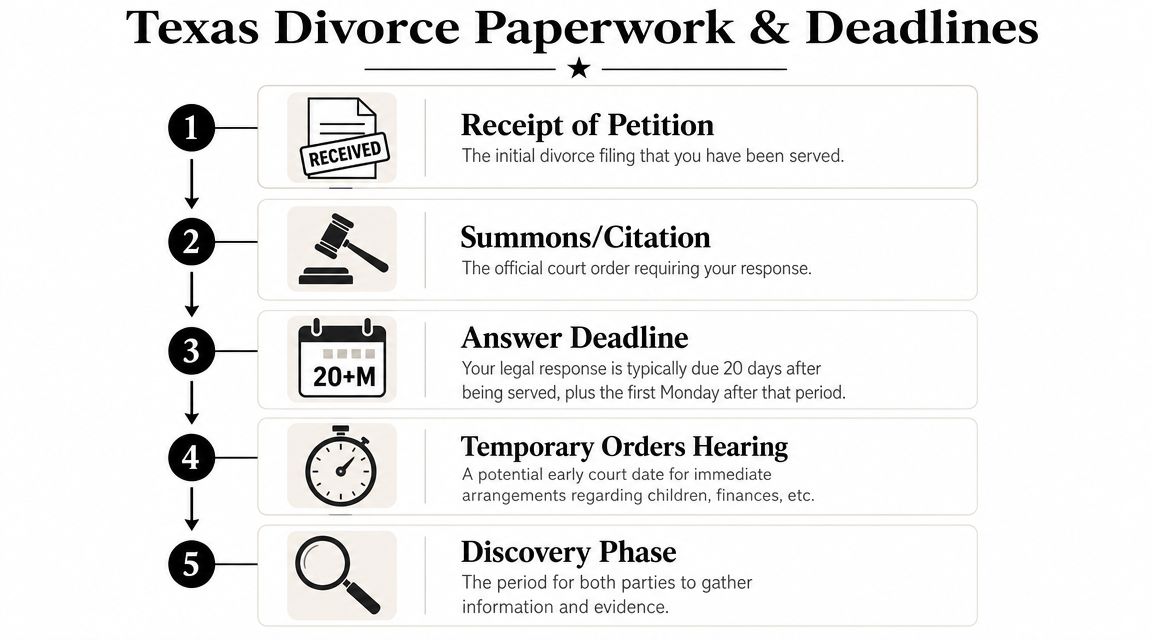
The paperwork you received probably includes two core documents. One is the Original Petition for Divorce, which tells the court what your spouse is requesting. The other is the Citation, which is the official notice that you have been sued and must respond.
Those papers may look formal and repetitive, but one part matters more than anything else right now. Your deadline to file an Answer.
The deadline most people miscalculate
In Texas divorce cases, the respondent generally has until 10:00 a.m. on the Monday after 20 days have passed from service to file an Answer, and missing that deadline can allow the case to move forward without the respondent's participation. If no Answer is filed, the spouse can obtain a default judgment. The Texas State Law Library explains that rule in its guide to answering a divorce in Texas.
That deadline catches people off guard because it isn't the simple 30-day window many expect. In practice, that means waiting around to "see what your spouse really wants" can put you in default posture before you understand what's happening.
What a default judgment means in real life
A default judgment is not just a technical loss. It can allow the court to proceed without your participation. That changes the conversation from negotiation to damage control.
For a person in Kingwood, Humble, or Northeast Houston, the practical takeaway is direct. Calendar the answer deadline immediately and treat it as a strict requirement.
Miss the answer deadline, and you may give up your chance to shape the case before it starts moving without you.
What these documents usually tell you
Here is a simple way to read what you've been handed:
| Document | What it does | Why it matters |
|---|---|---|
| Original Petition for Divorce | States what your spouse is asking for | Shows the issues in dispute |
| Citation | Orders you to respond | Starts your response clock |
| Hearing notice | Sets an appearance date if included | Tells you when the judge may act early |
| Any attached orders or requests | May ask for immediate relief | Signals urgent issues involving home, children, or finances |
The practical reading strategy
Don't try to understand every legal phrase on the first pass. Read for function:
- Who filed the case
- Which court is handling it
- Whether children are involved
- Whether temporary relief is being requested
- Whether a hearing date appears anywhere
- What your spouse is asking for regarding property or possession
If the wording feels broad or one-sided, that's not unusual. Petitions often ask for as much room as possible. Your response is what prevents the case from becoming one-sided by default.
Protecting Your Family and Finances with Temporary Orders
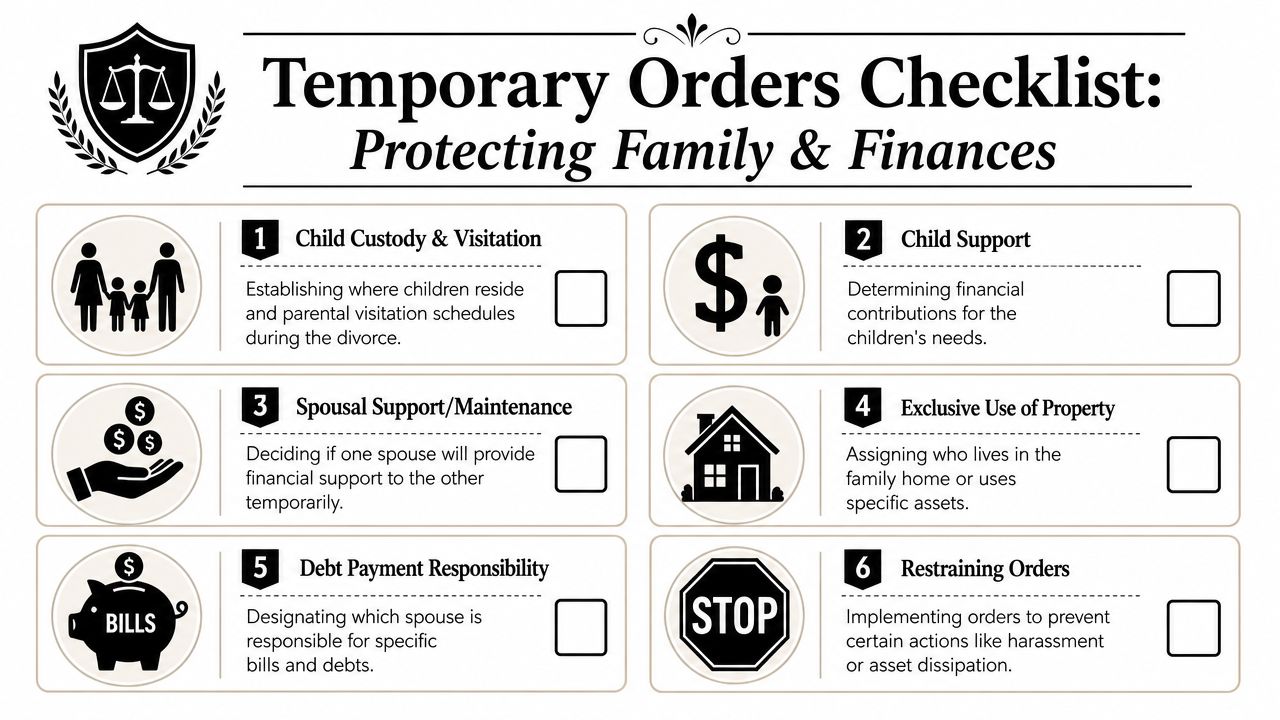
Final divorce terms may take time, but some of the most important decisions happen near the start. Temporary orders often decide who stays in the home, how bills get paid, what the parenting schedule looks like, and how conflict is managed while the case is pending.
That is why delay is expensive. Not because being served means you're behind forever, but because early court settings often shape daily life long before the final decree.
Why temporary orders matter so much
Texas divorce guidance warns that if a served divorce includes a hearing date and the respondent does not appear, the judge may make orders about money, property, and children without that person's input. The same guidance recommends gathering tax returns, pay stubs, bank statements, property records, and childcare or school records so you can respond quickly and credibly, as explained in this discussion of what to do next after being served divorce papers in Texas.
That's the heart of it. Temporary orders reward preparation. They punish wishful thinking.
What judges often need to see early
At an early hearing, the court usually wants a workable picture of family life, not broad complaints. A prepared spouse can present facts. An unprepared spouse often offers only frustration.
Bring organization to these issues:
- Children's routines such as school, childcare, medical needs, and exchange logistics
- Household finances including payroll, recurring bills, and account access
- Property use like who is living in the home and who is using vehicles
- Immediate stability concerns involving communication, spending, or conflict
For parents trying to create a predictable routine, practical tools can help reduce misunderstandings. A shared calendar system such as Everblog for shared co-parenting schedules can be useful for documenting exchanges, school events, and parenting time while a temporary plan is taking shape.
What works and what doesn't
The spouses who protect themselves early usually do three things well. They show up, they bring records, and they ask for realistic orders the court can enforce.
What doesn't work is hoping your spouse will be fair without structure. What also doesn't work is arriving at court with vague statements like "I always pay the bills" or "the kids are better with me" but no calendar, no statements, and no school records.
If children are involved, it's smart to understand how temporary custody orders in Texas can affect possession, decision-making, and daily routines while the case is pending.
Courts can only protect what is clearly presented to them. If you want stability, bring proof that supports it.
Critical Mistakes to Avoid During Your Kingwood Divorce
People rarely damage their case because they didn't care. They damage it because they acted fast in the wrong direction. In Kingwood divorce cases, the most costly mistakes usually come from fear, anger, or bad advice from friends who don't know Texas family court.
Leaving the house without a plan
A common scenario goes like this. One spouse gets served, feels humiliated, grabs a bag, and leaves the Kingwood home "to keep the peace." Sometimes that is the safest choice in a high-conflict situation. Often, though, people leave without documenting belongings, discussing temporary parenting arrangements, or getting legal advice first.
That can create problems. The issue usually isn't that moving out automatically means you've surrendered everything. The problem is that your day-to-day role in the home, your access to records, and your practical influence can change quickly once you're gone.
A better move is to pause and ask:
- Is there a safety concern that requires immediate separation
- Do I need photos or inventories before I leave
- How will parenting exchanges work tomorrow
- What bills or account access could change if I go
Draining accounts or hiding property
Another common reaction is financial retaliation. Someone sees a divorce filing and thinks, "I'd better move the money before my spouse does." That usually creates more legal trouble than protection.
Judges don't like self-help solutions that destabilize the household. If you clean out a joint account, cancel cards, or transfer assets in a way that looks secretive, you may spend the next hearing explaining your conduct instead of focusing on the main issues.
The smarter approach is documentation first, legal strategy second. Save statements, note balances, and get advice before making major financial moves.
The court expects adults in a divorce to preserve stability, not create chaos and then ask the judge to sort it out.
Using children as messengers or witnesses
In Northeast Houston family cases, one of the clearest signs that a divorce is going off track is when parents start recruiting children into the conflict. A parent shows them the petition. A parent asks, "Who do you want to live with?" A parent sends messages through them about pickup times or missed bills.
That behavior usually backfires. Children need consistency and emotional protection, not litigation roles. Even when a parent is profoundly hurt, the better path is to keep adult legal issues between adults.
Try this instead:
- Keep explanations age-appropriate and brief
- Avoid blame language
- Use direct adult communication whenever possible
- Save disputes for counsel, email, or court settings, not the car ride to school
Posting, texting, and venting in writing
A lot of people know not to post a long rant on Facebook. Fewer realize that group texts, sarcastic emails, and private messages can do the same damage.
Suppose your spouse accuses you of being unstable, and you answer with ten angry texts at midnight. You may have just created the most memorable exhibit in the temporary orders hearing. The same goes for photos, location check-ins, and comments that undercut what you're asking the court to believe about your parenting or finances.
A simple rule helps. Before you send anything, ask whether you'd be comfortable seeing it printed and handed to a judge in Harris County or Montgomery County.
Ignoring requests because "we already agreed"
This mistake shows up in quieter divorces. The spouses are still talking. They believe they'll work it out. One of them starts treating the legal case like background noise and doesn't respond seriously to requests for documents or court notices because the other spouse promised to be reasonable.
Verbal peace does not replace written legal protection. Until an agreement is properly documented and signed in the right way, the case remains active and enforceable according to the court's rules, not hallway conversations or text-message promises.
Letting pride delay legal help
Many people wait too long because they don't want to "make it worse" by calling a lawyer. In reality, early advice often lowers conflict because it replaces panic with a plan.
A lawyer's job at the start isn't just to fight. It's to help you avoid preventable mistakes, frame realistic goals, and respond in a way that protects your children, your finances, and your credibility.
You Don't Have to Go Through This Alone Partner with a Kingwood Attorney
You may be sitting at your kitchen table in Kingwood with a citation, a petition, and a deadline that is already running. That is usually the point where fear turns into paralysis. The right legal help stops that slide early by turning a confusing packet into a short list of decisions, dates, and next steps.

Why local counsel matters in Kingwood
For families in Kingwood, Humble, Porter, and Northeast Houston, divorce is not just a matter of knowing Texas law. It also involves knowing how Harris County and Montgomery County courts process settings, temporary hearings, notices, and required filings. People who wait often miss the practical side of the case. They assume they have plenty of time because no hearing is set yet, then they learn a response deadline passed or a temporary orders request is already on file.
Local counsel helps you respond before delay costs you advantage with the court. That is not about being aggressive. It is about self-protection, especially when the other side has already started the process and the court expects you to keep up.
If you are deciding who to call, these questions to ask a family lawyer in Kingwood, TX can help you compare attorneys in a practical way.
Confidentiality matters early. During a divorce, it helps to understand how to protect your legal communications so sensitive discussions and documents are handled thoughtfully from the start.
What legal help actually does
A divorce lawyer should do more than explain the law. Good early representation should help you figure out what must be filed now, what can wait, what documents need to be preserved, and whether you need fast court intervention on children, support, use of property, or access to accounts.
That work often includes:
- Calculating your Texas answer deadline and filing on time
- Reviewing county-specific notices, standing orders, and hearing procedures
- Preparing for temporary orders if the other side is asking for immediate relief
- Organizing financial records, parenting information, and communications that may matter in court
- Screening proposed agreements so you do not give up rights just to lower tension
- Communicating with the other side in a way that protects your position and lowers avoidable conflict
A local law firm that handles divorce, custody, support, and property disputes in the Kingwood area can be a valuable partner during this stage.
If you'd like a quick overview of how divorce cases are handled, this video is a helpful starting point.
You do not need every answer on day one.
You do need a plan that fits the court deadlines, protects your relationship with your children, and keeps temporary decisions from hardening into long-term problems. Early legal advice often makes the case more stable, not more hostile, because it replaces guessing with clear steps.