
Some couples in Kingwood reach the same difficult conclusion without a blowup. They’ve already had the long talks at the kitchen table. They know the marriage is ending, but they also know they don’t want to drain savings, fight in court, or make life harder for their children.
That’s where an uncontested divorce kingwood case can make sense.
If you and your spouse agree that the marriage should end and you can agree on the terms, Texas gives you a path that is more orderly and less combative. Texas also maintains one of the lowest divorce rates in the nation at 1.4 divorces per 1,000 population in 2021, and in uncontested divorces common in Kingwood and Northeast Houston, couples usually file on insupportability grounds without assigning blame, which supports faster resolution according to Texas divorce statistics.
For families in Kingwood, Humble, Porter, and Northeast Houston, that matters. A peaceful divorce isn’t about pretending the situation is easy. It’s about handling it with enough care that the legal process doesn’t create new damage.
Starting Your Uncontested Divorce Journey in Kingwood
A typical Kingwood uncontested divorce unfolds without drama. One spouse moves into a guest room. The other starts asking practical questions about the house, the bank accounts, and the kids’ schedule. Nobody wants a courtroom fight. Both people just want the paperwork done correctly so they can move forward.
That instinct is often the right one. In Texas, an uncontested divorce works best when both spouses want a respectful exit and are willing to put every major agreement in writing. If the marriage is over and the dispute is not, uncontested divorce usually won’t hold. But if the conflict is low and the communication is still workable, this route can preserve money, time, and peace at home.
What uncontested really means
Uncontested doesn’t just mean “we’re being nice.” It means both spouses agree on the full set of legal terms before the court signs the final decree.
That usually includes:
- The decision to divorce: Both spouses agree the marriage should end.
- Property and debt division: You have a clear plan for bank accounts, vehicles, retirement funds, credit cards, and the home.
- Children’s issues: If you have children, you agree on conservatorship, possession, support, and day-to-day logistics.
- Final paperwork: Both sides are willing to sign the required documents without later reopening the deal.
Practical rule: If either spouse says, “I agree with everything except this one part,” you should assume the case may no longer stay uncontested.
For many neighbors in Kingwood and Humble, the biggest relief is that no one has to prove wrongdoing. Texas allows no-fault divorce based on insupportability, which lets couples end the marriage without building a case around blame. If you want a basic overview of the filing path, this guide on how to file for divorce in Kingwood, Texas is a helpful starting point.
What works and what doesn’t
What works is simple. Clear agreement, full disclosure, and realistic expectations.
What doesn’t work is trying to rush through a “friendly” divorce while avoiding uncomfortable topics. The house still has to be addressed. Retirement accounts still matter. Parenting details still matter. The couples who do best are usually the ones who handle those issues early, while the tone is still cooperative.
Confirming Your Eligibility for a Texas Uncontested Divorce
A couple in Kingwood can agree on the divorce itself and still hit a problem before filing. One spouse may live on the Harris County side, the other may have recently moved, or both may believe they have an uncontested case when they still have not settled retirement, child support, or even a cryptocurrency account. Eligibility turns on those details.
Residency rules for Kingwood and nearby communities
Texas law requires that at least one spouse has lived in Texas for at least six months and in the county of filing for at least 90 days. You can review the statute directly in Texas Family Code § 6.301.
For Kingwood residents, the county question matters more than statewide guides usually admit. Some addresses place you in Harris County. Others fall in Montgomery County. Filing in the right county is a legal requirement, but it is also a practical choice if you have options based on where a spouse resides.
That choice affects pace, docket culture, and how long your agreement has to hold together. Harris County is often the more practical forum for Kingwood families who qualify there because the filing process, hearing settings, and clerk procedures are familiar to many local family lawyers handling high-volume uncontested matters. Montgomery County may still be the correct venue for your case, but I tell clients not to treat the county line as a small detail. In an amicable divorce, delay can create new conflict.
A short waiting period can still feel long when the agreement is fragile. If you want a plain-English explanation of the 60-day rule, read this guide on the Texas divorce waiting period.
Complete agreement means complete
An uncontested divorce works only if both spouses have reached a real agreement that can be written into a final decree and signed without last-minute changes.
That includes agreement on:
- division of the house, land, vehicles, and personal property
- bank accounts, retirement accounts, and investment accounts
- credit cards, loans, and tax obligations
- conservatorship, possession, child support, and medical support if children are involved
- digital property such as online business income, payment apps, stored rewards, cryptocurrency, and other digital assets
That last category gets missed in Kingwood cases more often than it should. A couple may agree on the checking account and the truck, then realize later that one spouse controls PayPal funds, an Etsy shop, airline miles, or a Coinbase account. Once that happens, the case can stop being uncontested.
Local strategy matters as much as legal eligibility
I have seen couples qualify on paper and still be poor candidates for an uncontested divorce. The usual warning signs are familiar. One spouse will not provide account statements. Someone keeps saying, "We will work that out later." The parties agree in general terms but not in language a judge can sign.
By contrast, a case with children, a mortgage, and retirement savings can stay uncontested if the details are addressed early and put in writing clearly.
Accuracy matters here. Lawyers and legal staff often use tools like AI comparison for legal professionals to catch inconsistencies between drafts, because even small wording changes in an agreed decree can create expensive problems later.
A practical Kingwood test
Before filing, ask two direct questions.
Can we file in the correct county right now under the residency rules?
Can we state every term of our agreement clearly enough that a judge in Harris County or Montgomery County could sign the decree without guessing what we meant?
If the answer to either question is no, the smarter move is to fix that first. That is not a setback. It is how uncontested divorces stay uncontested.
Preparing Your Essential Divorce Documents
Paperwork decides whether an uncontested divorce stays smooth or starts to unravel. Most delays don’t happen because the idea was wrong. They happen because the documents were incomplete, vague, or internally inconsistent.

The core documents you’ll usually need
Most Texas uncontested divorces involve a set of foundational documents. The names may sound formal, but each serves a clear purpose.
Original Petition for Divorce
This opens the case. It identifies the parties, states the grounds for divorce, and tells the court what kind of orders you’re requesting.Waiver of Service
In many uncontested cases, the responding spouse signs a waiver instead of requiring formal service. This can keep the process more efficient, but it has to be drafted and signed correctly.Final Decree of Divorce
This is the final court order. It must include the exact terms of your agreement, not rough concepts or informal promises.Child-related orders if children are involved
These address conservatorship, possession, support, and medical responsibilities.
The agreement is the foundation
The most important document is the written settlement reflected in the final decree. If that document is thin, your case is fragile.
A good agreement doesn’t say “we’ll work out the retirement later.” It states who receives what, how transfers happen, and what each spouse must do next. It doesn’t say “we’ll split the debt fairly.” It identifies the debt and assigns responsibility.
In practice, the best agreements answer the questions people are most likely to fight about after the divorce:
- Who keeps the home, and by when
- Who refinances, if refinancing is required
- Who keeps which account
- How personal property gets exchanged
- What happens if a transfer document isn’t signed on time
- How the parenting schedule works on ordinary weeks and holidays
Digital assets are the modern trouble spot
A lot of Kingwood professionals have assets that don’t fit the old checklist. Stock-based compensation, digital wallets, online brokerage accounts, app-based income, and remote-work bonuses often get overlooked because they aren’t sitting in a local file cabinet.
That’s a mistake. A 2025 Texas Bar survey revealed that 28% of divorces involved undisclosed digital assets like cryptocurrency, according to this discussion of uncontested divorce FAQs in Texas. In practical terms, hidden or poorly documented digital property is one of the fastest ways for a supposedly uncontested case to become contested.
For Kingwood families, I’d treat these as required review items:
- Cryptocurrency holdings: Identify the wallet, exchange, and valuation method used for the agreement.
- Stock options or restricted units: Determine whether they were earned during the marriage and how they’ll be divided or offset.
- Remote work bonuses and deferred compensation: Clarify whether a payment relates to work performed during the marriage.
- Online-only accounts: Include fintech, payment apps, online savings platforms, and rewards balances if they have meaningful value.
If an asset exists on a screen, it still belongs on the inventory.
A practical drafting workflow
Many people do better when they gather documents in categories instead of trying to “do divorce paperwork” all at once.
| Category | Examples to collect |
|---|---|
| Income | Pay stubs, bonus records, tax returns |
| Property | Deeds, vehicle titles, mortgage statements |
| Accounts | Bank, retirement, brokerage, digital asset records |
| Debts | Credit card statements, loans, personal lines of credit |
| Children | School schedules, health insurance details, childcare costs |
One useful resource for reviewing versions of agreements and spotting language changes is this AI comparison for legal professionals. Tools like that can help when spouses, attorneys, or mediators are revising the same decree repeatedly and need to confirm exactly what changed.
The Law Office of Bryan Fagan – Kingwood TX Lawyers handles this kind of document preparation for families who want a lawyer-managed uncontested process rather than a stack of forms with no legal review.
What to insist on before signing
Before anyone signs, read the agreement like a future problem is trying to get in.
Ask:
- Is every asset accounted for
- Is every debt assigned
- Does the parenting language answer real-life scheduling issues
- Are dates, names, and account references accurate
- Can someone outside your family read this and understand who must do what
The clearer the writing, the fewer surprises you’ll face after the decree is signed.
Filing Your Case at the Harris County Courthouse
A common Kingwood scenario looks like this. One spouse lives on the Harris County side, both people agree on the terms, and they want the case filed without wasting a month correcting a county choice they should have settled on first.

For many Kingwood residents, filing in Harris County makes practical sense because daily life already runs through this side of town. Work, school, child exchanges, and property records often tie back here. That does not mean Harris County is always the right venue. If the residency facts point to Montgomery County, forcing a Harris County filing can create delay instead of convenience.
The first filed document is the Original Petition for Divorce. After that, the other spouse must be formally served or sign a waiver of service that is prepared and signed the right way. In my practice, waiver problems are one of the easiest ways to turn an uncontested case into a frustrating one. A rushed signature, the wrong timing, or sloppy notarization can send you back to fix paperwork that should have been done correctly the first time.
Filing also starts the Texas waiting period. Use that time well. Good uncontested cases do not sit still after filing. They get cleaned up.
Harris County is often a strong fit for Kingwood families who live, work, or parent on the Harris County side, but there is a real trade-off here. Some Montgomery County filers prefer to keep the case closer to where they live or where the children spend most of their time. The right choice depends on residency, convenience, and where the court is most likely to match the facts cleanly. A venue mistake costs more time than the drive to the courthouse.
During the waiting period, review the file as if a clerk and a judge are both trying to find the weak spot. That is the stage where I tell clients to confirm more than bank accounts and house titles. Digital assets belong in that review too. If you agreed on who keeps a PayPal balance, crypto holdings, airline points, online storefront income, domain names, or a monetized social media account, the decree should say so plainly. Generic language about "all remaining property in your possession" is often too loose for modern assets.
What happens between filing and final court
Most uncontested delays come from preventable filing problems, including:
- Wrong county or weak residency facts
- A waiver of service signed incorrectly
- Names that do not match prior filings or IDs
- Property terms that are too vague to enforce
- Missing child-related forms or support language
- Digital assets or online accounts left out of the decree
The prove-up hearing is usually brief, but brief does not mean casual. The judge wants a file that is complete, accurate, and consistent. The filing spouse is commonly asked a few direct questions about residency, the marriage, and whether the proposed decree reflects the agreement.
If your paperwork is solid, the hearing often feels routine. If your paperwork has gaps, the hearing is where those gaps become public and expensive in time.
For Kingwood residents filing in Harris County, the courthouse step is less about courtroom drama and more about disciplined preparation. Choose the right county. File clean documents. Use the waiting period to fix details before the judge sees them.
Your Kingwood Uncontested Divorce Checklist
Some readers don’t need another explanation. They need a clean list they can follow.
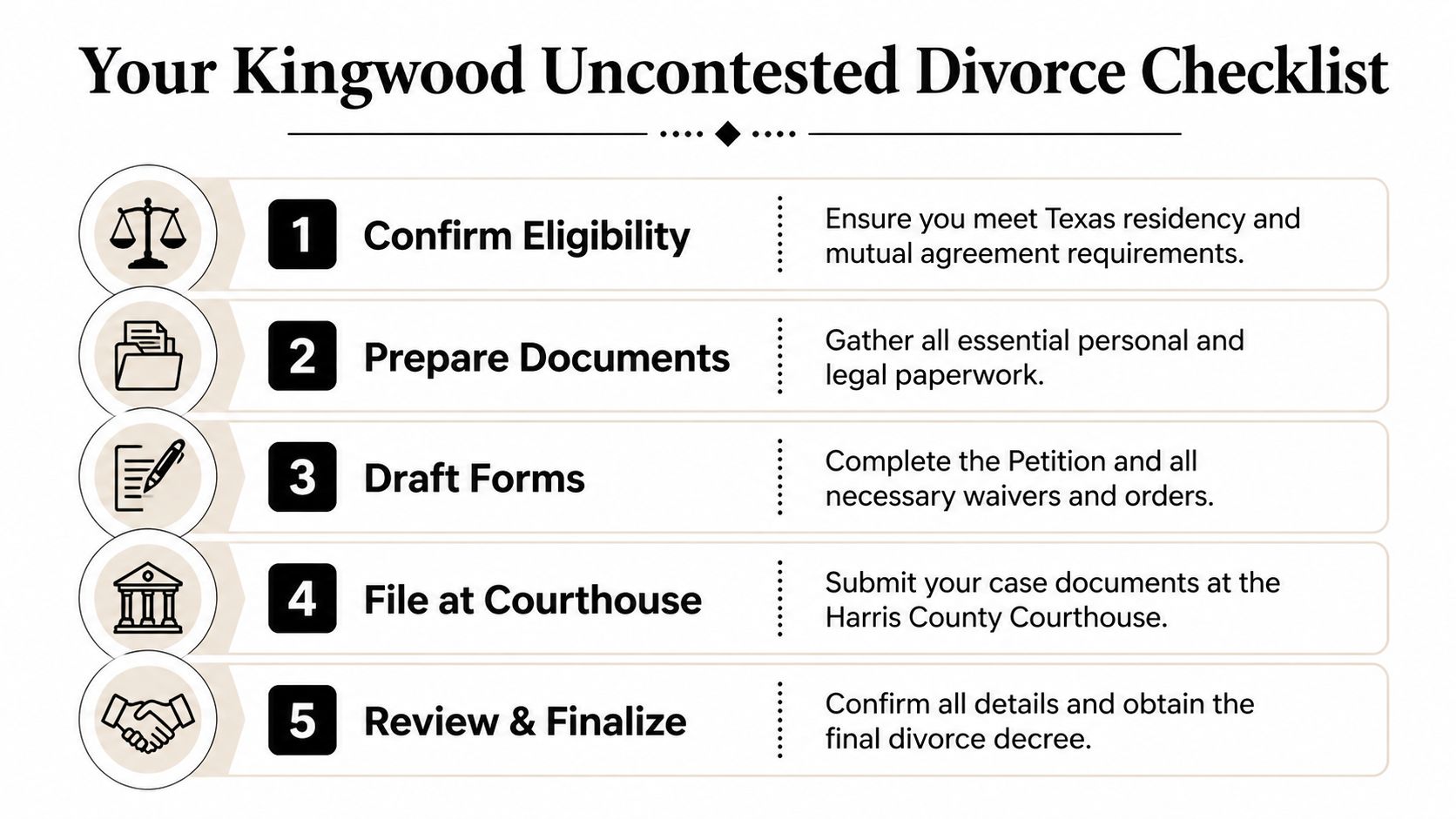
Five checkpoints that keep a case on track
Confirm eligibility
Make sure at least one spouse meets the Texas and county residency rules, and confirm that both spouses fully agree on every term that belongs in the decree.Prepare your records
Gather account statements, debt information, property records, income documents, and child-related details before drafting starts.Draft the forms carefully
Prepare the petition, waiver if appropriate, child-related documents if needed, and a final decree that clearly states every obligation.File in the correct county
For many Kingwood residents, that means Harris County. Filing in the right place reduces avoidable delay and keeps the case moving toward final hearing.Review before finalization
Read every line before the prove-up. Confirm names, dates, property descriptions, and support terms.
A simple timeline mindset
Think of the process in three phases:
| Phase | Focus |
|---|---|
| Before filing | Eligibility, disclosure, agreement |
| After filing | Waiting period, signatures, corrections |
| Final stage | Prove-up, signed decree, implementation |
The people who stay organized usually feel less overwhelmed. That’s true whether you’re filing from Kingwood, coordinating from Humble, or managing the process while living separately in Northeast Houston.
Common Missteps That Can Derail Your Divorce
Many people assume uncontested means easy. It can be simpler than litigation, but it is not self-correcting. Courts frequently reject uncontested divorce petitions because of procedural errors or incomplete documentation, and vague property language or asset mischaracterization can create enforcement problems later, as noted in this guide to uncontested divorce errors in Houston-area cases.
The mistakes I see most often
Some problems start small and become expensive later.
- Vague property terms: “Each party keeps the property in his or her possession” may sound convenient, but it often fails when valuable items, accounts, or documents were never physically exchanged.
- Incomplete inventories: If an account, bonus, debt, or digital asset is missing, the agreement may not resolve the marital estate.
- Wrong assumptions about waivers: A waiver of service is useful only if it is executed properly. If it isn’t, the case can stall.
- Parenting terms that are too casual: Parents may verbally understand the plan, but the decree must be specific enough for enforcement.
- Mislabeling separate and community property: This can create problems long after the divorce if one spouse later challenges the division.
Why DIY divorces fail even when the couple agrees
The problem usually isn’t hostility. It’s precision.
A couple may agree that one spouse keeps a retirement account and the other keeps the house. But if the decree doesn’t say exactly how related debts, transfer duties, deadlines, or supporting orders are handled, the agreement may not function in real life.
The risk in an uncontested divorce isn’t just losing time. It’s signing an order that leaves you with a future dispute no one thought they were creating.
A quick warning list for Kingwood families
If any of these are true, slow down before filing:
- You’re saying “we’ll figure that out later” about any asset or debt
- You’re unsure whether something is community or separate property
- One spouse handles all finances and the other hasn’t reviewed the records
- There are retirement accounts, business interests, or digital assets
- You’ve copied language from an online form without checking whether it fits your family
In Kingwood, Humble, and Porter, the families who avoid trouble usually do one thing well. They treat the final decree like a real operating manual, not a rough summary.
When to Call Your Local Kingwood Divorce Attorney
Call a lawyer if there’s any disagreement, any concern about hidden property, any unusual compensation structure, or any history of intimidation or family violence. At that point, the risk of a DIY approach goes up fast. If you’re comparing support tools that help firms organize intake and communication, this overview of how Recepta.ai helps law firms gives useful context about how modern legal teams manage client workflow.
If you’re trying to decide whether legal help makes sense for your situation, this page on how to choose a divorce attorney is a solid next step for Kingwood and Northeast Houston families.
If you’re considering an uncontested divorce in Kingwood, Humble, Porter, or Northeast Houston, the right guidance can make the process calmer and more predictable. The Law Office of Bryan Fagan – Kingwood TX Lawyers offers free consultations and can help you understand whether your case is ready for an uncontested filing, what documents you’ll need, and where legal review could prevent costly mistakes later.