Skip to content
You may be putting this off for a familiar reason. Life in Kingwood is busy. Between work, kids, aging parents, a home, maybe a small business, estate planning can feel like one more heavy task that belongs on “someday's” list.
But most families in Kingwood, Humble, Porter, and Northeast Houston don't need a complicated legal project. They need clear decisions, the right documents, and a plan their loved ones can use when it matters.
What Is Estate Planning and Why It Matters in Kingwood
For many people, estate planning starts with one practical question. “If something happened to me, would my family know what to do?”
That question matters whether you own a house in Kingwood, have retirement savings, help support children, care for an older parent, or want to pass down a family business in Humble or Northeast Houston. Estate planning is the process of putting legal instructions in place so your property, healthcare decisions, and financial affairs are handled the way you want.

It's not just about wealth
A lot of people hear “estate” and think it only applies to wealthy families. In reality, estate planning matters for ordinary households across Kingwood.
You may need a plan if you want to:
- Protect your children: Name who should care for them and who should manage money for them.
- Protect your spouse or partner: Make sure assets pass in an orderly way and key decisions aren't left to guesswork.
- Protect your wishes: Set out who can speak for you if you can't make medical or financial decisions yourself.
- Protect family peace: Reduce confusion, conflict, and avoidable court problems later.
Practical rule: Estate planning isn't really about documents first. It's about making life easier for the people you love.
Texas families also face state-specific rules that affect what happens after death or incapacity. That's why local guidance matters. A family in Kingwood may own a homestead, retirement accounts, business interests, or blended-family assets, and each of those raises different questions under Texas law.
Why more families are paying attention
Demand for estate planning has grown as more families deal with aging parents, second marriages, inherited property, and long-term care questions. The US Estate Lawyers & Attorneys sector is projected to grow significantly through 2030, driven by demographic shifts like the aging of Baby Boomers, according to IBISWorld's estate lawyers and attorneys industry outlook. That reflects the same reality many Kingwood families are already seeing at home.
Estate planning is also part of a bigger legal picture. A local law practice may help clients with family law, civil disputes, or criminal defense, but estate planning serves a different role. It helps people prepare before a crisis, instead of reacting after one.
If you've searched for an Estate Planning Attorney Kingwood Texas, you're probably not looking for legal theory. You're looking for a way to protect your family without making the process feel overwhelming. That's exactly where a clear, step-by-step plan helps.
Key Estate Planning Documents for Texas Families
Most Texas estate plans are built from a handful of core documents. You may not need every option, but you do need to understand what each one does.
The core documents in plain English
A will says who should receive your property and who should handle your estate after death. It can also name guardians for minor children. A will is often the starting point for families in Kingwood who want clear instructions in place.
A revocable living trust is a separate legal arrangement that can hold property during your lifetime and direct what happens to that property later. In Texas, trust planning can be useful for people who want more control over how assets are managed or distributed. If you want a deeper overview, this plain-language guide on what is a living trust is a helpful next step.
A durable power of attorney lets someone manage financial matters for you if you become unable to handle them yourself. That can include paying bills, managing accounts, or dealing with property issues.
A medical directive and related healthcare documents tell doctors and family members what kind of care you want, and who may speak for you if you can't communicate.
Comparing Core Estate Planning Documents in Texas
| Document | Primary Purpose | When It's Used |
|---|---|---|
| Will | Directs who receives property and names an executor or guardian | After death |
| Revocable Living Trust | Holds and manages assets under written trust terms | During life and after death |
| Durable Power of Attorney | Authorizes someone to handle financial matters | During incapacity or as authorized |
| Medical Directive | States healthcare wishes and decision-making authority | During serious illness or incapacity |
Why trusts require careful drafting
Under Texas Property Code Chapter 112, a valid trust requires a settlor, trustee, beneficiary, and clearly identified property, as explained in this discussion of Kingwood trust and estate planning requirements. That sounds technical, but the idea is simple. A trust has to clearly identify who creates it, who manages it, who benefits from it, and what property belongs in it.
That's one reason an attorney may recommend a trust for one family and a will-based plan for another. If a couple in Northeast Houston owns a home, has adult children, and wants straightforward distribution, a will may be enough. If a family in Kingwood wants to manage property across generations or coordinate more complex assets, a trust may make more sense.
A document isn't useful just because it sounds sophisticated. It's useful when it matches your life.
For readers comparing options, Estate Planning Attorney in Kingwood covers wills, trusts, and estate plans for Kingwood families. That kind of local service page can help you see what tools may fit your situation before you sit down with a lawyer.
Navigating Texas Probate and Estate Law
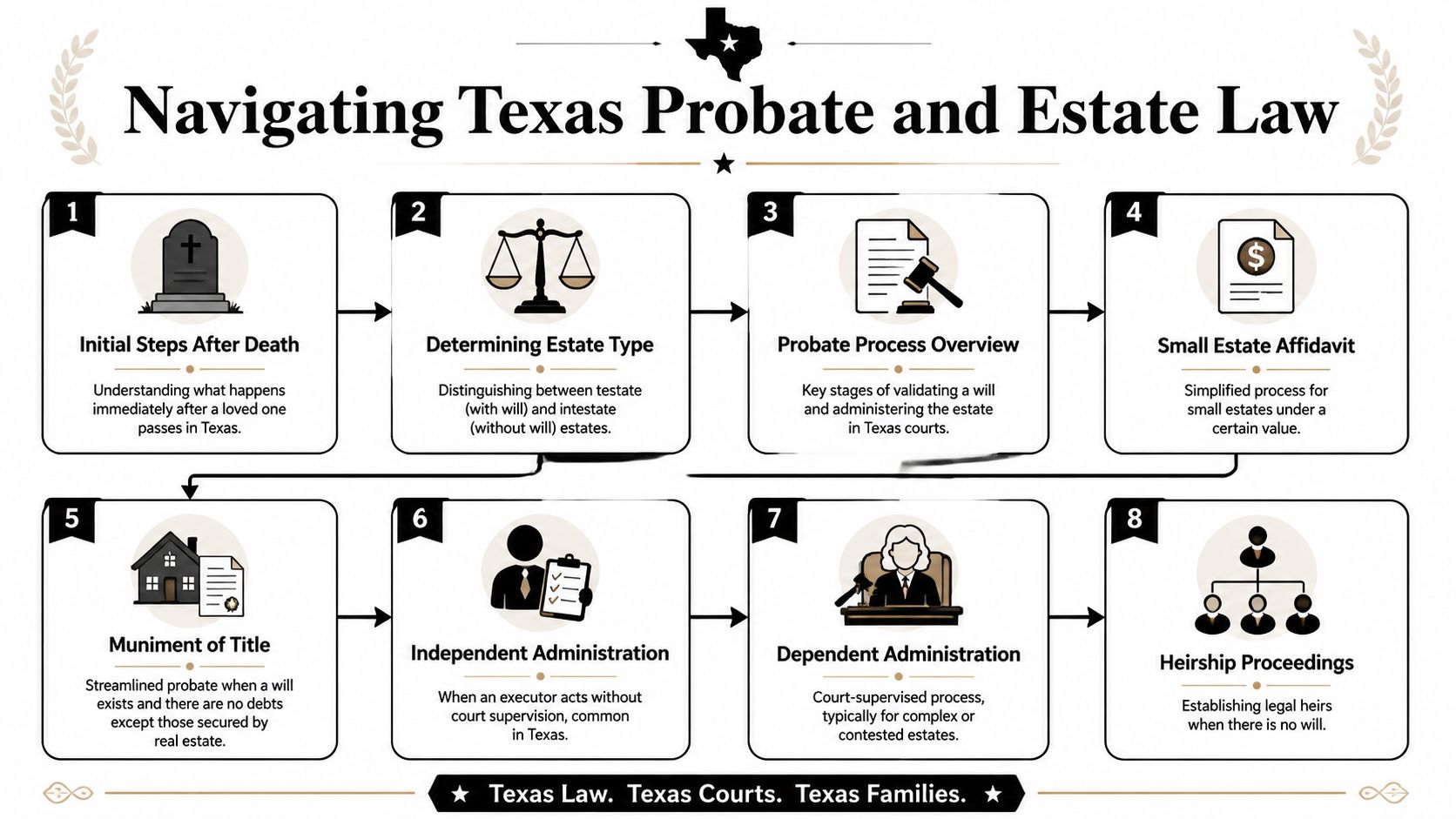
Probate is the court-supervised process of recognizing a will, identifying heirs or beneficiaries, paying proper obligations, and transferring property. Many people in Kingwood worry about probate because they've heard it's confusing, expensive, or slow. Sometimes it can be. But a lot depends on the type of estate, the documents in place, and whether there's conflict.
What probate looks like in Texas
Texas has several probate paths. Some estates move through independent administration, where the executor acts with limited court supervision. Others require more court involvement. There are also simplified procedures in some situations, including small estate options and other efficient routes.
According to the Texas State Bar's guidelines, the average probate process in Texas takes between 12 and 18 months from initial filing to final asset distribution, as summarized in these Texas probate timing guidelines. That timeline often surprises families in Harris County and nearby communities because they expect a much shorter process.
Local issues that often affect Kingwood families
Texas law can raise questions about community property, separate property, creditor claims, and title to real estate. A family home in Kingwood, rental property, or a closely held business can complicate what looks simple at first glance.
Here are a few places where confusion tends to start:
- Marital property questions: People often assume everything automatically passes one way, but Texas property classification can matter.
- No will situations: If someone dies intestate, the court may need heirship proceedings to determine legal heirs.
- Disputed facts: If the cause of death becomes relevant in related civil litigation, families may need outside professionals. In those settings, forensic pathology expert insights can help people understand how medical evidence may connect to estate-related disputes or wrongful death matters.
- Avoidance planning: Families who want to reduce probate exposure often start by learning how to avoid probate in Texas.
This overview video gives a useful visual explanation before you start sorting through forms and court steps.
For people dealing with an active estate, Probate Lawyer in Kingwood, TX addresses probate administration and estate settlement in Harris County. That's often the practical need after a death, especially when a family is trying to balance grief with deadlines, notices, and property questions.
Our Client-Focused Process at The Law Office of Bryan Fagan
Clients don't want a stack of forms dropped in their lap. They want someone to listen, translate Texas law into plain English, and help them make decisions one at a time.
That's the value of a structured process. It keeps estate planning from feeling abstract.
How the process usually works
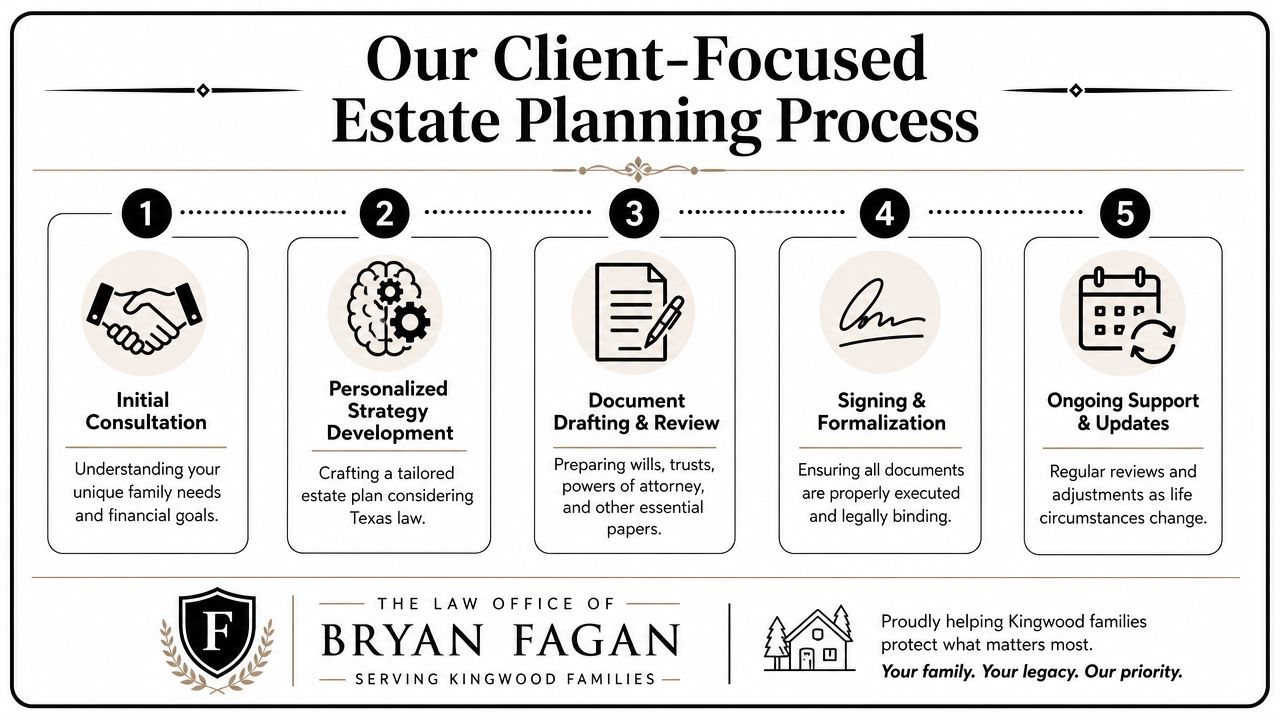
A good first meeting focuses on your life, not just your assets. That means talking through your family structure, your home, accounts, business interests, health concerns, and the people you trust to make decisions if needed.
Then the attorney develops a plan that fits your goals. Some clients need a straightforward will package. Others need trust planning, powers of attorney, and healthcare directives because of blended families, older relatives, or property concerns in Kingwood or Humble.
A careful process usually includes:
- Listening first: The lawyer learns your family dynamics and your concerns.
- Choosing the right tools: A will, trust, power of attorney, or directive should match your circumstances.
- Drafting clearly: Documents need to be understandable, not just legally valid.
- Reviewing details: Names, asset descriptions, fiduciaries, and backup choices all matter.
- Signing correctly: Execution mistakes can cause major trouble later.
- Updating over time: Marriage, divorce, births, deaths, and moves can all affect your plan.
Why this approach helps
Estate planning often overlaps with other legal issues. A family law matter may affect beneficiary choices or guardianship planning. A civil dispute may change how someone thinks about asset protection. If someone is facing criminal allegations, protecting the stability of the household may become part of the broader conversation about planning ahead. Texas law touches all of these areas differently, and local families benefit when legal advice reflects real life instead of a generic template.
The best estate plan is usually the one your family can understand and follow under stress.
For people comparing attorneys, this guide on how to choose an estate planning attorney is a practical place to start. It helps you think through experience, communication style, and whether a lawyer can explain options without making the process harder than it needs to be.
The Law Office of Bryan Fagan – Kingwood TX Lawyers offers local legal services in estate planning, probate, family law, criminal defense, and civil matters, which can be useful for households whose planning questions overlap with other Texas legal concerns.
Understanding Estate Planning Costs and Your Free Consultation
Cost is one of the main reasons people wait. That hesitation is understandable. You want to protect your family, but you also want to know what you're signing up for.
The good news is that estate planning usually starts with a conversation, not a commitment.
What estate planning can cost in Texas
In Texas, the average cost for a basic will drafted by an estate lawyer ranges from $300 to $1,000, while estate plans that include trusts and powers of attorney typically fall between $1,500 and $5,000, according to this overview of Texas estate lawyer costs.
That range exists because no two families have the same needs. A simple plan for a single person with modest assets will usually look very different from a plan for married homeowners, parents of minor children, retirees, or business owners in Northeast Houston.
What you're really paying for
You're not just paying for paper. You're paying for judgment.
A lawyer helps you answer questions like:
- Who should make decisions for you: Not everyone who's close to you is the right legal choice.
- How should property pass: Direct distribution isn't always the best option.
- What can create conflict later: Small drafting issues can become big family problems.
- What needs updating: Life changes can make an old plan less effective.
Keep this in mind: The cheapest plan is often the one that works the first time, not the one that costs the least upfront.
Why a free consultation matters
A free consultation gives you room to ask basic questions without pressure. You can discuss your family, your goals, and the documents you may need. You can also ask what process makes sense for your stage of life, whether you're a young parent in Porter, a professional in Kingwood, or a retiree helping organize a spouse's affairs.
That first meeting often lowers the temperature around the whole topic. People walk in worried they'll be judged for waiting too long or for not knowing legal terms. Most leave relieved because the path forward is more manageable than they expected.
Frequently Asked Questions About Kingwood Estate Planning
Do recent Texas probate law changes affect families in Kingwood
Yes, they can. In early 2025, Texas updated its probate code to streamline processes for estates under $75,000. Many families are unaware of these new efficiencies, which can reduce legal costs and delays. A knowledgeable local attorney can advise if your estate qualifies, based on this summary of recent probate information for Kingwood estate planning matters.
That matters in Kingwood because many households include retirees, homeowners, and small business owners with estates that may not require the most burdensome path. The key is not assuming that every estate must go through the same court process.
What credentials should I look for in an estate planning attorney
Start with experience that relates to estate planning and probate work in Texas. You want someone who regularly handles wills, trusts, powers of attorney, and estate administration, not someone who only touches those issues occasionally.
Formal credentials can also help you evaluate depth of practice. The Texas Board of Legal Specialization requires an attorney seeking board certification in Estate Planning and Probate Law to practice law full-time for at least 5 years as an active State Bar member and have at least 3 years of dedicated experience in Estate Planning and Probate law, as outlined by the Texas Board of Legal Specialization estate planning requirements. Separate from board certification, ACTEC notes that membership is based on rigorous peer review and requires at least 10 years of substantial involvement in trust and estate law and a minimum of 25% of practice dedicated to estate planning, according to ACTEC's guidance on choosing an estate planning attorney.
If those labels feel technical, use a simpler test too. Ask whether the lawyer explains things clearly, listens well, and works with families in Kingwood, Humble, and Northeast Houston on situations like yours.
Is it too early if I'm healthy and nothing seems urgent
Usually, no. The calm season is often the best time to plan.
When there's no medical emergency, no active dispute, and no immediate court deadline, you have more control. You can think carefully about who should serve in key roles, how property should pass, and what documents match your goals. That's much easier than trying to solve everything during a hospital stay or after a death.
If you've been waiting because the process feels intimidating, that's common. But estate planning is often less about preparing for the worst and more about giving your family a clearer path forward.
If you're ready to stop guessing and start planning, schedule a free consultation with Law Office of Bryan Fagan – Kingwood TX Lawyers. Whether you live in Kingwood, Humble, Porter, or Northeast Houston, a local conversation can help you understand your options, protect your family, and put a practical estate plan in place with confidence.