Skip to content
Individuals seeking a probate attorney in Kingwood, TX near me are typically not browsing out of curiosity. They're sitting at a kitchen table in Kingwood, Humble, Porter, or Northeast Houston with a stack of papers, a death certificate, a house key, and a growing fear that one wrong move could create delays or family conflict.
That feeling is normal.
A loved one passes away, and suddenly someone has to figure out the will, the bank accounts, the home, the car title, the bills, and the court process. If you're the person everyone is looking to for answers, probate can feel much heavier than the legal word makes it sound. In real life, it's about honoring someone's wishes while trying to keep life moving for the family left behind.
Texas probate law gives families a process. It isn't always fast, and it isn't always simple, but it is manageable when you understand what the court is asking for and what choices are available.
Navigating a Loved One's Estate in Kingwood
A common local situation looks like this. Your father lived in Kingwood for years. He had a house, a checking account, a vehicle, and a will tucked into a desk drawer. One sibling lives in Humble, another is in another state, and nobody is sure what has to go through court first.
The first few days after a loss are rarely the best time to learn probate law.
What most families need first is reassurance that probate is not a punishment and not automatically a lawsuit. In many cases, it's the legal process for recognizing a will, handling final debts, and transferring property to the right people. It gives the executor authority to act so banks, title companies, and others will speak with them.
Where families usually get stuck
Most confusion starts with practical questions, not legal theory:
- Where is the original will and who should hold it?
- Which assets need court authority before they can be transferred?
- Can the house be sold before probate is opened?
- What happens if an heir lives outside Texas and can't easily appear in person?
If the estate includes real property in another state, that can add another layer of work. For families dealing with that issue, a practical overview of the steps to sell a Florida probate house can help you understand how out-of-state real estate often creates a separate process from a Texas probate case.
A good first step is finding and reviewing the will itself. If you're unsure how access works, this guide on how to view a deceased person's will explains the basics in plain language.
Probate feels overwhelming when everything is uncertain at once. It becomes more manageable when you break it into one decision at a time.
A steady local approach
Families in Kingwood and Northeast Houston often don't need a dramatic legal strategy first. They need someone to help them sort documents, identify the right court, and avoid early mistakes that create months of delay later.
That matters whether the issue is estate administration, a family law problem, a criminal matter, or a civil dispute. Texas law has procedures for each, but the first job is always the same. Understand the facts, apply the right process, and move carefully.
What Is Probate and When Is It Required in Texas
Think of probate as the formal process for closing out a person's legal and financial affairs. The court doesn't take over every part of the estate. Instead, it confirms who has authority to act and gives a legal path for transferring property that can't pass automatically.
In plain terms, probate often does three things:
- Validates a will if there is one.
- Appoints an executor or administrator to handle the estate.
- Creates a legal path to pay debts and distribute what remains.
When probate is commonly required
Probate is often necessary when a person owned property in their sole name and no automatic transfer method is in place. A home in Kingwood titled only in the decedent's name is a common example. A bank account without a payable-on-death beneficiary can create the same problem.
Texas families are often surprised to learn that not every asset goes through probate. Some assets pass outside probate because they already name a beneficiary or are held in a form that transfers automatically. This overview of what assets go through probate is useful if you're trying to separate probate property from non-probate property.
In Harris County, Probate Lawyer in Kingwood, TX addresses probate administration and estate settlement in Harris County, which is often the core issue for local families handling a home, accounts, and final paperwork after a death.
When a simpler path may exist
Not every estate needs the same level of court involvement. Some estates may qualify for a more limited process depending on the assets, debts, and whether there is a valid will. In some cases, families may explore alternatives such as a small estate procedure, a muniment of title, or trust-based transfers.
Those options depend on the facts.
A simple example helps. If your aunt in Porter had a valid will, minimal debt, and mainly a house that needs to pass to one child, the legal path may be more straightforward than a case involving multiple heirs, disputed paperwork, or unclear ownership records. If there is no will, or if relatives disagree, the court usually requires more work and more formal steps.
Practical rule: Don't assume probate is required for every asset, but don't assume you can skip probate just because a family member left a will.
Probate also overlaps with other areas of Texas law more often than people expect. A prior divorce decree, child support obligation, criminal restitution issue, or civil judgment can affect an estate. That's one reason a careful legal review matters early.
Why You Need a Local Kingwood Probate Attorney
Typing "near me" into a search bar makes sense in probate because location matters. Probate cases are filed in a specific county, and local practice affects how smoothly the case moves. A lawyer who regularly works with courts serving Kingwood, Humble, and Northeast Houston will usually spot procedural issues faster than someone treating the case like a generic Texas filing.
There are also practical reasons to stay local. The executor may need help gathering records from nearby banks, dealing with local real estate questions, or coordinating with relatives spread between Harris County, Montgomery County, and out of state.
Local knowledge reduces avoidable problems
A probate attorney doesn't just fill out forms. The attorney helps the executor answer questions like these:
- Is this estate likely routine or disputed
- What documents should be filed first
- Which heirs must receive notice
- What can be done now and what must wait for court authority
That guidance can lower the chance of family conflict. Many disputes don't begin with bad intentions. They begin because one sibling thinks another is hiding information, moving too slowly, or taking action without authority.
Kingwood has a meaningful depth of probate experience. There are approximately 15 to 20 probate attorneys actively serving Kingwood, Texas, and the presence of multiple board-certified specialists and lawyers with nearly two decades of dedicated probate experience underscores the high concentration of legal expertise available locally according to this Kingwood probate attorney overview.
Why this matters beyond probate
Local legal issues rarely stay neatly in one category. A probate case may involve a homestead issue, a business dispute, or tension between former spouses over support obligations. In another setting, a family may already be dealing with Child Support Attorney in Kingwood for establishing, modifying, and enforcing child support in Harris County while also trying to settle an estate after a death in the family.
That overlap is common in real life.
A probate lawyer's job is partly legal and partly administrative. Much of the value comes from helping the executor carry the burden correctly, on schedule, and with less friction.
When families in Northeast Houston look for a probate attorney in Kingwood, TX near me, they're usually looking for convenience. What they actually need is county-specific judgment, clear communication, and someone who understands how local probate practice affects everyday decisions.
The Texas Probate Process and Timeline Explained
Probate is easier to understand when you see it as a sequence. Most families feel better once they know what happens first, what happens later, and where delays usually show up.
Early in the process, it helps to visualize the full path:
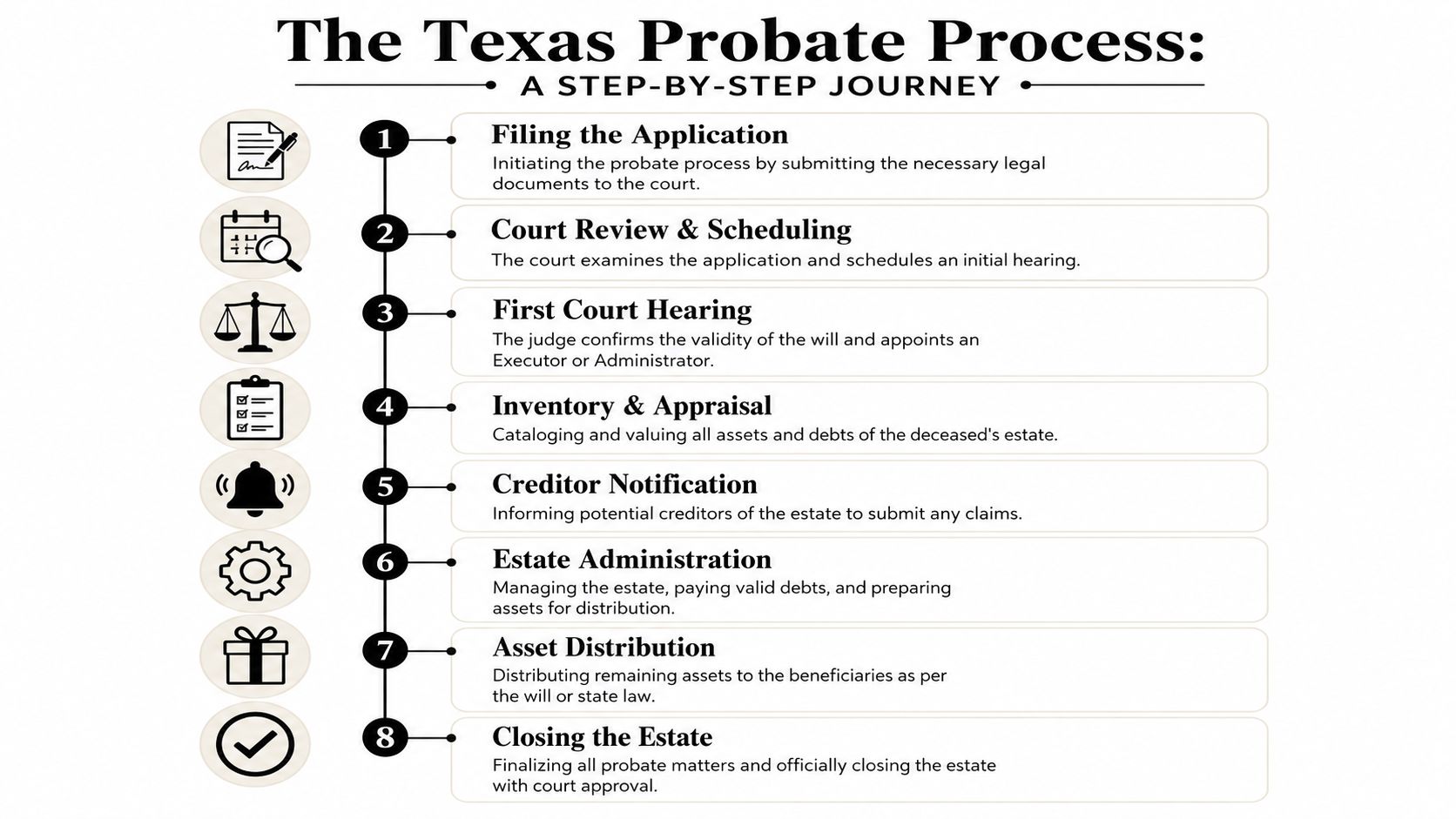
The main probate stages
Here is the usual progression for a Texas probate case involving an estate in the Kingwood area:
File the application with the court
The case begins when the proper probate documents are filed in the county with jurisdiction.Wait for court review and scheduling
The court reviews the filing and sets an initial hearing.Attend the first hearing
If the court is satisfied, the judge admits the will if one exists and appoints the executor or administrator.Receive legal authority to act
The executor then uses the court-issued authority to deal with banks, title issues, and estate business.Prepare the inventory and appraisal
Estate assets and debts need to be identified and valued.Address creditor issues and administration tasks
Valid debts are handled, records are maintained, and the estate is managed.Distribute property
After required steps are completed, remaining assets are transferred to the correct beneficiaries or heirs.Close the estate
The final stage wraps up the probate matter according to court requirements.
For readers who want a quick visual explanation, this video gives a useful overview of how the process works in practice:
How long probate takes in Harris County
Time is the question families ask most, and it's usually the one they get the vaguest answer to. The more accurate answer is that timeline depends on whether the case is routine or contested.
According to the Texas State Bar's 2025 Probate Report, uncontested probates in Harris County average 6 to 9 months, while contested cases average 14 to 22 months. Statistics also show that while over 60% of cases are standard, the remaining 40% face complexities like disputed wills that require experienced legal representation, as summarized in this Harris County probate timeline discussion.
If you want a fuller explanation of timing issues, this page on how long probate takes in Texas breaks down common delays and expectations.
Why one estate moves faster than another
Two estates can look similar on paper and still move very differently.
A routine estate in Humble with a valid will, cooperative beneficiaries, and clearly titled assets may move steadily. A contested estate in Northeast Houston can slow down when heirs dispute the will, when property needs deeper investigation, or when the court must resolve disagreements before distribution can happen.
The biggest timing mistake executors make is assuming silence means progress. In probate, deadlines, notices, and missing documents often control the pace.
That doesn't mean every delay is a crisis. Some are built into the court process. The key is knowing which delays are expected and which ones need immediate attention.
Understanding the Costs of Probate in Kingwood
Probate costs matter because families are often paying bills, maintaining a house, and handling funeral and administrative expenses at the same time. It's hard to make good decisions if you don't have a realistic picture of what probate may cost.
Texas probate fees usually depend on two things. How complex the estate is and whether there is a valid will.
Common fee structures
Some probate lawyers charge a flat fee for a straightforward estate. Others bill by the hour, especially when the estate may become contested or involve unusual issues.
The key is to ask what the quoted fee covers. A low quote can be misleading if it doesn't include the work your case will realistically require.
According to this Texas probate fee guide, flat fees for a straightforward, uncontested probate with a will typically range from $2,500 to $5,000. However, for an intestate estate, meaning no will, baseline attorney fees average approximately $9,500 due to the court-mandated work required to identify legal heirs.
A side-by-side cost view
| Estimated Probate Costs in Harris County (With vs. Without a Will) | ||
|---|---|---|
| Cost Component | With a Valid Will (Testate) | Without a Will (Intestate) |
| Attorney fee structure | Often a flat fee may be available for a straightforward case | More often rises because heirship work and added court involvement are required |
| Attorney fees | $2,500 to $5,000 | Approximately $9,500 baseline |
| Court involvement | Usually more direct if the will is valid and uncontested | Usually more involved because the court must determine legal heirs |
| Risk of extra work | Lower if family members cooperate | Higher if family relationships or heirship questions are unclear |
What families should take from this
The absence of a will doesn't just create emotional uncertainty. It usually creates more legal work. The court may need more documentation, more notice requirements, and more formal proof about family relationships before anyone can move assets.
A valid will doesn't guarantee a cheap probate, but it often creates a clearer path.
If you're the executor, ask two questions early. Is the estate likely routine, and is the fee quote built for a routine case or for a contested one?
Families in Kingwood and Porter also need to remember that probate costs are only one piece of estate administration. The house may still need maintenance, insurance may need to stay active, and account access may remain restricted until court authority is in place.
Local Considerations for Northeast Houston Families
Probate in this area isn't just about Texas law in the abstract. Local families need to know where the case belongs and how geography affects the work. For many Kingwood residents, that means sorting out whether the estate will be handled through Harris County or Montgomery County, depending on where the decedent lived and how property is titled.
That issue sounds simple until family members are spread out across several cities.
A parent may have lived in Kingwood, one child may be in Humble, another in Porter, and a named executor may be living in another state. That mix is common, and it changes the practical side of probate quickly.
The out-of-state executor problem
One of the most overlooked probate problems in Northeast Houston involves non-resident family members. Over 18% of probate filings in Harris County involve at least one non-resident party, and Texas law has specific procedures for out-of-state representatives, as noted in the earlier Kingwood-focused source.
That matters because an out-of-state executor often assumes the role works like a simple power of attorney. It doesn't. Texas probate courts may require additional procedural steps before an out-of-state representative can fully act on behalf of the estate.
What local families should check first
When an estate involves people across state lines, these questions usually need answers early:
- Where did the decedent legally reside
- Is the original will available in Texas
- Does the executor live outside Texas
- Are there assets in more than one state
A Kingwood estate can also involve a second home, mineral interests, or inherited property outside Texas. That doesn't always complicate the Texas probate itself, but it can create parallel legal tasks.
Families often think distance is the main problem. Usually the real issue is procedure. Once the right filings and authority are in place, distance becomes easier to manage.
This is one reason local guidance matters. A lawyer serving Kingwood, Humble, and Northeast Houston can help connect county procedure with practical logistics of keys, records, deeds, and communication among relatives who aren't all in one place.
Schedule Your Free Consultation at Our Kingwood Office
By the time many individuals start looking for a probate attorney in Kingwood, TX near me, they've already spent days trying to piece together what happened, what property exists, and who is supposed to do what next. That's a lot to carry while grieving.
The good news is that probate is a process. It has rules, deadlines, and paperwork, but it also has a beginning, a middle, and an end. When you understand which court is involved, whether the estate is contested, and whether the executor or heirs live out of state, the path becomes much clearer.
The Law Office of Bryan Fagan – Kingwood TX Lawyers handles legal matters that affect local families across probate, estate planning, family law, criminal defense, and civil disputes. In probate matters, that means helping clients in Kingwood and nearby communities understand estate administration, court procedure, and their practical next steps under Texas law.
If you're dealing with a loved one's estate in Kingwood, Humble, Porter, or Northeast Houston, you don't have to figure it all out alone. A short conversation can often answer the most urgent questions, identify the right probate path, and help you avoid mistakes that cost time later.
The next step is simple. Gather the will if you have it, a death certificate if available, and any basic information about the home, bank accounts, vehicles, or debts. Then schedule a consultation and talk through your situation with someone who can explain it in plain English.
If you need clear guidance on probate, wills, trusts, or related legal issues in Kingwood, schedule a free consultation with Law Office of Bryan Fagan – Kingwood TX Lawyers. You'll get a chance to discuss your situation, understand your options under Texas law, and take the next step with local support.