Skip to content
When a child support payment doesn’t arrive, the problem isn’t abstract. It shows up at the grocery store, in after-school fees, in prescription costs, and in the quiet stress that follows you around Kingwood, Humble, and Northeast Houston. Many parents wait a little too long because they hope the other parent will catch up on their own. Sometimes that happens. Often, it doesn’t.
Texas gives you ways to act. If you're trying to enforce child support Kingwood parents rely on, the key is choosing the right path early, getting organized, and filing the right request in the right court. The process can feel intimidating at first, but it becomes much more manageable once you understand what the court can do and what evidence you need to bring.
The Reality of Unpaid Child Support in Kingwood
A familiar pattern plays out in Kingwood every month. Support is due on a certain date. That date passes. Then a text comes in with an explanation, a promise, or silence. The child still needs school clothes, meals, transportation, and stability, and the parent who was counting on that support has to cover the gap.
That situation is more common than many parents realize. In Texas, child support issues take up a meaningful share of family court work. In Fiscal Year 2021, Post-Judgment Child Support cases accounted for 6% of all family law filings in Texas, while original Child Support (IV-D) cases made up 18%, according to the Texas courts annual statistical report. That matters for families in Kingwood because it confirms something worried parents often need to hear. You are not overreacting, and you are not dealing with a rare problem.

What unpaid support usually looks like on the ground
Most enforcement cases don’t begin with dramatic conflict. They usually begin with one of these situations:
- Payments become irregular: The other parent pays some months, skips others, or pays only part of what the order requires.
- Excuses replace compliance: You hear about a job change, a car problem, a medical issue, or a promise to “double up next month.”
- The burden shifts to one household: Rent, childcare, food, and activity costs still have to be paid, so one parent absorbs everything.
- The amount owed starts growing: What felt manageable after one missed payment can become a serious arrearage before long.
Practical rule: Child support is a court order, not a suggestion and not a private side agreement you have to tolerate indefinitely.
Parents in Kingwood often ask whether they should keep waiting, call the Office of the Attorney General, or hire a private attorney right away. The answer depends on the facts, but waiting without documenting missed payments is usually the least effective choice.
Why local action matters
Enforcement is always easier when you move before records get messy and before the paying parent changes jobs, changes addresses, or becomes harder to locate. Local families in Humble, Porter, and Northeast Houston benefit from treating missed support like a legal issue early, not just a co-parenting disagreement.
If you’re already dealing with unpaid support, start by learning how these cases are handled locally and what options may fit your circumstances. This overview of unpaid child support in Kingwood is a useful next step if you want a more focused look at remedies and procedure.
Your Legal Toolkit for Enforcing Child Support in Texas
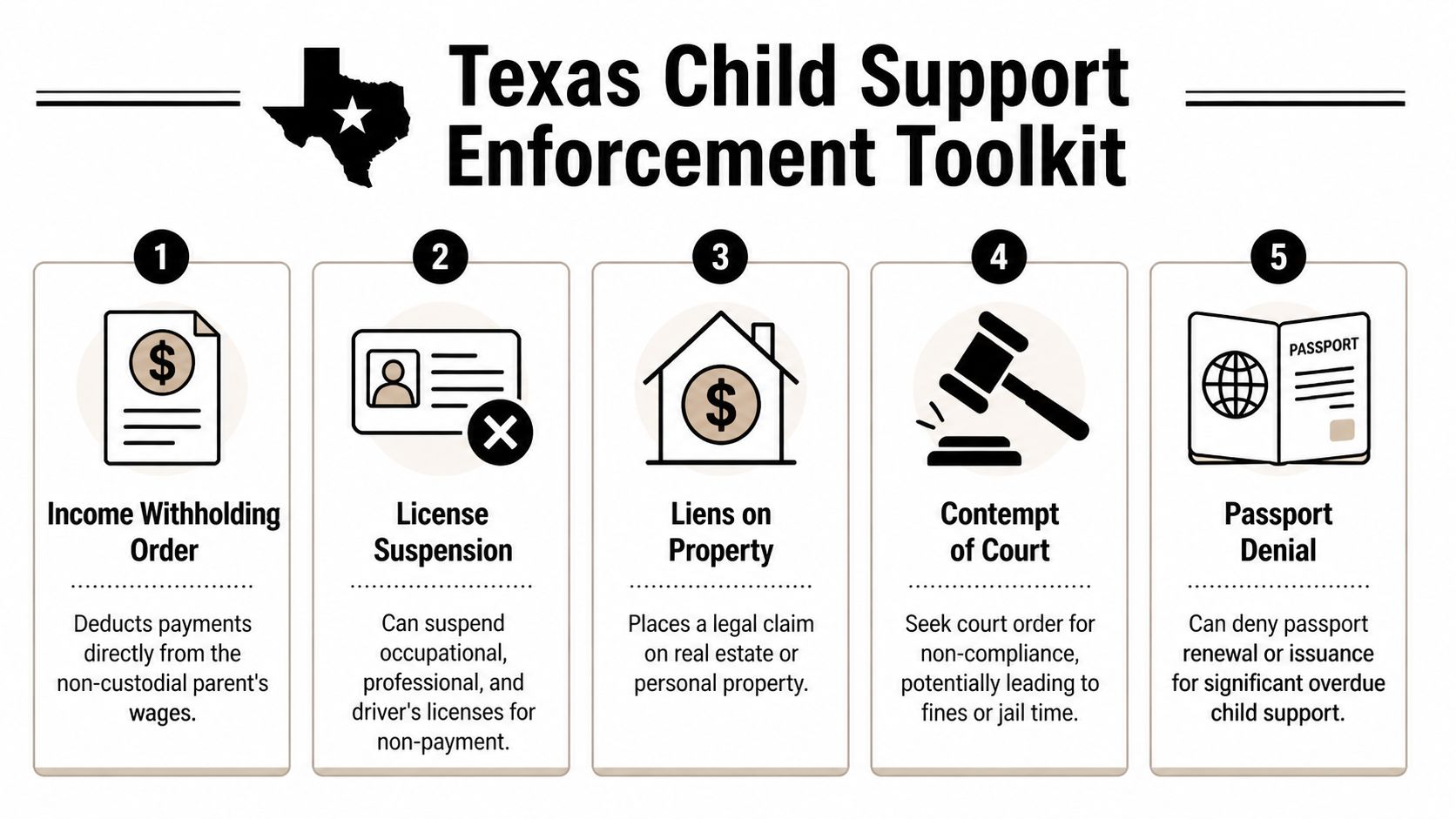
Texas gives courts and the Office of the Attorney General several ways to enforce support. Some tools are designed to collect money efficiently. Others are meant to pressure a nonpaying parent into compliance. The right tool depends on how the other parent earns income, whether they’re employed by someone else, and how long the support has been unpaid.
The main enforcement tools Texas uses
The starting point in many cases is a Motion for Enforcement. Under Texas practice, that filing tells the court exactly how the order was violated and asks the judge to impose remedies. Process matters here. According to this discussion of Texas enforcement procedure, courts can order wage garnishment of up to 50-65% of disposable earnings, and incomplete documentation causes 40% of motions to be denied in Harris County.
That’s why enforcement cases are won or lost on details. Dates, amounts due, amounts paid, and the wording of the original order all matter.
Income withholding and wage garnishment
For many families, income withholding is the cleanest tool. If the other parent works a regular job, the court can direct the employer to withhold support from wages. This approach works best when the obligor has stable payroll income and an identifiable employer.
It’s straightforward, but it still requires accuracy. A withholding request tied to the wrong order amount, wrong employer, or incomplete payment history can create delay. If your case involves payroll deductions and you also want to understand the broader scope of wage-withholding, this consumer guide on how to stop wage garnishment can help you see how garnishment works in related debt settings and why timing matters.
Contempt and court pressure
A contempt action is the heavier tool. It asks the judge to find that the other parent failed to obey a court order. In the right case, contempt can push resolution quickly because it carries real consequences.
A contempt request is often useful when:
- The nonpaying parent clearly knew the order existed
- Payments were skipped repeatedly without a lawful excuse
- Other softer collection efforts didn’t work
- The parent has the ability to pay but chooses not to
The point isn’t punishment for its own sake. It’s compliance.
Courts respond best when the filing is specific. “He never pays” is frustration. “Payment due on these dates was not made under this paragraph of the order” is evidence.
Liens, seizure, and government collection tools
Not every case is a payroll case. Some obligors own property, operate businesses, or have assets that don’t flow through a paycheck. In those situations, the court may enter a child support judgment that opens the door to property-related collection remedies.
The Office of the Attorney General also has tools private attorneys don’t control directly. Those include tax refund interception, passport-related consequences, credit reporting consequences, and other government enforcement mechanisms. That broad authority can be important in older arrearage cases or when the paying parent moves around and leaves little paper trail.
License suspension and pressure points
Texas can also use license suspension as a tool. That can affect a driver’s license or a professional or occupational license. This doesn’t fit every case, but it can be effective when the nonpaying parent has ignored repeated opportunities to fix the problem.
Parents sometimes assume the court will automatically use every available remedy. It won’t. You have to ask for the right relief, support it with clean records, and make the judge’s decision easy to sign.
Texas child support enforcement methods compared
| Enforcement Method | How It Works | Best For… | Potential Speed |
|---|---|---|---|
| Income withholding | Support is deducted from wages through the employer | A parent with regular payroll employment | Often one of the more direct options once the employer is identified |
| Motion for Enforcement | Tells the court exactly how the order was violated and requests remedies | Cases with documented missed payments and a clear court order | Depends on the court’s docket and how prepared the filing is |
| Contempt request | Seeks court sanctions for willful noncompliance | Repeated nonpayment where the parent knew about the order | Can create fast pressure once set for hearing |
| Liens or asset-based remedies | Targets property or assets after the proper judgment steps are taken | Parents with property, accounts, or non-wage assets | Usually slower than wage withholding, but useful in the right case |
| OAG-specific collection tools | Uses state and federal enforcement channels such as tax intercepts or passport-related consequences | Older arrears, interstate issues, or difficult collection cases | Often thorough, but not always fast |
What works and what usually doesn’t
The most effective enforcement strategy usually has three features: a current payment ledger, a clear copy of the existing order, and a realistic plan based on how the other parent earns money. A self-employed parent who gets paid in cash is different from a refinery employee in Northeast Houston with steady payroll records.
What doesn’t work well is informal bargaining after the arrears have already grown. A string of text messages promising payment next week rarely solves an enforcement problem. It often just delays the court action that should have been filed sooner.
How to Prepare Your Enforcement Case in Montgomery County
Preparation wins enforcement cases. If you live in Kingwood and your case belongs in Montgomery County or another nearby court, the judge will want to see a clean record, not a rough estimate. Your goal is to show what was ordered, what was paid, what was missed, and what remedy makes sense.

Start with the core file
Pull together the documents that form the spine of your case. In many Kingwood enforcement matters, that means collecting papers before anyone files anything.
Focus on these first:
- Your current child support order: Make sure you have the signed version, including later modifications if any were entered.
- Payment history: Gather state disbursement records, bank records, payroll records, or other proof showing what was and wasn’t paid.
- A simple ledger: List each due date, the amount due, the amount paid, and the shortage if there was one.
- Communication records: Save texts, emails, and messages where the other parent acknowledges the missed payments or discusses income and job changes.
If you don’t know where the other parent works now, don’t guess. Confirm what you can through lawful records and reliable research. When families are trying to locate updated employment or contact information, a basic guide on how to do an online background check can help them understand what public information may be available before formal service efforts begin.
Build the timeline before you file
Parents often come into an enforcement case with a stack of screenshots and a general sense that “he’s behind” or “she stopped paying months ago.” That isn’t enough. Turn the facts into a timeline.
A useful timeline usually includes:
- The date the current order was signed
- When support was first due under that order
- Each missed or partial payment
- Any significant employment or address changes
- Any prior enforcement attempts through the OAG or court
This step sounds simple, but it often reveals issues that need legal attention before filing. Sometimes the problem is unpaid support. Sometimes the order itself also needs to be updated.
Consider whether modification belongs with enforcement
Not every enforcement case is only about collection. Some parents in Kingwood should also ask whether the support amount itself needs review. One important future change is the 2026 increase in the Texas child support cap on monthly net resources from $9,200 to $11,700, effective September 1, 2025, as discussed in this explanation of the Texas child support cap update. For some high-income cases, that change may qualify as a material and substantial change that supports a modification request alongside enforcement.
That doesn’t mean every case should combine the two. It means you should look at the full picture before filing.
If the other parent’s income has changed, or the legal cap used in your earlier order is being updated in the future, it may be worth reviewing enforcement and modification together instead of treating them as separate problems.
A hearing-focused guide like this page on a child support hearing in Kingwood, Texas can also help you understand what local preparation should look like before you step into court.
Here’s a helpful overview of the hearing dynamic and why preparation matters:
Small mistakes that can slow everything down
Some delays are avoidable. Parents hurt their own case when they rely on memory, bring only phone screenshots, or assume the court already knows what’s unpaid. The judge doesn’t build your ledger for you.
A well-prepared file is easier to review, easier to present, and harder for the other side to dodge. That matters in Montgomery County just as much as it does in Harris County or other nearby courts serving Northeast Houston families.
Choosing Your Path OAG vs Private Attorney in Kingwood
This is the decision many parents struggle with most. Should you open or continue a case with the Texas Office of the Attorney General, or should you hire a private family law attorney in Kingwood? Both paths are legitimate. They just solve different problems.

What the OAG does well
The OAG handles a huge volume of child support matters across Texas. That scale matters because the agency has tools that private enforcement does not control directly. According to TexasLawHelp’s explanation of enforcing your child support orders, private enforcement is significantly faster but underused, while the OAG has unique powers such as passport suspension and tax intercepts.
For some Kingwood parents, the OAG is the right first stop. That’s especially true when:
- You need government collection tools: Tax intercepts and passport-related consequences can matter in stubborn arrears cases.
- You need a lower-cost starting point: The agency route is often attractive when private representation isn’t practical.
- Your case is straightforward: Some matters involve a clear order, known employment, and a payment issue that fits the agency’s systems.
Where the OAG can be frustrating
The OAG’s size is both its strength and its limitation. Large caseloads can mean less personal attention and slower movement. That doesn’t mean the agency is ineffective. It means your case may not receive the same level of customized strategy that a private lawyer can offer.
That trade-off becomes more noticeable when the case has complications like:
- A self-employed obligor
- Cash income
- A parent who changes jobs often
- A need to combine enforcement with modification
- A history of partial compliance and disputed payment records
In those cases, speed and strategy matter more.
What a private attorney changes
A private attorney can move with more focus. Instead of working inside a large statewide system, counsel can review your exact order, build the payment chart, decide whether contempt belongs in the filing, and prepare the hearing around your facts.
This is often where parents in Kingwood, Humble, and Porter see the practical difference. A private lawyer can respond to a changing situation without waiting for the same administrative path that an agency file may follow.
One local resource for this process is the child support enforcement page for Harris County matters, which can help families understand how private enforcement fits into nearby court practice. The Law Office of Bryan Fagan – Kingwood TX Lawyers also handles family law matters involving child support enforcement, modification, and related hearing preparation for local clients.
The right question usually isn’t “Which option is better?” It’s “Which option fits the way this other parent earns money, avoids payment, and responds to pressure?”
A practical side by side comparison
| Path | Main Advantages | Main Limits | Often a good fit when… |
|---|---|---|---|
| OAG enforcement | Broad government tools, established statewide systems, useful for difficult collection channels | Less individualized strategy, possible delay, less flexibility in complex fact patterns | You want agency-based enforcement and your case fits standard collection methods |
| Private attorney enforcement | Faster movement, direct case strategy, customized filings, hearing preparation tailored to the facts | You pay for private representation, and some government-only tools still remain with the OAG | You need speed, personal attention, or your case involves complications the agency process may not address quickly |
| Hybrid approach | Private counsel can push the court case while the OAG remains useful for separate collection channels | Requires coordination and clear expectations | You want both courtroom momentum and access to broader state collection power |
When private enforcement often makes more sense
Private enforcement tends to make sense sooner when the arrears are recent enough that records are still clean, the other parent is actively working, and you need the issue in front of a judge without unnecessary delay. It also becomes more attractive when the paying parent is manipulating the situation by switching employers, underreporting income, or making just enough partial payments to create confusion.
By contrast, if your main goal is access to tax intercepts or other state tools, the OAG may still play an important role even if private counsel is involved elsewhere.
For many families in Northeast Houston, the smartest answer isn’t an either-or decision. It’s a strategy decision.
Common Questions About Kingwood Child Support Enforcement
These are the questions parents in Kingwood ask all the time once they realize enforcement is possible but aren’t sure how the process works in real life.
Can I stop visitation if support isn’t being paid
No. Child support and visitation are separate issues under Texas family law. If the other parent isn’t paying, your remedy is enforcement through the court or appropriate agency channels. If you block court-ordered possession because you’re angry about unpaid support, you can create a new legal problem for yourself.
That feels unfair to many parents, but it’s still the rule. The court expects you to enforce support through legal procedure, not by changing the possession schedule on your own.
Unpaid child support does not cancel the other parent’s visitation rights, and denied visitation does not cancel child support. Courts treat those as separate orders.
What if the other parent is self-employed or paid in cash
These cases are harder, but not hopeless. Payroll withholding is easier when there’s a regular employer. A self-employed parent may require a different approach, including tighter document review, business record analysis, and pressure through court orders or asset-based remedies where available.
A quick, informal agreement usually fails in these situations. If someone controls how they invoice, deposit, or report income, you need a strategy built around proof, not assumptions.
What if the other parent says they lost their job
Job loss does not erase already owed child support. Arrears continue to matter unless the order is changed by the court. Many parents make the mistake of treating unemployment as an automatic pause. It isn’t.
The paying parent must still seek a lawful modification if circumstances justify one. Until a judge changes the order, the existing order remains in force.
How long should I wait before enforcing
Usually less time than you think. Parents often wait because they want to avoid conflict or because they believe one missed payment is too small to bring to court. The question isn’t whether you must file after the first missed payment. It’s whether delay is helping or hurting your position.
If nonpayment is becoming a pattern, waiting tends to make the record messier and collection harder.
Is private enforcement worth the cost
That depends on the facts. If the arrears are modest and the OAG can address the case effectively, a private fee may not be necessary right away. If the amount owed is growing, the parent is hard to pin down, or the case needs a prompt hearing, private enforcement can be a sensible investment because it may bring structure and speed to a problem that has been dragging on.
The better way to think about cost is practical. Ask what delay is costing your household each month, what the arrears look like now, and whether the paying parent’s conduct suggests simple collection or active evasion.
Can I enforce support if we made side agreements by text
Maybe, but informal side deals create problems. The court primarily looks at the signed order, not casual messages where one parent agreed to “catch up later” or accepted partial payment for a time. Those communications may matter as evidence, but they usually don’t replace the order.
That’s why parents should be careful about relying on unwritten arrangements. A side agreement can muddy the facts without giving you enforceable protection.
What if I don’t have perfect records
Bring what you do have and start organizing now. A missing piece of paperwork doesn’t always prevent enforcement, but a scattered file will slow it down. Courts respond better when you can hand over a readable timeline, an order, and supporting payment proof instead of trying to explain months of history from memory.
Will the judge care that I’ve tried to be reasonable
Yes, but reasonableness alone doesn’t win the case. Judges appreciate parents who tried to resolve things without escalating conflict. Still, enforcement requires specifics. Being patient helps your credibility. Documentation wins the order.
Take the Next Step for Your Family's Financial Future
Unpaid child support puts pressure on every part of family life. It affects routines, bills, and your child’s sense of stability. The good news is that you don’t have to stay stuck in the cycle of missed payments, excuses, and uncertainty.
If you need to enforce child support Kingwood families depend on for everyday expenses, the strongest move is usually a prompt, organized one. That means identifying the order in place, gathering payment records, choosing the right enforcement path, and preparing for the local court process with a clear strategy. For some parents, the OAG is the right tool. For others, private enforcement is the more practical route. What matters is using the option that fits your case, not the one that sounds easiest in theory.
Families in Kingwood, Humble, Porter, and Northeast Houston deserve clear answers and a plan they can use. When support isn’t being paid, legal action can create structure, accountability, and a path toward collection.
If you’re worried about what comes next, start with a conversation. A focused review of your order and payment history can tell you a lot about what’s realistic, what should be filed, and what mistakes to avoid.
If you’re dealing with unpaid child support in Kingwood, Humble, Porter, or Northeast Houston, schedule a free consultation with Law Office of Bryan Fagan – Kingwood TX Lawyers. You can discuss your order, your payment history, and the fastest practical next step for your family in a confidential, no-obligation meeting at the Kingwood office.