Skip to content
When Texas families have to make tough decisions about a child's well-being or an adult loved one's care, the legal terms can be overwhelming. As your neighbors and local attorneys at The Law Office of Bryan Fagan in Kingwood, we want to help you understand two of the most common—and most commonly confused—terms: conservatorship and guardianship.
Here’s the simplest way to think about it for our Kingwood community: Conservatorship is a family law term specific to Texas, outlining a parent's rights and responsibilities for their child. It's what most people mean when they talk about "custody." On the other hand, guardianship is a more serious legal step taken in probate court, where someone is appointed to care for a minor or an incapacitated adult who simply can't manage their own affairs.
Defining Conservatorship And Guardianship For Kingwood Families

For families here in Kingwood, Humble, and the surrounding Northeast Houston area, getting this distinction right from the start is critical. Choosing the wrong legal path isn't just a minor mistake; it can mean wasted time, unnecessary legal fees, and a great deal of added stress during an already difficult time. These terms aren't interchangeable—they exist in completely different parts of Texas law and are designed for very different situations.
Conservatorship cases are heard in family court, usually as part of a divorce or a suit affecting the parent-child relationship. The court’s order will specify which parent gets to make crucial decisions about the child's life, like where they go to school in the Humble ISD, what medical care they receive, and where they primarily live.
Guardianship is a different matter entirely. It’s handled in probate court and is considered a last resort when an individual is legally found to be unable to care for themselves. This could be a minor whose parents have passed away or are unable to care for them, or an adult in our community who, due to an illness like dementia or a severe injury, can no longer make their own decisions.
These aren't niche legal issues. An estimated 1.3 million adults across the country are under some form of guardianship, with courts overseeing a staggering $50 billion in assets. These numbers, which you can read more about on Business Insider, show just how often families must turn to the courts to protect their most vulnerable loved ones.
To cut through the legal jargon, we’ve put together a straightforward table to help our Kingwood community see the core differences at a glance.
Texas Conservatorship vs Guardianship at a Glance
This table offers a quick summary of the fundamental differences between family law conservatorship and probate guardianship for Kingwood residents.
| Aspect | Conservatorship (Family Law) | Guardianship (Probate Law) |
|---|---|---|
| Primary Focus | Parental rights and duties for a minor child. | Personal care and financial management for a minor or incapacitated adult. |
| Who It Affects | Parents and their children. | A "ward"—a minor or an adult unable to make their own decisions. |
| Court Involved | Family Court | Probate Court |
| Common Scenario | A divorce or custody modification in Porter. | An aging parent with dementia in Humble needing comprehensive care. |
Seeing the key details side-by-side makes it clear that while both involve caring for another person, they are fundamentally different legal tools used in separate court systems to solve very different family problems.
Understanding Texas Conservatorship in Child Custody Cases

When parents in Kingwood go through a divorce or custody dispute, they quickly encounter a term that might be new to them: conservatorship. This is simply the legal term Texas uses to define a parent's rights and responsibilities for their child—it’s what most people think of as "custody."
At its core, conservatorship is the legal blueprint that dictates who gets to make important decisions for a child and outlines where that child will live. Whether your case is in Harris County or Montgomery County, the court's one and only guiding principle is the “best interest of the child.” This isn't about what’s fair to the parents; it’s about crafting a stable, loving, and safe future for the child.
Joint vs. Sole Managing Conservatorship
The starting point for nearly every Texas custody case, including those right here in Northeast Houston, is the presumption that a Joint Managing Conservatorship (JMC) is best for the child. This doesn’t always mean a 50/50 split of physical time, but it does mean both parents are expected to share the responsibility of making key decisions together.
In a JMC, the court allocates specific rights and duties to each parent. These typically include things like:
- Making choices about the child's education and medical care.
- Giving consent for medical, dental, or surgical procedures.
- Having access to all of the child’s records, from school grades to medical charts.
Even when parents are joint conservators, one parent is usually designated as the "primary" conservator, giving them the exclusive right to decide where the child lives (often within a specific geographic area, like the Kingwood school district). If you're looking into how these arrangements work in practice, our guide to shared custody in Texas offers practical insights.
A Sole Managing Conservatorship (SMC) is far less common. A judge will only order this arrangement if there's convincing evidence that having both parents involved would harm the child's physical or emotional health. This is typically reserved for situations involving family violence, neglect, or severe substance abuse. The sole managing conservator then holds the exclusive authority to make most decisions for the child.
A key point for Kingwood parents: Even if one parent is named the sole managing conservator, the other parent is almost always named a possessory conservator. This means they still have rights, including the right to have scheduled time with their child.
Getting these details right from the beginning is crucial, as the final conservatorship order will define your parental relationship for years to come. At The Law Office of Bryan Fagan, our Kingwood attorneys focus on providing clear, practical advice to help you secure an arrangement that genuinely serves your child's best interests. We invite you to schedule a free consultation to talk about your family's unique situation.
A Closer Look at Guardianship for Minors and Incapacitated Adults

While conservatorship is rooted in family law and parental rights, guardianship exists in a different legal world: the probate court. Think of it as a powerful legal shield designed to protect people who simply cannot care for themselves, whether they are a child or an adult who has lost that capacity.
For families here in Kingwood and Humble, grasping when guardianship becomes necessary is a crucial piece of elder law and long-term planning. It is a formal court process that gives a responsible person (the guardian) the legal authority to make critical life decisions for someone else (the ward).
This isn't a step anyone takes lightly. It involves removing some of the ward's most basic rights to self-determination. For this very reason, Texas courts are incredibly cautious and will always search for a less restrictive alternative before appointing a guardian.
Common Guardianship Scenarios We See in Northeast Houston
In our Kingwood practice, guardianship cases almost always fall into one of two categories. The first is for a minor child whose parents have died or become unable to care for them. The second, which is becoming much more frequent, involves an adult who is incapacitated because of advanced age, a severe illness, or a disability.
The need for adult guardianship is on the rise. With an aging population, guardianship caseloads are climbing. These demographic shifts mean more seniors require help managing their affairs, a trend reflected in national reports on the topic.
The Different Powers a Guardian Can Hold
When a Texas court appoints a guardian, the powers granted are tailored specifically to what the ward needs. It’s not an all-or-nothing deal; the court limits the guardian’s authority to only what is absolutely necessary.
- Guardian of the Person: This guardian handles the ward's physical well-being. They're the ones making decisions about medical treatments, where the ward lives, and other daily personal needs.
- Guardian of the Estate: This guardian is put in charge of the ward's money and property. Their job is to pay bills, manage investments and real estate, and safeguard the ward's assets from being wasted or stolen.
Often, the court will appoint one trusted person to handle both roles. But in more complicated situations, it might make sense to name two different people—one for personal care and another for the finances. If you're starting down this path, our guide on how to get guardianship in Texas breaks down the essential steps.
The court's primary goal is always to protect the proposed ward while preserving as much of their independence as possible. The evidence must be clear and convincing that the person is truly incapacitated and that no less restrictive option, like a power of attorney, is workable.
When dealing with guardianship for an adult with a degenerative condition, learning about the specifics of their illness, such as What Is Alzheimer's Disease, can provide crucial context for both legal and care planning. If you're worried about a loved one's ability to stay safe and manage their own life, the compassionate attorneys at The Law Office of Bryan Fagan are here to help. Schedule a free consultation at our Kingwood office to talk through your options.
Comparing the Legal Pathways in Family and Probate Court
One of the biggest distinctions between conservatorship and guardianship is the courtroom where your case will be heard. This isn't just a minor detail for families in Kingwood—it completely shapes the legal process, the rules you have to follow, and the ultimate outcome.
Conservatorship matters fall squarely within the jurisdiction of family court. These cases are part of a larger action called a "Suit Affecting the Parent-Child Relationship" (or SAPCR), which is the same type of lawsuit used for divorces and custody disputes. The guiding principle here is always the "best interest of the child."
Guardianships, on the other hand, are handled in probate court. These specialized courts oversee wills, estates, and, critically, cases involving people who lack the capacity to manage their own affairs. The focus in probate court is different; the judge’s primary duty is to protect a vulnerable person (the "proposed ward") without unnecessarily removing their fundamental rights.
Navigating the Different Court Systems
The journey through each court system is unique. In a family court conservatorship case, a parent files a petition to either create or change custody orders. It's often an adversarial process between parents. In probate court, an interested person files an application to begin the guardianship process, which immediately kicks off a formal investigation into the proposed ward's situation.
A key figure in both proceedings can be an attorney ad litem, but their role and appointment differ significantly.
- In Conservatorship: An ad litem might be appointed to represent what's best for the child, but it’s not guaranteed in every case. The judge decides if it's necessary.
- In Guardianship: The court must appoint an attorney ad litem to advocate for the proposed ward's personal wishes and legal interests. This is a non-negotiable safeguard.
Understanding the distinct legal pathways, including those within Family Law, is a foundational step when deciding between these two options. The court you are in dictates the rules of engagement.
The legal standard you have to meet also changes dramatically. Family courts use a "preponderance of the evidence" standard for conservatorship, which basically means you just have to prove your side is more likely true than not.
Guardianship is a whole different matter. Because it involves taking away someone's civil liberties, the law requires "clear and convincing evidence" to prove incapacity. This is a much higher and more difficult standard to meet.
For anyone in Northeast Houston facing these issues, working with an attorney who knows the ins and outs of the specific court system for your case is absolutely critical. It's also worth looking into alternatives to avoid court altogether; for instance, understanding the difference between a durable POA vs medical POA can provide powerful tools for planning ahead.
The legal steps in family and probate court have their own rhythm and requirements. Here’s a side-by-side look at what to expect in each venue.
Legal Process Comparison Family Court vs Probate Court
| Procedural Step | Conservatorship (Family Court) | Guardianship (Probate Court) |
|---|---|---|
| Initiating the Case | A parent or interested party files a Petition in a Suit Affecting the Parent-Child Relationship (SAPCR). | An interested person files an Application for Appointment of Guardian, often with a physician's certificate. |
| Initial Hearing | Typically involves Temporary Orders hearings to set temporary rules for custody, visitation, and support. | A hearing is set to determine if there is a need for a guardian and to appoint an attorney ad litem. |
| Investigation | Parties conduct discovery (requests for documents, depositions). A social study or custody evaluation may be ordered. | The court appoints a "guardian ad litem" or court investigator to conduct a thorough investigation and report back. |
| Key Appointments | An amicus attorney or attorney ad litem may be appointed to represent the child's best interests, but it's not mandatory. | An attorney ad litem must be appointed to represent the proposed ward’s legal interests and wishes. |
| Standard of Proof | "Preponderance of the evidence" – what is more likely true than not. | "Clear and convincing evidence" – a high standard required to prove incapacity and the need for a guardian. |
| Final Resolution | The case is resolved through mediation, a settlement agreement, or a final trial, resulting in a Final Order. | A final hearing is held where the judge hears evidence and decides whether to grant the guardianship, outlining specific powers. |
This table highlights just how different the two paths are. While both aim to protect someone, the legal framework, safeguards, and standards of proof are tailored to very different situations.
Real-Life Scenarios: When to Choose Conservatorship or Guardianship
Legal definitions can feel abstract, but when a family crisis hits, you need to know which tool to reach for. The real difference between conservatorship and guardianship becomes crystal clear when you see how they apply to situations we handle for families every day right here in the Kingwood area.
Let’s walk through a few common scenarios that come across our desks at our Kingwood office. Seeing these examples will help you recognize which legal path might be the right one for your family.
Divorcing Parents in Porter
Imagine a couple with two young kids getting divorced in Porter. They’re still on speaking terms and their main goal is to build a practical co-parenting plan. They need to sort out who makes the final call on school and medical decisions and figure out a visitation schedule that works for everyone.
- The Right Tool: Conservatorship.
- Why It Fits: This is a classic family law case. It’s all about defining the rights and responsibilities between parents. A family court judge will issue an order, typically naming them Joint Managing Conservators. This order will act as a roadmap, spelling out their duties and setting a clear possession schedule that puts the children's best interests first.
An Aging Parent in Humble
Think of an adult daughter in Humble worried about her elderly mother. Her mom has an advanced Alzheimer's diagnosis, and she's starting to miss bill payments, forget her medications, and even wander away from home. Crucially, there are no power of attorney documents in place.
- The Right Tool: Guardianship.
- Why It Fits: The mother is now considered an incapacitated adult, meaning she can no longer make safe decisions for herself. Her daughter will need to go to a probate court and ask to be appointed as the guardian of the person and the estate. This gives her the legal authority to manage her mom’s healthcare, pay her bills, and protect her assets.
This decision tree helps visualize how different your starting point is for these two legal paths.
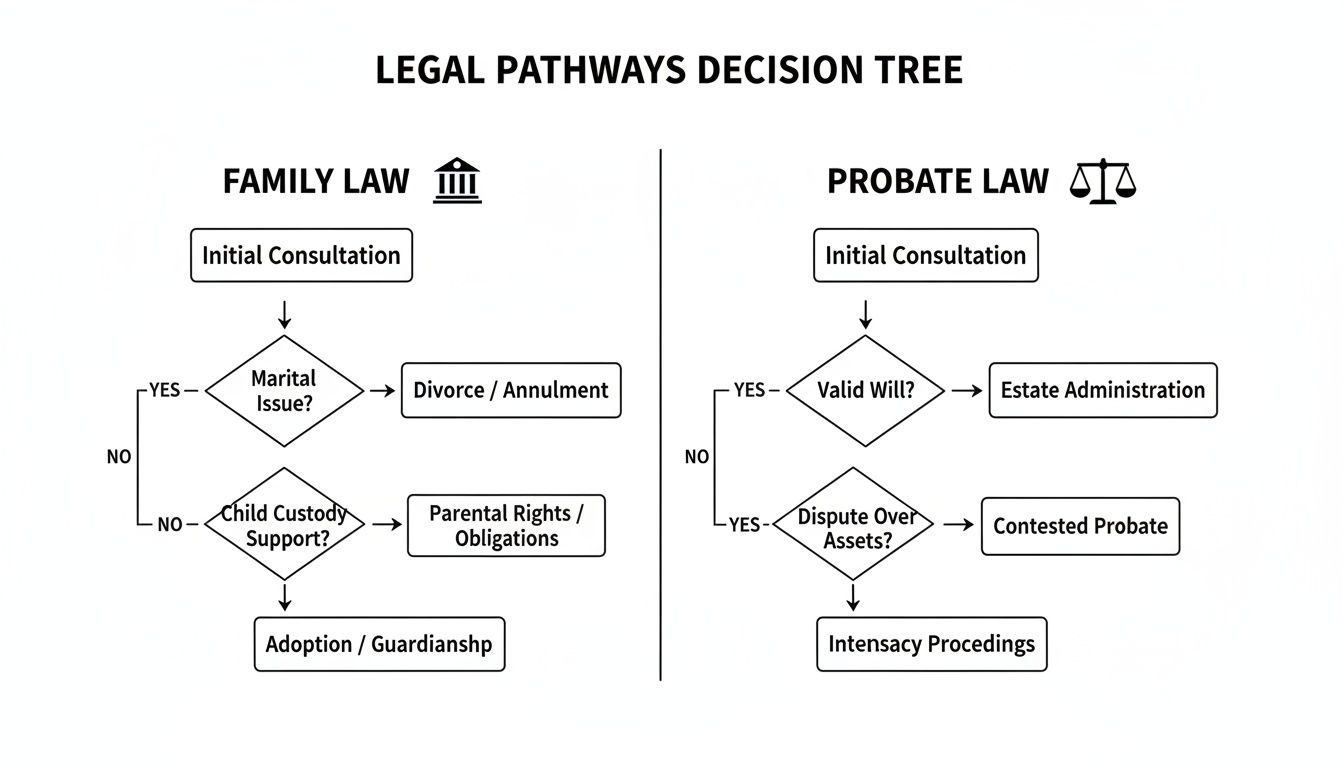
As you can see, whether you’re dealing with a child custody dispute or an adult's inability to care for themselves determines which courthouse you’ll be walking into.
Grandparents Raising Their Grandchild in Kingwood
Here’s a situation we see often: Grandparents in Kingwood have been raising their 10-year-old grandson for the last two years. The child's parents are battling severe substance abuse problems and simply can't provide a stable home. The grandparents need official authority to enroll him in school and get him medical care.
- The Right Tool: It could be both, but one usually comes before the other.
- Why It Fits: The most direct route is often for the grandparents to file a Suit Affecting the Parent-Child Relationship (SAPCR) in family court. This would allow them to be named the child's Managing Conservators. If, down the road, the parents' rights are legally terminated, the grandparents could then pursue a guardianship in probate court for more permanent authority until he turns 18.
At its core, the distinction is this: Conservatorship is about managing the rights and duties of parents. Guardianship is about protecting vulnerable people who lack the legal capacity to protect themselves.
Seeing these examples laid out often brings a moment of clarity for people. If you recognize your own family’s story in one of these scenarios, please know you are not alone and there are clear steps you can take. Here at The Law Office of Bryan Fagan, we guide families in Kingwood through these exact situations. We encourage you to schedule a free consultation with us so we can talk through your specific options.
How a Kingwood Attorney Can Guide Your Decision
Figuring out the difference between conservatorship and guardianship is a great first step, but knowing which one actually fits your family's situation is another challenge. While this guide provides a helpful overview, navigating the specifics for your family here in Kingwood, Humble, or anywhere in Northeast Houston really calls for personalized legal advice.
No two families are the same. And when the stakes are this high—we're talking about a child's future or an adult's safety and well-being—this is not the time for a DIY approach. Trying to handle this alone in family or probate court can easily lead to costly mistakes. Worse, a simple error could mean your loved one doesn't get the protection they desperately need. This isn't a path you should walk by yourself.
Your Local Legal Partner in Kingwood
Here at The Law Office of Bryan Fagan, we're not just lawyers; we're part of this community. Our team has spent years working in the very courts that handle these cases—the family courts for conservatorship and the probate courts for guardianship. We know the local procedures and what judges in Harris and Montgomery counties expect to see. We are here to listen to your story, understand your worries, and provide clear, straightforward advice that makes sense for your situation.
We can help your family:
- Assess your unique circumstances to determine if conservatorship or guardianship is the right legal path.
- Explore less restrictive options that could meet your goals without a full court process.
- Handle all the paperwork accurately and file it on time, so there are no unnecessary delays.
- Advocate for your family's best interests in court with a strategy built on experience and compassion.
Getting this legal choice right from the start brings an incredible amount of peace of mind during what is almost always a stressful time. It means your loved one is protected, your rights are respected, and you can build a stable future.
You don't have to sort through this complex decision on your own. The Law Office of Bryan Fagan is right here in Kingwood, ready to be your legal resource. We invite you to schedule a free, no-obligation consultation with our team. Let's sit down together, talk through what's going on, and map out the best way forward for your family. Contact us today.
Common Questions We Hear from Texas Families
When you're trying to sort out the differences between a conservatorship and a guardianship, it's natural to have questions. Here in Kingwood, we hear many of the same concerns from families trying to do what's best for their loved ones. Let's walk through a few of the most frequent ones.
Can My Special Needs Child Have Both a Conservatorship and a Guardianship?
This is a critical question for many parents, and the answer comes down to timing. While your child is a minor (under 18), your rights and responsibilities are governed by what Texas family law calls a conservatorship. This is the legal framework for custody and parental rights.
The moment your child turns 18, they become a legal adult, and that family court order—the conservatorship—automatically ends. If your adult child is unable to manage their own affairs due to a disability, you'll need a new legal tool to continue making decisions for them. That's where guardianship comes in, which is handled by a probate court, not the family court. It’s a completely separate process, and planning for this transition well before their 18th birthday is incredibly important.
What Can We Do for My Aging Parent in Humble Besides a Full Guardianship?
Courts in Texas see guardianship as a last resort. The law requires exploring every "least restrictive alternative" before taking away an individual's rights. Before a Harris or Montgomery County judge will even consider a guardianship, they’ll want to know if other arrangements could work instead.
Fortunately, there are several powerful alternatives:
- A Durable Power of Attorney lets someone you trust handle financial matters.
- A Medical Power of Attorney allows a designated person to make healthcare decisions.
- A Living Will (officially a Directive to Physicians in Texas) specifies end-of-life wishes, taking that burden off family members.
The key is to get these documents in place with an attorney while your parent is still mentally competent. Doing so can help you avoid the public, expensive, and often emotionally draining guardianship process down the road.
How Long Does It Take to Set Up a Conservatorship or Guardianship?
There’s no single answer here, as the timeline really depends on the situation. A conservatorship created during an amicable divorce could be wrapped up in a couple of months. But if you’re heading into a contentious custody fight, the process can easily stretch out for a year or more.
Guardianships can sometimes move faster, mainly because the court recognizes the urgency of protecting a vulnerable person. Still, the process is thorough. It involves filing petitions, a court-appointed investigation, and at least one formal hearing, so you’re typically looking at several weeks to a few months. The court’s schedule and any unique complexities in the case will always play a huge role.
Understanding the right path forward—whether it's through family court for a conservatorship or probate court for a guardianship—requires a deep understanding of local courts and Texas law. At The Law Office of Bryan Fagan – Kingwood TX Lawyers, we provide the clear, straightforward advice your family needs. To talk about your specific situation, schedule a free consultation with our Kingwood attorneys.