Skip to content
When parents in the Kingwood area aren't married, figuring out child custody can feel like navigating a maze. But Texas law has a very specific, and often surprising, starting point. If you're not married when your child is born, the law automatically gives the mother sole legal and physical custody.
This means that a father, even if his name is on the birth certificate, has no automatic legal rights to custody or even visitation. It’s a reality that catches many new parents in Humble and Porter off guard, but our team at The Law Office of Bryan Fagan is here to help you understand your next steps.
Understanding Your Rights as an Unmarried Parent in Kingwood

For a child born to unmarried parents here in Kingwood, the legal situation is stark. The law’s default position is really about creating immediate stability for the child, placing them in the clear care of one parent from day one. But what it also does is create an urgent need for fathers to take legal action to establish their parental rights. For mothers, this initial setup gives you control, but it also saddles you with 100% of the responsibility.
This isn't a rare situation. In fact, it affects a huge number of families. In Texas, about 41% of all babies are born to parents who aren't married. That means thousands of families in the Northeast Houston area start with this exact legal arrangement every single year. You can dive deeper into these Texas family law statistics and their implications for parents to see the bigger picture.
To make this clear, here's a simple breakdown of where each parent stands legally at the moment of birth.
Default Custody Status for Unmarried Parents in Texas
| Parent | Default Legal Status at Birth | Initial Rights |
|---|---|---|
| Mother | Sole Managing Conservator | Full legal and physical custody. Can make all decisions (residence, medical, education). |
| Father | No Legal Status | No automatic rights to custody or visitation, even if named on the birth certificate. |
This table shows why it's so critical for unmarried fathers to take proactive steps if they want to be legally involved in their child's life.
The Mother’s Automatic Rights
When an unmarried woman in Texas gives birth, her parental rights are immediately established. No court order is needed. She is, by default, the sole managing conservator. This gives her the exclusive power to:
- Decide where the child will live.
- Make every decision about the child’s schooling, healthcare, and religious upbringing.
- Consent to any medical or dental care the child needs.
If you’re a mom in Humble or Porter, this means you hold all the legal cards right from the start. However, it also means you'll likely need to go to court to get a formal child support order from the father.
The Father’s Path to Gaining Rights
For an unmarried father, the road is completely different. Just being at the hospital for the birth or signing the birth certificate doesn't give you any legal rights in Texas. Your status as a parent isn't legally recognized until you take formal steps.
To gain the right to see your child (possession and access) and have a say in their life (conservatorship), a father must first legally establish he is the father—a process called establishing paternity—and then get a court order through a Suit Affecting the Parent-Child Relationship (SAPCR).
This SAPCR is the official legal process that lets unmarried parents define their roles, rights, and responsibilities. It’s what turns a biological father into a legal father with rights that a court can actually enforce. For any family in the Kingwood area, starting a SAPCR is the single most important step toward building a stable, court-ordered co-parenting plan that truly serves your child’s best interest.
If you're an unmarried parent trying to navigate this, please know you don't have to do it alone. Here at The Law Office of Bryan Fagan in Kingwood, we provide clear, practical guidance to our neighbors every day. Schedule a free consultation with our team to figure out your next steps.
The First Step: Gaining Legal Paternity

For an unmarried father in Texas, the path to securing parental rights starts with one critical action: establishing legal paternity. Think of it as the foundation of a house. Without it, you can't build anything else—no custody, no visitation, no say in your child's life. Legally being recognized as the father is the key that unlocks all your other rights.
It's a common misconception among fathers in the Kingwood and Humble areas that signing the birth certificate is enough. While that's an important document, it doesn't automatically grant you enforceable rights. You have to take a formal legal step to go from being a biological father to a legal father.
In Texas, you have two main ways to do this. Each route has its pros and cons, so understanding which one fits your situation is essential.
The Acknowledgment of Paternity (AOP)
The simplest and most common method is signing a legal form called the Acknowledgment of Paternity (AOP). This is a sworn statement, signed by both the mother and the father, that formally identifies the man as the child's biological father.
Most often, this form is presented to parents at the hospital shortly after the baby is born. Once it's signed by both parents and filed with the Texas Vital Statistics Unit, it carries the same legal weight as a court order.
- When It’s a Good Choice: The AOP is perfect when both parents are on good terms and are 100% certain about the father's identity. It’s quick, straightforward, and keeps you out of court.
- A Word of Caution: Signing an AOP is a serious legal act. Once that ink is dry, it is incredibly difficult to reverse, even if a DNA test later proves you aren't the biological father. If you have even a shadow of a doubt about paternity, do not sign this form.
Court-Ordered Paternity Testing
What if there's any doubt about who the father is? Or what if one parent simply refuses to sign the AOP? The next step is to file a paternity case in court. This process is formally part of the Suit Affecting the Parent-Child Relationship (SAPCR) we talked about earlier.
A judge in Harris County will then order a DNA test to scientifically determine the child's parentage. Genetic testing provides a conclusive answer, with results that are nearly 99% accurate, giving the court the solid proof it needs to move forward.
Key Takeaway for Northeast Houston Fathers: Choosing between an AOP and a court order is a major decision. The AOP is like a handshake deal—it’s fast and built on mutual trust. A court-ordered DNA test is like a notarized contract—it provides undeniable certainty and legal protection for everyone.
Once paternity is established, either through the AOP or a court order, the door is officially open. The father can now petition the court for custody (conservatorship), visitation schedules (possession and access), and the right to make decisions about his child’s upbringing. This is a crucial milestone for any father who wants to be legally and actively involved in his child's life. For more detailed guidance, feel free to explore our articles on the rights of fathers in Texas.
Establishing paternity isn't just about filling out paperwork; it's about cementing your legal bond with your child. If you're an unmarried father in the Kingwood area trying to figure out your next steps, our team is here to help. Schedule a confidential consultation at our Kingwood office, and we'll guide you through this vital first step with clarity and confidence.
How Texas Courts Decide Custody Arrangements
Once you’ve legally established paternity, the big question on every unmarried parent's mind is, "So, how does a judge actually decide who the kids live with?" It’s a nerve-wracking thought, but the Texas court system has a clear, predictable framework for making this decision. The goal isn't to pick a "winner" and a "loser"; it's all about figuring out the best possible setup for your child's life moving forward.
First, let's get the language right, because what you hear in a Harris County courtroom might sound a little different from what you expect. In Texas, the official orders don't really use the word "custody." Instead, the court breaks it down into two main ideas:
- Conservatorship: Think of this as the power to make major decisions. It answers the question, "Who gets to decide where the child goes to school, which doctor they see, or their religious upbringing?"
- Possession and Access: This is simply the visitation schedule. It lays out exactly when each parent gets to have the child with them.
Getting a handle on these terms is the first step. It helps you see that the judge isn't just making a random choice but is carefully building a plan that fits your child's specific needs.
The “Best Interest of the Child” Standard
Every single decision a Texas judge makes about your child—every single one—boils down to a single guiding principle: the best interest of the child. This isn’t a vague guideline; it's a legal command baked into the Texas Family Code. What this means is that the judge’s personal opinions, and even what might seem "fair" to you as a parent, come second to what will best support your child's physical, mental, and emotional health.
For a family in Northeast Houston, a judge will apply this standard by looking at a list of factors known as the "Holley factors." These factors help the judge get a complete 360-degree view of your family's life.
In a Texas family court, the judge is required to look at the entire picture of a child’s life. No single factor automatically trumps the others; it's about weighing all the relevant details to determine what environment will allow the child to thrive.
The Holley Factors Explained
So, what exactly does a judge look at to figure out what's in your child's best interest? They'll dig into several aspects of your family dynamic, guided by these key Holley factors:
- The Child's Needs: What does your child need right now, and what will they need in the future? A toddler in Kingwood has vastly different emotional and physical needs than a teenager at Humble High School.
- Parental Abilities: This isn't about who has more money. It’s about which parent has shown they can provide a stable, loving, and nurturing home. The court is looking for proven parenting skills.
- Stability of the Home: Is the home environment consistent and predictable? Frequent moves or a chaotic living situation can be seen as harmful to a child's development.
- The Child's Preference: If a child is 12 years or older, the judge can meet with them privately to hear their thoughts on which parent they'd prefer to live with most of the time. It's an important piece of the puzzle, but it's not the final word.
- Acts or Omissions: The court will look for any red flags. Has either parent acted in a way—or failed to act—that could put the child's well-being at risk? This covers serious issues like substance abuse, family violence, or neglect.
Joint vs. Sole Managing Conservatorship
After weighing these factors, the judge will structure the conservatorship in one of two ways: either naming the parents as Joint Managing Conservators or appointing one as the Sole Managing Conservator.
In Texas, the law starts with the assumption that a joint arrangement is what’s best for the child. This is by far the most common outcome for unmarried parents. Being Joint Managing Conservators means both parents share the rights and duties of making big decisions for their child.
Even in a joint setup, one parent is usually designated as the "primary" conservator. This parent gets the exclusive right to decide where the child lives, although it's typically restricted to a specific area, like Harris County and its surrounding counties.
A judge will only move to a Sole Managing Conservatorship if there’s clear evidence that giving the other parent decision-making power would actually be harmful to the child. This is reserved for serious situations, usually involving family violence, chronic substance abuse, or extreme parental conflict.
While the law aims for an even playing field, it's crucial for unmarried fathers to be aware of the on-the-ground reality. Statistics consistently show that mothers are more frequently named the primary parent. Despite the "best interest" standard, data on Texas child custody outcomes reveals that fathers receive only about 33% of parenting time on average. This fact underscores how vital it is to build a strong, well-documented case. You can discover more insights about these Texas custody statistics to get a clearer picture of the landscape.
Facing these decisions can feel overwhelming, but you don't have to go through it alone. Here at The Law Office of Bryan Fagan, our Kingwood attorneys are dedicated to helping you present the strongest case possible, ensuring the judge gets a full and accurate understanding of your role as a parent. We invite you to schedule a free, no-obligation consultation to talk about your unique situation and find out how we can help protect your relationship with your child.
A Step-by-Step Guide to the Texas Custody Process (SAPCR)
The formal name for a Texas custody case is a "Suit Affecting the Parent-Child Relationship," or SAPCR (pronounced sap-sir). It sounds complicated and a little intimidating, but don't let the legal jargon fool you.
Think of it as the official roadmap for unmarried parents. It’s the legal process we use to get a clear, enforceable court order that spells out everyone's rights and responsibilities, ultimately protecting your relationship with your child.
For parents here in Kingwood and the surrounding Humble area, understanding this journey from start to finish can replace that feeling of legal anxiety with a sense of control. Let's walk through the key stages of a typical SAPCR case so you know exactly what to expect.
This flowchart breaks down the basic journey from establishing who the legal father is to getting a binding court order.
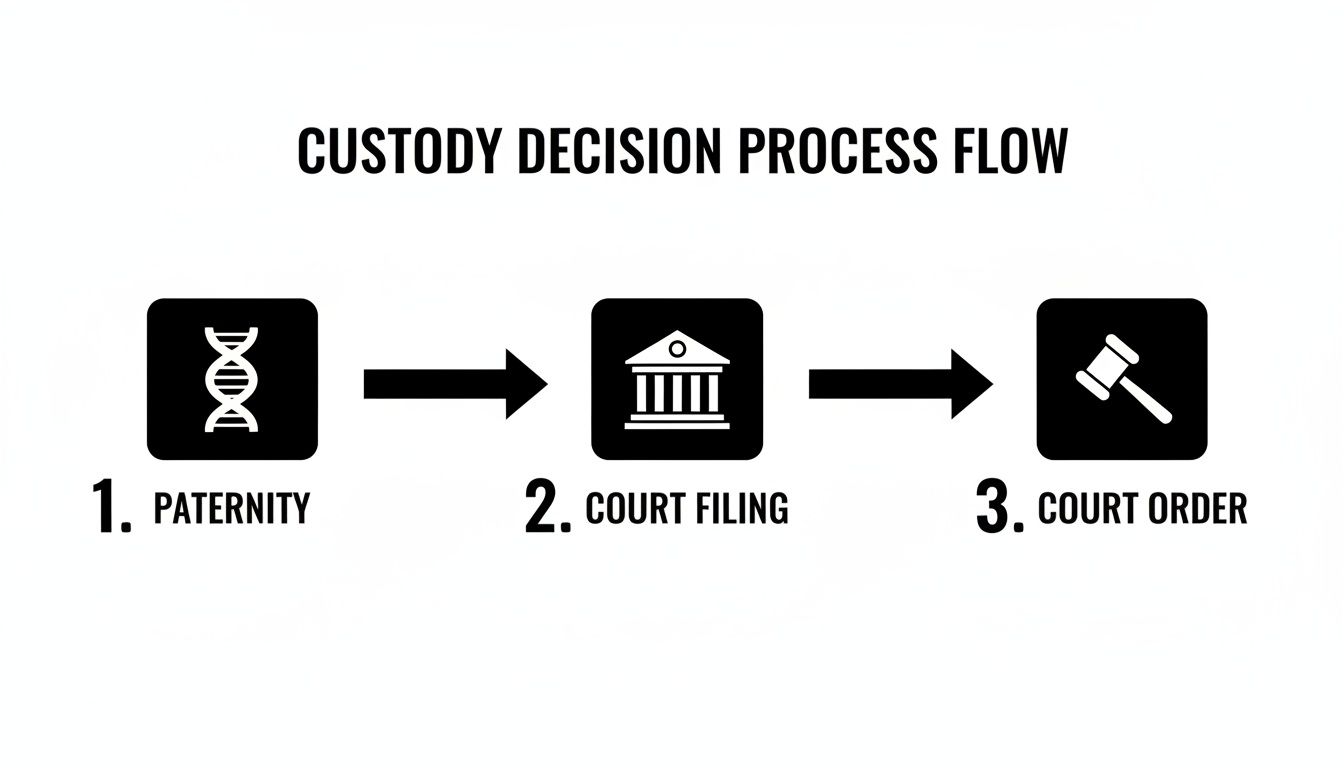
As you can see, everything starts with paternity. The court can't issue custody orders until the child's legal father is officially recognized.
Step 1: Filing the Initial Petition
The whole process kicks off when one parent files an Original Petition in a Suit Affecting the Parent-Child Relationship with the district court. This document is the legal starting gun.
It tells the court who the parents and child are, confirms that a Harris or Montgomery County court has the authority to hear the case (jurisdiction), and clearly states what you're asking the judge to do—establish paternity, create a custody schedule, and set child support.
Step 2: Serving the Other Parent
Once the petition is filed, you can't just text the other parent a copy. The law requires a formal notification called service of process. This means a neutral third party, like a sheriff’s deputy or a private process server, must personally deliver the lawsuit papers to them.
This step is a non-negotiable legal requirement. It's designed to protect the other parent's due process rights, ensuring they have a fair and official opportunity to respond to the lawsuit.
After being served with the lawsuit, the other parent (known as the Respondent) has a specific deadline to file a formal Answer with the court. If they miss this deadline, they risk a default judgment, where the judge can make a final ruling without ever hearing their side of the story.
Step 3: Temporary Orders and Mediation
Life doesn’t hit pause just because a court case has started. Kids still have school, doctor's appointments, and day-to-day needs. This is where temporary orders come into play.
A judge can hold a hearing early on to put a temporary rulebook in place for things like:
- A temporary visitation schedule so both parents see the child.
- Temporary child support to cover immediate expenses.
- Who has the right to make urgent decisions for the child.
These orders create stability while the case moves forward. Before you get to a contested hearing, however, most judges in our area will require you to attend mediation. This is a confidential meeting where a neutral mediator helps you and the other parent try to negotiate an agreement. A surprisingly high number of cases are resolved in mediation, saving families a ton of time, money, and emotional strain.
Step 4: Reaching a Final Order
The finish line is getting a Final Order signed by the judge.
If you and the other parent reached an agreement in mediation, your attorneys will draft a document called an Agreed Final Order. Once the judge signs it, that agreement becomes a legally binding court order.
If you just can't agree, your case will be set for a final hearing or trial. At trial, both sides present evidence and call witnesses, and the judge makes the final decision based on what is in the child's best interest. Knowing how to prepare for a custody hearing is absolutely critical to presenting your case effectively.
Once the judge’s signature is on that Final Order, it becomes the law governing your co-parenting relationship for years to come.
The SAPCR process has a clear and logical progression. Here’s a quick overview of how a typical case unfolds from start to finish.
Key Stages of a Texas SAPCR Case
| Stage | What Happens | Typical Goal |
|---|---|---|
| 1. Filing | One parent files a Petition with the court. | To officially start the legal process and define what is being requested. |
| 2. Service | The other parent is formally served with the lawsuit papers. | To provide legal notice and give the other parent a chance to respond. |
| 3. Answer | The served parent files a formal Answer with the court. | To participate in the case and prevent a default judgment. |
| 4. Temporary Orders | A hearing is held to set temporary rules for custody and support. | To create stability for the child while the case is pending. |
| 5. Discovery | Parents exchange information, documents, and evidence. | To gather all the facts needed to build a case or negotiate a settlement. |
| 6. Mediation | A neutral mediator helps parents try to reach an agreement. | To settle the case outside of court, saving time, money, and stress. |
| 7. Final Order | An agreement is signed by the judge, or a trial is held. | To obtain a final, legally enforceable court order on all issues. |
While this table provides a general roadmap, every family's situation is unique, and the path can have different twists and turns.
Navigating the SAPCR process might feel overwhelming, but you don’t have to do it alone. The Law Office of Bryan Fagan in Kingwood is here to guide you every step of the way. Schedule a free consultation with us to talk about your specific situation and start building a clear plan to protect your rights as a parent.
How Child Support and Medical Costs Work in Texas
When a judge finalizes a custody order, it’s about much more than just a calendar with visitation dates. It’s also a plan to ensure your child has the financial stability they need to grow and thrive. For unmarried parents in Kingwood and Porter, this is often where the most practical, day-to-day questions start popping up.
The good news? Texas doesn’t leave child support up to guesswork. The state uses a clear, predictable formula to keep things fair and consistent for families, whether you're in Harris County, Montgomery County, or anywhere else.
The Texas Child Support Formula
In Texas, child support is based on a percentage of the non-primary parent's net monthly resources. This parent is often called the "obligor" in court documents. To get to this number, the court totals up all sources of monthly income (wages, self-employment earnings, etc.) and then subtracts things like taxes and the cost of the child's health insurance.
Once that net resource number is set, a standard percentage is applied depending on how many children are involved.
- 1 Child: 20% of net resources
- 2 Children: 25% of net resources
- 3 Children: 30% of net resources
- 4 Children: 35% of net resources
- 5 or more Children: 40% of net resources
So, if a parent in Humble has net monthly resources of $4,000 and one child, their guideline child support payment would be $800 per month ($4,000 x 20%). It's a straightforward calculation.
It's a common myth that paying child support is like buying a ticket for visitation. That’s not how Texas law sees it. These are two completely separate duties. The non-primary parent must pay support even if they aren't seeing the child, and the primary parent must stick to the visitation schedule even if a support payment is late.
Covering Health Insurance and Medical Bills
Beyond the monthly check, the court order will also spell out who handles the child’s healthcare needs—a critical detail for any parent in the Northeast Houston area.
Typically, the judge will order one parent (usually the obligor) to provide the child's health insurance coverage. The amount that parent pays for the monthly premium is then credited back to them when their child support is calculated, which is a key detail to remember.
But what about the bills insurance doesn't cover, like co-pays for doctor visits, deductibles, or orthodontics? The final custody order will divide responsibility for these out-of-pocket medical expenses. In the vast majority of cases, parents are ordered to split these costs 50/50.
What if My Income Changes?
Life happens. People get promotions, change careers, or get laid off. If your financial situation changes significantly, you aren't stuck with the original child support amount forever.
Texas law allows you to ask the court to review and adjust the support order if there has been a "material and substantial change in circumstances." But you can't just stop paying if you lose your job—you have to file a formal modification case to get the amount legally changed. Our firm helps local parents navigate this all the time, and you can learn more about how to modify child support in Texas in our detailed guide.
Getting a handle on the financial side of a custody case provides clarity and a predictable path forward. If you have questions about how child support might look in your specific situation, the attorneys at The Law Office of Bryan Fagan are here to help. We invite you to schedule a free, no-pressure consultation at our Kingwood office to talk about what's best for your family.
What Happens When Life Changes? Changing or Enforcing Your Custody Order
Getting that final custody order feels like a huge relief. It provides a roadmap and a sense of stability for you and your child. But let's be honest—life rarely stays the same for long.
The plan that worked perfectly for your family in Kingwood last year might feel completely unworkable today. Maybe you landed a new job in Northeast Houston with a different schedule, your child's school activities have ramped up, or one of you needs to move. Life happens, and sometimes, the legal order needs to catch up.
You can't just agree to a new plan over text, though. In Texas, any changes to your official possession schedule or child support obligations have to be done through the court. This is called a modification.
When Can You Change a Custody Order?
To ask a judge to modify your order, you have to show that there's been a "material and substantial change in circumstances" since the original order was signed. It's a high bar, and for good reason—it keeps the courts from getting bogged down with every minor disagreement or scheduling squabble.
So, what actually counts as a "material and substantial change"? While every situation is unique, here are some common examples we see with families in the Humble and Porter areas:
- A major income shift, like an unexpected job loss or a significant promotion.
- One parent needs to relocate a considerable distance for a legitimate reason, like a new job.
- The child's preference, if they are 12 or older and can clearly tell the judge who they want to live with primarily.
- Concerns about safety, such as one parent's living situation becoming unstable or dangerous for the child.
What if the Other Parent Just Ignores the Order?
It's one thing when life changes, but it's another level of frustration when you have a perfectly good order that the other parent simply won't follow. Maybe they're consistently late dropping off your child, they’ve stopped paying child support, or they refuse to let you have your scheduled phone calls.
These aren't just minor annoyances. These violations disrupt your child's routine and trample on your legal rights.
When this happens, you don’t have to just put up with it. Your next step is to file an enforcement action with the court.
Think of an enforcement action as asking a judge to step in and be the referee. You're not trying to change the rules of the game; you're asking the judge to make sure the other player follows the rules that are already in place.
Filing an enforcement lawsuit is a serious move. If the judge finds that the other parent intentionally violated a clear and specific part of the order, there can be significant consequences. The court can order make-up possession time, demand payment of all back-due child support (plus interest), and even make the non-compliant parent pay your attorney's fees.
Whether you need to update your order to match your family's new reality or you need to hold the other parent accountable, the court system provides a path forward. Both modifications and enforcements require a smart legal strategy to protect your child's well-being and create a stable future.
Navigating these processes can feel overwhelming on your own. If your circumstances have changed or you're dealing with a co-parent who refuses to follow the rules, we're here to help. Contact The Law Office of Bryan Fagan in Kingwood for a free consultation to talk through your options.
Common Questions We Hear from Unmarried Parents in Kingwood
When you're navigating a child custody situation without being married, a flood of questions is completely normal. Here in our Kingwood office, we spend a lot of time clearing up confusion and giving local parents the straightforward answers they need to move forward.
"I'm on the birth certificate. Doesn't that give me custody?"
This is probably the single most common misunderstanding we encounter. It’s a logical assumption, but in Texas, it’s incorrect.
Putting your name on the birth certificate is a crucial first step—it's an official acknowledgment of paternity. However, it does not grant an unmarried father any legal custody or visitation rights. To get rights that a court can actually enforce, you have to go through the formal legal process and get a court order, usually through a SAPCR case.
"Can my child's mother just move away with our kid?"
If there isn't a court order in place, the answer is unfortunately yes. Without a formal custody agreement, the mother has the sole right to decide where the child lives.
But, and this is a big but, if you file a custody case, a Harris County judge might see that relocation in a very negative light, especially if it seems like she did it to interfere with your relationship with the child. The only real way to prevent this is to get a custody order that includes a geographic restriction, which limits how far the child can be moved without your agreement or a judge's permission.
"How long is this custody case going to take?"
There’s no one-size-fits-all answer here; the timeline really depends on how well you and the other parent can cooperate.
If you can work things out in mediation and come to an agreement, you could have everything finalized in just a few months. On the other hand, if you're in a high-conflict situation that goes to trial, you could be looking at a timeline of six months to well over a year.
Knowing your rights is the first and most important step in protecting your relationship with your child. At The Law Office of Bryan Fagan – Kingwood TX Lawyers, we focus on providing that local, experienced guidance that makes a real difference. We're here to help our neighbors in the Kingwood community get through these tough family law issues with clarity and confidence.
If you have more questions, let's talk. We offer a free, no-pressure consultation to help you understand your options.
Schedule Your Free Consultation at https://kingwoodattorneys.com