
Without a doubt, the first question on the minds of most Kingwood families facing a divorce is, "How long is this going to take?"
In Texas, there's a legally required waiting period, so the absolute fastest a divorce can be finalized is 61 days after the initial petition is filed. But let's be realistic—that's the best-case scenario for a simple, amicable split. For most families in Kingwood and the surrounding communities, the actual timeline hinges on your unique situation, stretching from a couple of months to well over a year if things get complicated.
Setting Realistic Expectations for Your Texas Divorce Timeline
When you're facing a divorce in Kingwood, Humble, or anywhere in Northeast Houston, the uncertainty can be the hardest part. At The Law Office of Bryan Fagan, our goal is to bring clarity to the process. Understanding the potential timeline is often the first step toward feeling like you have some control over the situation.
Think of the divorce process less like a fixed timeline and more like a road trip. Some routes are direct and get you to your destination quickly, while others have unexpected detours and traffic jams.
The route your divorce takes is determined almost entirely by a single factor: how much you and your spouse agree on. This is what separates a straightforward "uncontested" divorce from a longer, more involved "contested" one.
This infographic gives a great visual overview of the different paths a Texas divorce can take.
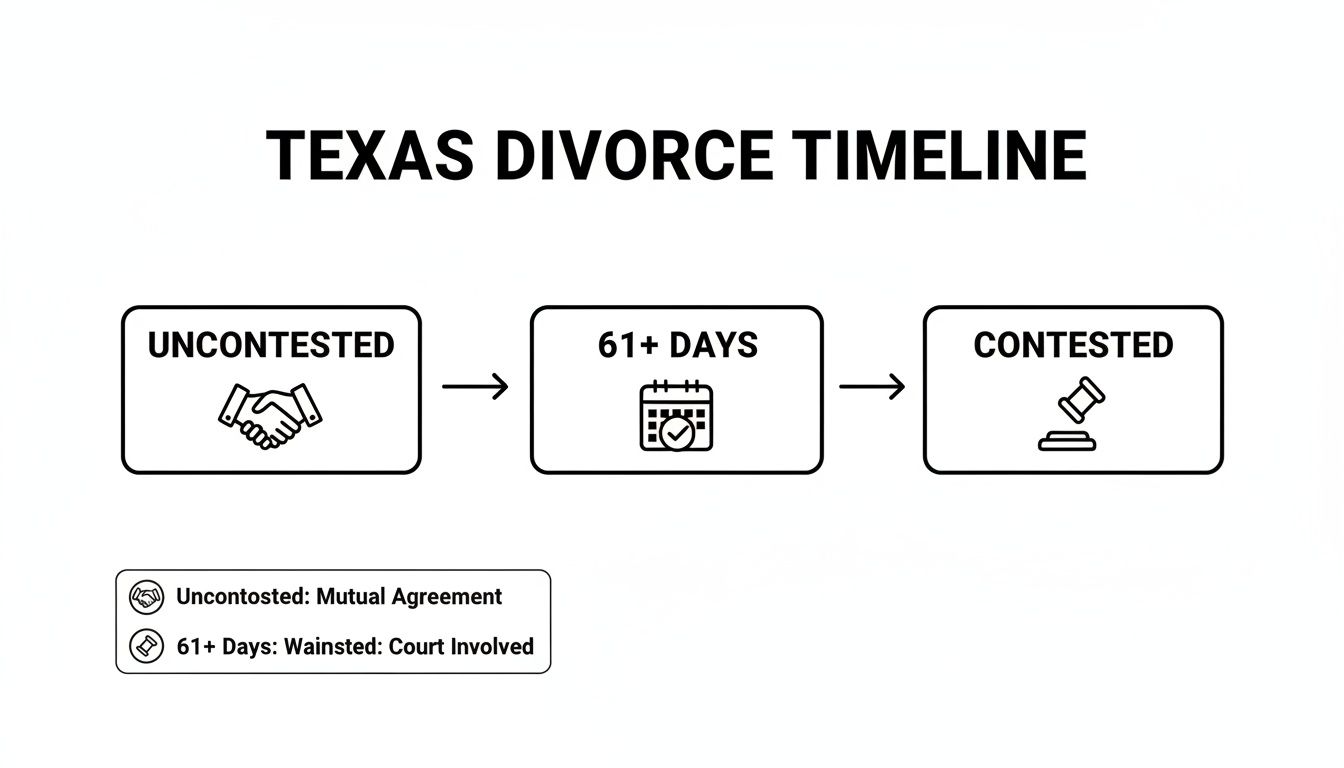
As you can see, every divorce starts with that mandatory 61+ day waiting period. After that, the road forks, and the timeline depends on whether you and your spouse can find common ground or need the court to step in and make decisions for you.
To give you a clearer picture, let's break down the typical timelines you can expect.
Estimated Texas Divorce Timelines At a Glance
This table provides a simplified overview of what to expect, from filing the petition to receiving the final decree, for both uncontested and contested divorces in Texas.
| Divorce Type | Typical Timeline | Key Characteristics |
|---|---|---|
| Uncontested Divorce | 3 to 6 Months | Both spouses agree on all major issues. Minimal court involvement. Less stressful and more cost-effective. |
| Contested Divorce | 6 to 18+ Months | Spouses cannot agree on one or more key issues. Requires formal legal procedures like discovery, hearings, and potentially a trial. |
It's important to remember these are just estimates. Every family's situation is different, and various factors can speed up or slow down the process.
Uncontested vs. Contested: The Two Main Roads
An uncontested divorce is the expressway of the divorce world. This is where you and your spouse are on the same page about all the big issues—how to divide property, who the kids will live with, and so on.
- These cases are often finalized shortly after the 60-day waiting period is over.
- Most wrap up within 3 to 6 months.
- It's a smoother, cheaper, and far less emotionally draining process for everyone involved, especially children.
For a deeper dive into getting started, you can check out our guide on how to file for divorce in Texas.
A contested divorce, on the other hand, is the scenic route with plenty of stop-and-go traffic. This happens when you and your spouse just can't see eye to eye. Because you're at an impasse, the court system has to get more involved through procedures like formal discovery, multiple hearings, mediation, and sometimes even a full-blown trial.
- These cases can take anywhere from 6 months to well over a year.
- The timeline often depends on how many issues are in dispute and the court's own schedule in Harris or Montgomery County.
Here at The Law Office of Bryan Fagan, we believe in setting clear, realistic expectations from our very first conversation. As your local Kingwood legal team, we're here to help you navigate this process with honesty and support. If you're feeling unsure about what your timeline might look like, we encourage you to schedule a free, no-obligation consultation at our Kingwood office.
Understanding the Mandatory 60-Day Waiting Period

No matter where you are in Texas, from Kingwood to El Paso, every single divorce has to follow one specific rule: a mandatory 60-day waiting period. This is written directly into the Texas Family Code, and it's a non-negotiable part of the process that often raises questions for families here in Northeast Houston.
It's completely natural to wonder why the law forces you to wait, especially when you feel ready to move on. The official thinking behind it is to provide a "cooling-off" period, giving couples one last chance to think about reconciliation before the divorce becomes final.
From a practical, step-by-step perspective, we find this time is best used for getting your affairs in order and starting negotiations without the pressure of an immediate court date. The clock for this 60-day period starts ticking the day after your Original Petition for Divorce is officially filed with the court clerk, whether that's in Harris County for our Kingwood clients or Montgomery County for others nearby.
What the Waiting Period Really Means for Your Timeline
One of the biggest misconceptions we clear up for our Kingwood clients is the idea that their divorce will be finalized on day 61. While that’s technically the earliest a judge is allowed to sign your Final Decree of Divorce, it rarely happens that way.
To finalize your divorce on the 61st day, you and your spouse would need a complete, signed agreement on every single issue—from who gets the house in Kingwood to the last detail of your parenting plan. All the paperwork would have to be perfectly drafted and ready for the judge. For most people, that’s a very tall order.
Think of the 60-day waiting period not as a finish line, but as the mandatory warm-up lap before the race truly begins. It sets the minimum timeframe, but the actual duration of the race depends on how many hurdles you and your spouse need to clear.
This legally required pause is designed to prevent people from making rash, emotionally-charged decisions about their children, finances, and future. It forces everyone to take a breath, which is often crucial for reaching a more thoughtful and lasting agreement.
How to Use the 60 Days Productively
Instead of seeing this time as a frustrating delay, our team encourages clients from Humble to Porter to view it as a strategic head start. You can use these two months to lay the groundwork for a much smoother, faster process once the waiting period is over.
Here is some practical, step-by-step guidance on how to make this time count:
- Gather Financial Documents: Start pulling together all important papers. This includes bank statements, tax returns, property deeds, car titles, and information on any retirement or investment accounts.
- Create a Household Budget: Get a realistic picture of your post-divorce life. What will your income be? What are your expenses? This helps you understand what you need to ask for in the settlement.
- Consult with Your Attorney: This is the perfect window to meet with our Kingwood legal team. We can discuss your goals, explain Texas law and how it applies to you, and start mapping out a clear strategy for your case.
- Begin Informal Negotiations: If you and your spouse are on speaking terms, you can begin discussing the basic terms of your divorce with the guidance of your attorneys.
Exceptions to this rule are extremely rare. The only time a judge might waive the waiting period is in a documented case of family violence that has resulted in a conviction or deferred adjudication. For the vast majority of divorces in the Kingwood area, the 60 days are set in stone.
At The Law Office of Bryan Fagan, we help you make the most of this required time. By working proactively from day one, we can ensure you’re in the strongest possible position to finalize your divorce efficiently once the waiting period ends. Contact our Kingwood office for a free consultation to learn how we can help you prepare.
Uncontested vs. Contested Divorce: The Two Roads Through a Texas Divorce
When Kingwood residents ask how long their divorce will take, our first question is always the same: "How much do you and your spouse agree on?" The answer is the single biggest factor determining your timeline. For families here in Kingwood and the surrounding areas, a divorce will follow one of two very different paths—an amicable, uncontested route or a more complex, contested one.
Knowing which path you’re on is key to setting realistic expectations from the start. One is typically faster and far less expensive, while the other involves more legal steps, court involvement, and time.
The Path of Agreement: An Uncontested Divorce
An uncontested divorce is exactly what it sounds like—you and your spouse have worked out all the major issues and are on the same page. This is the best-case scenario for couples in Kingwood or Humble who have already had the tough conversations and reached a mutual understanding.
To go this route, you need 100% agreement on every single issue. There’s no room for "we'll figure it out later." That means you’ve settled everything, including:
- Property and Debt Division: A clear plan for splitting assets like your home, cars, and retirement accounts, as well as liabilities like mortgages and credit card debt, all according to Texas community property law.
- Child Custody and Visitation: A detailed parenting plan that spells out who the children live with and the visitation schedule for the other parent.
- Child Support: An agreed-upon amount for child support, typically following Texas guidelines.
- Spousal Support (Alimony): A decision on whether one spouse will provide financial support to the other and for how long.
When you can present a united front to the court, the legal process becomes much more of a formality. The timeline usually lines up with Texas's mandatory 60-day waiting period, and for most families on this path, the entire divorce is finalized in about three to six months.
The Path of Disagreement: A Contested Divorce
A divorce becomes "contested" the moment you and your spouse can't agree on one or more of those key issues. It doesn’t have to be a major fight. Something as simple as a disagreement over who keeps the family home in Porter or the specifics of a holiday visitation schedule is enough to move your case into the contested category.
This path takes longer because it forces you to use the court system to resolve your disputes. Instead of a judge just signing off on your joint agreement, they may have to step in and make the final decisions for you.
A contested divorce isn't always the high-drama courtroom battle you see on TV. It simply means there's a disagreement that requires a formal legal process—like mediation or court hearings—to get resolved. The goal is still to find a final agreement, but the journey to get there has more mandatory stops.
A contested case involves several formal legal steps that aren't necessary when you agree on everything. We're talking about discovery (exchanging financial information), hearings for temporary orders, and mandatory mediation. Each stage adds time and expense, which is why these cases often take anywhere from six months to over a year to complete.
Key Differences: Uncontested vs. Contested Divorce
To make it perfectly clear, let’s break down what you can expect from each type of divorce here in the Northeast Houston area.
The table below provides a side-by-side look at the timelines, costs, and procedures involved.
| Factor | Uncontested Divorce | Contested Divorce |
|---|---|---|
| Agreement Level | Full agreement on all issues before or shortly after filing. | Disagreement on one or more key issues. |
| Typical Timeline | 3 to 6 months | 6 to 18+ months |
| Court Involvement | Minimal; often just one final hearing to approve the agreement. | Significant; includes multiple hearings, a potential trial, and judicial decisions. |
| Legal Process | Straightforward paperwork leading to a final decree. | Involves discovery, mediation, temporary orders, and various hearings. |
| Overall Cost | Lower, thanks to fewer legal procedures and attorney hours. | Higher, due to the need for extensive legal work and court appearances. |
Ultimately, whether your divorce is contested isn't entirely up to you—it takes two people to agree. Understanding where your case stands is the first step toward building the right strategy.
At The Law Office of Bryan Fagan, we can help you assess your situation and figure out the most effective path forward. Whether you're aiming for a collaborative uncontested divorce or need a strong advocate in a contested fight, our Kingwood attorneys are here to guide you. Schedule a free consultation to talk about your specific options.
What Really Dictates Your Divorce Timeline?

While the "contested vs. uncontested" label gives us a ballpark idea, a few key factors truly control the speed of a divorce. Think of them as the traffic lights on the road to your final decree. For families here in Kingwood and Humble, getting a handle on these real-world variables helps you see potential roadblocks before you hit them.
Every family's life is different. The more intertwined your lives have become, the more time and care it will take to separate everything in a way that’s fair and legally sound. This is exactly where patience and good legal strategy make all the difference.
The Complexity of Your Marital Estate
One of the biggest time sinks in any divorce is dividing up what you own and what you owe. A couple who rents an apartment and has separate bank accounts can wrap this up pretty quickly. It's a whole different story for a couple with a house, a family business, and a few retirement accounts to sort through.
Here are the common property issues that can really slow things down:
- Real Estate: Figuring out what to do with the family home is a major hurdle. Deciding whether to sell it, have one person buy the other out, or keep co-owning it involves appraisals, negotiations, and a lot of paperwork. For a deeper dive, there are great resources on selling the marital home during divorce.
- Business Ownership: If you or your spouse owns a business in Northeast Houston, it has to be professionally valued. This process alone can be lengthy and is often a major point of disagreement.
- Retirement Accounts: Splitting 401(k)s, pensions, or IRAs isn't straightforward. It requires a special court order—a QDRO (Qualified Domestic Relations Order)—which adds extra legal and administrative steps to the timeline.
Simply put, the more assets and debts you need to identify, value, and divide, the longer your divorce will take. Our Kingwood lawyers can help you navigate these complex financial matters efficiently.
When Minor Children Are Involved
Having kids adds a critical and non-negotiable layer of complexity to any divorce. Texas law puts the best interests of children first, and that means you can't just speed through decisions that will shape their future.
You and your spouse will need to hammer out a detailed parenting plan. This document is the roadmap for your co-parenting life, covering everything from custody schedules and holidays to who makes decisions about school and healthcare. On top of that, you’ll have to calculate child support based on state guidelines, which requires a full financial picture from both sides. When parents can't agree on these sensitive issues, the divorce almost always becomes contested and takes much, much longer.
The Level of Cooperation Between Spouses
At the end of the day, the single biggest factor influencing your divorce timeline is something you have direct control over: how well you and your soon-to-be-ex-spouse can work together. This is the engine that drives the entire process forward—or grinds it to a halt.
Think of a divorce as a business negotiation. If both people come to the table focused on finding fair, practical solutions, you can move through it efficiently. But if one or both of you dig in your heels, refuse to communicate, or act out of anger, the whole thing gets stuck in the mud.
An uncooperative spouse can drag things out by refusing to sign papers, hiding financial documents, or fighting over every last detail. This forces your attorney to file motions and get the judge involved, which adds months and significant expense to your case.
Working with an experienced Kingwood family law attorney can help manage a difficult spouse and keep the process on track. At The Law Office of Bryan Fagan, we are skilled negotiators who know how to de-escalate conflict and steer the focus back to reaching an efficient resolution. If you're worried about how these factors might play out in your divorce, schedule a free consultation with us to talk through your options.
A Step-by-Step Walkthrough of the Texas Divorce Process
When you're facing a divorce, the legal system can feel like a foreign country with its own language and rules. It's overwhelming. Here at The Law Office of Bryan Fagan, we see our job as being your personal guide, giving you a clear map of the road ahead. Let's break down the typical stages of a Texas divorce so you know exactly what to expect.
Knowing what’s coming next can make a world of difference. Each step has a purpose, designed to move your case forward in an orderly way, whether you’re in Kingwood, Porter, Humble, or anywhere else in the Houston area.
Stage 1: The First Step – Filing the Petition
A Texas divorce officially kicks off when one spouse, the Petitioner, files a document called an Original Petition for Divorce. This is filed with the district court—for most of our local clients, that’s in either Harris or Montgomery County. This petition is a formal request to the court to dissolve the marriage.
After the petition is filed, the other spouse, now called the Respondent, has to be formally notified. This critical step, known as service, ensures that both people are aware of the legal proceedings and have a chance to participate. Without it, the case simply can’t move forward.
Stage 2: Laying the Cards on the Table – Discovery
Once the initial paperwork is handled, we enter a phase called discovery. This is the formal process where you and your spouse exchange information and documents that are relevant to your case. Think of it as putting all the financial cards on the table—assets, debts, income, everything.
The goal here is transparency. Discovery gives both sides a complete picture of the marital estate and any facts related to child custody. This is absolutely essential for making smart, informed decisions later on. To get a better handle on this crucial stage, you can learn more about what discovery in a divorce entails and see how it works in practice.
The most common tools we use in this phase are:
- Requests for Production: A formal request for documents like bank statements, pay stubs, retirement account info, and property deeds.
- Interrogatories: A list of written questions that the other person must answer in writing, under oath.
- Depositions: An in-person (or virtual) meeting where one party answers questions from the other side's attorney in front of a court reporter.
This stage can take a few months, and the timeline often depends on how complex your finances are and, frankly, how cooperative everyone is.
Stage 3: The Search for Common Ground – Mediation
Here in Harris and Montgomery counties, nearly every judge will require a couple to try mediation before they'll even consider scheduling a final trial. Mediation is a structured, confidential negotiation session where you, your spouse, and your lawyers sit down with a neutral professional—the mediator.
The mediator's job isn't to take sides or make decisions. Their role is to help you and your spouse communicate productively and guide you toward a compromise you can both live with. It’s an incredibly powerful tool for resolving disputes without the cost, stress, and uncertainty of a courtroom battle.
For many Kingwood families, mediation is where the real progress happens. It’s a chance to work through the tough issues in a controlled setting and craft an agreement you both had a say in, rather than having a stranger in a black robe make those decisions for you.
When mediation is successful, it can settle your entire case and drastically shorten the divorce timeline.
Stage 4: Crossing the Finish Line – The Final Decree
If you reach a complete agreement, your attorney will draft the Final Decree of Divorce. This is the official, legally binding document that lays out every detail of your settlement, from who gets the house to your parenting plan. Once you both sign it, we present it to the judge for their signature.
If there are still issues you just can't agree on, those will be decided by a judge at a final trial. The judge will hear testimony and review evidence from both sides before making a ruling. Your attorney then drafts the Final Decree based on the judge's orders.
The moment the judge signs that decree, your divorce is legally final.
Understanding these stages helps take some of the mystery out of the process. Our Kingwood legal team is here to walk you through every single step, making sure you feel informed and supported from start to finish.
How Our Kingwood Lawyers Help Move Your Divorce Forward

You shouldn’t have to navigate this process by yourself. This is where having an experienced local team from The Law Office of Bryan Fagan truly matters for families here in Kingwood, Humble, and across Northeast Houston. Our entire focus is on finding efficient paths forward while making sure your interests are always protected.
Knowing how long a divorce might take is essential for planning the next chapter of your life. We bring clarity to the process by concentrating on proactive solutions. For many of our clients, that means using skilled negotiation and mediation to settle disagreements without a costly and emotionally draining court battle.
Our Local, Proactive Approach
We pay close attention to every detail, ensuring all paperwork is filed correctly and on schedule. It’s a simple thing, but it helps avoid the kinds of administrative hiccups that can easily add weeks to your case. As attorneys who live and work right here in the community, we have a deep, practical understanding of the local Harris and Montgomery County courts. That firsthand knowledge lets us guide you with real confidence.
Choosing the right legal partner is probably the single most important decision you'll make. For more on this, take a look at our guide on how to choose a divorce attorney that's right for you.
At The Law Office of Bryan Fagan, our philosophy is straightforward. We work to shorten your divorce timeline not by cutting corners, but by working smarter, communicating clearly, and resolving conflicts efficiently to protect your peace of mind.
We are committed to helping you find the clearest, most direct path to your new beginning. It all starts with a simple conversation.
We invite you to schedule a free, no-obligation consultation at our Kingwood office. Let’s talk about your specific situation and show you how our client-focused approach can make all the difference.
Common Questions About Divorce Timelines Answered
Even after laying out the basic timeline, we know you probably have more questions buzzing around in your head. It’s completely normal. Here in our Kingwood office, we spend a lot of time talking with our neighbors about the specific details of their situations, and the same questions tend to pop up.
Our goal here is to answer some of those common questions directly and practically, so you can feel a bit more grounded as you think about what’s next.
Can I Get Divorced in Less Than 60 Days in Texas?
That's a hard no. Texas law is very firm on this point: there's a mandatory 60-day waiting period.
This clock starts the day the divorce is filed, and a judge cannot sign your final decree until at least day 61. There are almost no ways around this. The only exception is in rare, extreme cases involving a recent conviction for family violence. For virtually every divorce happening in Kingwood, Humble, and across Northeast Houston, that 61-day minimum is the rule.
Does It Matter Who Files for Divorce First?
As far as the timeline is concerned, it really doesn't make a difference. The same Texas laws, waiting periods, and steps apply whether you're the one filing or the one responding. The path is the same for both spouses.
That said, there can be a slight strategic edge. The person who files the initial petition (the "Petitioner") gets to present their side of the story first if the case ever goes to trial. It’s a small advantage, but in certain situations, it can matter. If you’re wondering if this applies to you, that's something we can talk through during a free consultation at our Kingwood office.
Will Mediation Make My Divorce Take Longer?
This is a great question, and people often worry about this. But the truth is actually the opposite. Mediation almost always makes your divorce faster, not slower.
Think of it this way: mediation is a single, focused day designed to help you and your spouse find common ground and settle your case. The alternative is getting on the court's calendar for a trial, which can take months—sometimes even longer—to schedule. A successful mediation lets you skip that line entirely. By reaching an agreement yourselves, you avoid the delays, costs, and stress of letting a judge make all the final decisions.
Beyond just the legal schedule, many people are also thinking about the deeper issues, like the impact of divorce on a child's mental health. Handling these personal concerns is just as crucial as managing the legal steps.
How Does an Out-of-State Spouse Affect the Timeline?
If your spouse lives in another state, it can add a little time to the very beginning of the process. It's not a huge delay, but it's a real one.
The reason is simple: we have to follow specific legal procedures to officially notify them of the divorce, which we call "service of process." The rules for serving someone out-of-state are just more complex than serving someone down the street in Kingwood. This might tack on a few extra weeks at the start. Once they've been properly served, however, the rest of the divorce proceeds just like any other Texas case. Our firm handles these situations all the time, so we know how to manage it efficiently.
Trying to figure out the divorce timeline on your own can feel overwhelming, but you don't have to navigate it alone. The experienced and compassionate team at The Law Office of Bryan Fagan – Kingwood TX Lawyers is here to give you the clear guidance you need. We're your local law firm, and we're dedicated to helping Kingwood families find the most efficient and sensible path forward.
If you have questions about your own situation, we invite you to schedule a free, no-obligation consultation at our Kingwood office. Let us provide the practical, step-by-step guidance you need to feel confident about your next chapter. Visit us at https://kingwoodattorneys.com to get started today.