Skip to content
When you're not married, figuring out child custody in Texas can feel like stepping into a legal maze. For families here in Kingwood, it’s confusing, it’s stressful, and the stakes couldn't be higher. We understand what you're going through, and we're here to provide some clarity.
The simple truth is, under Texas law, the starting line isn't the same for both parents. An unmarried mother automatically has full legal and physical custody of her child from the moment they're born. On the other hand, an unmarried father has no legal rights at all until he takes specific legal action to establish them. This fundamental difference is the starting point for everything that follows.
Your First Steps With Unmarried Parent Custody in Kingwood
For parents in Kingwood and the nearby communities of Humble and Porter, navigating child custody laws in Texas for unmarried parents starts with understanding this initial legal reality. The law creates a stark, unequal footing right out of the gate: the mother is presumed to be the sole legal parent, and the father has to proactively prove he is the dad to gain any rights.
This initial imbalance can be a tough pill to swallow, but it’s crucial to know that Texas law provides a clear path forward. There are established legal procedures for fathers to secure their role and for both parents to create a stable, court-ordered plan that works. You aren't walking this path alone; our team at The Law Office of Bryan Fagan is a local resource for Northeast Houston families just like yours.
The Legal Framework for Unmarried Parents
So, what does this legal difference mean for you in the real world?
- For Mothers: From day one, you have the sole authority to make decisions about your child’s schooling, healthcare, and well-being. You also decide where the child lives.
- For Fathers: Without a court order, you have no legal say in major decisions for your child and no guaranteed right to see them. Any time you spend with your child is based entirely on an informal agreement with the mother, which she can change or revoke at any time.
To create a solid, enforceable agreement that protects everyone, you have to file a Suit Affecting the Parent-Child Relationship (SAPCR). This is the official court case in Texas for establishing custody (called conservatorship), visitation schedules (called a possession order), and child support. When dealing with these crucial legal matters, especially if there are language barriers, it's vital to follow expert tips for translating legal documents to ensure everything is accurate and accepted by the court.
The SAPCR process is what transforms a fragile, informal handshake deal into a legally binding court order. This order provides the stability and predictability your child needs and deserves by giving both parents clearly defined rights and responsibilities.
Taking that first step to file a SAPCR can feel like a huge leap, but it’s the most important thing you can do to secure your relationship with your child. Here at The Law Office of Bryan Fagan, we're right here in Kingwood to guide you through this process with compassion and local expertise. We can help you understand your options and take decisive action. If you're an unmarried parent in Northeast Houston with custody questions, schedule a free consultation at our Kingwood office today.
Establishing Paternity Is The Foundational Step
For unmarried parents in Texas, the entire conversation about custody, visitation, and parental rights hinges on one critical legal action: establishing paternity. This is especially true for fathers. Think of it as the foundation of a house—without it, you simply can't build anything stable or lasting for your child. Until a father is legally recognized, he has no enforceable rights to see his child or have a say in their upbringing.
This legal reality puts unmarried mothers and fathers in very different starting positions. Under Texas law, when a child is born, the mother automatically has full legal and physical custody. Her marital status doesn't matter. The father's situation, however, is a world apart. His paternity must be legally established before he can be awarded any rights at all.
For many fathers in Kingwood and Humble, this comes as a shock and can be an incredibly stressful hurdle. The good news is that Texas provides two clear, step-by-step paths to make your fatherhood legally official.
Two Paths to Legal Fatherhood in Texas
Establishing paternity is what solidifies your legal connection to your child. It gives you the standing to walk into a courtroom and ask for specific rights and responsibilities. The path you take usually depends on whether you and the child's mother are on the same page.
- Voluntary Acknowledgment of Paternity (AOP): This is the most straightforward and common route. The AOP is a legal form that both unmarried parents can sign to voluntarily name the biological father. It's often done right at the hospital after the child is born. Once it's filed with the Texas Vital Statistics Unit, it carries the full weight of a court order, legally establishing the man as the child's father.
- Court Order: If there's any disagreement about who the father is, or if one parent simply refuses to sign an AOP, a lawsuit can be filed to establish paternity. In this scenario, a court can order genetic (DNA) testing to confirm the biological link. After the results are in, the judge will issue an order that formally and legally establishes paternity.
This flowchart gives a clear visual of how Texas law initially treats the rights of unmarried mothers versus fathers.
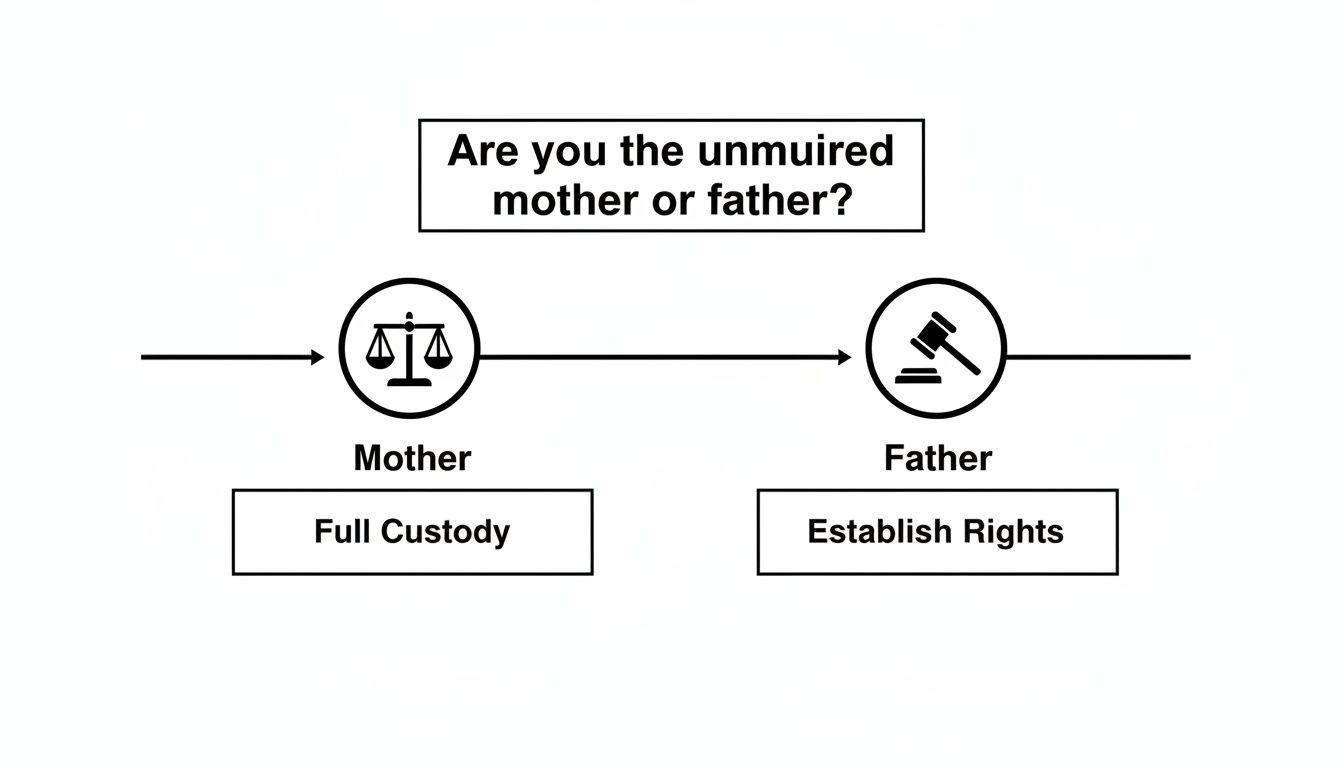
As you can see, the legal paths for unmarried parents diverge right from the start. It’s up to the father to take proactive legal steps to secure his rights.
Why Paternity Is About More Than Just Custody
While securing your parental rights is a huge motivator, establishing paternity provides profound, lifelong benefits for your child that go way beyond a simple visitation schedule.
By legally establishing paternity, you are giving your child access to a legal, emotional, and financial heritage. It is one of the most important gifts an unmarried father can provide.
Legally recognizing a father ensures the child has the right to:
- Inherit from their father's estate.
- Receive Social Security or veteran's benefits through their father.
- Be covered by the father's health insurance.
- Access the father’s family medical history, which can be critical for their own health down the road.
For fathers in Porter and across Northeast Houston, this is the only way to get on equal legal footing and cement your role in your child’s life. If you're looking to learn more, you can explore additional resources on father's rights in Texas to better understand your options. Here at The Law Office of Bryan Fagan in Kingwood, we can help you navigate this essential first step with clarity and confidence. Give us a call to schedule a free, confidential consultation.
Understanding Conservatorship And Possession Orders In Texas
Once you’ve legally established paternity, the court process shifts to its next major task: setting up the ground rules for co-parenting. This is where a Texas court will issue orders that clearly define each parent’s rights and responsibilities. If you're going through this in Kingwood or anywhere in Northeast Houston, you'll hear a lot of legal terms. Let's simplify the two concepts that matter most: conservatorship and possession orders.

Here's a simple way to think about it: Conservatorship is about your right to make major decisions for your child. The possession order is the calendar that details when your child will be with each parent.
What Is Conservatorship In A Texas Custody Case?
In Texas, we call "custody" conservatorship. This legal term covers your authority to make the major decisions in your child's life. Texas law has a strong preference for naming both parents as Joint Managing Conservators (JMCs). This is the starting point for most cases because the state believes it's best for a child to have both parents actively involved.
In a JMC setup, you and the other parent share the rights and duties of raising your child. But it's not always a 50/50 split on every single issue. Usually, one parent is named the "primary" conservator. This parent has the exclusive right to decide where the child lives (often within a specific geographic area, like Harris or Montgomery County) and is the one who receives child support.
The alternative, which is far less common, is for one parent to be named the Sole Managing Conservator (SMC) while the other is a Possessory Conservator (PC). A court in Kingwood typically only goes this route when there are serious issues at play, like a history of family violence, substance abuse, or such extreme conflict that working together is simply not possible.
"In a Joint Managing Conservatorship, both parents have a seat at the table for the big decisions. One may hold the tie-breaking vote on where the child lives, but both voices are legally recognized and valued."
Some of the key decisions covered by conservatorship include:
- Medical and Dental Care: Who gets to make choices about doctors, treatments, and other health matters.
- Education: Who has the final say on school enrollment and other educational decisions.
- Psychological and Psychiatric Care: Who can consent to counseling or mental health treatment for your child.
- Legal Rights: Who has the authority to represent the child in legal matters.
For many parents in our area, getting familiar with the details of a shared custody arrangement in Texas can bring a huge amount of clarity and relief during a stressful time.
Joint Vs Sole Managing Conservatorship Rights In Texas
To understand the practical differences, it helps to see the rights laid out side-by-side. The default Joint Managing Conservatorship (JMC) promotes shared parenting, while a Sole Managing Conservatorship (SMC) centralizes decision-making with one parent for specific, serious reasons.
| Parental Right or Duty | Joint Managing Conservatorship (JMC) | Sole Managing Conservator (SMC) |
|---|---|---|
| Designate Child's Residence | One parent is given the exclusive right. | The SMC has the exclusive right. |
| Make Educational Decisions | Can be shared, independent, or exclusive to one parent. | The SMC has the exclusive right. |
| Consent to Medical Treatment | Usually shared by both parents. | The SMC has the exclusive right. |
| Receive Child Support | The "primary" JMC receives payments. | The SMC receives payments. |
| Manage Child's Services/Earnings | Shared by both parents. | The SMC has the exclusive right. |
| Access Child's Records | Both parents have full access. | Both parents typically have access. |
This table highlights the fundamental shift from a collaborative model (JMC) to a hierarchical one (SMC). The court's goal is always to create an arrangement that best supports the child's stability and well-being.
Defining The Possession Order Or Visitation Schedule
While conservatorship is about decision-making, the possession order is the hands-on calendar. It's the "visitation schedule" that details exactly when the child will be with each parent.
Texas has a default schedule called the Standard Possession Order (SPO), which is legally presumed to be in a child's best interest. It’s designed to provide a consistent, predictable routine that kids can count on. The specifics of the SPO change based on how far apart the parents live.
- Parents Living 50 Miles Apart or Less: The non-primary parent usually gets the kids on the first, third, and fifth weekends of a month. They also split major holidays and get 30 days in the summer.
- Parents Living Over 100 Miles Apart: The schedule adjusts to make travel more manageable. For instance, the non-primary parent might get the child for every spring break, a longer summer visit of 42 days, and the choice to pick one month to have all their weekend visits.
But remember, the SPO is just a template. You and the other parent can absolutely create a custom possession schedule that works for your family. If you live in Humble or Porter and have non-traditional work schedules or kids with packed extracurricular calendars, a custom plan might be necessary. As long as you both agree and the judge signs off that it's in your child's best interest, you can make it official.
Getting a handle on these terms is the first real step toward building a stable foundation for your child's future. Here at The Law Office of Bryan Fagan, our Kingwood attorneys specialize in helping parents create agreements that protect their rights while focusing on their family's unique needs. Give us a call to schedule a free consultation to talk about your situation.
How Courts Decide What's in the Best Interest of the Child
When unmarried parents in Texas can't find common ground on a custody plan, the final call rests with a family court judge. Every single decision that judge makes—from who gets to decide where the child goes to school to the specifics of the holiday schedule—is filtered through one guiding principle: the best interest of the child.
This isn't some vague concept. It's the legal standard, and every piece of evidence and testimony is weighed against it. For parents in Kingwood and Northeast Houston, grasping what this means in a real-world courtroom setting is absolutely vital. This isn't about proving you're the "better" parent. It's about showing the court that your plan provides your child a safe, stable, and nurturing environment where they can flourish.
The Holley Factors: A Judge's Checklist
So, how does a judge figure out what's in a child's best interest? They don't just go with a gut feeling. Texas courts use a specific set of guidelines known as the "Holley Factors." These came from a landmark Texas Supreme Court case and essentially serve as a roadmap for judges, ensuring they look at the whole picture of a child’s life and each parent’s situation.
A judge in Harris or Montgomery County won’t just focus on one or two issues. They're going to evaluate the entire family dynamic. Knowing what they're looking for can help you focus your energy on what actually matters in court.
Here are the key Holley Factors a judge will consider:
- The Child's Needs: This is about more than just food and shelter. It covers their emotional, physical, and developmental needs, both now and in the future.
- Parental Abilities: The court looks at what each parent brings to the table. This isn’t just about money; it’s about who can provide consistent emotional support, guidance, and handle the day-to-day work of parenting.
- Stability of the Home: A stable, predictable, and safe home environment is a huge factor. The court highly values consistency in a child’s life.
- Any Danger to the Child: Judges are on high alert for any potential emotional or physical danger. This could be anything from exposing the child to conflict to issues with substance abuse or neglect.
- The Child's Wishes: If a child is 12 or older, a judge can meet with them privately to hear their preference on who they want to live with. It's important to know, however, that the child's wish is just one piece of the puzzle and the judge isn't required to follow it.
A judge’s final decision isn't a simple math problem. It’s a deeply human judgment call based on all the evidence, designed to create a situation that will best serve the child’s well-being for the long haul.
Your Actions Speak Louder Than Words
Knowing the "best interest" standard is one thing, but proving it is another. For parents in Humble and Porter, your behavior before and during your custody case will send a powerful message to the court.
It's often the simple, consistent actions that have the biggest impact. For instance, a parent who has always been the one to schedule doctor's appointments and show up for parent-teacher conferences is building a strong case for their involvement. On the flip side, a parent who constantly criticizes the other parent in front of the kids can be seen as creating emotional turmoil—a major red flag for any judge.
At the end of the day, navigating child custody laws in Texas for unmarried parents means you have to rise above your personal feelings and laser-focus on your child's needs. It's all about demonstrating to the court that you are the parent who provides consistency, safety, and unwavering support.
The Law Office of Bryan Fagan in Kingwood is here to help you build the strongest possible case, centered on the factors that truly matter to the court. We know the local court systems and can give you the straightforward, practical guidance you need. Give us a call today for a free, confidential consultation to talk about how we can help protect your child's best interest.
Navigating Child Support For Unmarried Parents
Once the court sorts out conservatorship and visitation schedules, the next big piece of the puzzle is financial responsibility—specifically, child support. It's crucial to understand that child support isn't a penalty or a fee you pay to see your kids. Think of it as a legal framework ensuring both parents contribute to the child's financial well-being, providing consistency even when you're no longer together.
For unmarried parents in Kingwood, getting a handle on how Texas calculates and manages child support can bring a sense of control and clarity during what is often a very uncertain time.

How Texas Calculates Child Support
Texas keeps things relatively straightforward by using a percentage-based formula. The entire calculation hinges on the net monthly resources of the non-primary parent—that's the parent who doesn't have the exclusive right to decide where the child lives.
Here's our step-by-step guide to how it works:
- The court adds up all sources of a parent's monthly income.
- From that total, they subtract specific allowed deductions, such as federal income tax, Social Security taxes, and what that parent pays for the child's health insurance. The number you're left with is the net monthly resource figure.
- A set percentage is applied based on how many children are involved in the case:
- One Child:20% of net monthly resources
- Two Children:25% of net monthly resources
- Three Children:30% of net monthly resources
- Four Children:35% of net monthly resources
- Five or More Children:40% of net monthly resources
Let's make it real. Say a parent in Humble has one child and their net monthly resources come out to $4,000. Based on the guidelines, their child support payment would be $800 per month (20% of $4,000).
Additional Financial Responsibilities
That monthly check is just one part of the financial picture. A proper Texas court order will also spell out who is responsible for other critical expenses, making sure all of your child’s needs are met.
"A comprehensive child support order provides a complete financial roadmap for co-parenting. It goes beyond the monthly payment to cover health and medical needs, ensuring there are no surprises when a child gets sick or needs braces."
Typically, the order will require one parent to provide health and dental insurance for the child. What about everything else? Any uninsured medical costs—like co-pays for doctor visits, prescription fees, or orthodontics—are usually split 50/50 between the parents. This practical approach helps ensure that a sudden illness or trip to the dentist in Kingwood doesn't turn into another source of conflict.
When Financial Situations Change
Life happens. People get laid off, earn a big promotion, or a child develops new needs that weren't there before. For parents across Northeast Houston facing these shifts, it's vital to know you can't just decide to stop paying or informally agree to a new amount.
To legally change the child support payment, you have to file a formal modification lawsuit with the court. A judge will look for a "material and substantial change" in either parent's circumstances to justify adjusting the order. We offer a deeper dive on how to modify child support in Texas that walks you through the steps. Ignoring a court order, even if you have a good reason, can trigger serious legal trouble.
Money talk can add a whole new layer of stress to any custody case. At The Law Office of Bryan Fagan, our Kingwood attorneys are here to give you clear, practical advice on all parts of child custody laws in Texas for unmarried parents, including child support. Schedule a free consultation with us today, and let's talk about securing your family's financial future.
How Modern Family Law Serves Kingwood's Unmarried Parents
The classic picture of a family has changed a lot over the past few decades. Thankfully, Texas law has kept up. If you're an unmarried parent in Kingwood, Humble, or anywhere in Northeast Houston, you should know your situation is far from unique, and the legal system has pathways built specifically for you.
This isn't just a feeling; the numbers back it up. In a recent year, around 40% of all children born in Texas were to unmarried parents. That's a huge shift from generations past. This reality has directly influenced how local courts in Harris and Montgomery Counties handle custody and parenting plans, creating a much more predictable process for parents who aren't married. You can find more details about these trends in single-parent families on bencarrascolaw.com.
A Legal Path Designed for Today's Families
This evolution in family law is genuinely good news for you. It means there's a well-defined legal framework—the Suit Affecting the Parent-Child Relationship (SAPCR)—designed to establish clear and enforceable orders. These orders are what protect your rights as a parent and, most importantly, provide stability for your child. It's a way to move beyond informal handshake agreements that often crumble under pressure.
The legal process for unmarried parents isn't a sign of failure. It's a tool for building a secure and predictable future for your child. It provides the clarity and legal backing that every co-parenting relationship needs to succeed long-term.
Working with a Kingwood law firm that gets these modern dynamics is crucial. To keep things moving efficiently and stay focused on clients, today's family law practices rely on advanced tools. You can learn more about the general applications of modern law firm technology to see how firms are better serving clients. Here at The Law Office of Bryan Fagan, we combine this modern approach with a deep understanding of what our community needs.
We're here to help you use the law to create a solid foundation for your family's future. When you're ready to take the next step, just give us a call to schedule a free, no-obligation consultation at our Kingwood office.
Unmarried Custody in Texas: Your Questions Answered
Going through the legal system can feel overwhelming, especially when your kids are involved. As a law firm right here in Kingwood, we’ve sat down with countless unmarried parents and helped them find a clear path forward. Let's tackle some of the most common questions we hear from families in our community.
I Signed the Acknowledgment of Paternity. Does That Give Me Visitation Rights?
This is a huge point of confusion for many new fathers in the Kingwood area. Signing the Acknowledgment of Paternity (AOP) at the hospital is a critical first step—it officially makes you the legal father. But here's the key: it does not automatically give you visitation rights.
The AOP is the foundation. It establishes your legal relationship with your child, which is necessary before you can build anything else. To actually get a legally binding visitation schedule that a judge can enforce, you have to file a Suit Affecting the Parent-Child Relationship (SAPCR) and get a court order.
Without that court order, any time you spend with your child is based purely on an informal agreement with the mother. She can change her mind at any moment, leaving you with no legal recourse. A formal order from the court provides the stability and predictability that every child deserves.
Can I Stop the Other Parent's Visitation If They Haven't Paid Child Support?
Absolutely not. In the eyes of Texas law, child support and visitation are two entirely separate issues. One doesn't legally impact the other. You cannot withhold court-ordered visitation, even if the other parent is months or years behind on their child support payments.
A parent’s right to see their child isn’t tied to their financial contributions. The proper way to deal with unpaid support is to go back to court and file an enforcement action. A judge in Harris or Montgomery County has the power to force payment through tools like wage garnishment. If you take matters into your own hands and block visitation, you could find yourself in contempt of court, facing serious legal trouble.
"Even when emotions are running high, it's critical to remember that Texas law separates visitation from child support. A parent's failure to pay does not give the other parent the right to violate a possession order. The court system provides specific remedies for enforcement that must be followed."
We Agree on Everything. Do We Really Need a Court Order?
Yes, you absolutely do. We strongly advise parents in Kingwood and the surrounding areas to get a formal court order, even if you’re on the best of terms right now. A handshake deal or an informal written plan is simply not legally enforceable.
Life is unpredictable. People move, new partners enter the picture, and disagreements can pop up out of nowhere. If a conflict arises down the road, your informal agreement won't give you any legal standing to protect your rights or your child's routine.
Turning your agreement into a formal Agreed Order gives you both legal protection and absolute clarity. It locks in the terms for conservatorship, lays out a clear possession schedule, and details the child support obligations. This creates a stable foundation for co-parenting. The process for an agreed order is far simpler and less stressful than fighting it out in court, and our Kingwood office can help you get it done right to protect everyone involved.
Understanding child custody laws in Texas for unmarried parents is the first step toward building a secure and stable future for your child. The legal process has its complexities, but you shouldn't have to figure it out alone. The experienced team at The Law Office of Bryan Fagan – Kingwood TX Lawyers is right here in your community, ready to offer the straightforward, compassionate guidance you need. We'll help you make sense of your rights and take the right steps to protect your family.
Don’t put off getting the answers you deserve. You can schedule a free, no-obligation consultation with our Kingwood attorneys today by visiting our website.