Yes, Texas is a no-fault divorce state. This is a huge relief for many people in our Kingwood community, because it means you don't have to prove your spouse did something wrong just to end your marriage. The law provides a straightforward path forward.
However, Texas law also keeps traditional "fault-based" reasons for divorce available. This gives families in Kingwood, Humble, and Northeast Houston a choice, with different legal pathways depending on their specific circumstances. At The Law Office of Bryan Fagan, our goal is to help you understand these options so you can make the best decision for your family.
Navigating Divorce in a No-Fault State: What Kingwood Residents Should Know

When you're facing the end of your marriage, one of the biggest worries is often the thought of a messy, public fight over who’s to blame. The good news for our neighbors in Kingwood is that, in Texas, that's not required. Knowing this can be a huge weight off your shoulders, as it allows the legal process to focus on finding practical solutions rather than pointing fingers.
This practical approach isn't new. In fact, Texas was one of the first states to embrace the no-fault concept back in 1970. But instead of completely throwing out the old fault-based grounds, the legislature simply added no-fault as an option. This created the hybrid system we still use today. You can learn more about the history of Texas divorce laws to see how this decision has shaped family law over the past five decades.
What “Insupportability” Really Means for You
The legal term for a no-fault divorce in Texas is insupportability. In simple terms, it’s a formal way of telling the court that the marriage has broken down and can’t be fixed.
The Texas Family Code explains it this way: the marriage has become insupportable "because of discord or conflict of personalities that destroys the legitimate ends of the marital relationship and prevents any reasonable expectation of reconciliation."
Think of it like a business partnership that’s run its course. Two people might start a business in Humble with high hopes, but over the years their goals and working styles just don’t line up anymore. They can't work together. No one has to be the "bad guy" for the partnership to dissolve; it's just become unworkable. That's essentially what insupportability means for a marriage in Texas.
Key Advantages of a No-Fault Divorce
For families in Porter and the surrounding Northeast Houston area, taking the no-fault route usually makes the process much smoother. Here’s why:
- Less Conflict: You don't have to prove things like adultery or cruelty in court. This saves a tremendous amount of emotional stress and money.
- Greater Privacy: The deeply personal reasons for your split can stay private. All you have to tell the court is that the marriage is insupportable.
- A Focus on the Future: Instead of getting stuck on past hurts, the divorce can center on what matters now: dividing property, creating a parenting plan, and moving forward.
No-Fault vs. Fault Divorce: A Quick Comparison
To help you see the difference more clearly, this table provides a quick, at-a-glance overview of the two primary divorce paths available to families in Texas.
| Feature | No-Fault Divorce (Insupportability) | Fault-Based Divorce |
|---|---|---|
| Reason Given | The marriage has broken down; no blame assigned. | One spouse's misconduct (e.g., adultery, cruelty) caused the divorce. |
| Proof Required | None. You just state the marriage is insupportable. | You must present evidence to prove the specific fault ground. |
| Impact on Property | Property is divided in a "just and right" manner. | The judge can award a larger share of property to the innocent spouse. |
| Typical Cost | Generally less expensive due to lower conflict. | Often more costly due to litigation, discovery, and potential trial. |
| Privacy Level | Higher. Personal details are kept out of court records. | Lower. Specific acts of misconduct become part of the public record. |
While a no-fault divorce is often the most direct path, choosing the right strategy depends entirely on your situation. Sometimes, proving fault is necessary to protect your financial interests or your children's well-being.
This no-fault framework is designed to help your family navigate a difficult transition with more dignity and less acrimony. While the concept itself is simple, getting the legal steps right is critical. At The Law Office of Bryan Fagan, our Kingwood attorneys are here to help you understand all your options with the empathy and experience you deserve. Call us today for a free consultation to talk about your case.
Choosing Your Path: The Legal Grounds for Divorce in Texas
When you file for divorce, the court needs a legal reason—what we call "grounds"—to end the marriage. In Texas, you have a few options. While most people here in Kingwood and the surrounding communities go the "no-fault" route, it's crucial to know all your options. The path you choose at the very beginning can genuinely shape the final outcome of your case.
By far, the most common route is filing on the no-fault ground of insupportability. This is a legal way of saying the marriage has simply broken down, and there's no reasonable expectation you'll get back together. No blame, no finger-pointing—just a statement that the relationship is over.
For many families in Kingwood and Humble, this is the best choice because it tends to be:
- Less stressful: It keeps you from having to prove wrongdoing, which saves an incredible amount of emotional turmoil for everyone involved, especially the kids.
- More private: You don't have to air the intimate, and often painful, details of your marriage's end in a public courtroom.
- More affordable: A no-fault divorce usually involves fewer court battles, which can significantly lower attorney's fees and other legal costs.
When "Fault" Becomes Part of the Conversation
While insupportability is the simplest option, Texas law also recognizes seven "fault-based" grounds for divorce. Filing on one of these grounds means you are claiming that your spouse's specific actions directly caused the marriage to fail. This isn't just about placing blame; it can be a very strategic move, particularly when it comes to dividing property or figuring out spousal support.
A judge can absolutely consider fault when making a "just and right" division of your community property. If one spouse’s misconduct wasted marital funds or was the primary reason for the split, the judge has the power to award a larger share of the assets to the other spouse.
Here are the specific fault-based grounds available to anyone in Northeast Houston and across Texas:
- Cruelty: This isn't just about physical harm. It means one spouse’s behavior is so severe it makes living together intolerable. Think of a constant pattern of verbal abuse, threats, or extreme controlling behavior—that could qualify as cruelty.
- Adultery: This is when a spouse has a voluntary sexual relationship with someone outside the marriage. Proving it in court often requires more than just a suspicion; you typically need concrete evidence like text messages, photos, or even testimony from a witness.
- Conviction of a Felony: You can file on this ground if your spouse has been convicted of a felony, locked up for at least one year in a state or federal prison, and has not been pardoned.
- Abandonment: This applies when your spouse has intentionally left you, with no plans to return, and has stayed away for at least one year.
- Living Apart: If you and your spouse have lived in separate households without being together for at least three years, this can be used as a ground for divorce.
- Confinement in a Mental Hospital: This ground can be used if your spouse has been confined to a mental hospital for at least three years and a medical professional believes their condition is unlikely to improve.
Making the Right Choice for Your Family
Deciding whether to file on no-fault or fault grounds is one of the first, and most important, decisions you'll make. An uncontested, no-fault divorce is often a smooth path for couples who are on the same page about all the big issues.
But what if your spouse's actions have hurt you financially or emotionally? In that case, filing on fault grounds might be the only way to protect your interests and get a fair result. For example, if your spouse spent thousands of dollars of your joint savings on an affair, proving adultery could be your key to getting your fair share of those wasted assets back.
Understanding which path is right for you requires a hard look at your specific situation. For families in the Porter and Kingwood areas, the best first step is to get practical, honest legal advice. The attorneys at The Law Office of Bryan Fagan are here to listen to your story with compassion and help you see how Texas law applies to you.
We can walk you through the pros and cons of each approach and help you build a strategy that protects your future. You don't have to figure this out on your own. Contact our Kingwood office today for a free, no-obligation consultation to talk through your options.
Navigating the Divorce Process in Harris County: A Step-by-Step Guide
So, you understand the legal grounds for divorce in Texas. But what does the actual journey look like for a family here in Kingwood or Northeast Houston? Knowing the stages can make the path forward feel much less intimidating. Think of it as a roadmap.
While every family's situation is unique, the core legal steps are the same for everyone in Harris County. From the first piece of paperwork to the final signature, let's break down the entire legal journey into manageable phases.
This visual guide shows the two main pathways your divorce can take, whether you choose a no-fault or fault-based approach.
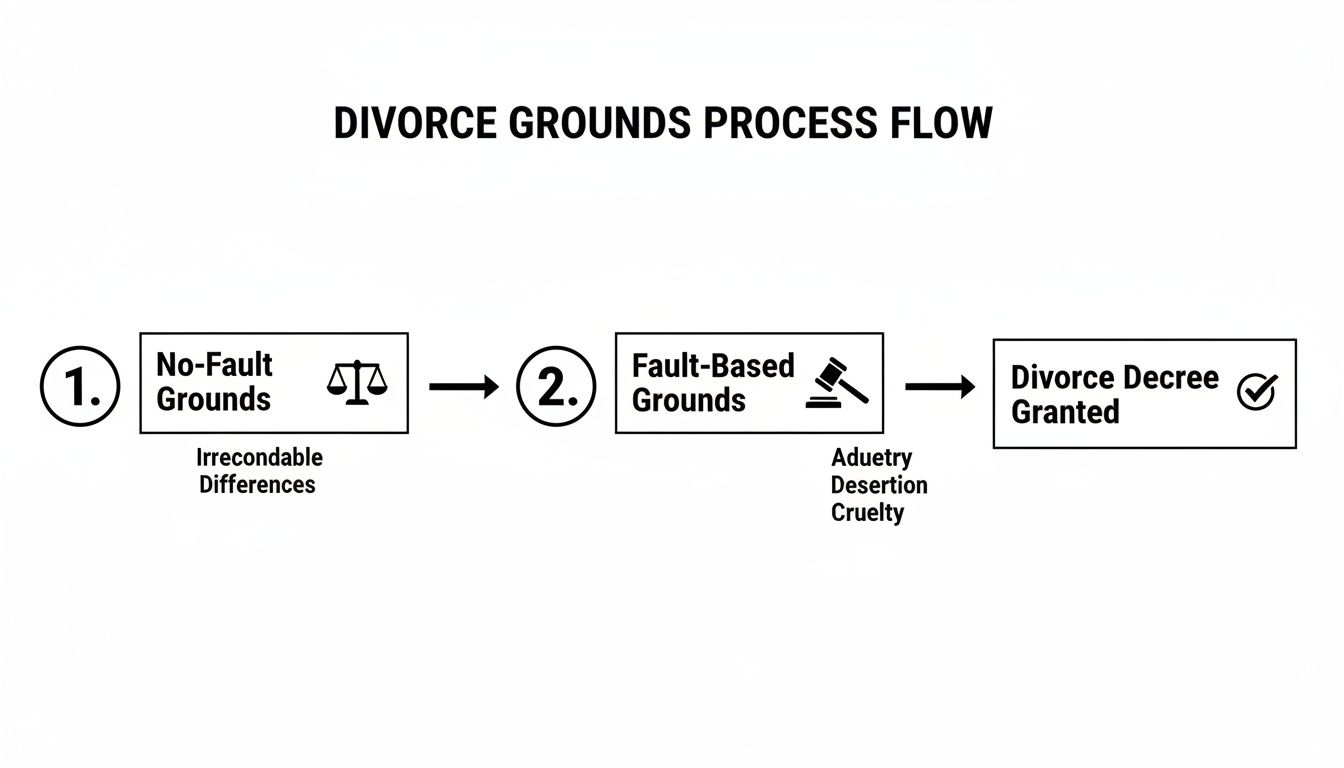
As you can see, both the no-fault path (insupportability) and any of the fault-based grounds ultimately lead to the same destination: a final divorce decree.
Step 1: Meeting the Residency Requirements
Before you can even think about filing for divorce in Harris County, you have to meet Texas's residency rules. This is a non-negotiable first step, and the court will check.
Here’s what’s required:
- You or your spouse must have lived in Texas for at least the last six months.
- You or your spouse must have been a resident of Harris County (or whichever county you file in) for at least the last 90 days.
These rules ensure your case is handled in the right local courthouse—the one that serves your community, whether you're in Kingwood, Humble, or another part of our corner of Northeast Houston.
Step 2: Filing the Original Petition for Divorce
Once you've confirmed you meet the residency rules, the next move is to file an Original Petition for Divorce. This is the official document that kicks off your case with the Harris County District Clerk.
This petition gives the court basic information about your marriage and officially states the grounds for the divorce, which is usually "insupportability" for a no-fault case. After it's filed, your spouse must be formally notified through a legal process called "service." Our team at The Law Office of Bryan Fagan handles this critical step meticulously to make sure everything is done by the book.
Step 3: The Mandatory 60-Day Waiting Period
In Texas, the law hits the brakes right after filing. There is a mandatory 60-day "cooling-off" period that starts the day after the petition is filed. A judge cannot legally finalize your divorce until this time has passed.
This waiting period is designed to give couples a moment to pause, reflect, and maybe even reconsider. It also provides a crucial window to work out temporary issues, like who stays in the house or how bills get paid while the case is ongoing.
Interestingly, this 60-day period is becoming a finish line fewer Texans are crossing. Over the past decade, the divorce rate in the state has dropped significantly. In 2010, the rate was 3.3 per 1,000 people, but by 2021, it had fallen to just 1.4 per 1,000—a decline of about 58%.
Step 4: The Path to Resolution
After the initial filing and waiting period, the real work begins. The focus shifts to resolving the big issues: property division, child custody, and support.
This is where things can go a couple of different ways, but most cases involve:
- Discovery: This is the formal process where you and your spouse exchange financial information and other relevant documents. It's all about getting everything out on the table.
- Negotiation or Mediation: The vast majority of cases in the Kingwood area are settled out of court. This usually happens through direct negotiation between attorneys or with the help of a neutral third-party mediator who guides the conversation.
- Final Decree of Divorce: Once you’ve reached an agreement on all the issues, your attorney will draft the Final Decree of Divorce. This is the comprehensive, legally binding document that spells out every single term of your settlement—from who gets the house in Porter to your child's possession schedule.
After the decree is signed by you, your spouse, and the judge, your marriage is legally over.
This timeline visualizes the key milestones in a Texas divorce, from the initial filing to the final decree, helping you anticipate what comes next.
Typical Texas Divorce Timeline
| Milestone | What It Involves | Typical Duration |
|---|---|---|
| Meeting Residency | Confirming 6 months in TX & 90 days in the county. | N/A (Prerequisite) |
| Filing Petition | Preparing & filing the official divorce paperwork. | 1-2 weeks |
| Serving Your Spouse | Officially notifying your spouse of the lawsuit. | 1-4 weeks |
| 60-Day Waiting Period | The mandatory "cooling-off" period. | Minimum 60 days |
| Discovery & Negotiation | Exchanging info, mediation, and reaching agreements. | 2-6 months (or longer) |
| Finalizing the Decree | Drafting & signing the final legal documents. | 1-3 weeks |
| Judge's Signature | The judge signs the decree, making it official. | Varies by court docket |
While this table provides a general outline, remember that contested or high-conflict cases can take significantly longer to resolve.
Navigating these procedural steps requires careful attention to detail and a steady hand. For a more in-depth look, check out our guide on how to file for divorce in Texas. If you're ready to take the first step, our Kingwood attorneys are here to provide clear, compassionate guidance. Contact us for a free consultation.
How a No-Fault Filing Shapes Your Family's Future

When you choose to file for a no-fault divorce, you're doing more than just checking a box on a form. You're setting the tone for how the most important parts of your family's future will be decided. For the families we work with in Kingwood, the concerns are almost always the same: what happens to our home and savings, and how will this all affect our kids?
A no-fault filing helps everyone pivot from pointing fingers about the past to focusing on building a stable future. It clears the way for practical problem-solving and cooperation on the three biggest issues you'll face: property division, children’s issues, and potential spousal support.
Dividing Your Marital Property Fairly
Texas is a community property state. This means that, for the most part, any assets and debts you and your spouse accumulated during the marriage belong to both of you. The goal during the divorce is to divide this "community estate" in a way that is "just and right."
Now, it's a common myth that "just and right" always translates to a clean 50/50 split. While that's often the starting line, a Harris County judge can absolutely award one person a larger share based on various factors.
In a no-fault divorce, the division tends to focus more on practical things like each person's earning power and future financial needs. That said, fault can still creep in. If one spouse gambled away marital savings, for instance, a judge might award the other spouse a larger share to even the score. This is why accurately identifying every asset is so crucial, making the discovery phase one of the most important parts of the process. You can dig deeper into what is discovery in a divorce and see how it ensures nothing gets hidden.
Putting Your Children's Best Interests First
For any parent in Kingwood or Humble, nothing matters more than their kids' well-being. The good news is that the Texas Family Code is on the same page. Whether you file on no-fault or fault-based grounds, every decision about your children must pass one critical test: what is in the best interest of the child?
This single principle means the court’s job is to create a stable, nurturing environment, not to punish a parent for why the marriage ended. The court will focus on:
- Possession Schedules: Building a practical calendar that maps out when the children will be with each parent, including holidays, summers, and the regular school week.
- Decision-Making Rights: Deciding who gets the final say on big-picture issues like education, non-emergency medical care, and religious upbringing.
- Child Support: Calculating monthly support based on the Texas statutory guidelines, which primarily look at the paying parent's income and how many children are involved.
Starting with a no-fault approach often helps parents transition into being effective co-parents. It dials down the conflict from day one and helps preserve a functional relationship for the sake of the children.
Understanding Spousal Support in Texas
Spousal support—often called alimony or spousal maintenance—is not a given in a Texas divorce. In reality, the state has some pretty strict eligibility rules. A no-fault filing doesn't change those rules, but it can certainly change the conversation around the request.
To get a judge to order spousal maintenance, the spouse asking for it usually has to prove they can't meet their minimum reasonable needs with the property they receive in the divorce. On top of that, they must meet at least one of these conditions:
- The marriage lasted 10 years or longer.
- The other spouse has a conviction for family violence.
- The requesting spouse has a serious disability that prevents them from working.
In a fault-based divorce where one spouse's bad behavior is proven, a judge may feel more inclined to award spousal maintenance. But in a no-fault case, the decision is based almost entirely on the financial realities and needs of each person, not on who was to blame for the marriage ending.
Navigating these critical issues takes a clear head and a steady focus on your long-term goals. At The Law Office of Bryan Fagan, our Kingwood attorneys are dedicated to protecting your family's future. We invite you to schedule a free, confidential consultation at our local office to talk about your situation and see how we can help.
The Future of No-Fault Divorce Laws in Texas
For over 50 years, the "insupportability" standard has been the foundation of Texas divorce law. But the legal world is anything but static. For families here in Kingwood and across Northeast Houston, it’s worth knowing that the very idea of a no-fault divorce has recently come under fire from some Texas lawmakers.
From time to time, discussions crop up in the legislature about repealing or modifying these laws. This isn't just political chatter; any shift could completely change how families navigate the end of a marriage. Keeping an ear to the ground on these conversations is smart, as it helps you prepare for what might be coming down the pike.
The Debate Over No-Fault Divorce
The push to change the law is often framed as a way to "strengthen marriage." Those in favor argue that forcing one spouse to prove the other was at fault—for things like adultery or cruelty—would make divorce a higher hurdle, perhaps encouraging couples to try harder to reconcile. The core of their argument is that the current system makes walking away from a marriage too simple.
However, many legal professionals and family advocates, especially in communities like Humble and Porter, have raised the alarm about this idea. They argue that getting rid of the no-fault option would lead to some very real, and very dangerous, unintended consequences.
A major concern is the chilling effect it would have on victims of domestic abuse. Forcing someone to publicly prove cruelty or another fault-based reason in court can be terrifying, expensive, and outright dangerous. The no-fault option currently gives people in abusive situations a critical and much safer way out.
Recent legislative sessions have seen real attempts to tear down the current system. For instance, Texas lawmakers introduced House Bill 3401 (HB 3401), a piece of legislation aimed squarely at repealing no-fault divorce. The fear is that requiring fault-based proof would create financial roadblocks, effectively trapping victims in abusive relationships and putting them at even greater risk. You can discover more insights about these legislative efforts to get a better sense of the arguments on both sides.
Why This Matters for Your Family in Kingwood
Let's be clear: for now, Texas is still a no-fault divorce state. The "insupportability" ground is alive and well, and fully available to you. But these ongoing debates really underscore why having an experienced local guide in your corner is so important. Laws can change, and they sometimes do.
When you work with a local law firm that lives and breathes Texas family law, you're ensuring you won't be caught flat-footed. At The Law Office of Bryan Fagan, we make it our business to stay on top of legislative trends and potential changes that could affect our clients in Kingwood. Our promise is to give you the most current, relevant advice so you can make the best possible decisions for your family's future.
Protecting your rights means having a legal partner who is always looking ahead. If you have any questions about how current laws—or potential future ones—might impact your situation, please reach out to our Kingwood office for a free, confidential consultation.
How a Kingwood Divorce Attorney Can Help You Move Forward
Going through a divorce is tough, no matter the circumstances. Understanding that Texas is a no-fault state is one thing, but knowing how the legal steps will impact your future is another challenge entirely. This is where having a local, experienced guide makes all the difference.
Even a divorce that seems straightforward and uncontested has massive implications. The papers you sign will set the stage for your financial life for years, define your parental rights, and shape your children's future. This isn't the time to go it alone; having an experienced legal guide isn't a luxury, it's essential for protecting everything you hold dear.
Your Advocate Here in Northeast Houston
Trying to manage all of this by yourself is completely overwhelming. A dedicated Kingwood divorce attorney does so much more than fill out forms. We bring clarity to the confusion, offer a clear strategy when you feel lost, and fight for you when it matters most. We’re here to make sure every single detail is handled correctly, shielding you from common mistakes that can cause problems for years.
From fighting for a fair division of your property to building a parenting plan that genuinely puts your kids first, a seasoned lawyer is the best tool you can have. At The Law Office of Bryan Fagan, our Kingwood attorneys are focused on helping our neighbors in Humble, Porter, and across Northeast Houston start their next chapter with confidence.
Navigating a divorce is about more than just ending a chapter; it's about carefully writing the beginning of the next one. A skilled attorney ensures your new story starts on the strongest possible foundation, protecting your rights and your family’s well-being every step of the way.
To manage all the moving parts of your case, a modern law firm relies on powerful tools. We use advanced legal case management software to keep every document, deadline, and detail perfectly organized. This efficiency allows us to spend less time on administration and more time focused on you and your goals. Of course, finding the right fit is key, and we have a helpful guide on how to choose a divorce attorney that can help.
You don't have to face this journey by yourself. The Law Office of Bryan Fagan is right here in the community, ready to provide the supportive, experienced guidance you need. We invite you to contact our Kingwood office today for a free, confidential consultation. Let's sit down, talk about your situation, and start building a plan to help you move forward.
Common Questions We Hear About No-Fault Divorce
When you're thinking about divorce, your head is probably swimming with questions. It's completely normal. Here in our Kingwood office, we sit down with people from all over Northeast Houston who are trying to make sense of it all. Let’s walk through some of the questions we hear most often to give you some clarity.
What’s the Real Cost of a No-Fault Divorce in Kingwood, TX?
This is the big question, and the honest answer is: it depends. If you and your spouse are on the same page about everything—the house, the kids, the money—you're looking at a much lower cost. In that case, it’s mostly about paying court filing fees for Harris or Montgomery County and having an attorney properly draft and review all the final paperwork.
But life is rarely that simple. The moment disagreements pop up over who gets what or how parenting time is split, the costs will naturally go up. You might need to bring in a mediator or spend more time negotiating, and that adds to the expense. The best way to get a clear picture is to talk it through. We can give you a realistic cost estimate based on your specific situation during a free consultation right here in our Kingwood office.
What if My Spouse Doesn't Want the Divorce?
You can still move forward. In Texas, you don't need your spouse's permission to end the marriage. All it takes is for one of you to tell the court that the relationship has broken down with no chance of reconciliation.
Now, that doesn't mean it will be easy. If your spouse refuses to cooperate or sign documents, it will definitely slow things down and make the process more complicated. But it won't stop it. Our attorneys in Kingwood have handled plenty of these cases, and we know exactly what legal steps to take to keep things moving forward, with or without your spouse’s participation.
Does "No-Fault" Mean We Just Split Everything 50/50?
That’s a very common myth. The "no-fault" part only applies to why you’re getting divorced. It has nothing to do with how your property is divided. Texas is a community property state, which means the law requires a "just and right" division of your assets.
A 50/50 split is often the starting point, but it's not a hard-and-fast rule. A judge can, and often does, award an unequal division. They might look at factors like differences in earning power, who has separate property, or even if one spouse was at fault for the breakup (like through adultery or wasting family money).
Having a dedicated Kingwood family law attorney in your corner is crucial to making sure the final property division is genuinely fair for you.
Will I Have to Go to Court?
Probably not for a full-blown trial. The vast majority of no-fault divorces in our area (including Humble and Porter) are settled out of court. If you and your spouse can hammer out an agreement, even with help from a mediator, your lawyers will put everything into a document called a Final Decree of Divorce.
Once that's signed, the only "court" you'll likely see is a quick, informal hearing called a "prove-up." It’s a brief meeting where the judge simply reviews your agreement to make sure it’s in order and officially finalizes the divorce. At The Law Office of Bryan Fagan, our first goal is always to find the most peaceful and efficient path forward, keeping you out of a stressful courtroom battle whenever possible.
Even a seemingly straightforward divorce has legal hurdles that can impact your future. You need a local expert to make sure your rights are protected. The team at The Law Office of Bryan Fagan – Kingwood TX Lawyers lives and works here, and we're ready to provide the experienced support you need. Contact us today to set up a free, no-pressure consultation at our Kingwood office and let us help you map out your next steps.