
If you’re facing a divorce in Kingwood, one of the first and most pressing questions is always: what happens to our property? It’s a common misconception that Texas simply splits everything 50/50 down the middle. The reality is quite different. Here in Harris County, a judge will divide your assets based on what is 'just and right,' a standard that looks at the big picture to find a fair outcome for you and your family. For our neighbors in Kingwood, Humble, and the surrounding communities, understanding this process is the first step to securing your financial future.
Your First Steps in Kingwood Property Division
Going through a divorce is tough, and the anxiety around dividing a life's worth of assets can feel overwhelming. We see it with our Kingwood clients every day. But you’re not in this alone, and the best way to regain a sense of control is through knowledge and solid preparation.

Think of this part of your divorce as a comprehensive inventory of your life together. It’s a process of identifying everything you and your spouse own and owe, and then figuring out the most equitable way to separate it all as you each begin a new chapter. We're talking about more than just the house and cars; this covers bank accounts, retirement plans, business interests, and even debts.
What Does a 'Just and Right' Division Mean for You?
The "just and right" standard is truly the heart of property division in Texas. Unlike some states with rigid, automatic splits, this principle gives Harris County judges the discretion to shape a division that is fair and equitable given the real-life circumstances of your marriage.
A "just and right" division is designed to be fair, not necessarily equal. It allows a judge to consider the human element of your divorce—your family's needs, each spouse's ability to earn a living, and other personal factors.
So, what exactly does a judge consider? It’s not just one thing, but a collection of factors, including:
- Earning capacity and education. A judge might award a larger portion of the estate to a spouse who has been out of the workforce to raise children and has a lower earning potential.
- The needs of the children. To provide stability, the parent who has primary custody of the kids may be awarded the family home.
- Fault in the marriage. While Texas is a "no-fault" state, behavior like adultery, cruelty, or wasting community funds can certainly influence a judge's decision on the property split.
- The size and complexity of the estate. Dividing a straightforward estate is a world away from a high-net-worth divorce involving business valuations and complex investments.
Understanding these factors is crucial for building a solid strategy. This is where organized record-keeping becomes your best friend. A key part of gathering this information is a formal stage called the discovery process, where you and your spouse exchange all relevant financial documents. You can learn more about this in our detailed guide to discovery in a Texas divorce.
Our Kingwood attorneys are here to provide the support and expert guidance you need to navigate this process with a clear path forward. To get started, schedule a free, no-obligation consultation at our Kingwood office.
Community Property vs. Separate Property in Texas
When you're facing a divorce in Kingwood, the first thing our lawyers will help you grasp is how Texas law sorts out your assets. It all comes down to one core distinction: community property versus separate property. Getting this right from the start is the bedrock of a fair and just division.
Think of it like this: your marriage is a partnership. Everything you owned before you walked down the aisle is yours alone, but most of what you and your spouse earned or acquired during the marriage belongs to the partnership itself.
What is Separate Property?
At its core, separate property is anything that was yours and yours alone before the marriage. This category also includes very specific things you might have received during the marriage, like an inheritance from a relative or a gift intended just for you.
So, if you owned a condo in Humble before you got married, that property remains yours. It’s not part of the marital pot that gets divided.
What is Community Property?
Community property, on the other hand, is pretty much everything else you and your spouse acquired while married. It doesn’t matter whose name is on the title or which paycheck paid for it. If you obtained it during the marriage, Texas law presumes it belongs to both of you.
This is a crucial point because a Harris County judge can only divide community property. Your separate property is off-limits.
Here’s a quick breakdown of common examples:
- Community Property: The family home bought in Kingwood, income earned by either of you, cars purchased after the wedding, and the value built up in retirement accounts (like a 401k or pension) during the marriage.
- Separate Property: A savings account you had from before you were married, a classic car you inherited from your grandfather, or a rental property over in Porter that you owned prior to saying "I do."
The most important rule to remember is the presumption of community property. In a Texas divorce, every asset is assumed to be community property unless one spouse can prove otherwise with "clear and convincing evidence."
That "clear and convincing" standard is a high legal bar to clear. If you don't have meticulous records, proving an asset is truly separate can feel like an uphill battle, especially when funds get mixed over the years.
The Challenge of Commingled Assets
Here's where things get tricky. Commingling is what happens when separate property gets mixed in with community property, blurring the lines until it's nearly impossible to tell what's what.
For instance, say you inherit money (your separate property) and deposit it into the joint checking account you share with your spouse. If you then use that account for years to pay household bills and buy groceries, those separate funds have become commingled with community funds.
This is an incredibly common issue for families here in Northeast Houston. With Harris County seeing around 28,500 divorce filings each year—the most in Texas—untangling these financial webs is a frequent challenge. When separate funds are used for something like a down payment on a jointly owned home, it takes a deep dive to figure out where that money originally came from. You can see more on how these numbers affect local divorces by reviewing these Texas divorce statistics and trends.
Separating commingled assets often requires a forensic accounting process called tracing. This involves meticulously following the paper trail to prove an asset's separate origin. Without that solid proof, what was once your separate property will likely be treated as community property and divided by the court. It’s why keeping detailed, separate records is one of the smartest things you can do to protect your assets.
How Courts Decide What’s a "Just and Right" Division
When it comes to dividing property in a Kingwood divorce, Harris County judges don't just split everything down the middle. Their ultimate goal is to reach a “just and right” division. It’s a legal term, but what it really means is that the court has the power to look beyond a simple 50/50 split to find a solution that’s genuinely fair given your family’s unique situation.
This isn't about running numbers through a calculator. It’s about a judge taking a hard look at the entire story of your marriage—the sacrifices made, the opportunities gained, and what each of you will need to get back on your feet. The aim is to prevent a lopsided financial outcome where one person is left struggling while the other is not.
Key Factors That Can Tip the Scales
A judge in Northeast Houston will weigh several crucial factors when determining what a "just and right" division looks like. While no single issue decides the outcome, a combination of them can absolutely shift the split away from an even 50/50. These are often called the "Murff factors," named after a landmark Texas case that established these guidelines.
Here are the most common ones we see in practice:
- Disparity in Earning Power: The court will compare each spouse's ability to earn a living after the divorce. If one person has a much higher income or earning potential, the judge might award a larger share of the community property to the lower-earning spouse. This is done to help create a more stable financial future for them.
- The Needs of the Children: When kids are involved, their well-being is a top priority. The parent who has primary custody is often awarded the family home to maintain stability for the children. This alone can lead to a disproportionate, but fair, division of the overall estate.
- Fault in the Breakup: Texas is a no-fault state, which means you don't need to prove wrongdoing to get a divorce. However, a judge can still consider bad behavior when dividing property. Things like adultery, cruelty, or wasting community funds (think spending marital money on an affair or gambling it away) can result in the at-fault spouse receiving a smaller share.
This diagram breaks down how a judge balances these elements to arrive at a fair division.
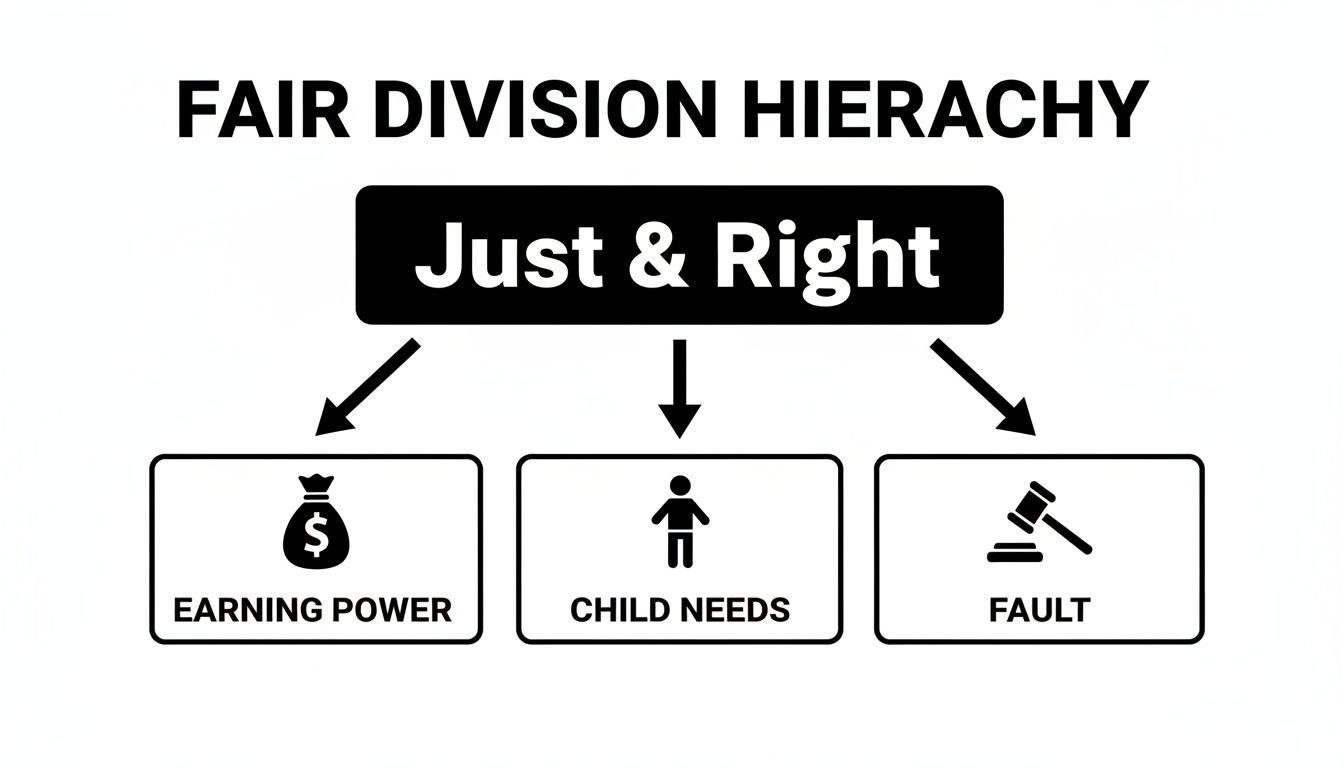
As you can see, the concept of a "just and right" outcome is built on pillars like each spouse's earning capacity, the needs of the children, and whether fault played a role in the marriage ending.
A Kingwood Story: From 50/50 to 65/35
So, how does this actually play out? Let’s imagine a Kingwood couple, Sarah and Mark, married for 15 years. Mark built a successful career in the energy sector, while Sarah put her teaching career on hold to raise their two children and manage their home.
They decide to divorce, and their community estate is worth $1 million. A straight 50/50 split seems simple enough: $500,000 each. But Sarah has been out of the workforce for more than a decade. Her earning potential is a fraction of Mark's, and she will be the children's primary caregiver.
In a situation like this, a Harris County judge would likely find that a 50/50 split isn't truly "just and right." Instead, the court might award Sarah 65% of the estate ($650,000), which includes the family home. This gives the children stability and helps offset Sarah’s much lower earning capacity. Mark, with his high income, is in a far better position to rebuild his finances.
This type of unequal division is more common than you might think. In fact, Texas appellate courts have upheld property divisions as skewed as 80/20 in cases with extreme differences in earning power or where one spouse’s misconduct was particularly damaging. You can explore more about how Texas property settlements can differ from a 50/50 split to get a sense of the possibilities.
Understanding how these factors could apply to your own life is key to setting realistic expectations for your property division in a Kingwood divorce. The attorneys at The Law Office of Bryan Fagan have the experience to help you build a compelling case that clearly presents your side of the story. Give us a call today to schedule a free consultation at our local Kingwood office.
A Practical Guide to Dividing Common Assets and Debts
Once you’ve got a handle on the difference between separate and community property, it’s time to roll up your sleeves. This is where the theory ends and the real work of untangling a shared financial life begins. This step-by-step process involves identifying, valuing, and figuring out how to divide everything you’ve accumulated together. It can feel like an overwhelming task, but we’re going to tackle it one piece at a time.

For most families here in Kingwood and the Humble area, the major assets are pretty standard. What makes every divorce different are the specific details and the emotional weight attached to each item. Let's break down the most common assets and debts you’ll be dealing with.
The Family Home and Other Real Estate
The house is almost always the biggest asset, and it’s usually the most emotionally charged one, too. Whether it's your primary home in a Kingwood neighborhood or a weekend place on Lake Houston, the first step is figuring out its real-world value with a professional appraisal.
After you know the home's value and what’s left on the mortgage, you generally have a few paths forward:
- Sell the house: This is often the cleanest option. You sell the property and divide the net proceeds as determined by the court.
- One spouse buys out the other: One person can keep the home, but they’ll need to refinance the mortgage into their name alone and pay the other spouse their share of the equity.
- Co-own the house (temporarily): It’s less common, but sometimes a couple agrees to keep owning the home together for a limited time, often to provide stability for young children.
This is a huge financial and personal decision. What you decide to do with the house will shape your financial future and your family's new normal, so it’s crucial to think through every angle with your attorney.
Retirement Accounts: 401(k)s and Pensions
Retirement funds are often the most valuable assets after the family home, but they’re also some of the most complex to divide. Any portion of a 401(k), IRA, or pension that was earned during the marriage is community property.
To split these accounts, you need a specific court order called a Qualified Domestic Relations Order (QDRO). This is a special legal document that tells the account administrator how to pay the non-employee spouse their share without triggering a massive tax bill or early withdrawal penalties.
CRITICAL STEP: Getting a QDRO isn't automatic; it's a completely separate step from the final divorce decree. It must be drafted by an attorney, signed by the judge, and approved by the retirement plan. Missing this step can lead to disastrous tax consequences or even losing your entire share of the funds.
Business Interests
For many entrepreneurs in Northeast Houston, their business isn't just a job—it's their life's work and largest asset. Putting a price tag on a business requires a specialist, like a business valuation expert or a forensic accountant. They’ll dig into the company’s books, assets, and market position to determine its fair market value.
Once valued, a business can be divided in a few ways. One spouse might buy out the other’s share over time, or the other spouse might receive different community assets of equal value to offset the business. Selling the company is also an option, though less common. Given the high stakes, getting trusted legal help here is non-negotiable.
Don’t Forget About the Debts
Property division is a two-sided coin: you divide the assets, but you also have to divide the debts. Any debts taken on during the marriage are generally considered community debts and must also be divided in a “just and right” manner.
This includes everything from:
- The mortgage and any home equity loans
- Car notes
- Credit card balances
- Student loans acquired during the marriage
- Personal loans
Here’s a critical piece of advice: creditors are not bound by your divorce decree. If your name is on an account, the lender can legally pursue you for payment, even if the judge ordered your ex-spouse to pay it. An experienced attorney can help structure the decree to protect you from this risk.
Sometimes, the issue isn't just known debt, but hidden debt or even hidden money. For a deeper dive into that problem, check out our guide on how to find hidden assets in a divorce.
To help you visualize how these pieces fit together, here is a quick summary of how common assets are typically handled in a Kingwood divorce.
Dividing Common Assets in a Kingwood Divorce
| Asset Type | Typical Classification (Community/Separate) | Key Division Consideration |
|---|---|---|
| The Family Home | Often a mix of community (mortgage paydown) and separate (down payment). | Requires an appraisal; options include selling, buyout, or temporary co-ownership. |
| Retirement Accounts | The portion earned during the marriage is community property. | Division requires a Qualified Domestic Relations Order (QDRO) to avoid taxes. |
| Business Interests | Value created during the marriage is community property. | Requires professional valuation; division can be complex (buyout, asset offset). |
| Bank Accounts | Presumed community unless funds can be traced to a separate source. | Commingling (mixing funds) can turn separate property into community property. |
| Vehicles | Community property if purchased during the marriage. | The loan must be addressed; one spouse often refinances the vehicle in their name. |
| Debts (Credit Cards, Loans) | Debts incurred during the marriage are presumed community. | Creditors aren't bound by the decree; your name on the loan means you're still liable. |
If this list makes your head spin, you’re not alone. This is complicated stuff. The attorneys at The Law Office of Bryan Fagan are right here in Kingwood, ready to help you inventory your estate and build a solid strategy for a fair and just division.
Steps to Protect Your Assets Before and During Divorce
Facing a divorce can make you feel like you're losing control, especially when it comes to your financial future. That uncertainty is one of the toughest parts of the process. But taking proactive steps is the best way to regain your footing and make sure the property division in your Kingwood divorce is fair.
Here are practical, step-by-step actions you can take to protect your hard-earned assets and build a strong position for whatever comes next, whether that's negotiation or a courtroom.

Create a Complete Financial Inventory
Your very first move should be to get a perfectly clear snapshot of your entire marital estate. This means tracking down and organizing every financial document you can get your hands on. Don't put this off. Start gathering paperwork immediately, even if divorce is just a possibility.
Here's a step-by-step guide to what you should start collecting:
- Bank Statements: Grab at least three years of statements for every account—checking, savings, and money markets—whether they are joint or held individually.
- Tax Returns: You'll want the last five years of personal and any business tax returns.
- Loan Documents: Find all the paperwork for your mortgage, car loans, personal loans, and any other outstanding debts.
- Retirement and Investment Statements: Pull the most recent statements for 401(k)s, IRAs, pensions, and any brokerage accounts.
- Pay Stubs and Income Records: For both you and your spouse, if possible.
Once you have everything, create a master list of all assets and all debts. This inventory isn't just a list; it's the foundation of your entire property division case. For a deeper dive into this topic, check out our guide on how to protect assets in a Texas divorce.
What Not to Do During a Divorce
Just as crucial as what you should do is what you absolutely should not do. Some actions can instantly destroy your credibility with a Harris County judge and do serious damage to your case.
A judge's view of your honesty is priceless. Any attempt to hide money or play games will eventually come to light, and the consequences are never good.
Steer clear of these major mistakes:
- Do not hide assets. Moving money to a secret account or "gifting" large sums to friends or family will raise huge red flags. If you suspect your spouse might be trying to hide things, it's good to know how a forensic accountant can find hidden assets.
- Do not make large, unusual purchases. Suddenly buying a sports car or going on a spending spree with community funds right before or during a divorce looks like an attempt to waste marital assets.
- Do not destroy financial records. This is almost always seen as a blatant attempt to hide information from the court, and it will backfire.
Using Legal Tools to Freeze Assets
If you have legitimate fears that your spouse might try to sell property, drain bank accounts, or rack up credit card debt, we can ask the court for a Temporary Restraining Order (TRO). When a divorce is filed here in Harris County, a TRO is commonly put in place to freeze the marital estate.
This court order essentially locks things down, preventing either of you from doing anything that would damage the community property. This includes things like:
- Closing bank accounts.
- Selling off stocks or other investments.
- Changing the beneficiaries on life insurance policies.
- Taking on new, non-essential debt.
A TRO creates a vital "cooling off" period. It preserves the assets you both worked for, ensuring they're still there to be divided fairly and justly down the road. Here at The Law Office of Bryan Fagan, we can help you figure out if a TRO is the right move for your situation. We're right here in Kingwood, ready to help you protect what you've built. Give us a call for a free, no-obligation consultation today.
Why a Kingwood Attorney Is Crucial for Property Division
Trying to handle your own property division in a Kingwood divorce is like trying to navigate the winding backroads of Northeast Houston for the first time without a map. You might eventually get somewhere, but the odds of making a costly wrong turn are incredibly high, especially when you're dealing with the kinds of high-value assets common in our area.
A single misstep in valuing a business, tracing separate property, or making your case for a "just and right" division can lead to an unfair settlement. The financial consequences of these mistakes don't just go away; they can follow you for years. This isn't just about paperwork—it's about protecting your financial future.
Local Expertise Matters in Harris County Courts
Every courthouse has its own rhythm and unwritten rules, and the Harris County family courts are no different. An experienced Kingwood attorney knows this local landscape inside and out. They understand the tendencies of specific judges, know which strategies are most effective, and have a feel for how to best present a case in that particular courtroom. That kind of local insight is a real, tangible advantage.
At The Law Office of Bryan Fagan, our attorneys don't just know Texas law on a theoretical level. We are part of this community. We live and work here, so we understand the unique challenges families in Kingwood, Humble, and Porter are up against because we see it firsthand every single day.
This isn't just another case file to us. It's about helping our neighbors find their footing and secure a stable, fair financial future. We're committed to fighting for your best interests, whether that means tough negotiation or powerful advocacy in the courtroom.
You Need a Strategic Partner, Not Just a Lawyer
A truly great family law attorney does more than just file motions; they become your strategic partner. Their job is to manage the complex legal details so you don't have to, anticipate roadblocks before they become major problems, and build a comprehensive case designed to meet your specific goals.
This partnership means we will:
- Build a strong negotiating position: We walk into every negotiation armed with a detailed understanding of your finances and a clear, well-defined strategy.
- Handle complex asset valuations: We work with a network of trusted professionals, like business appraisers and forensic accountants, to make sure every single asset is valued accurately.
- Offer clear-headed, objective advice: Divorce is an emotional rollercoaster. We provide the calm, objective guidance you need to make smart, forward-thinking decisions instead of emotional, short-term ones.
Going through a divorce is one of life's most difficult challenges. You shouldn't have to add the stress of becoming your own legal expert on top of it all. Let us carry that weight. The peace of mind you get from knowing a dedicated professional is in your corner, protecting your interests, is truly invaluable.
The Law Office of Bryan Fagan invites you to schedule a free, no-obligation consultation at our Kingwood office. Let’s sit down, talk about your situation, and show you exactly how trusted local representation can make all the difference.
Frequently Asked Questions About Kingwood Property Division
Even with a good grasp of the basics of property division in a Kingwood divorce, real-world "what-if" questions are bound to start popping up. That’s completely normal. We've put together answers to some of the most common questions we hear from folks right here in Kingwood, Humble, and the surrounding Northeast Houston communities to give you some practical clarity.
What Happens to Our House in a Kingwood Divorce?
It’s no surprise this is usually the first question on everyone's mind. For most families, the house isn't just a building; it's a home, and it’s almost always the most significant community asset.
Before any decisions can be made, you'll need a professional appraisal to nail down its fair market value. This lets you calculate the actual equity you have (the home's value minus what you still owe on the mortgage). From there, you're generally looking at three paths:
- Sell the house and split the proceeds. The court will ensure this split is "just and right."
- One spouse buys out the other. This involves refinancing the mortgage into one spouse's name and paying the other their share of the equity.
- Keep the house for the kids' sake. Sometimes, a judge will allow the parent who has the children most of the time to stay in the home for a set period, providing stability until the kids are older.
Is My Inheritance Considered Community Property?
In Texas, the answer is a pretty firm no. Any property you receive as a gift or through an inheritance is your separate property by law, even if it comes to you during your marriage. But there’s a huge catch: you have to keep it separate.
This is where the concept of "commingling" comes into play. Commingling is just a legal term for mixing your separate funds with community funds. For instance, if you deposit a $50,000 inheritance into your joint checking account and then use that account for groceries, bills, and vacations over the years, a court might see that money as having lost its separate character. The best practice is always to keep gifted or inherited assets in a completely separate account, under your name only.
What if My Spouse Is Hiding Assets?
Discovering your spouse is trying to hide assets is a nightmare scenario, but it's one Harris County judges take very seriously. Deliberately concealing or failing to disclose assets during a divorce isn't just dishonest—it's a serious offense with significant consequences.
If your spouse gets caught, the judge has the power to penalize them. A very common penalty is to award a much larger share—or sometimes, every penny—of the newly found asset to the innocent spouse. A good Kingwood attorney has powerful tools at their disposal, like formal discovery requests, subpoenas, and even forensic accountants, to track down hidden bank accounts, undisclosed property, or skimmed business income. When it comes to divorce, honesty really is the only policy.
How Long Does Property Division Take in Harris County?
The timeline can vary dramatically. The two biggest factors are the complexity of your finances and, frankly, the level of cooperation between you and your spouse.
If you both agree on most things and have a straightforward estate, you might wrap everything up in a few months, often close to the state's mandatory 60-day mandatory waiting period. On the other hand, a high-net-worth case with business valuations, arguments over separate property claims, or a hunt for hidden assets can easily stretch out for a year or even longer. Your attorney can give you a much more realistic timeline after reviewing the specifics of your situation.
Navigating the complexities of property division requires clear, experienced guidance tailored to your unique situation. As a local firm dedicated to serving our community, The Law Office of Bryan Fagan – Kingwood TX Lawyers is here to provide the support you need. Schedule your free, no-obligation consultation with our Kingwood attorneys today to protect your assets and secure your financial future. Visit us at kingwoodattorneys.com to get started.