Skip to content
A parent passes away. The family is still answering condolence texts, sorting photos, and trying to decide what to do with the house keys. Then someone finds a will in a desk drawer, a stack of bank statements on the counter, and a letter from a courthouse or insurance company that no one fully understands.
That moment is common in Kingwood, Humble, Porter, and Northeast Houston. People are grieving, but the paperwork does not wait for grief to settle. One adult child thinks the will should be filed right away. Another assumes everything transfers automatically. A surviving spouse may not even know which county court handles the estate.
If that sounds familiar, take a breath. Probate is a legal process, but it does not have to become a family crisis. With steady guidance, it can move from confusing to manageable.
This guide is written in plain language for local families looking for a probate lawyer kingwood tx. It walks through what probate means, how Harris and Montgomery County procedures affect Kingwood families, where people get stuck, and what kind of help can make the process lighter.
Losing a Loved One is Hard Enough Estate Admin Shouldnt Be
A Kingwood family often starts in the same place. Someone has passed away. The funeral is over or still being planned. A son or daughter is being asked questions like, “Who is the executor?” and “Has the will been filed yet?” before they have had time to process the loss.
That pressure can feel unfair. It is also real.
One family in Northeast Houston might have a clear will, a house, a few accounts, and relatives who get along. Another family in Humble may be dealing with a second marriage, children from different relationships, or uncertainty about whether a document they found is the latest will. Both families need answers, but not the same answers.
Probate becomes stressful when people think they are supposed to figure it out alone. They are not. Most executors have never handled estate administration before. They do not know what forms the court expects, when notices must go out, or how to respond if a bank freezes an account.
Local reality: The hardest part for many families is not the legal rule itself. It is trying to make good decisions while tired, emotional, and under time pressure.
The good news is that probate follows a structure. There is a process for validating a will, identifying property, handling debts, and transferring what remains to the right people. The court system in Harris County and Montgomery County may feel formal, but families in Kingwood go through it every day.
If you are carrying paperwork in one hand and grief in the other, you do not need perfect knowledge. You need a clear next step.
What is Probate and Why Does Texas Require It
Probate is the court process for handling a person’s estate after death. In simple terms, it is the legal system’s way of confirming who has authority to act, what property belongs to the estate, what debts must be addressed, and who should receive what remains.
Think of probate as the final chapter of a person’s financial story. The court helps make sure that chapter closes properly.

What probate does
When people hear the word probate, they sometimes assume it means a fight in court. It can involve disputes, but many estates are more administrative than dramatic.
Probate often handles tasks like these:
- Validating the will: The court determines whether the document presented should be recognized as the deceased person’s will.
- Appointing someone to act: If there is a will, that person is often the executor. If there is no will, the court may appoint an administrator.
- Identifying estate assets: This can include a home, bank accounts, vehicles, personal property, or other assets owned in the deceased person’s name.
- Addressing debts and claims: Some obligations must be paid from estate property before distributions occur.
- Transferring property to heirs or beneficiaries: After the legal steps are completed, the remaining property can pass according to the will or Texas law.
Why Texas requires probate
Texas requires probate because families, banks, title companies, and courts need a reliable way to know who has legal authority. Without that structure, almost anyone could claim to speak for the estate, transfer property, or dispute the deceased person’s wishes.
Probate helps prevent fraud. It also creates a clear record that institutions can rely on when releasing funds or transferring title to property.
For Kingwood families, this matters most when the estate includes real estate, accounts in one person’s name, or a will that must be formally recognized before anyone can act on it.
The key people you will hear about
A few terms come up often in probate, and they are easier than they sound.
Executor
The executor is the person named in the will to carry out the deceased person’s instructions. That person gathers information, works through the probate process, and helps see the estate through to completion.
Administrator
If there is no will, or if the named executor cannot serve, the court may appoint an administrator. The role is similar, but the authority comes from the court rather than the will.
Probate court
The court does not manage every detail of the estate for you. Instead, it oversees the process, confirms authority, and expects the personal representative to follow Texas rules and local procedures.
Why timing matters so much
One of the biggest points of confusion for families in Kingwood is timing. Texas probate law includes strict procedures and deadlines, and missing them can cause serious problems. As noted by McNamara’s discussion of probate in Kingwood and Houston, Texas probate law involves stringent timelines and procedures, and missing deadlines can permanently forfeit beneficiary rights.
That is one reason local knowledge matters. Families in Kingwood may deal with Harris County or Montgomery County courts depending on the facts, and each court has its own expectations, filing habits, and practical routines.
Takeaway: Probate is not just paperwork. It is legal authority, court procedure, and timing working together.
The Texas Probate Process A Step-by-Step Timeline for Kingwood Families
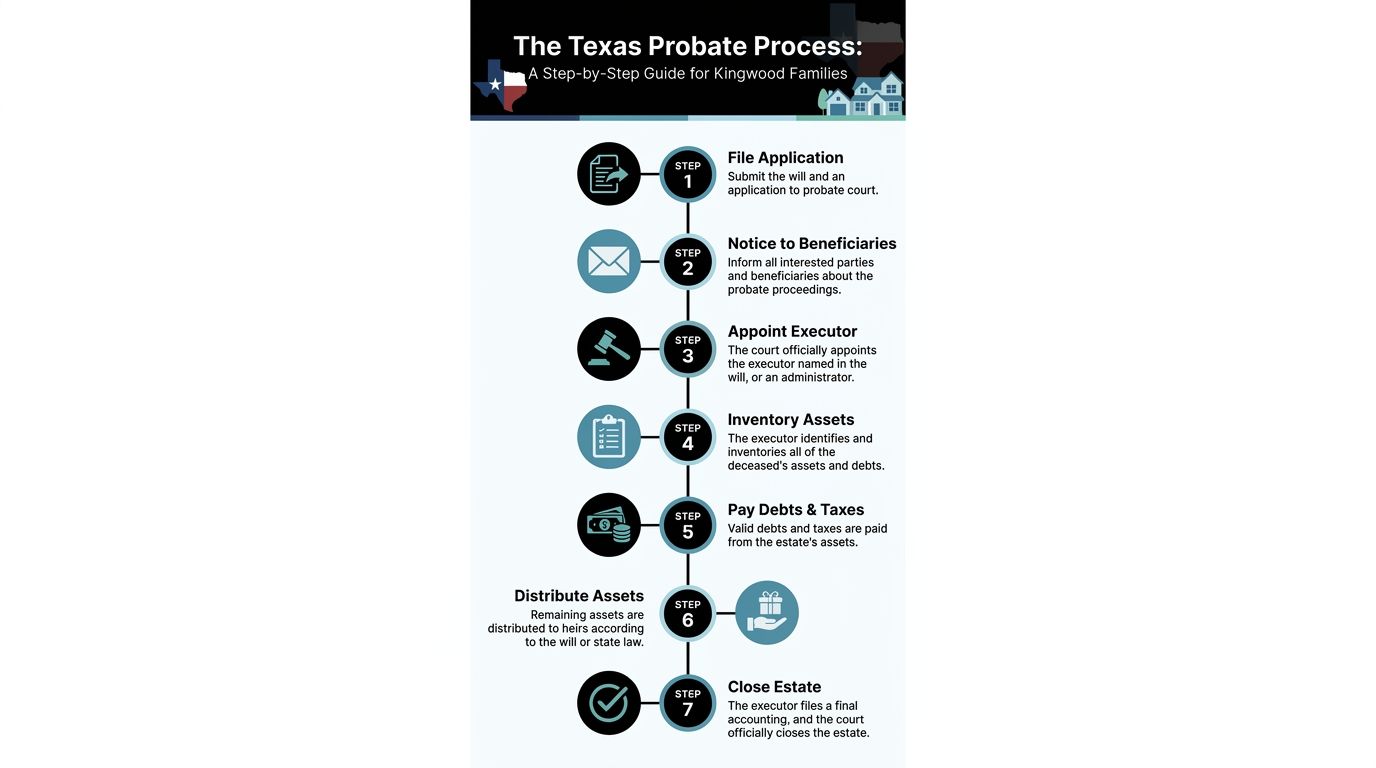
Families usually feel better once they can see the road ahead. Probate may still be emotionally difficult, but the steps are more manageable when you know what comes next.
Below is the general path many Kingwood estates follow through Harris County or Montgomery County.
Step 1 Filing the application
The process often begins by filing an application with the correct probate court. If there is a will, the original will is usually filed with the application.
The first practical question is often, which county handles the estate. For many Kingwood residents, that means Harris County or Montgomery County depending on where the deceased person resided and how the matter should be filed.
At this stage, families often need to gather:
- The original will
- A death certificate
- Basic family and heir information
- A preliminary list of assets
A more detailed walkthrough is available in this guide on how to probate a will in Texas.
Step 2 Court review and appointment
After filing, the court schedules the matter for review. If everything is in order, the court can admit the will to probate and recognize the executor named in it. If there is no will, the court may appoint an administrator.
This is the point where legal authority starts to become real. Banks, title companies, and other institutions usually want proof that the right person has authority to act for the estate.
Some families think being named in the will is enough by itself. In practice, institutions often need formal court-backed authority before they will release information or transfer property.
Step 3 Notice to beneficiaries and interested parties
Once the estate is moving, notices often need to be sent to the right people. Beneficiaries must be informed, and in some situations creditors must receive notice as well.
This step sounds simple, but it can trigger family tension. One sibling may think another is hiding information. A relative in Porter may worry the executor is moving too slowly. Another may believe a certain account should not be part of the estate at all.
Clear communication helps, but legal compliance matters more than family assumptions.
Here is the video version of the process for readers who prefer a visual overview.
Step 4 Gathering and inventorying assets
The executor or administrator must identify what the estate owns and what it owes. This usually includes reviewing mail, account statements, deeds, vehicle records, tax documents, and personal papers.
What counts as an estate asset
Some property passes through probate. Some does not.
Examples that may require close review include:
- A home titled only in the deceased person’s name
- A bank account with no payable-on-death designation
- A vehicle owned individually
- Personal property inside the home
- Business interests or investment holdings
The executor generally creates an inventory or similar filing required by the court. At this point, many people discover that estate administration is less about one dramatic court hearing and more about careful documentation.
Step 5 Paying debts and handling claims
An estate does not distribute everything immediately. Valid debts and expenses usually need to be addressed first.
That may include final bills, certain taxes, and creditor claims handled under Texas procedure. Not every demand should be paid automatically. Some claims are valid. Others may require review, supporting documentation, or a formal response.
Where executors get nervous
Executors often worry they will become personally liable if they make a mistake. That concern is understandable.
Risk usually increases when someone:
- Pays beneficiaries too early.
- Ignores formal notice requirements.
- Fails to keep records.
- Mixes estate money with personal money.
Practical tip: Keep a paper trail from day one. Save letters, account statements, receipts, and every court document in one place.
Step 6 Distributing what remains
After debts, claims, and required filings are addressed, the remaining property can be distributed. If there is a valid will, the distribution follows that document. If there is no will, Texas intestacy rules control who inherits.
This part can still bring conflict. A beneficiary may feel a parent “would have wanted” something different. Another may question whether the executor sold an item for the right amount. Probate does not erase emotion. It gives the process a legal framework.
Step 7 Closing the estate
The final phase involves wrapping up the estate and filing whatever closing documents the court requires. Once the estate is properly completed, the representative’s active role ends.
A simple timeline mindset
It helps to think of probate in three phases:
| Phase | What is happening | What families usually feel |
|---|---|---|
| Opening | Filing, appointment, first notices | Uncertainty and urgency |
| Administration | Inventory, claims, paperwork, communication | Workload and frustration |
| Closing | Distribution and final wrap-up | Relief mixed with caution |
Families in Humble, Kingwood, and Northeast Houston often feel pressure to rush straight to distribution. The smoother path is usually the opposite. Slow down, confirm authority, document everything, and complete each stage in order.
Probate Costs and Simpler Alternatives in Texas
Most families ask about cost early, and that is wise. Probate involves legal work, court involvement, and administrative effort. But formal probate is not the only possible path in every case.
The right question is not just, “How much does probate cost?” The better question is, “Which legal process fits this estate?”
What contributes to probate cost
Probate cost usually depends on the amount of work involved rather than a single flat rule. Common cost drivers include court filings, legal preparation, service requirements, document gathering, title issues, creditor handling, and whether family members agree.
A peaceful estate with a clear will is very different from an estate with missing documents, disputes over property, or uncertainty about heirs.
Costs also rise when people delay action, lose the original will, or try to handle complicated steps without guidance and then have to correct mistakes later.
Simpler probate-related options
Some Texas estates may qualify for less burdensome options than a full administration. That does not mean “no legal process.” It means a different process.
Small Estate Affidavit
This option may help when an estate is relatively simple and meets Texas requirements. It is commonly discussed when there is no will and the estate is modest enough to fit the legal standard.
It can be useful, but families should not assume they qualify just because the estate feels small. The type of property involved matters, especially when a home is part of the estate.
Muniment of Title
If there is a valid will and the situation fits the legal requirements, probate as a Muniment of Title can sometimes provide a simpler route. This approach is often considered when the main goal is transferring title and a full administration is unnecessary.
It can be especially relevant when there are few or no debts that require ongoing estate administration.
Non-probate transfers
Some assets may pass outside probate entirely. That can include accounts with beneficiary designations or property set up to transfer automatically by operation of law or prior planning.
For a broader overview, this guide on how to avoid probate in Texas explains planning tools and transfer methods that may reduce the need for probate in some situations.
Texas Probate Options at a Glance
| Method | Best For | Typical Timeline | Court Involvement |
|---|---|---|---|
| Formal probate administration | Estates with a will or estates needing full authority to collect assets, pay debts, and distribute property | Varies based on the estate and whether complications arise | Ongoing court process with filings and formal steps |
| Muniment of Title | Estates with a valid will where simpler title transfer may be available | Often simpler than full administration | Limited court involvement compared with full administration |
| Small Estate Affidavit | Certain smaller estates that meet Texas requirements, often where no will exists | Often shorter if the estate qualifies and paperwork is complete | Court review, but less extensive than full administration |
| Non-probate transfer | Assets that already pass by beneficiary designation, joint ownership, or other planning tools | Often handled outside the probate timeline | Minimal or no probate court involvement for those assets |
A good way to compare your options
If you are unsure which path fits, start with four questions:
- Is there a will: A valid will opens some options and closes others.
- What property exists: A house, land, or individually owned account can change the analysis.
- Are there debts: Debts may make full administration more appropriate.
- Is the family in agreement: Conflict usually increases complexity.
Helpful rule of thumb: The simplest legal option is only helpful if it fits the estate. Choosing the wrong shortcut often creates more work later.
For Kingwood families, the most cost-effective route is usually the one that fits the facts from the start.
How a Probate Lawyer Lifts the Burden From Your Shoulders
The legal process is one thing. Living through it is another.
An executor may be responsible, organized, and fully willing to help. Even then, probate can become a second job at the worst possible time. There are forms to prepare, institutions to contact, notices to track, family questions to answer, and deadlines that do not pause because someone is grieving.
What a probate lawyer handles
A probate lawyer does more than explain the law. In a practical sense, the lawyer often acts as a guide, document manager, deadline monitor, and buffer between the family and the stress.
That can include:
- Preparing court filings: Applications, notices, inventories, and supporting documents need to be accurate and complete.
- Managing the court process: Hearings, filings, and county-specific requirements need to be handled in the right order.
- Coordinating communication: Beneficiaries, creditors, title companies, and financial institutions may all need information.
- Flagging problems early: Missing documents, unclear asset ownership, or signs of a possible dispute can often be addressed before they grow.
- Protecting the executor: The executor needs guidance on what to do, what not to do, and how to document decisions.
A calmer way through family tension
Probate can stir up old family dynamics. One relative wants updates every day. Another disappears until it is time to receive property. Someone may accuse the executor of favoritism even when the executor is following the will.
A lawyer can reduce that pressure by becoming the point of contact for legal questions and formal communication. That changes the tone. Instead of one sibling arguing with another, the process has a professional structure.
Why local practice matters
A lawyer familiar with Kingwood-area probate work understands more than statewide rules. Local practice includes knowing how Harris County and Montgomery County filings are usually handled, what paperwork tends to slow cases down, and where families commonly get stuck.
The Law Office of Bryan Fagan – Kingwood TX Lawyers handles probate-related matters including estate administration, asset distribution, and related filings for local families through its Kingwood office.
Peace of mind matters: When the legal work is organized and deadlines are tracked, families can spend more energy on healing and less on guessing.
For many people searching for a probate lawyer kingwood tx, that is a primary value. Not more paperwork. Less weight on their shoulders.
Choosing the Right Probate Attorney in Kingwood
Kingwood families have options, and that is a good thing. According to Justia’s Kingwood probate attorney listings, directories list between 24 and 92 dedicated probate attorneys serving the area, and experienced attorneys in this space often bring decades of service and have handled thousands of wills, probate, and estate matters in Kingwood, Humble, and Northeast Houston.
That means you do not need to settle for the first name you find. You can be selective.

What to look for first
Start with fit, not flash.
Local court familiarity
Ask whether the attorney regularly handles probate matters tied to Harris County and Montgomery County. A lawyer who knows the local filing habits and expectations can often spot issues sooner.
Clear communication
Probate clients are often under stress. You should not have to decode legal jargon to understand your own case. Look for someone who answers questions directly and explains the next step in plain English.
A practical approach
Some lawyers focus heavily on litigation. Others focus more on routine estate administration. If your matter looks straightforward, you may want someone who emphasizes efficient handling. If conflict is already brewing, you may need someone comfortable with disputes.
Questions worth asking in a consultation
Bring a short list. Good questions can save a lot of uncertainty.
- How often do you handle probate matters in Kingwood, Humble, or Northeast Houston
- Have you worked with estates like mine, such as a home, blended family, or no will
- What complications do you see right away
- What documents should I gather before anything is filed
- Who will communicate with me about deadlines and court dates
- How are fees structured
A helpful companion resource is this list of questions to ask an estate planning attorney, which can also help probate clients prepare for a first meeting.
Signs to slow down
Not every attorney-client match is the right one. Be cautious if you feel rushed, talked over, or left with more confusion than clarity.
You should also pause if the attorney avoids discussing process, expected responsibilities, or possible obstacles. Probate rarely benefits from vague answers.
A strong consultation should leave you calmer than when you walked in. Even if every answer is not available yet, the path should feel clearer.
For many Kingwood residents, the right lawyer is the one who understands both the law and the family pressure surrounding it.
Your Trusted Partner for Navigating Probate in Kingwood
Probate feels heavy at the start because it arrives during a hard season. A loved one is gone, paperwork starts piling up, and every decision seems more important than you feel ready for.
But the process is not random. It has rules, stages, and options. Some estates need full probate. Others may qualify for a simpler route. Nearly all benefit from careful local guidance, especially when Harris County or Montgomery County procedures come into play for Kingwood families.
If you are trying to sort out a will, determine who should act as executor, handle property in Humble or Northeast Houston, or decide whether probate can be simplified, you do not have to figure it out by trial and error.
A good local probate lawyer helps turn uncertainty into an action plan. That is often the difference between a stressful estate and a manageable one.
Frequently Asked Questions About Kingwood Probate
Do I always need probate after someone dies
No. Some assets pass outside probate, and some estates may qualify for simplified procedures. Whether probate is needed depends on how property was owned, whether there is a valid will, and what legal authority is required to transfer assets.
What if the person lived in Kingwood but owned property somewhere else
The main probate matter is usually filed in the appropriate Texas county tied to the deceased person, but out-of-county or out-of-state property can add complexity. Real estate often requires special attention because title transfer rules matter.
What happens if there is no will
The estate may still need a court process. Instead of following a will, Texas intestacy law determines who inherits. That can surprise families, especially in blended-family situations or where people assumed everything would automatically pass to a surviving spouse.
Can an executor handle probate without a lawyer
Sometimes, but that does not mean it is wise in every case. If the estate includes real property, debts, unclear ownership issues, family disagreement, or county-specific filing questions, legal guidance can prevent expensive mistakes and delays.
How long does probate take in Kingwood
There is no one-size-fits-all answer. Timing depends on the type of estate, how organized the records are, whether anyone contests the process, and how quickly required notices, filings, and responses are completed.
What if the family disagrees about the will
Disagreements do not automatically stop everything, but they can shift the case from routine administration into a more contested matter. If anyone suspects undue influence, lack of capacity, or a problem with the document itself, legal advice should come early.
What documents should I gather before meeting a probate lawyer
Try to bring the will, death certificate if available, a list of close family members, information about the home and major accounts, and any letters you have received from courts, banks, or creditors. Even an incomplete folder is helpful.
Is Harris County or Montgomery County the right court for my case
That depends on the facts. Kingwood touches multiple local jurisdictions in everyday life, so families are often unsure where probate belongs. A local attorney can review the residence and estate details to identify the correct court and filing path.
If you are looking for compassionate, practical help with probate in Kingwood, Humble, Porter, or Northeast Houston, schedule a free consultation with Law Office of Bryan Fagan – Kingwood TX Lawyers. Our Kingwood office can help you understand your next step, evaluate your probate options, and move forward with clear guidance that fits your family’s situation.