When you hear the term "joint custody" in Texas, what comes to mind? For most parents in Kingwood, it’s a 50/50 split of time with their children. But that’s a common misunderstanding. The Texas legal system has its own language, and the term you’ll actually encounter in court is Joint Managing Conservatorship.
This is the starting point for nearly every custody case in Texas. The law presumes that keeping both parents deeply involved in their child's life is what’s best for the child, even after a divorce or separation. It’s the standard, not the exception, and it's a foundation that supports families right here in our community.
What Joint Custody Really Means for Kingwood Families
For families in Kingwood, Humble, and across Northeast Houston, understanding what the law actually says is the first step toward a stable co-parenting future. The key is to stop thinking about a perfect 50/50 division of the calendar and start thinking about a shared division of parental responsibility.
At its core, Joint Managing Conservatorship splits the idea of "custody" into two separate, but equally important, pieces:
- Legal Decision-Making: These are the shared rights and duties to make big-picture decisions for your child. Think education, non-emergency healthcare, and religious upbringing. Both parents get a say.
- Physical Time: This is the possession schedule—the "who has the kids when" part. Typically, one parent is designated as the "primary" conservator who has the exclusive right to decide where the child lives.
The Focus on Shared Decision-Making
The entire Texas framework is built on the idea that a child benefits most when both parents remain active, engaged decision-makers. The court wants to ensure that a divorce doesn't force one parent out of the picture when it comes to the important stuff.
This legal presumption is a huge relief for many parents in communities like Porter and Kingwood. It means that even if you don't have the kids living with you the majority of the time, your voice still matters in their upbringing. The goal is to encourage cooperation, not conflict, providing a reassuring path forward.
To help clear things up, let’s break down the two main components of joint custody.
Understanding Joint Managing Conservatorship
This table breaks down the two main parts of joint custody to clarify what Texas law focuses on for Kingwood parents.
| Custody Component | What It Means for Parents | A Common Misconception |
|---|---|---|
| Rights and Duties (Legal) | This is about shared decision-making power. Both parents have a legal right to be involved in major choices about the child's education, health, and general welfare. The law wants you to work together. | That the "primary" parent gets to make all the final decisions. In reality, most major decisions must be made jointly. |
| Possession and Access (Physical) | This is the actual parenting schedule that outlines where the child spends their time. One parent usually establishes the child's main residence, while the other has a clear, enforceable schedule for visitation. | That "joint custody" guarantees a 50/50 time split. A 50/50 schedule is possible but not the automatic or most common outcome. |
As you can see, the law places a heavy emphasis on parents working together on the big things, which is often more critical than counting overnights. Our guide on shared custody in Texas dives deeper into how these rights are specifically divided.
Custody Time and Real-World Outcomes
So, while the law champions equal parental rights, the physical time with the children often isn't perfectly equal. Yes, 50/50 schedules are more common than they used to be, but statistics show a different reality on the ground.
In Texas, fathers who are non-primary parents typically receive around 33% of the parenting time, a figure that mirrors national averages. So even though the Texas Family Code allows for equal possession schedules when it’s in the child's best interest, the traditional model where one parent has more overnights is still quite common.
Navigating all these legal terms and real-world outcomes can feel like a maze. But you don't have to figure it out alone. The Law Office of Bryan Fagan is right here in Kingwood, ready to help you understand your rights and build a plan for your family. Schedule a free consultation at our Kingwood office to talk through your specific situation with a team that cares.
How Texas Courts Decide the Best Interest of the Child
In any custody case in Harris or Montgomery County, every decision a judge makes comes down to a single, powerful principle: the best interest of the child. This isn't some fuzzy, feel-good concept; it's the legal bedrock for every order involving a joint custody arrangement in Texas. If you're a parent in Kingwood, grasping what this truly means is absolutely essential.
Judges don’t just go with their gut. They follow a specific set of guidelines that came from a famous Texas Supreme Court case. We now call these the "Holley Factors," and they give the court a roadmap for looking at a family's unique situation from every possible angle.
This chart helps visualize how Joint Managing Conservatorship (what most people call joint custody) really works, breaking down the difference between parental rights and the actual possession schedule.
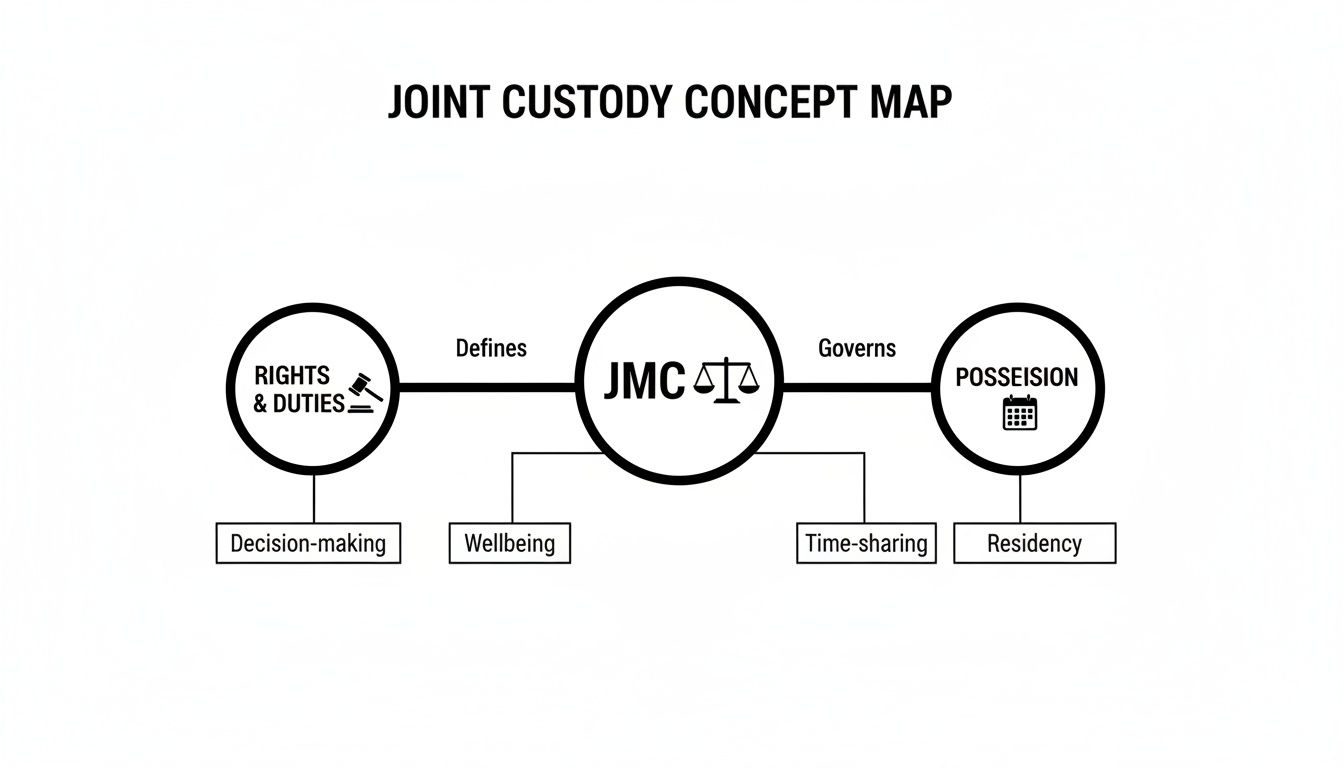
As you can see, the court’s job is to create a plan that balances shared decision-making with a practical living schedule, keeping the child’s well-being at the very center of it all.
Key Factors a Judge Considers
So, what exactly does a judge look at? The Holley Factors aren't a simple scorecard where you can rack up points against the other parent. Think of them as a holistic guide the judge uses to paint a full picture of your child's life.
For families here in Northeast Houston, some of the most critical factors a judge will weigh are:
- The Child's Needs: This is a broad category covering physical and emotional health, developmental stage, and unique needs. The judge wants to know which parent is best prepared to provide a stable and loving home.
- Each Parent's Abilities: The court takes a hard look at each parent’s capacity to raise the child. This includes everything from their parenting skills and emotional maturity to their financial stability.
- Stability of the Home: A judge will closely examine the home life each parent can offer, looking at both the physical environment and the emotional climate.
- Parental Cooperation: This one is huge. A judge is always looking for parents who can set aside their differences and work together for their child's sake. Showing you're willing to co-parent effectively can make a massive difference.
- Any Dangers to the Child: The court has a duty to protect the child from any potential physical or emotional harm, now or in the future. Any history of domestic violence, neglect, or substance abuse will be taken very seriously.
Presenting Your Case in Court
Once you understand what the court is looking for, you can start building a much stronger case. Everything—from your actions and your home environment to how you communicate with the other parent—helps shape the judge's perception. The goal is to show, not just tell, the court that your focus is on what’s right for your child.
A Kingwood judge isn't looking for the "perfect" parent. They're looking for the parent who provides the most stable, supportive, and safe environment for the child to thrive. Your ability to put your child’s needs above your own feelings is paramount.
For most parents, figuring out how to present all this evidence can feel like an impossible task. To help, we've put together a detailed guide on how to prepare for a custody hearing that breaks down the practical steps you can take.
At The Law Office of Bryan Fagan, we know the "best interest" standard inside and out. We help families in Humble, Porter, and Kingwood showcase their strengths and present a clear, compelling case. Our focus is on making sure your story is heard and your child’s future is protected.
Creating a Texas Parenting Plan That Actually Works
When it comes to joint custody in Texas, your parenting plan is the single most important document you will create. Don't think of it as just legal paperwork; it's the official rulebook for your co-parenting relationship. It’s a clear, legally binding guide designed to head off future conflicts and give your child the stability they need. For families here in Kingwood, a well-thought-out plan is the bedrock of a predictable and peaceful future.
A truly effective parenting plan goes way beyond a simple calendar. It anticipates the "what ifs" and provides clear answers before they can escalate into full-blown disputes. Remember, once a judge signs off on this document, it becomes a court order.

Core Elements of a Texas Parenting Plan
To get a judge's approval, every Texas parenting plan has to cover a few essential bases. These elements are non-negotiable and ensure both parents are crystal clear on their roles and responsibilities.
The most critical decision is designating the parent who has the exclusive right to determine the child’s primary residence. This parent is often called the "primary conservator," and their address is what usually determines the child's school district.
From there, a solid plan will spell out the details on:
- Decision-Making Authority: How will you handle big decisions about your child's education, major medical procedures, or counseling? Will you decide together, or will one parent have the final say?
- Possession Schedule: This is the detailed calendar that specifies exactly when the child will be with each parent—covering the school year, summer break, and all the holidays.
- Child Support and Medical Expenses: The plan needs to be clear about who pays for what, from monthly support to health insurance premiums and out-of-pocket medical bills.
- Travel Rules: What are the ground rules for traveling with your child, both inside Texas and out-of-state?
Standard vs. Expanded Possession Orders
For families in Northeast Houston and across the state, Texas law offers a helpful template known as the Standard Possession Order (SPO). It’s a default schedule that typically gives the non-primary parent the child on the first, third, and fifth weekends of a month, plus a 30-day summer visit and alternating holidays.
However, a more popular and often better option is the Expanded Standard Possession Order (ESPO). The ESPO gives the non-primary parent more time by adding Thursday overnights during the school year. It also allows them to pick the child up from school on their Friday and return them to school the following Monday morning. This schedule provides more frequent, consistent contact and is legally presumed to be in a child's best interest as long as the parents live within 100 miles of each other.
The real goal is to build a schedule that fits your family's actual life in Kingwood. The SPO and ESPO are fantastic starting points, but you and your co-parent can agree to almost any custom schedule you believe serves your child's best interest.
Recent updates in Texas law have made joint custody arrangements even more secure. New statutes have raised the bar for nonparents trying to interfere in a custody case, now requiring them to prove both biological parents are unfit—a very tough standard to meet. These changes show the state's strong commitment to protecting co-parenting relationships, and you can learn more about recent family law protections in Texas to see how they might apply to you.
Thinking Beyond the Basics
A good parenting plan covers the legal requirements. A great one goes deeper to address the small, day-to-day things that can cause the most friction down the road.
To save yourself future headaches, think about including specific terms for things like:
- Right of First Refusal: If one parent needs a babysitter for a few hours, do they have to ask the other parent first?
- Communication: How will you two communicate about the child? Agreeing to use a co-parenting app or scheduling a weekly check-in call can be a game-changer.
- Extracurricular Activities: Who gets to sign the child up for soccer or piano lessons? Who pays for the fees and equipment, and how will you manage getting them to and from practice?
- Introduction to New Partners: It can be helpful to agree on a general timeline or set of rules for when and how you introduce a new significant other to your child.
Trying to craft a parenting plan that covers all these bases can feel overwhelming, especially when you're already dealing with so much. The attorneys at The Law Office of Bryan Fagan have helped countless Kingwood families create detailed, practical parenting plans that are built to last. Schedule a free consultation with our team to start building a secure future for your child.
Calculating Child Support in a Joint Custody Case
It's one of the first questions we get from parents in Humble and Porter: "If we have joint custody, does that mean no one pays child support?" It’s a perfectly logical question, but in the joint custody state of Texas, the answer is almost always no. Even when you’re both called Joint Managing Conservators, the financial obligation doesn't just disappear.
Think of it this way: Texas law sees child support as a fundamental right of the child. It’s not about one parent paying the other; it’s about both parents contributing to ensure their child has a consistent, stable standard of living, regardless of which home they’re sleeping in that night.
Because of this, even with a perfectly balanced 50/50 parenting schedule, one parent is almost always ordered to pay child support to the other. Typically, the parent who has the right to determine the child’s primary residence (the primary conservator) receives the payments.

How Texas Calculates Child Support
The state uses a fairly straightforward formula to keep things predictable and fair. It’s not about penalizing anyone; it’s a math problem designed to meet the child’s needs. This is the practical, step-by-step approach the court takes:
First, the court calculates the paying parent's net monthly resources. This starts with all income—wages, salary, bonuses, commissions, you name it—and then subtracts specific, allowable deductions like federal income tax, Social Security taxes, and the amount paid for the child's health insurance.
Once that net monthly figure is nailed down, a set percentage is applied based on how many children need support:
- 1 Child: 20% of net resources
- 2 Children: 25% of net resources
- 3 Children: 30% of net resources
- 4 Children: 35% of net resources
- 5 or more Children: 40% of net resources
This guideline amount is what a court will typically order. It provides a reliable baseline for families across Northeast Houston and the entire state.
The Impact of the New Child Support Cap
For higher-income earners, there’s a ceiling—or "cap"—on the amount of monthly income used in that calculation. This cap is adjusted for inflation every six years, and a big change is coming.
Effective September 1, 2025, the Texas Family Code is raising the child support cap on net monthly resources from $9,200 to $11,700. This reflects the rising cost of living since the last adjustment in 2019 and can lead to a significant jump in monthly payments. As you can explore in more detail about recent Texas Family Code changes, this update is designed to keep support orders in line with today's economic realities.
The new cap means that for parents whose net income is above the old limit, the maximum guideline child support payment is about to increase substantially. The logic is simple: children of high-earning parents should continue to benefit from a standard of living that mirrors their parents' financial success.
Here's a look at how this new cap might affect maximum monthly support obligations.
Impact of the New Texas Child Support Cap
This table shows estimated maximum monthly child support payments based on the new statutory cap, illustrating potential increases.
| Number of Children | Old Max Monthly Support | New Max Monthly Support | Potential Monthly Increase |
|---|---|---|---|
| 1 | $1,840 | $2,340 | +$500 |
| 2 | $2,300 | $2,925 | +$625 |
| 3 | $2,760 | $3,510 | +$750 |
| 4 | $3,220 | $4,095 | +$875 |
| 5+ | $3,680 | $4,680 | +$1,000 |
As you can see, the changes are not minor. They represent a significant shift designed to provide more robust financial support for children in Texas.
Can the Possession Schedule Change the Amount?
Yes, it certainly can, though not always in the way people assume. Having a 50/50 schedule or an Expanded Standard Possession Order (ESPO) absolutely means you're spending more time—and more of your own money—on the kids. But that alone doesn't automatically wipe out a child support obligation.
A judge does have the discretion to deviate from the standard guidelines. If you can clearly prove that your direct expenses are significantly higher because of the nearly equal time you have with your children, the court may agree to an "offset" and order a lower payment. This isn't a guarantee, however. It all comes down to the specific facts of your case and how they are presented.
Calculating child support properly is a detailed process that demands accuracy. At The Law Office of Bryan Fagan, our Kingwood attorneys will make sure your income is calculated correctly and advocate for a fair support order that truly reflects your family’s unique circumstances. Schedule a free consultation with us today to get clarity on your financial responsibilities.
When and How to Modify Your Custody Order
Life in Kingwood is always moving. Kids grow up, parents switch jobs, and what worked for your family last year might feel completely wrong today. That joint custody order, which seemed perfect at the time, might not fit your current reality.
The good news is that in Texas, your parenting plan isn't carved in stone. You absolutely can change it to better suit your family's needs as they evolve.
To get a court to consider changing your custody order, you have to clear one major hurdle first: proving a "material and substantial change in circumstances" has occurred since the judge signed the last order. This is the legal key that unlocks the door to a modification. We're not talking about a minor disagreement or a temporary scheduling conflict; it has to be a significant life event that directly affects your child.
What Qualifies as a Material and Substantial Change?
So what does that legal phrase actually look like for families in Humble or Porter? It’s a pretty broad standard, but it almost always involves major shifts in the lives of the parents or the child.
A court will look at a wide range of situations. Some of the most common examples we see in our Kingwood practice include:
- A Parent is Relocating: If the parent who has the kids most of the time plans to move a significant distance away for a new job or to be closer to family, that’s a big deal and can trigger a modification.
- Living Conditions Have Changed: Has one parent’s home environment become unstable or unsafe? This is a clear-cut reason to revisit the custody arrangement.
- The Child's Needs Have Evolved: As kids grow, so do their needs. The schedule that worked for a toddler is often impossible for a teenager with after-school activities. A child might also develop new medical or educational requirements that need to be addressed.
- The Child's Preference (if they are 12+): Once a child hits age 12, Texas law allows them to speak privately with the judge about their wishes. It’s not the only factor the judge considers, but you can be sure they will give it serious weight.
- Big Swings in Income: A major, involuntary job loss or, on the flip side, a substantial promotion can affect a parent's ability to provide for the child. This often warrants a fresh look at the child support order as well.
The most important thing a court needs to see is that changing the order is truly in the child’s best interest. Proving a change in circumstances is just step one; you must also show how the new arrangement will be better for your child's well-being.
The Step-by-Step Process for Modification
Once you feel you have solid grounds for a modification, the process follows a pretty clear path. While the details of every case are different, the legal steps are fairly consistent for parents across Northeast Houston.
- File a Petition to Modify: It all starts by filing a formal "Petition to Modify the Parent-Child Relationship" with the same court that handled your original custody case. This document lays out the material and substantial change and explains why a new order would be in your child's best interest.
- Serve the Other Parent: The other parent has to be officially notified that you’ve filed a lawsuit. This is called "service of process," and it’s a critical step to ensure they have a legal opportunity to respond.
- Try to Negotiate: Honestly, most modifications are settled outside of court through negotiation or mediation. This is almost always the fastest, cheapest, and most amicable way to land on a new agreement that works for everyone.
- Go to Court (If You Can't Agree): If you and the other parent simply can't find common ground, your case will be presented to a judge. At that point, you'll need to provide evidence and testimony to back up your request for a modification.
Life's changes don't have to spiral into conflict. If your custody order is no longer a good fit, you have options. At The Law Office of Bryan Fagan, our Kingwood attorneys can help you figure out if you have grounds for a modification and walk you through every step. Schedule a free consultation with us to talk about your situation and start building a plan for your family’s new reality.
How Our Kingwood Attorneys Can Support Your Family
Walking into the Texas family court system by yourself can be incredibly intimidating. The stakes couldn't be higher—your children's future is on the line. Between the confusing legal jargon, the strict deadlines, and the sheer emotional weight of it all, it's easy to feel lost. For families here in Kingwood, Humble, and Porter, having a local attorney on your side isn't just about having a lawyer. It's about having a compassionate guide who actually knows this community and understands what you're going through.
At The Law Office of Bryan Fagan, we're not just some downtown law firm. We're your neighbors here in Northeast Houston, and we're dedicated to giving families the empathetic, experienced support they need to get through a joint custody case, from start to finish.
Practical Support Every Step of the Way
Our job is to take those complicated legal standards and turn them into real-world, practical solutions that work for your family. Think of us as your advocates, making sure your side of the story is heard and your rights as a parent are protected.
Here’s what that looks like in practice:
- Skillful Negotiation: We'll dive into the details and negotiate a parenting plan that’s fair, comprehensive, and genuinely puts your child first. Our goal is always to find common ground and resolve things without a messy court battle, if at all possible.
- Financial Accuracy: We make sure child support is calculated correctly, based on a true picture of net resources and accounting for critical costs like health insurance. No guesswork.
- Clear Guidance: We’ll break down every option you have in plain English. We want you to feel confident and empowered to make the right decisions for your family's future.
- Courtroom Advocacy: If you and the other parent simply can't agree, we are ready to be your strong voice in the courtroom. We’ll build a compelling case and present it clearly to the judge on your behalf.
Your peace of mind is our priority. We handle the legal complexities so you can focus on what matters most—supporting your children through this transition.
Your Local Kingwood Legal Team
Knowing the ins and outs of the joint custody state of Texas is one thing, but having an attorney who is a familiar face in the Harris and Montgomery County courts provides a real advantage. We are deeply invested in the well-being of our community and the families who make it a great place to live.
For a deeper dive into our philosophy, feel free to explore our resources on Texas child custody law and see how we help families just like yours. We’re here to bring clarity and support to a confusing process.
You don't have to go through this alone. The Law Office of Bryan Fagan is right here in Kingwood, ready to offer the trusted, client-focused representation you deserve. We invite you to schedule a free, no-obligation consultation at our Kingwood office to talk about your situation. Let's figure out the best path forward for you and your family, together.
Common Questions About Joint Custody in Texas
When you're trying to figure out joint custody, the legal jargon can feel like a foreign language. As family law attorneys in Kingwood, we get it. We've sat down with countless parents just like you, and we tend to hear the same questions pop up time and time again.
Let's cut through the noise. Here are some straightforward answers to the questions we hear most often from families in Kingwood, Humble, and across Northeast Houston.
Can We Agree to a 50/50 Possession Schedule in Texas?
Absolutely. In fact, Texas law wants you to. If you and the other parent can sit down and hammer out a 50/50 possession schedule that you both agree is best for your child, a judge will almost certainly sign off on it.
Think of it this way: when you bring an agreed-upon plan to a judge in Harris or Montgomery County, you're showing them you can work together for your child. That’s a huge win in their eyes. The trick is to make sure your plan is detailed, realistic, and truly puts your child’s well-being first.
Who Decides Where Our Child Goes to School?
This is a big one and a common source of confusion. Even when you have joint custody and share most decisions, the court order has to give one parent the exclusive right to designate the child's primary residence. This isn't optional; it's a legal requirement in Texas.
That parent is often called the "primary conservator," and their home address is what determines the child’s public school district. You can absolutely agree to send your child to private school or live in a certain area, but without a specific agreement, the school follows the primary parent's address.
It's crucial to understand this: being named the "primary" parent isn't about being the "better" parent. It's a practical tool the court uses to create a stable, predictable home base for a child's education and daily routine.
What if the Other Parent Violates the Custody Order?
A court order isn't a suggestion—it's the law. If the other parent is ignoring the possession schedule or breaking another part of your order, you have the power to do something about it. The legal tool for this is called a "motion for enforcement."
Filing this motion with the court officially asks the judge to step in and force the other parent to follow the rules. Depending on how serious the violation is, a judge can order several different remedies:
- Make-up possession time for any days you lost with your child.
- Fines or court costs, forcing the non-compliant parent to pay.
- In serious or repeated cases, a judge can even order jail time for contempt of court.
It’s incredibly stressful when a co-parent won't cooperate, but you don't have to just accept it. The system has tools built-in to protect your rights and your child's stability.
Trying to manage the details of a joint custody agreement can feel like a heavy burden, but the right legal partner can make all the difference. At The Law Office of Bryan Fagan – Kingwood TX Lawyers, we're dedicated to giving our neighbors clear, practical guidance. If you have more questions or need to discuss your situation, we're here to help. Schedule a free consultation with our team by visiting us at https://kingwoodattorneys.com.