Skip to content
When a family in Kingwood loses someone they love, the legal side often arrives before the grief has had time to settle. A son may be handed a banker’s box with a will, property records, old tax returns, and a few sticky notes. A surviving spouse in Humble may know where the house deed is, but not whether the bank account needs court approval. An adult daughter in Porter may be trying to help from out of town while also fielding calls from relatives who all want answers.
That is where harris county probate kingwood issues usually begin. Not in a courtroom, but at a kitchen table.
Probate is not automatically a fight. In many estates, it is the legal process for recognizing a will, appointing the right person to act, paying valid debts, and transferring property the right way. The hard part is that the system has rules, deadlines, and local court practices that are not obvious if you have never been through it before. Families in Kingwood and Northeast Houston do better when they treat probate as a structured project instead of a mystery.
Losing a Loved One in Kingwood The First Steps
A common local scenario looks like this. Someone passes away, and by the weekend the family is sorting papers in a home near Kingwood Drive or over in Humble. One person finds the will. Another finds insurance information. Someone else says the deed is in a file cabinet. Nobody is sure what has to be filed, what can wait, or whether touching any account creates a problem.
That confusion is normal.
The first step is not rushing to the courthouse. The first step is gathering the basics and slowing the process down enough to make good decisions.
Start with documents, not assumptions
Look for:
- The original will: A copy may help you understand intent, but the original matters.
- Death certificates: Financial institutions and the court often require certified copies.
- Property and account records: Deeds, vehicle titles, bank statements, retirement statements, and business records.
- A debt snapshot: Mortgage statements, credit cards, medical bills, and tax notices.
Some families also run into uncertainty before probate even begins because the death certificate is not final yet. If that happened in your family, this explanation of deferred on a death certificate can help you understand why that wording appears and what it may mean for timing.
What not to do in the first few days
Grieving families in Northeast Houston often create problems by acting too quickly.
Keep personal money and estate money separate from day one. Even well-meant shortcuts can create suspicion later.
Avoid these early mistakes:
- Do not distribute property too soon: A promise made in the living room is not the same as legal authority.
- Do not ignore mail: Bills, court notices, and bank letters often tell you what needs attention.
- Do not assume a will avoids court: Sometimes it does not.
- Do not rely on verbal family agreements alone: They may fall apart once assets are identified.
Probate feels intimidating because it uses formal language for ordinary family tasks. It is a process for carrying out a person’s affairs in an orderly way. For Kingwood families, the advantage of getting local guidance early is not drama control. It is error prevention.
Determining if Probate is Required for the Estate
The first legal question is simple. Do you need probate?
Not every estate in Kingwood, Humble, or Northeast Houston requires a full probate case. The better way to think about it is this. Probate is the key that unlocks assets still stuck in the deceased person’s individual name. If an asset already has its own transfer mechanism, the court may not need to be involved for that item.

Assets that often require probate
Probate is commonly needed when property was owned solely by the deceased and no beneficiary or transfer device takes it outside the estate.
Examples include:
- A house titled only in the deceased’s name
- A bank account with no payable-on-death beneficiary
- An investment account owned individually
- A vehicle title with no automatic transfer path
- Claims belonging to the estate itself
Real estate is where many families in Kingwood get stuck. If the home cannot be sold, refinanced, or formally transferred because title remains in the deceased owner’s name, probate may be the tool that clears the path. This plain-language article on What Is Probate In Real Estate gives a useful overview of why property title issues so often drive the process.
Assets that may pass outside probate
Some assets move by contract or by ownership structure instead of by court order.
These often include:
- Life insurance with a named beneficiary
- Retirement accounts with a valid beneficiary designation
- Accounts with payable-on-death or transfer-on-death designations
- Trust assets
- Some jointly owned property, depending on how title is held
Families often discover that the estate is partly probate and partly non-probate. That is common. One account may transfer directly, while the house still requires court action. If you want a practical breakdown, this page on probate and non-probate assets is a useful starting point for sorting what belongs in which category.
A quick Kingwood checklist
Ask these questions:
- Was there a valid will?
- Did the deceased own real estate in their name alone?
- Are there bank or investment accounts with no named beneficiary?
- Did major assets already sit in a trust or pass by designation?
- Will a title company, bank, or buyer demand court-issued authority?
If the answer to the property and title questions is yes, probate is often necessary.
What works and what does not
What works is building an asset-by-asset map. Write down each account, parcel of real estate, vehicle, and debt. Then identify how each item is titled.
What does not work is making a global assumption such as “there was a will, so we’re fine” or “Mom had very little, so no court is needed.” Sometimes a modest estate still needs a probate filing because one key asset cannot move otherwise.
Probate is not triggered by grief or family consensus. It is triggered by how assets are owned and what institutions require before they will release control.
For harris county probate kingwood matters, this early sorting step saves time, reduces unnecessary filings, and helps families choose the right process instead of the most intimidating one.
How to Open a Probate Case in Harris County
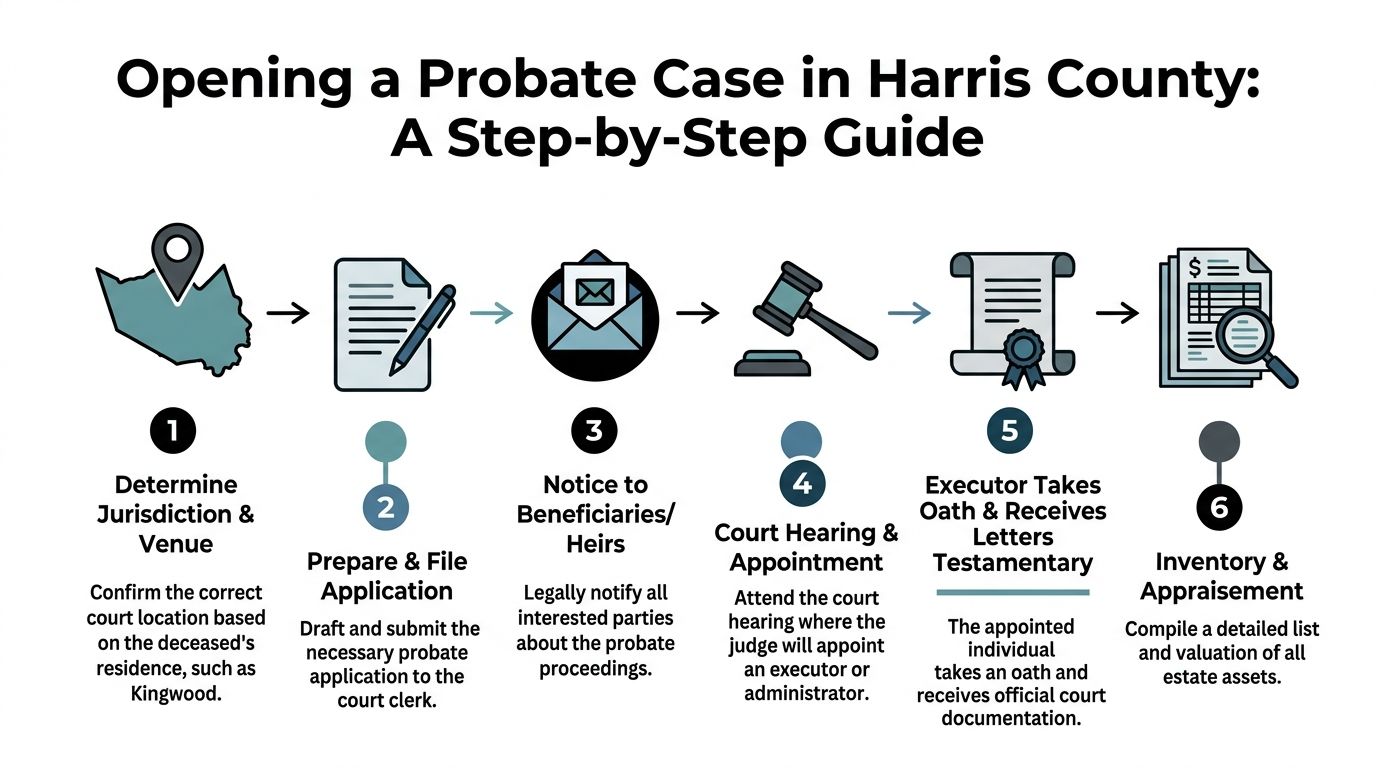
Opening a probate case is easier when you know the sequence. Families in Kingwood often feel overwhelmed because they think the process starts with a hearing. It does not. It starts with choosing the right procedure and filing the right paperwork in the right court.
Harris County uses a specialized probate system. It operates five statutory probate courts. Courts 1 through 4 are located at 201 Caroline St., Houston, and there is a uniform $360 filing fee for most new proceedings, including probate of a will, administration, or heirship determination. Attorneys must e-file applications, while pro se filers are exempt but encouraged to do so, as described in this discussion of understanding the probate courts in Harris County, Texas.
Choose the right probate path first
Before filing anything, identify the legal vehicle that fits the estate.
The main options include:
- Independent administration: Usually the most practical route when the will supports it or the heirs can agree. Court involvement is lighter after appointment.
- Dependent administration: More court supervision, often used when extra oversight is necessary.
- Muniment of title: An efficient option in the right estate.
- Heirship determination: Often needed when someone dies without a will and heirs must be formally identified.
- Small estate affidavit: Available only in specific situations.
Many families in Porter and Kingwood want to start filing immediately. That urge is understandable, but filing the wrong type of case can waste time and create avoidable expense.
Prepare the application carefully
The application must match the facts of the estate. Details matter. Names, dates, addresses, and the requested authority should all be checked closely.
If there is a will, the original must be treated carefully. In Harris County practice, attorneys e-file the application through eFileTexas.gov and deposit the original will with the County Clerk within the required time window. Pro se filers are not required to e-file, but many still benefit from understanding the same filing sequence.
For a more detailed Texas-focused walkthrough, this resource on how to probate a will in Texas can help you understand what the paperwork is trying to accomplish.
Notice and citation matter
Once filed, the case does not jump straight to approval. The court requires notice.
Harris County probate procedure includes posted citation before the hearing, and some case types require other forms of notice. That notice gives interested parties an opportunity to respond.
What works here is patience and accuracy. What does not work is treating notice as a technicality.
When notice is handled correctly, the hearing tends to focus on whether the legal requirements are met. When notice is mishandled, even a simple estate can stall.
A hearing often follows within a few weeks of filing in routine matters. The exact setting depends on the court and the nature of the case.
The video below gives a helpful overview of the probate process in practical terms.
What happens at the hearing
A routine hearing is usually straightforward. The judge or court reviews whether:
- The will is admissible, if there is one
- Venue is proper
- Notice requirements were met
- The proposed executor or administrator is qualified
If approved, the personal representative takes an oath and receives the authority needed to act for the estate.
Court-specific practice matters
This is one place where local experience pays off. The five Harris County probate courts handle the same broad subject matter, but standing orders and hearing practices can differ. Some matters may proceed remotely, while others, especially contested cases, may require in-person appearances and additional procedural steps.
That difference matters to Kingwood residents because the trip into downtown Houston is only part of the issue. The larger issue is filing and preparing in a way that matches the assigned court’s expectations.
A practical sequence for families in Kingwood
Here is the cleanest filing workflow:
- Confirm the estate type and likely procedure
- Gather the original will and key records
- Draft the application with exact party information
- File in the correct Harris County probate court
- Handle citation and notice properly
- Prepare the witness or applicant for hearing
- Take the oath and obtain the court’s letters
- Move into administration without delay
Some families handle parts of this themselves. Others use counsel for all of it. One local option is the Law Office of Bryan Fagan’s Kingwood office, which handles probate filings and estate administration for clients dealing with Harris County procedure from Northeast Houston. Whether a family chooses that office or another probate lawyer, the important part is choosing someone who works comfortably with the Harris County probate system rather than treating it like a generic county filing.
Simplified Alternatives to Full Probate
A lot of Kingwood families assume probate means a full court case downtown. In Harris County, that is not always true. Some estates qualify for shorter procedures that solve a narrower problem without opening a full administration.
The two options that come up most often are muniment of title and a small estate affidavit. Each can save time and expense. Each can also create delay if used for the wrong estate.
When a simpler route makes sense
A muniment of title works for estates with a valid will when no ongoing administration is needed. In plain terms, it is often the right fit when the family needs to transfer title, especially real property, and there are no unpaid debts other than secured debt tied to property.
That point matters in Kingwood. Many estates here involve a home that has been in the family for years, and the immediate concern is getting title records cleaned up so a sale, refinance, or transfer can move forward. In that situation, muniment of title may do the job without appointing an executor for a full administration.
A small estate affidavit is narrower. It is available only when there is no will, and Texas law limits it to estates where the value of the estate, excluding the homestead and exempt property, does not exceed $75,000, as set out in the Texas Estates Code provisions on small estate affidavits. Even if the numbers work, the paperwork still has to be exact, and all distributees must line up correctly.
Harris County Probate Options at a Glance
| Procedure | Best For | Typical Timeline | Estimated Cost | Court Oversight |
|---|---|---|---|---|
| Independent Administration | Estate with a valid will or agreement that supports lighter supervision | Often more efficient than heavily supervised proceedings | Filing fees, attorney fees if used, and estate-specific costs | Lower after appointment |
| Dependent Administration | Estates needing closer supervision or lacking authority for independent administration | Often slower because more court approval is required | Higher than simplified options because of added procedure | Higher |
| Muniment of Title | Valid will, limited need for ongoing administration, often property-focused estates | Often more efficient than full administration | Usually less than a full administration, depending on the facts | Limited |
| Small Estate Affidavit | Intestate estates that meet the statutory requirements, including the value cap described above | Often simpler if the estate qualifies | Generally lower than full probate, but still requires careful preparation | Limited but still formal |
Trade-offs families should understand
The appeal is obvious. Lower cost, fewer steps, and less court involvement.
The trade-off is authority. A muniment of title does not give someone the broad powers an executor receives in a full administration. A small estate affidavit can help transfer certain assets, but banks, title companies, and other institutions sometimes scrutinize them closely or ask for corrections when family history, heirship, or asset classification is unclear.
That is where local experience matters. A Kingwood estate may look simple on paper, then turn complicated because the home is in one spouse’s name, an out-of-state child needs to sign, or a financial institution will not accept the documents without extra proof. The legal option may still be available, but the practical path gets narrower.
Questions to ask before choosing an alternative
- Is there a will?
- Are there unpaid debts that call for active administration?
- Does someone need formal authority to deal with a bank, buyer, or title company?
- Is the main problem transferring title to a house or other property?
- Will every heir or beneficiary cooperate and sign what is needed?
A simplified procedure saves time only when the estate fits the rule.
For harris county probate kingwood matters, that usually means slowing down long enough to classify the estate correctly before filing anything. Families in Kingwood often want the fastest route. The better goal is the route the Harris County probate court will accept the first time.
The Executor's Guide to Managing an Estate
Being named executor sounds honorable. It is also work. Once the court appoints you, you become a fiduciary. That means you must act for the estate’s benefit, not your own convenience.
In Harris County, efficiency in the courts helps, but it does not eliminate the executor’s obligations. Harris County Probate Court No. 1 reported a 128.8% clearance rate from March 1, 2024, to February 28, 2025, resolving 3,092 cases against 2,401 new or reopened cases, while still carrying 5,687 active cases at year-end 2024. Executors should still expect the probate process to take several months to a year or more depending on complexity, as noted in this report on Harris County Probate Court No. 1.

Phase one, secure and identify the estate
Start with control.
That usually means:
- Collecting mail and records
- Locating bank, brokerage, and property information
- Securing real estate and valuable personal property
- Separating estate assets from anyone’s personal funds
If you are serving in this role, this guide to the responsibilities of executor of a will provides a solid practical overview of the job.
Phase two, notify the right people
Executors often think administration is mostly about assets. In reality, communication matters just as much.
That includes:
- Beneficiaries and heirs
- Creditors who must receive proper notice
- Banks and financial institutions
- Insurance carriers and title-related parties when needed
Silence creates suspicion. Clear updates reduce family friction.
Phase three, inventory and claims
One of the executor’s most important jobs is preparing a reliable inventory of estate property and dealing with claims in the correct order.
Do not estimate casually. Do not rely on memory. Use records.
Good executors document everything. They keep statements, save receipts, and create a timeline of what was received, paid, and distributed.
Phase four, pay valid debts and distribute correctly
The executor is not supposed to pay every bill that arrives without question. The executor is supposed to evaluate claims, pay valid obligations from estate assets, and preserve what belongs to beneficiaries.
Only after debts, expenses, and required legal steps are handled should distributions begin.
What works and what causes trouble
What works:
- A dedicated estate account
- Written updates to beneficiaries
- A current asset list
- Professional help with title, tax, and court filings when needed
What causes trouble:
- Mixing funds
- Informal loans to family members
- Early distributions
- Assuming court appointment gives unlimited discretion
Kingwood executors usually do best when they treat administration like a formal business project with family consequences. That mindset helps them stay careful, calm, and credible.
Common Probate Pitfalls in Harris County
A common Kingwood scenario looks like this. The family has a will, everyone says they want to keep things peaceful, and the estate seems straightforward. Then a deadline gets missed, an account is handled informally, or one heir hears updates through another relative instead of from the executor. That is how manageable probate cases in Harris County turn expensive.
The mistakes that cause trouble here are usually procedural, but the consequences are personal. Delays can affect access to a home, vehicle title work, sale timing, and family trust. In Kingwood, where many estates involve a longtime residence, blended families, or adult children living in different parts of Houston, small administrative errors tend to grow fast.
Missing required deadlines
One of the first places executors get into trouble is timing. Harris County probate cases come with filing deadlines, and the court expects them to be taken seriously. An inventory, appraisement, and list of claims is often due soon after appointment unless the case qualifies for a different filing approach.
The practical problem is bigger than any court cost or sanction. A missed deadline tells the court, and everyone watching the case, that the estate may not be organized.
Put every deadline in one place on day one. Include court dates, notice requirements, inventory due dates, and follow-up dates for banks, appraisers, and tax documents. Families in Kingwood often juggle storm repairs, vacant-home upkeep, and property insurance questions at the same time. Deadlines do not pause for any of that.
Handling estate money informally
This issue creates more disputes than people expect.
A son pays for lawn service at the decedent's house and reimburses himself from an account. A surviving spouse moves funds to cover immediate expenses without a paper trail. A sibling takes an advance and calls it temporary. Each step may feel reasonable in the moment, but informal transfers are hard to defend later.
Estate funds need clean separation from personal funds. Reimbursements should be documented. If there is any doubt about whether a payment is proper, pause and get advice before money moves.
Keeping heirs in the dark
Poor communication turns routine administration into suspicion. I see this often with Kingwood families who are trying to avoid conflict by staying quiet. Silence usually has the opposite effect.
Written updates help. They do not need to be long or legalistic. A short email or letter explaining what has been filed, what assets are still being confirmed, what bills are under review, and what has to happen before distributions can calm a case down considerably.
That is especially true when heirs live outside Kingwood and do not see what is happening with the home, vehicles, or mail. Lack of information invites assumptions.
Ignoring local court practice
Harris County probate is not just Texas probate in the abstract. Each court has its own expectations about filings, settings, and how lawyers and self-represented parties present matters. A document that seems acceptable in theory can still draw a correction request or a reset if it does not match local practice.
That catches Kingwood residents off guard because the courthouse is downtown, the property is out in northeast Harris County, and the process can feel remote until something stalls. Local procedure matters on hearing settings, proposed orders, and the details that keep a case moving instead of sitting.
Letting family tension run the estate
Family conflict does not need to rise to a formal contest to damage an estate. It is enough for one person to start making side promises, another to demand early distributions, and a third to question every expense after the fact.
Executors should keep boundaries clear:
- Do not promise specific property before authority is confirmed
- Put major decisions in writing
- Use the will, court orders, and estate records as the reference point
- Get counsel involved before disagreements harden into positions
A careful executor does not need to satisfy everyone. The job is to follow the law, protect the estate, and keep a clear record. In Harris County probate, that approach prevents many of the problems that cost Kingwood families the most time and money.
Frequently Asked Questions about Kingwood Probate
What happens if someone dies without a will in Kingwood
The estate may still need a probate proceeding. The difference is that the court is no longer following a written will. Instead, Texas intestacy rules determine who inherits and who can serve as administrator.
In practical terms, that often means more paperwork and more family fact-gathering. The court may need proof of family relationships and heirship before property can move.
Can probate be contested in Harris County
Yes. A probate case can become contested if someone challenges the will, the proposed executor, or the way the estate is being handled.
Common disputes involve claims that a will is invalid, that someone exerted undue influence, or that a representative is not acting properly. Once a case becomes contested, the tone changes. Discovery, witness issues, and more formal court appearances may follow. At that point, local probate counsel is usually important.
Can an out-of-state executor handle a Harris County estate
Sometimes, yes. But being out of state can make the process less convenient.
The executor still has to comply with Harris County procedure, provide required documents, communicate with institutions, and manage deadlines. If the estate includes property in Kingwood or elsewhere in Northeast Houston, local help often makes administration smoother even when the named executor lives elsewhere.
How long will a probate case take
There is no single answer because the timeline depends on the estate’s complexity, debt issues, family cooperation, and the procedure used.
Some estates move in an orderly way. Others take much longer because title issues, creditor concerns, or disputes slow things down. Families usually do better when they focus less on guessing the finish date and more on completing each legal step correctly.
Do all heirs have to agree
No. Agreement helps, but probate does not always require universal family harmony.
A valid will can still be admitted even when someone is unhappy, assuming the legal requirements are satisfied and no successful contest is brought. In estates without a will, disagreements among relatives can make things harder, especially when heirship facts are unclear.
What if the main asset is a house in Kingwood
Then the title question becomes central. Buyers, title companies, and lenders usually want clear legal authority before property can be sold or transferred.
That is one reason families often discover they need probate even when there is not much cash in the estate. The home is the issue, not necessarily the overall size of the estate.
Can a family handle probate without a lawyer
Some people file on their own, especially in simpler matters. But probate is less forgiving than many families expect.
The risk is not only making a legal mistake. It is choosing the wrong procedure, missing a local court requirement, or creating title problems that surface later when property is sold. For many Kingwood families, a short consultation early on prevents a much bigger problem later.
What should I bring to a probate consultation
Bring whatever you have, even if the file is incomplete.
Useful items include:
- The will and any codicils
- Death certificate
- A list of known assets and debts
- Names and contact information for heirs and beneficiaries
- Any court notices or correspondence already received
- Deeds, statements, and insurance paperwork if available
The right next step in a harris county probate kingwood matter depends on facts, not guesswork. A good consultation turns scattered papers into a plan.
If your family in Kingwood, Humble, Porter, or Northeast Houston is trying to figure out what to do after a loss, the Law Office of Bryan Fagan – Kingwood TX Lawyers offers free consultations at the Kingwood office. A probate attorney can review the will, identify whether probate is required, explain the available procedures, and help you choose a practical path forward under Texas law.