If you're facing a misdemeanor charge in Kingwood, the first and most important thing to understand is that an arrest is not a conviction. So, can misdemeanor charges actually be dropped in Texas?
Absolutely. It happens more often than you might think, and there are several well-established legal avenues that can lead to a complete dismissal, allowing you to move on with a clean slate.
Understanding Your Path to a Dismissal
Being charged with a crime can be an overwhelming experience, making you feel like the odds are stacked against you. But for anyone in Kingwood, Humble, or anywhere in Northeast Houston, it’s vital to remember that the prosecutor has the entire burden of proof. They must prove their case beyond a reasonable doubt, and their case isn't always as solid as it first appears.
A skilled attorney often finds weaknesses that can be used to your advantage. A case might get dropped for a number of reasons, and each one demands a different strategic approach. The road to a dismissal isn't always a straight line, but knowing the possibilities is the first step in building a defense.
Some of the most common reasons for a dismissal include:
- Insufficient Evidence: The prosecutor simply might not have enough credible proof to convince a jury you're guilty.
- Constitutional Rights Violations: If evidence was gathered illegally—say, through an improper search of your car or home—it can be suppressed and thrown out of court.
- Successful Completion of a Program: In some cases, alternatives like pre-trial diversion programs can result in a full dismissal once you've met the program's requirements.
This flowchart gives you a visual breakdown of the key decision points that can lead to a misdemeanor dismissal.
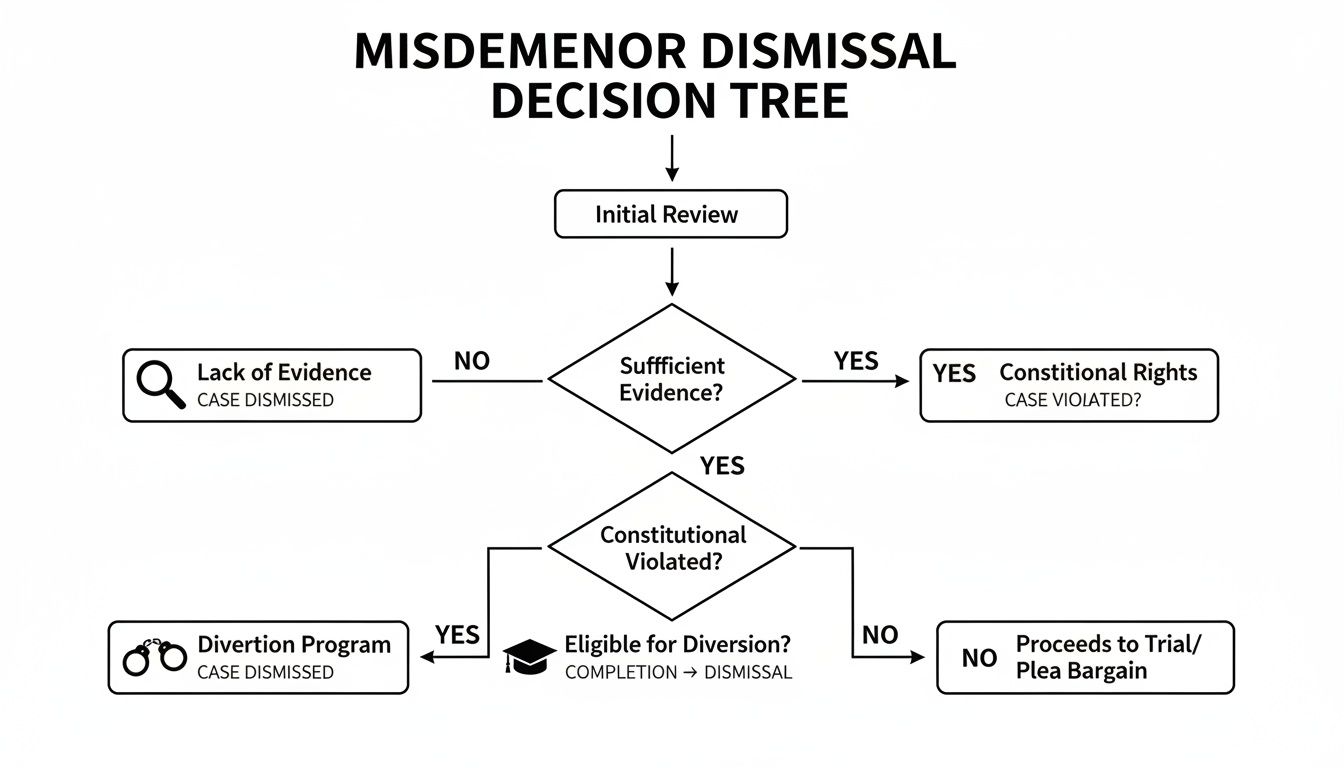
As you can see, getting a case dismissed can stem from problems with the evidence itself, mistakes made by law enforcement, or your own successful participation in an alternative resolution program.
Navigating these pathways requires a deep understanding of Texas law and local court procedures. Here's a quick summary of the most common routes to getting a misdemeanor charge dismissed.
Common Pathways to Misdemeanor Dismissal in Texas
| Dismissal Pathway | Brief Description | Who Makes the Decision? |
|---|---|---|
| Prosecutorial Discretion | The prosecutor decides not to pursue the case due to weak evidence, witness issues, or other factors. | The District Attorney's Office |
| Motion to Suppress | Your attorney files a motion to exclude illegally obtained evidence, gutting the prosecutor's case. | The Judge |
| Pre-Trial Diversion | You complete a program (e.g., classes, community service), and the charge is dropped upon successful completion. | The Prosecutor (with court approval) |
| Deferred Adjudication | You plead "guilty" or "no contest," complete probation, and the case is dismissed, avoiding a final conviction. | The Judge |
| Not Guilty Verdict | You are found not guilty after a trial. | A Judge or Jury |
Each of these scenarios presents a real opportunity to protect your record, but timing and strategy are everything.
Why Early Action Matters
The key is to be proactive. The time right after an arrest is absolutely critical for your defense. An experienced local Kingwood attorney can get to work immediately—investigating the facts, preserving crucial evidence, and opening lines of communication with the Harris County prosecutor's office on your behalf. This early intervention often creates the best opportunity to argue for a dismissal before the case really gets going.
At The Law Office of Bryan Fagan, we firmly believe that every Kingwood resident deserves a robust defense. We dig into every detail of your case to uncover the most effective strategy for getting your charges dropped.
Don't let a misdemeanor charge dictate the rest of your life. You have options, and you don’t have to figure this out alone. If you or someone you care about is dealing with a charge in the Kingwood area, contact us for a free, confidential consultation. Let our dedicated Kingwood team review your situation and explain how we can fight to protect your rights and your future.
Understanding What a Misdemeanor Charge Means in Texas
Before we can even talk about getting a misdemeanor charge dropped, we need to be crystal clear on what one means for you and your family here in Texas. A misdemeanor is a criminal offense, and while it's considered less severe than a felony, the consequences can still ripple through your life, affecting your job, finances, and reputation right here in the Kingwood community.
Think of it this way: not every storm is a hurricane, but even a strong thunderstorm can cause some real damage. A misdemeanor conviction is a lot like that. It might not be a felony, but it can still lead to fines, jail time, and a permanent criminal record that follows you around. Getting a handle on the seriousness of the charge is the very first step in building a smart defense.
The Texas Penal Code breaks down misdemeanors into three distinct classes, and each one comes with its own set of potential punishments. The class of the charge all depends on how serious the alleged offense is.
The Three Classes of Texas Misdemeanors
Our state laws are very specific about the penalties for each type of misdemeanor. Understanding where your charge falls on this spectrum helps you grasp exactly what's at stake.
- Class C Misdemeanor: This is the lowest level. These offenses are punishable only by a fine, which can be up to $500. Common examples are things like traffic tickets, public intoxication near a park in Kingwood, or stealing something worth less than $100.
- Class B Misdemeanor: Now we're getting more serious. A conviction here can mean up to 180 days in county jail and a fine as high as $2,000. Things like a first-offense DWI, shoplifting items from a Humble store valued between $100 and $750, or possessing a small amount of marijuana often fall into this category.
- Class A Misdemeanor: This is the most serious misdemeanor you can face. The penalties can include up to one full year in county jail and a fine of up to $4,000. Charges like assault that causes bodily injury or a second DWI are typically classified as Class A misdemeanors.
The classification of the charge definitely plays a role in how willing a prosecutor might be to consider a dismissal. They might be more open to dropping a Class C public intoxication charge than a Class A assault, but every single case is different. A well-crafted legal argument can make a huge difference, no matter the charge.
How These Charges Impact Your Case
Knowing these classifications is so important because it sets the stage for everything that comes next, starting with your first court appearance. That first formal step is usually the arraignment hearing, which is where the charges are officially read to you and you're asked to enter a plea. To get ready for that critical day, you can learn more about what happens at an arraignment hearing in our detailed guide.
It's crucial to remember this: a charge is just an accusation from the state. It is not proof of guilt, and it is certainly not the final word. The prosecutor still has the burden to prove their case beyond a reasonable doubt, and that’s where the opportunities to get a case dismissed often pop up.
Interestingly, while facing a misdemeanor can feel like a very personal and lonely experience, it’s worth noting some broader trends. Across major cities in the U.S., misdemeanor arrests have actually dropped significantly. Research that tracked several cities found that arrest rates per 100,000 residents fell by as much as 76% in some areas from their peak years. This data points to a potential shift in how law enforcement and prosecutors view low-level offenses, which can sometimes work to your advantage.
Facing any charge, whether it's a simple ticket or a serious Class A misdemeanor, is daunting. At The Law Office of Bryan Fagan, our Kingwood attorneys are here to help you make sense of it all and fight for your rights. We give clear, practical advice to help our neighbors in Northeast Houston navigate the legal system. Call us today for a free consultation to talk about your case.
Key Reasons Prosecutors Dismiss Misdemeanor Cases

If you're facing a misdemeanor charge in Harris County, it's easy to feel like the prosecutor has all the power. But the truth is, their decision to move forward with a case isn't always set in stone. Prosecutors have something called prosecutorial discretion, which is a simple way of saying they get to decide whether to file charges, what charges to file, and, most importantly, when to dismiss a case altogether.
This discretion is exactly where a savvy Kingwood defense attorney can make a real impact. We don't just take the state's story at face value. Our job is to dig in, analyze every report and piece of evidence, and find the cracks in their case. When we can show a prosecutor that their case is weak or that pursuing it isn't in the interest of justice, we can often convince them to drop the charges.
Let's walk through some of the most common reasons a prosecutor might decide your misdemeanor case isn't worth taking to trial.
Lack of Sufficient Evidence
By far, the most common reason for a dismissal is that the state’s case is just plain weak. The U.S. Constitution is clear: you are innocent until proven guilty. That means the entire burden of proof is on the prosecution. They have to prove every single element of the crime beyond a reasonable doubt, which is the highest standard in our legal system.
Think about it like this: say you were charged with a DWI in Porter. If the officer’s dashcam video is so grainy you can't see any bad driving, or if records show the breathalyzer machine was overdue for calibration, that evidence gets wobbly. A good attorney will pounce on these issues and show the prosecutor that getting twelve jurors to agree on a conviction is going to be a tough, if not impossible, sell.
Without solid, credible evidence, a prosecutor's case is just a collection of accusations. Our job is to expose those weaknesses and show that the state cannot meet its high burden of proof.
Violations of Your Constitutional Rights
Police officers don’t get to make up the rules as they go. They have to follow strict procedures grounded in the Constitution when they investigate a crime, make an arrest, or gather evidence. Your rights—like the right to be free from unreasonable searches (Fourth Amendment) and the right to remain silent (Fifth Amendment)—are not optional guidelines. They are the law.
If a cop in Northeast Houston pulls you over without a legitimate reason or searches your car without probable cause, any evidence they find can be tossed out. We do this by filing a legal tool called a Motion to Suppress Evidence.
Some of the most common rights violations that can get a case dismissed are:
- Illegal Stop or Search: The police didn't have the reasonable suspicion or probable cause required to stop you or search your property.
- Failure to Read Miranda Rights: You were questioned in custody without being properly informed of your right to remain silent and your right to an attorney.
- Improper Police Lineup: A witness ID was tainted because the police used a suggestive or flawed lineup procedure.
When we get a key piece of evidence suppressed, it can completely gut the prosecutor’s case, leaving them with no other option but to dismiss the charges.
Witness Credibility and Cooperation Issues
Many misdemeanor cases, particularly things like assault or theft, hinge on witness testimony. But what if the main witness against you isn't believable? If they have a criminal history involving dishonesty, for example, their credibility is immediately called into question.
Other times, the person who made the complaint simply changes their mind and doesn't want to cooperate anymore. While the prosecutor makes the final call, a witness who refuses to show up or is hostile to the state makes it incredibly difficult to prove a case. Without the accuser there to testify, the case often just crumbles.
The impact of getting a case dropped is huge. A Cato Institute study found that defendants whose misdemeanor cases were dismissed were 33 percentage points less likely to get a new criminal complaint within two years. That's a massive 58% reduction in recidivism compared to people who were prosecuted. It goes to show that a dismissal can genuinely help you move on with your life. You can learn more about how prosecutorial discretion affects future outcomes.
At The Law Office of Bryan Fagan, we know how to poke holes in the prosecution's case. If you're in Kingwood, Humble, or anywhere nearby and are worried about a misdemeanor charge, give our office a call for a free consultation. Let's talk about your situation and figure out a strategy to get your charges dropped.
Finding Alternatives to a Criminal Conviction
When you're facing a misdemeanor charge, it's easy to feel like the walls are closing in. A common fear we hear from our clients in Kingwood and Humble is that the evidence is just too strong to fight, and a conviction is inevitable. But that’s rarely the whole story.
Even if the facts seem stacked against you, a permanent conviction is far from a foregone conclusion. The Texas justice system actually has built-in pathways that offer a second chance—opportunities that can lead to a complete dismissal. Our job is to find the right path for you and negotiate hard to get you there.
Two of the most effective tools in our legal arsenal here in Harris County are pre-trial diversion programs and deferred adjudication. While both can help you walk away without a conviction, they get you there in very different ways. Knowing the difference is crucial for protecting your future.
Pre-Trial Diversion: Your Path to a Full Dismissal
Think of pre-trial diversion as a formal, off-the-record agreement between you and the prosecutor's office. It’s a chance to show them that the alleged offense was a one-time mistake, not a pattern of behavior. In simple terms, the prosecutor agrees to hit the "pause" button on your case.
Instead of battling it out in court, you agree to complete a specific set of requirements. These aren't meant to be purely punitive; they're often constructive. Common conditions include things like:
- Attending educational classes, such as an anger management or drug awareness course.
- Putting in a certain number of community service hours in the Kingwood area.
- Paying restitution to a victim if money or property was involved.
- Most importantly, staying out of trouble for a set amount of time.
If you check every box and complete all the requirements successfully, the prosecutor dismisses the charge. It’s gone. This is a fantastic outcome, particularly for first-time offenders in Northeast Houston, because a conviction never even touches your record.
Deferred Adjudication: Avoiding a Final Conviction
Deferred adjudication works a little differently and brings the judge into the picture. With this option, you plead "guilty" or "no contest" in front of the court. But here's the key: instead of finding you guilty right then and there, the judge defers (or postpones) that finding.
From there, you’re placed on community supervision—what most people call probation—with a list of conditions to follow for a specific period. It feels a lot like pre-trial diversion. If you complete the probation successfully without any slip-ups, the judge dismisses the case. The huge win here is that you avoid a final, formal conviction. For instance, our firm often negotiates deferred adjudication when clients want to know how to get assault charges dropped but don't want to risk a trial.
There's a catch, though. If you violate the terms of your deferred adjudication, the judge can bring you back to court, find you guilty on the spot, and sentence you to any punishment within the full range for that crime, including jail time.
Choosing between these options requires a careful legal strategy. Pre-trial diversion is generally the preferred route because it doesn't require a plea, but deferred adjudication is a powerful alternative when diversion isn't on the table.
Figuring out which road to take is a critical decision, and it depends entirely on the specifics of your case. To help our Kingwood-area clients see the difference more clearly, here’s a quick breakdown.
Pre-Trial Diversion vs. Deferred Adjudication in Harris County
This table compares two of the most common pathways to avoiding a misdemeanor conviction. Understanding these key differences is the first step toward making an informed decision about your case.
| Feature | Pre-Trial Diversion | Deferred Adjudication |
|---|---|---|
| Plea Requirement | No plea of guilty is required. | A plea of "guilty" or "no contest" is required. |
| Who Offers It? | Negotiated directly with the Prosecutor's Office. | Offered by the Judge as a sentencing option. |
| Outcome on Success | Case is dismissed; charges are dropped. | Case is dismissed; no final conviction is entered. |
| Consequence of Failure | The case proceeds to trial as it would have before. | The Judge can find you guilty and impose a sentence. |
| Best For | First-time offenders with minor charges. | Cases where evidence is challenging but a conviction must be avoided. |
These alternatives can feel overwhelming, but they also offer real hope. You don't have to navigate this complex system on your own. At the Law Office of Bryan Fagan, we have extensive experience with the diversion programs and court procedures right here in Harris County.
If you’re in Kingwood or a surrounding community, give us a call. We’ll sit down with you for a free, confidential consultation, explain your options in plain English, and start building a defense designed to protect your record and your future.
How Your Attorney Fights to Get Charges Dismissed

When you hire a defense attorney, you're not just getting a representative; you're bringing a skilled fighter into your corner. You shouldn't be a passive bystander in your own case. By partnering with the right local Kingwood lawyer, you start actively challenging the prosecution's story and fighting back. A proactive defense is hands-down the most important factor in improving the odds of getting your misdemeanor charges dropped.
The moment you hire us, the state’s version of events is no longer the only one that matters. We immediately launch our own investigation, treating the police report not as the final word, but as a starting point to be picked apart. Our goal is to find the details the state overlooked or misinterpreted—the very details that can dismantle their case, piece by piece.
Building Your Defense from the Ground Up
A strong defense begins with a meticulous review of every shred of information. This is more than just reading reports; it's about questioning everything. We gather all available evidence, from police bodycam footage to witness statements, and analyze it for inconsistencies, procedural mistakes, and constitutional violations.
This step-by-step process involves several critical actions:
- Conducting an Independent Investigation: We don't take the police's work at face value. We might go to the scene of the alleged incident in Humble, re-interview witnesses to get their unfiltered story, and look for evidence or people the police may have missed entirely.
- Scrutinizing Police Procedures: We examine every single step of the arrest. Did the officer have a legitimate reason to stop you? Were you read your Miranda rights before they started questioning you? Any misstep can become a powerful tool for your defense.
- Analyzing All Evidence: We look at breathalyzer calibration logs, lab reports, and video footage with a highly critical eye. Sometimes, a tiny technical error is all it takes to make a key piece of evidence inadmissible in court.
A Kingwood Story of Diligence
Not long ago, we represented a client from Northeast Houston charged with possession. The police report seemed cut and dry, but one small detail caught our attorney's eye: the officer’s report was vague about why he started the search in the first place. We filed a motion demanding the dashcam footage, which ultimately revealed the officer had no legal basis—no probable cause—to search our client’s car.
We immediately filed a Motion to Suppress Evidence, arguing that everything found during that illegal search had to be thrown out. The judge agreed. Without that evidence, the prosecutor's case completely fell apart, and the charges were dismissed. This is the kind of diligent, detail-oriented work we bring to every single case in the Kingwood community.
Challenging the Prosecution’s Case in Court
Once our investigation is complete, we use what we've found to attack the state's case head-on. This often involves filing targeted legal motions designed to weaken their position before a trial can even begin. A key part of an attorney's strategy often involves writing persuasive legal briefs to present their arguments effectively to the court.
These actions can force a prosecutor's hand, making a dismissal the most logical option. The goal of a strong defense is to show the prosecutor that moving forward is a losing battle for them. This is exactly the kind of strategic advocacy our Kingwood criminal defense attorneys provide.
The decision to drop charges often comes down to leverage. By building a powerful, evidence-based defense, we create the leverage needed to negotiate a dismissal from a position of strength.
This proactive approach isn't just about legal maneuvering; it's about changing lives. Research confirms that when prosecutors choose not to pursue nonviolent misdemeanors, it has a profoundly positive impact. One study found that adults whose cases were dropped were 81% less likely to face new complaints over the next five years, proving that a dismissal can genuinely break the cycle of involvement with the justice system.
If you're facing a misdemeanor charge, don't wait. Contact The Law Office of Bryan Fagan for a free consultation at our Kingwood office. Let's start building your defense today.
Taking the First Step to Protect Your Future
Being charged with a misdemeanor in Kingwood can leave you feeling overwhelmed, with a million questions running through your mind. If there’s one thing to take away from all this, it’s that an arrest is not a conviction. You absolutely have options. As we've walked through, getting a misdemeanor charge dropped is a real possibility, and a skilled attorney has many ways to fight for that outcome.
We can challenge the evidence, scrutinize every detail of the police report, or negotiate for alternatives like diversion programs. The path to a dismissal exists, but the clock is ticking. That initial period right after an arrest is a crucial window for your defense attorney to get to work before the prosecutor's case solidifies.
You shouldn't have to face the Harris County justice system by yourself. Going it alone is a huge risk, and the process can be incredibly confusing. One wrong move could derail your entire case, putting your job, your family, and your standing in the community on the line.
Don’t let fear or uncertainty make decisions for you. The best thing you can do right now is get clear, confidential legal advice based on the specifics of your situation.
At The Law Office of Bryan Fagan, we're not just lawyers who work in the area—we are part of the Kingwood community. We're here to help our neighbors in Kingwood, Humble, and across Northeast Houston get the focused, local legal support they need. We get what’s at stake for you.
We invite you to schedule a free, no-obligation consultation with our Kingwood team. It's a chance for us to hear what happened, answer your questions, and start laying out a real strategy to protect your future. Call The Law Office of Bryan Fagan today and take that first critical step.
Frequently Asked Questions About Misdemeanor Charges
After digging into the legal strategies and different paths a case can take, it's natural to have more specific questions. People we work with in the Kingwood area often ask about the practical, day-to-day realities of their situation. Let's tackle some of the most common concerns that come up when you're facing a misdemeanor charge here in Harris County.
How Long Does It Take to Get a Misdemeanor Dismissed in Harris County?
This is the big one, and everyone wants to know. The honest answer? It varies. There's just no single timeline that fits every case. We've seen dismissals happen in a matter of weeks, while others can stretch out for several months or even longer.
What causes such a wide range? A few key things come into play:
- Case Complexity: Is it a simple situation with a clear-cut evidence problem? That might get resolved fairly quickly. Or does your case need a deeper investigation and more back-and-forth? That will take more time.
- Court Schedules: The Harris County courts are packed. Simply getting on the docket for hearings can create delays that are out of anyone's control.
- Prosecutor’s Caseload: The prosecutor handling your case is juggling dozens, if not hundreds, of other files. Their schedule and how open they are to negotiation can seriously impact the timeline.
The best way to push for a faster resolution is through early intervention. When you have an attorney involved right from the start, they can get to work immediately—preserving evidence, opening a line of communication with the prosecutor, and starting negotiations before the case gets bogged down in the system. If you're just starting out, understanding the immediate actions after an arrest is a crucial first step before you even begin to think about the charge itself.
Will a Dropped Charge Still Appear on a Background Check?
Yes, and this is a critical detail people often overlook. Getting a case dismissed is a huge win, but it does not automatically wipe the slate clean. The record of the arrest, the original charge, and the final dismissal can all still pop up on background checks for jobs, apartment leases, or loans.
To truly make it disappear, you have to take the next step: expunction. An expunction is a completely separate legal process where your attorney files a petition asking the court to order the destruction of all records related to your arrest. If the judge grants it, it’s like it never happened. You can legally deny the arrest ever occurred, giving you a truly fresh start.
Can I Talk to the Prosecutor Myself to Get My Case Dropped?
In a word: don't. While the idea of just explaining your side of the story and clearing things up seems logical, it's an incredibly risky move. The prosecutor is not your advocate; their job is to build a case against you.
It is shockingly easy to say something—even with the best intentions—that can be twisted or used to hurt your defense down the road. Every word you say to them can be noted in your file and used as evidence. Let your lawyer do the talking. An experienced Kingwood attorney knows exactly how to frame the facts, what to say, and more importantly, what not to say to protect your rights and argue your case effectively.
Trying to make sense of the legal system on your own can be overwhelming, but you don't have to face it alone. The team at The Law Office of Bryan Fagan – Kingwood TX Lawyers is here to give you straight answers and build a defense that protects your future. Schedule your free, confidential consultation at our Kingwood office today.