When a marriage comes to an end, most people in our community immediately think of one option: divorce. But there's another, less common path called an annulment of marriage in Texas, which doesn't just end a marriage—it declares that a valid marriage never legally existed in the first place.
Is an Annulment an Option for You in Kingwood?

If you live in Kingwood, Humble, or anywhere in Northeast Houston, it’s easy to assume that divorce is the only way out of a marriage that isn't working. An annulment, however, operates on a totally different legal principle.
Think of it this way: a divorce ends a legally binding contract. An annulment, on the other hand, proves that the contract was fundamentally flawed from the very beginning and was never enforceable. It essentially erases the marriage from your legal record, treating it as if it never happened.
This is a significant distinction, but getting an annulment isn't easy. The Texas Family Code lays out very specific, narrow reasons—or "grounds"—that a judge will accept. The standard of proof is much higher than it is for a standard no-fault divorce.
Understanding the Basics of Annulment
Before we get into the legal details, let's clarify the core concept. An annulment isn’t a quick divorce or a simple way to get out of a short marriage you regret. It's a formal declaration from a court that no valid marriage ever existed.
This is always based on something that was true at the moment you said, "I do." A few common examples that Kingwood residents might face include:
- One person was still legally married to someone else.
- The marriage only happened because of fraud or force.
- Someone was underage and didn't have the required parental consent.
- The couple is too closely related by blood to marry legally in Texas.
Each of these grounds comes with its own set of strict requirements for proof. It's also worth noting this applies to both traditional and informal marriages. An experienced attorney can help you determine if your relationship qualifies as a common law marriage, as these can also be annulled if the right conditions are met.
Why Local Legal Guidance Is Essential
Figuring out if you qualify for an annulment requires a deep dive into Texas law and your personal circumstances. These cases often involve very sensitive information, so you need to be able to speak freely with an attorney. Knowing how attorney-client privilege rules work is key, as it ensures your conversations are completely confidential and protected.
The court process for an annulment is often more complicated than a divorce because the burden of proof is on you. You can't just say you want out; you have to convince a judge that your specific grounds are valid under Texas law.
At The Law Office of Bryan Fagan, our Kingwood attorneys provide clear, straightforward advice. We’ll help you understand whether an annulment is a realistic path for you and guide you with empathy and local expertise. [Schedule a free consultation] (https://www.bryanfagan.com/contact-us) at our Kingwood office to talk through your situation with a lawyer who understands our community.
Understanding the Grounds for Annulment in Texas

If you're looking to get a marriage annulled in Texas, you can't just tell a judge it was a bad idea. You have to prove that a specific, legally recognized reason—what we call "grounds"—existed the very moment you said, "I do." It’s a high bar to clear.
Texas law splits these grounds into two completely different buckets: void marriages and voidable marriages. Getting a handle on this distinction is the first and most critical step for anyone in Kingwood, Humble, or Northeast Houston thinking about annulment.
One type was never legal in the first place, while the other is considered valid until a court steps in to nullify it.
Void Marriages: Invalid from the Start
A void marriage is one that was illegal from the moment it happened. Think of it as a marriage that legally never existed, even if you had a ceremony and a license. Under the Texas Family Code, it’s invalid from day one, with or without a court order.
So why file for an annulment? It's really about cleaning up the public record and getting an official court declaration that confirms the marriage was never valid.
There are only two scenarios that create a void marriage in Texas:
- Bigamy: One person was already legally married to someone else at the time of the wedding. That second marriage is automatically void—no exceptions.
- Consanguinity (Incest): The couple is too closely related by blood or adoption. Texas law is very specific here, prohibiting marriage between a parent, child, sibling, aunt, uncle, niece, or nephew.
For these situations, the law is black and white. The union simply has no legal standing.
Voidable Marriages: Valid Until Proven Otherwise
This is where most annulment cases fall. A voidable marriage is different because it's considered legally valid… until a court says it isn't. Something was fundamentally wrong with the circumstances of the marriage, giving one spouse the right to ask a judge to erase it.
It's a bit like a flawed contract that one party can choose to cancel. But there’s a catch.
A key rule with voidable marriages is that you can’t keep living together as a couple after you discover the problem. If you do, the court will likely say you’ve “ratified” or accepted the marriage, flaws and all, and you’ll lose your chance at an annulment.
Let’s break down the specific grounds for a voidable marriage that our clients in the Kingwood area frequently ask about. To make it clearer, here is a table outlining the grounds recognized by Texas law.
Grounds for Annulment in Texas Explained
| Ground for Annulment | Type (Void or Voidable) | Brief Description |
|---|---|---|
| Bigamy | Void | One spouse was already married to someone else at the time of the wedding. |
| Consanguinity (Incest) | Void | The spouses are too closely related by blood (e.g., parent-child, siblings). |
| Underage Marriage | Voidable | A spouse was between 16 and 17 and married without parental consent or a court order. |
| Under the Influence | Voidable | A spouse was so intoxicated by alcohol or drugs they couldn't consent to the marriage. |
| Impotency | Voidable | One spouse was permanently impotent, the other spouse didn't know, and they haven't lived together since finding out. |
| Fraud, Duress, or Force | Voidable | A spouse was tricked or coerced into the marriage against their will. |
| Mental Incapacity | Voidable | A spouse lacked the mental capacity to understand they were getting married due to a mental defect or disease. |
| Concealed Divorce | Voidable | A spouse hid the fact they had divorced someone else within 30 days before the wedding. |
As you can see, most grounds fall into the "voidable" category, which requires swift action once the issue is discovered.
A Closer Look at Common Voidable Grounds
1. Marriage Under the Influence
If one person was under the influence of alcohol or narcotics to the point they didn't have the mental capacity to agree to the marriage, it can be annulled. The crucial detail is that the person seeking the annulment must not have voluntarily lived with the other spouse after sobering up.
2. Impotency
This applies if one spouse was permanently impotent when they got married, the other spouse didn't know, and they stopped living together as soon as the issue came to light.
3. Fraud, Duress, or Force
This is one of the most common grounds, but it can be tough to prove in a Northeast Houston court.
- Fraud: This isn't just about a small lie. You have to prove your spouse made a significant, intentional misrepresentation that you relied on to agree to the marriage. A classic example is a spouse who lies about their ability or desire to have children. Just suspecting your spouse married you for a green card isn't enough; you need hard evidence they made a specific, false promise that tricked you into the marriage.
- Duress or Force: This means you were threatened or physically forced into the marriage against your will.
For any of these, the clock starts ticking the moment you discover the fraud or are free from the threat. You must stop living together immediately.
4. Mental Incapacity
A marriage can be annulled if a court determines one person didn't understand what was happening at the wedding ceremony because of a mental disease or defect.
5. Concealed Divorce
This one has a strict deadline. If you discover your spouse divorced someone else less than 30 days before you got married and they hid it from you, you have exactly one year from the date of your marriage to file for an annulment.
Figuring out if your situation fits one of these legal boxes is the hardest part of the process. The evidentiary standards are high, and the facts matter immensely. This is precisely where having an experienced local family law attorney from Kingwood on your side can make all the difference.
The attorneys at The Law Office of Bryan Fagan in Kingwood are here to help you navigate these complexities. We can sit down with you, listen to the facts of your case, and give you a straight answer about whether you have valid grounds for an annulment in Texas. Schedule a free consultation with our team to explore your options.
The Step-by-Step Annulment Process in Harris County
Thinking about an annulment can feel like navigating a maze. For anyone in Kingwood and Northeast Houston, knowing the specific steps in Harris County can make all the difference, turning a confusing process into a clear path forward.
An annulment of marriage in Texas isn't a single event but a series of legal milestones. Below, we've mapped out the journey from start to finish so you know exactly what to expect at every turn. It’s a roadmap to help you understand the process and see why having local legal guidance is so important.
Step 1: Confirming Your Eligibility with a Kingwood Attorney
Before a single piece of paper is filed, the absolute first step is making sure you actually have legal grounds for an annulment. This isn't something you can just assume. The requirements are incredibly strict, and moving forward without a valid reason can be a painful waste of time, money, and emotional energy.
This is where sitting down with an experienced Kingwood family law attorney is crucial. During a free, no-obligation consultation at The Law Office of Bryan Fagan, we'll:
- Listen to your story and the unique details of your marriage.
- Compare your situation against the specific grounds for annulment laid out in the Texas Family Code.
- Give you an honest, straightforward assessment of whether you have a strong case.
- Talk through the kind of evidence you’ll need to prove your claim in court.
This initial conversation is completely confidential. Our goal is to give you clarity and a solid sense of direction right from the get-go.
Step 2: Preparing and Filing the Right Paperwork
Once you and your attorney agree that you have a case, it's time to kick off the legal process. This starts with preparing and filing an Original Petition to Annul Marriage. Think of this document as the foundation of your entire case.
Your petition has to be filed with the District Clerk’s office in the correct county—for our clients in Kingwood, Humble, and nearby areas, that's usually a Harris County courthouse. The petition will identify you and your spouse, confirm you meet Texas residency requirements, and most importantly, clearly explain the specific legal grounds you're using to request the annulment.
Getting this document right is non-negotiable. Even small errors or omissions can cause major delays. Our team knows the ins and outs of Harris County’s filing procedures, and we make sure your paperwork is prepared and filed correctly the first time.
Step 3: Legally Notifying the Other Spouse
After your petition is on file with the court, Texas law is very clear: your spouse must be formally notified about the lawsuit. This is known as service of process. A simple text message or phone call won't cut it; the notification has to follow strict legal rules.
There are a couple of ways this can play out:
- Waiver of Service: If your spouse is on board with the annulment, they can sign a "Waiver of Service." This document is filed with the court and basically says, "I know about the lawsuit and I don't need to be formally served." It's the most straightforward and peaceful option.
- Personal Service: If your spouse won't sign a waiver, a professional process server or a sheriff’s deputy will have to hand-deliver a copy of the petition and a legal notice (called a citation) directly to them.
Proper service is a legal must-have that protects everyone's rights. If it isn't done correctly, your case will grind to a halt.
Step 4: Presenting Your Case in Court
Unlike a simple no-fault divorce, which can sometimes be finalized without ever seeing a judge, an annulment always requires a court hearing. You have to physically go to court and prove your case.
This is where everything comes together. You and your attorney will present testimony and evidence to back up your claim. For instance, if you're arguing fraud, you might show the judge emails, text messages, or have a witness testify about a lie that tricked you into the marriage.
The judge will carefully listen to your side, look at the evidence, and decide if you've met the high legal standard Texas requires for an annulment. Having an attorney who is familiar with the Harris County judges and their perspectives on these cases can be a real advantage.
Step 5: Receiving the Final Decree of Annulment
If the judge is convinced by your evidence, they will grant the annulment. The final piece of the puzzle is the Final Decree of Annulment, a legal document your attorney drafts. This is the official court order that declares your marriage void.
Both you and your spouse (or your attorneys) will sign the decree, and the judge’s signature makes it law. Once that signed decree is filed with the District Clerk, your marriage is legally nullified. It’s the document that officially restores your status as a single person, as if the marriage never happened.
The annulment process has its complexities, but you don't have to figure it out on your own. If you’re in Kingwood, Humble, or anywhere in Northeast Houston and think an annulment might be right for you, contact The Law Office of Bryan Fagan. Schedule a free consultation with our experienced team today to get the clear, supportive guidance you deserve.
Annulment vs. Divorce: The Critical Differences for Kingwood Families
In everyday conversation around Kingwood, people often use “annulment” and “divorce” interchangeably. While both legal actions end a marriage, Texas law treats them as completely separate roads with very different destinations. Getting a handle on these differences is the crucial first step in figuring out the right path for your family.
Simply put, a divorce ends a marriage that was legally valid. An annulment, on the other hand, is a court order that declares a valid marriage never existed in the first place because of a specific legal problem at the time you said, "I do."
What’s the Real Legal Difference?
The heart of the matter is the legal status of your marriage. Think of it this way: a divorce is like legally terminating a valid contract. An annulment is like proving that the contract was invalid from the very start—maybe due to fraud or a critical mistake.
- Divorce: Confirms a valid marriage existed and is now being legally dissolved.
- Annulment: Declares the marriage was never legally valid to begin with.
This isn't just a legal technicality; it has real personal and social weight. For many Kingwood residents, an annulment offers a clean slate, essentially erasing the marriage from the legal record as if it never happened. But because the requirements are so strict, it’s a much less common option than divorce.
Splitting Up Assets: Restoring vs. Dividing
The way property is handled also highlights the stark contrast between these two processes. In a Texas divorce, the court divides community property—that’s everything you acquired during the marriage—in a way that is "just and right." The goal is a fair, equitable split. You can learn more about this in our guide on how to file for divorce in Texas.
An annulment tackles property from a completely different perspective. Since the law considers the marriage to have never existed, there's no "community property" to divide.
The court's goal in an annulment isn't to split assets between spouses. Instead, it’s to restore both people to the financial position they were in before the invalid marriage. This means sorting out who owns what as separate property and giving it back.
This can be straightforward if the marriage was brief. However, for many families in Humble or Porter, it can get messy quickly if you've mixed funds, bought property together, or put both names on titles.
The annulment process itself, while legally complex, follows a few core steps.
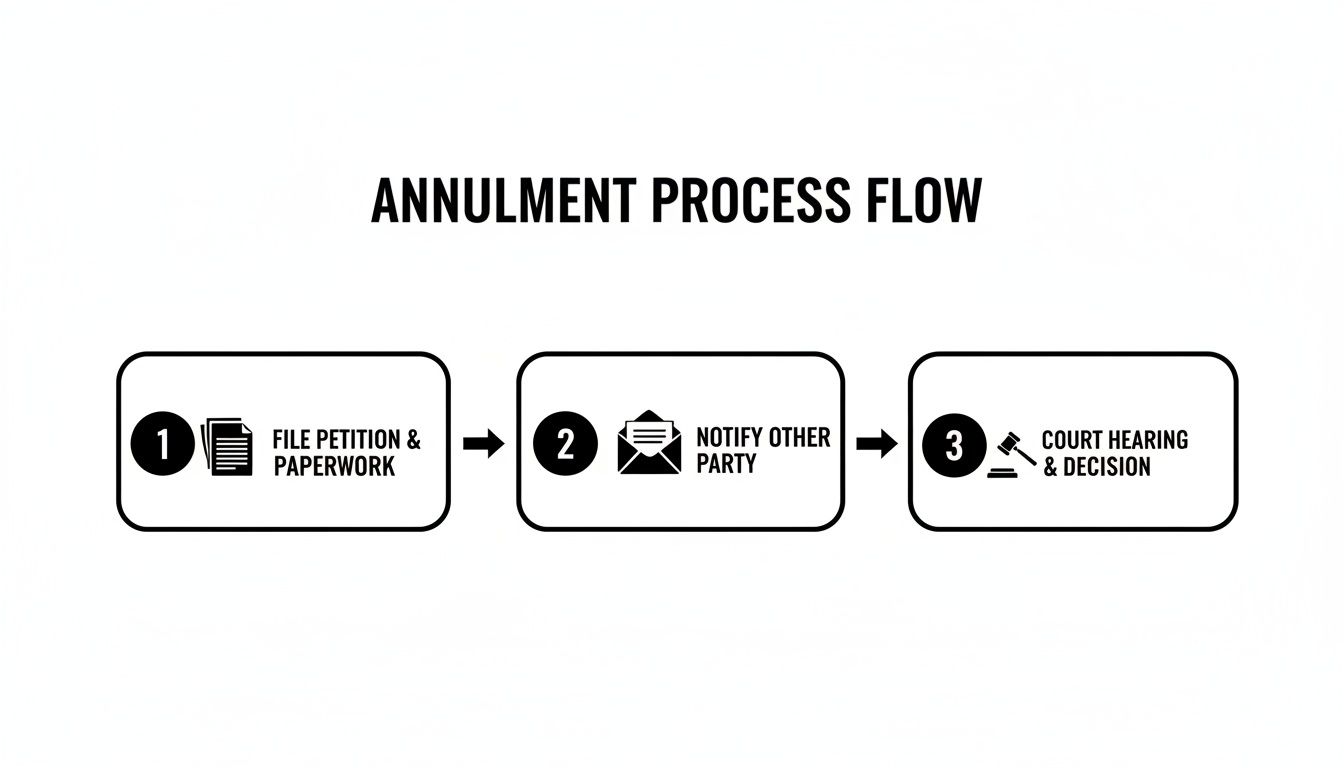
As you can see, every annulment case begins with filing a formal petition with the court and ends with a judge's final ruling.
A Quick Comparison
To make the differences even clearer, here's a side-by-side look at the two.
Annulment vs. Divorce in Texas at a Glance
| Aspect | Annulment | Divorce |
|---|---|---|
| Legal Basis | Marriage was never valid from the start due to specific legal grounds (e.g., fraud, duress). | A legally valid marriage existed but has broken down and is now being terminated. |
| Property Outcome | Aims to restore each person's separate property. No "community property" is divided. | Divides community property (assets acquired during the marriage) in a "just and right" manner. |
| Legal Record | Legally voids the marriage, treating it as if it never happened. | Acknowledges the marriage existed and legally dissolves it. The record reflects a divorce. |
This table shows the fundamental split: annulment invalidates the marriage entirely, while divorce ends a valid one. This core distinction drives all the other differences in how property and legal history are handled.
Statewide Trends and What They Mean for You
Although annulments are not nearly as common as divorces, they are still part of the bigger picture of marriage dissolution in Texas. Back in 2021, Texas saw a divorce rate of 1.5 per 1,000 residents. This continues a downward trend over the past decade or so, reflecting broader shifts like people marrying later in life and changing family dynamics across the state.
For families here in Kingwood and Northeast Houston, knowing this context is helpful. It underscores that while ending a marriage is common, the specific path you take—annulment or divorce—requires careful thought and a solid understanding of the law.
How an Annulment Affects Children and Property

When people in Humble, Porter, or anywhere in Northeast Houston start exploring an annulment of marriage in Texas, the legal grounds are just the beginning. The real, pressing questions are almost always about the practical side of things: What happens to the kids? Who gets the house? How does this change our lives moving forward?
Getting clear, straightforward answers to these questions is critical. An annulment isn't just about erasing a marriage from the books; it establishes a unique set of rules for disentangling the life you built together.
Protecting Your Children After an Annulment
Let’s tackle the biggest myth right away. There's a persistent, damaging idea that an annulment makes children born during the marriage "illegitimate." Let me be crystal clear: this is absolutely false in Texas.
The Texas Family Code is specifically written to shield children from any negative legal fallout from an annulment. No matter how a parental relationship ends, a judge's number one job is to protect the best interests of the children.
Because of this, a judge in Harris County will issue orders that look almost identical to what you'd see in a divorce. These orders will cover all the crucial details:
- Custody and Visitation: The court will lay out a possession schedule, which is the legal term for who the children live with and the time they spend with each parent. Our attorneys work closely with Kingwood parents to craft practical arrangements that truly work for their families.
- Child Support: An order for child support will be established to make sure both parents are contributing financially to raising their kids.
- Medical and Dental Support: The judge will also determine who is responsible for providing health insurance and how out-of-pocket medical costs will be handled.
When it comes to your children's rights and your duties as a parent, an annulment changes nothing. You can learn more about how parents can navigate these arrangements by reading our guide on shared custody in Texas.
How Annulment Changes Property Division
While the approach to children is the same as in a divorce, property division is a completely different ballgame. In a Texas divorce, the court divides "community property"—assets you both acquired during the marriage—in a way that is "just and right."
An annulment throws that rulebook out the window. Because the law is treating the marriage as if it never legally happened, there is no such thing as "community property."
The entire goal of property division in an annulment is not to split assets fairly, but to hit the rewind button and restore each person to the financial position they held before the invalid marriage began.
This means a judge has to painstakingly trace who owned what and when. Imagine you bought a house in Kingwood together and both your names are on the deed. The court has to untangle that ownership without using community property laws, which can get incredibly complicated. This is where having an experienced attorney becomes invaluable.
The Impact on Your Legal Record
One of the key reasons people seek an annulment is the final outcome on their official record. A divorce decree is a legal document that ends a valid marriage. A Decree of Annulment, on the other hand, is a court order declaring the marriage was invalid from the very start.
This isn't just a matter of semantics. In 1968, Texas began keeping a central registry of all divorces and annulments. Before that, records were only kept at the local district clerk’s office in the county where it happened. Having a clear, official record that legally clarifies your marital status is incredibly important.
For many, having the marriage legally voided provides a deep sense of closure—a true clean slate. It means that on future applications or legal forms, you can honestly state that you were never married. For some of our Kingwood clients, that peace of mind is everything.
If you're in Kingwood or the surrounding communities and wondering what an annulment would mean for you and your family, we can help you find the answers. Contact The Law Office of Bryan Fagan today to set up a free, confidential consultation and get the straightforward legal advice you need.
Frequently Asked Questions About Texas Annulments
When folks in Kingwood, Humble, and across our corner of Northeast Houston start looking into an annulment of marriage in Texas, the questions they ask are usually very practical. It's one thing to understand the legal reasons, but it's another to know how it will actually affect your life, your wallet, and your future. We hear these questions all the time at our Kingwood office, so let's get you some straight answers.
We want to cut through the legal jargon and give you the clarity you need to figure out your next steps with confidence.
How Long Do I Have to File for an Annulment in Texas?
This is a big one. Unlike a divorce, which you can file for at any time, annulments are on a strict clock. The law calls these deadlines statutes of limitations, and if you miss the window for your specific situation, you lose the right to ask for an annulment forever.
The deadline you're facing depends entirely on why you're seeking the annulment. Here’s how it generally breaks down for voidable marriages:
- Fraud, Duress, or Force: You have to act fast. As soon as you uncover the fraud or are no longer under threat, you must file. The key is that you can't have voluntarily lived with your spouse after that point.
- Under the Influence: If you weren't sober enough to consent to the marriage, you must file before you voluntarily live with your spouse after sobering up.
- Mental Incapacity: A petition can be filed by you (or a guardian on your behalf) at any time, as long as you haven't freely lived together as a couple after your mental capacity was restored.
- Concealed Divorce: This one has a hard deadline. If you found out your spouse was divorced within 30 days of marrying you, you have exactly one year from your wedding date to file for an annulment.
What about void marriages, like bigamy? Since those marriages were never legal in the first place, there isn't really a deadline. Still, it's always smart to act quickly to get the official record corrected.
Is an Annulment Cheaper or Faster Than a Divorce?
It's a common myth that an annulment is the quick, easy, and cheap way out of a marriage. In reality, the opposite is often true for families in Kingwood.
Getting an annulment can easily become more complicated and more expensive than a standard no-fault divorce. It all comes down to the proof. In a typical Texas divorce, you don't have to prove who was at fault; you just need to state that the marriage has broken down and can't be fixed.
An annulment is different. You must go before a judge and present clear, convincing evidence that proves the specific legal grounds you're claiming. This means gathering documents, finding witnesses, and building a solid legal case, which takes significant time and skill.
A simple, uncontested divorce can be wrapped up pretty quickly and without a huge financial strain. An annulment, even if your spouse agrees to it, still requires a formal court hearing. And if your spouse decides to fight it? You could be looking at a long and costly legal battle.
Can I Get Spousal Support After an Annulment?
This question gets to the heart of what makes an annulment so different from a divorce. Spousal support—what many people call alimony or spousal maintenance—is designed to help a lower-earning spouse get back on their feet after a valid marriage ends.
Since an annulment declares that a valid marriage never existed in the eyes of the law, it wipes out the legal foundation for spousal maintenance. Generally speaking, you can't get ongoing alimony after a marriage is annulled. The court's main goal is to put both of you back in the financial position you were in before the marriage, not to create a new support obligation.
That said, a judge might grant temporary financial support orders while the annulment case is active. These orders are just a short-term solution to keep things stable until the final ruling, but they end once the annulment is granted. Every situation is different, so it's critical to talk through the financial details with an attorney who knows the ins and outs of these cases.
Navigating the specifics of an annulment of marriage in Texas requires clear guidance from a legal team that understands both the law and the local courts. At The Law Office of Bryan Fagan – Kingwood TX Lawyers, we are committed to providing our Kingwood and Northeast Houston neighbors with the supportive, practical advice they deserve. If you have more questions or need to understand your options, we invite you to schedule a free, no-obligation consultation with our experienced family law attorneys.
Contact us today at https://kingwoodattorneys.com to get started.