Skip to content
The call often comes when a Kingwood parent is still at work, making dinner, or driving home from Humble. A school official or police officer says their child has been taken into custody, and suddenly the family is trying to understand the charge, the detention location, and what happens next. Fear is natural, but panic can make the first conversations harder.
Texas juvenile court is different from adult criminal court. Its framework developed around rehabilitation, parental notice, probation oversight, and helping young people avoid unnecessary secure custody. A juvenile defense lawyer in Kingwood, TX can help your family respond calmly, protect your child during the first critical hours, and pursue an outcome that limits disruption to school, family life, and future opportunities.
When Your Child Faces Charges in Kingwood
A first arrest can make a family feel as though the future has changed in an instant. Consider a teenager from Kingwood who is accused of taking property at school, getting into a fight, or possessing something prohibited. The family may hear words such as “detention,” “probation,” or “petition” before anyone has explained what those terms mean. The immediate question is usually simple: Will my child come home tonight?
The answer depends on the allegations, the evidence, the child's history, and the detention decision. It also depends on how quickly a parent gathers information and obtains legal guidance. A juvenile case isn't handled exactly like an adult criminal case, and the right first step is often to focus on release, communication, and preserving options rather than trying to argue the entire case during an emotional phone call.

Why the first response matters
Texas juvenile court has a separate legal history. The first juvenile court legislation in Texas was enacted in 1907, and the state replaced adult criminal procedures in juvenile cases with special civil procedures in 1943. That history still matters because the court often considers rehabilitation, family supervision, treatment, school needs, and probation alternatives alongside the allegations.
For a Kingwood, Porter, or Northeast Houston family, the process can involve police, Harris County juvenile authorities, a prosecutor, a judge, and probation personnel. Each participant has a different role. Parents shouldn't assume that a school referral or an arrest automatically means secure placement, and they shouldn't assume that a minor allegation has no lasting consequences.
Practical rule: Treat the first detention decision as urgent, but don't treat the arrest as a final judgment.
This guide explains the basic age rules, the Harris County process, the first 24 to 48 hours, possible defenses, and record-protection questions. The Law Office of Bryan Fagan serves Kingwood families with local legal guidance across family, criminal, estate, and civil matters. A local consultation can help you understand what your child faces before an early decision narrows the available choices.
Understanding Juvenile Offenses Under Texas Law
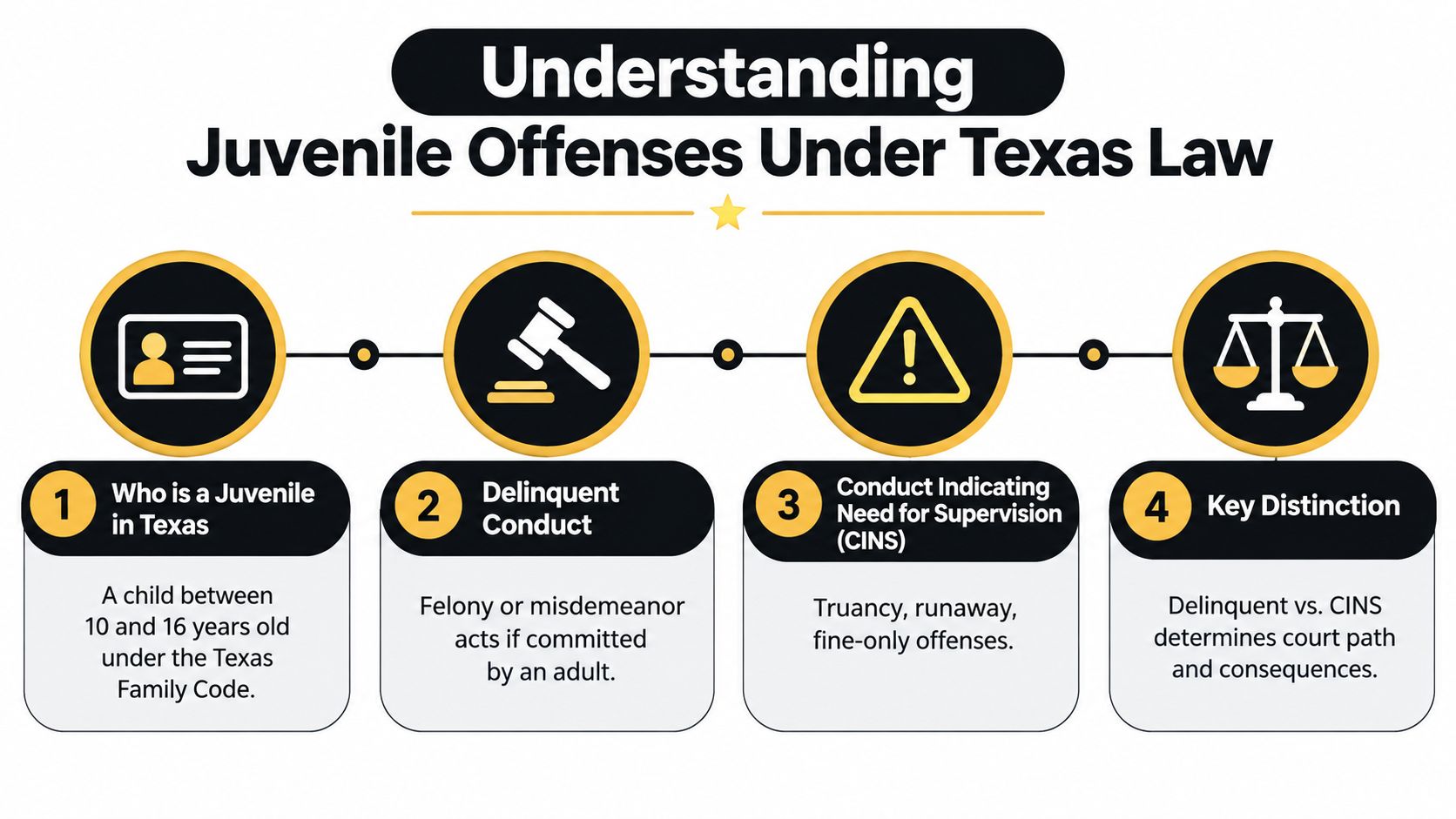
Start with age. Texas juvenile court generally applies to a child who is 10 or older and under 17, with limited exceptions for certain offenses committed before age 17. The Texas juvenile law overview explains the basic jurisdictional framework. A child's age at the time of the alleged conduct can matter even if the case continues after the child turns 17.
Two broad categories
Delinquent conduct generally describes conduct that would be a felony or misdemeanor if an adult committed it. Examples can include theft, assault, or certain drug-related allegations. The court still examines the evidence and legal requirements, but the case travels through the juvenile system unless a lawful transfer to adult court becomes an issue.
Conduct indicating a need for supervision, often called CINS, covers conduct that signals a need for court or community intervention but isn't treated in exactly the same way as ordinary adult criminal conduct. Truancy, running away, and certain fine-only offenses can fall into this category. A school-related referral may therefore involve a different path from a felony allegation, even when both situations feel frightening to parents.
The distinction matters because the classification can affect the court process, available services, and potential consequences. A juvenile defense lawyer looks at the allegation, the child's age, the evidence, school records, family circumstances, and whether diversion or another non-court resolution is available.
When adult court becomes a concern
Texas law allows transfer to adult criminal court for certain juveniles as young as 14 for specific serious offenses, including capital felonies, first-degree felonies, and some controlled-substance felonies. A juvenile who is 15 or 16 and commits any felony may also be eligible for transfer. The Office of Juvenile Justice and Delinquency Prevention's Texas transfer summary describes the hearing and required findings, including probable cause and a determination involving community welfare.
Parents should also consider the circumstances behind an allegation. If anger, impulsivity, bullying, or conflict played a role, counseling can sometimes become part of a responsible defense plan. Families looking for general emotional-regulation resources may review california anger management for children, while remembering that an online resource isn't a substitute for individualized legal advice. Family changes can also create related legal questions, including the Divorce Lawyer in Kingwood, TX service for divorce representation for clients in Kingwood and Harris County.
How Juvenile Court Works in Harris County
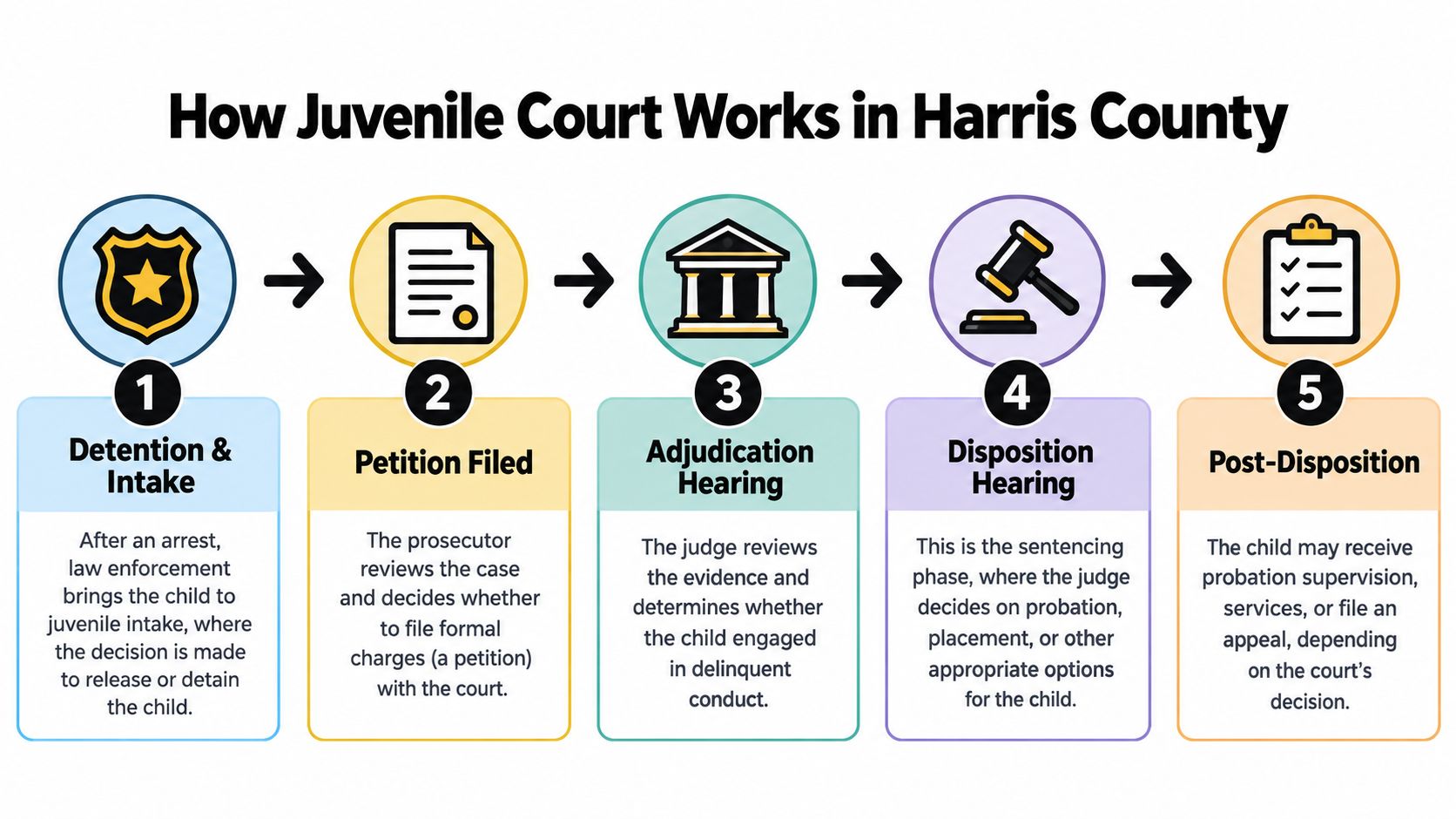
A juvenile case usually develops through several stages, and knowing the sequence can reduce confusion. The first stage is custody and intake. Police may release the child to a parent or refer the matter for detention review. Juvenile probation personnel assess the circumstances and help the court determine whether detention is necessary.
From detention to adjudication
If the child remains detained, the court holds a detention hearing within the legally required deadline. The judge considers whether continued detention is justified, whether conditions can protect the community, and whether the child can safely return to a parent or another approved supervisor. Parents should bring information that helps answer those questions, rather than waiting for the case to reach a later hearing.
A prosecutor may then file a petition alleging delinquent conduct or conduct indicating a need for supervision. The petition sets out the allegations, but it isn't proof that the allegations are true. At the adjudication stage, the judge determines whether the child engaged in the conduct alleged. Defense counsel can challenge the evidence, examine legal deficiencies, and present a defense.
If the court makes a finding, the case moves to disposition. Probation, counseling, education, community-based services, or placement may be considered. Texas tracks juvenile supervision through local probation departments and the Texas Juvenile Justice Department, which coordinates information related to supervision, detention, and commitment.
The statewide figures provide important context. In FY 2025, about 1% of youth referred to the juvenile justice system were committed to TJJD, according to TJJD data and statistics. Most referred youth therefore had outcomes outside state custody, although probation and other sanctions can still impose substantial obligations.
What parents should ask at each stage
Ask where your child is being held, what allegations are listed, when the next hearing will occur, and who is responsible for probation communication. Ask whether the child has counsel and whether the court has addressed parental notice. Later, ask whether the disposition can be completed through community-based services and whether the record may qualify for sealing or another form of protection.
A short video can also help families visualize the court process. Use it as general education, not as a substitute for advice about a specific Harris County case.
Immediate Steps to Protect Your Child After an Arrest
The first 24 to 48 hours require organized action. Texas law sets a tight deadline for detention review. A detained child generally must receive a detention hearing no later than the second working day after custody, or the first working day when detention begins on Friday or Saturday. If the child is held in a county jail or another non-detention facility because no certified detention bed is available, the hearing must occur within 24 hours, excluding weekends and holidays, as explained in the Texas Juvenile Justice Handbook.
A practical first-day checklist
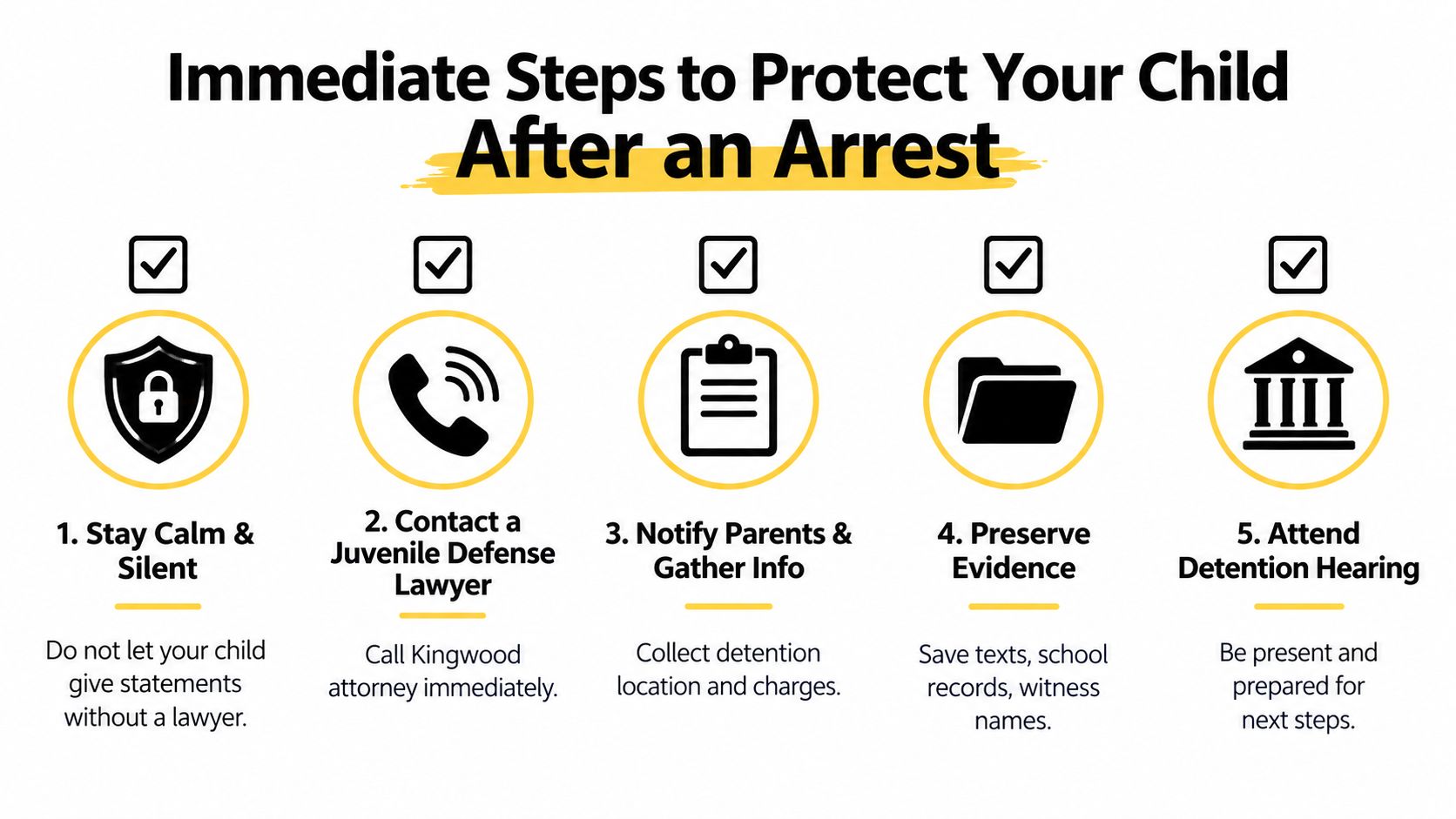
Stay calm and limit statements. Tell your child to remain respectful and not discuss the facts with police, school personnel, other detained youth, or anyone posting about the matter online. Parents should avoid coaching a story. They should preserve the child's right to speak with counsel first.
Call a juvenile defense lawyer immediately. Counsel may need to prepare before the initial detention hearing, not after it. If indigency is found, counsel must be appointed before that hearing, but a family may also seek private representation.
Confirm the basic facts. Write down the detention location, alleged offense, arresting agency, time of custody, names of officials, and hearing information. Keep every document and message in one secure folder.
Build a release package. Useful materials may include school records, attendance information, a parent supervision plan, counseling options, transportation arrangements, and names of responsible adults. The goal is to show the judge a realistic structure for safe release.
Attend prepared. A parent's presence matters practically and emotionally. Counsel can present the supervision plan, address concerns, and request conditions that are workable for a Kingwood or Humble household.
The first hearing is not a formality. It can determine whether a short custody period ends quickly or becomes more disruptive.
If detention continues, later hearings must occur within 10 business days after the prior hearing in counties with a certified juvenile detention facility, or no later than 15 business days in other counties, according to the Texas Children's Commission detention hearing guide. Early preparation therefore continues to matter after release is denied.
Parents may also face related child-protection concerns if allegations involve neglect, household conflict, or a report to child protective authorities. The firm's CPS defense attorney in Kingwood, TX page addresses that separate but sometimes connected process.
Common Defenses and Possible Outcomes for Juvenile Cases
A child may be released after the first Harris County hearing, placed on probation, or kept in detention while the case develops. The first 48 hours often shape those choices. Counsel can challenge the legal basis for detention, test witness accounts, examine school and digital evidence, and identify gaps in the allegation. The right approach depends on the child's age, the alleged conduct, the evidence, and the family's ability to follow a proposed plan.
Texas data show why a lower-level case still deserves prompt attention. In FY 2023, almost half of juvenile case adjudications resulted in findings of delinquent conduct or conduct indicating a need for supervision. Traffic cases made up 46% of all Class C juvenile cases filed, according to the Texas Judicial Council presentation on juvenile data. A Class C matter may appear minor, yet it can still create court obligations and affect the child's record.
| Case Type | Defense Focus | Potential Outcome |
|---|---|---|
| Truancy, traffic, or other Class C matter | Clarify the allegation, review school or attendance records, and seek a practical resolution | Dismissal, informal handling, services, or limited supervision |
| First-time misdemeanor allegation | Test witness accounts and evidence, then present supervision and counseling options | Diversion, deferred prosecution, dismissal after completion, or probation |
| Felony allegation | Challenge probable cause, investigate digital and physical evidence, and assess lasting consequences | Reduced allegation, community-based disposition, probation, or contested adjudication |
| Serious felony with transfer risk | Present the child's age, maturity, history, services, and community-based alternatives | Continued juvenile-court jurisdiction or, if ordered, transfer to adult court |
Diversion and probation
Diversion and deferred prosecution may fit when the facts, history, and risk assessment support a non-adjudication path. Conditions can include counseling, education, community service, drug testing, restitution, or regular probation contact. Before agreeing, parents should understand each requirement. A missed appointment or incomplete program can create a new problem.
Probation is one possible outcome outside state commitment. A Texas juvenile-justice presentation reported 18,692 youth in juvenile probation in August 2024, with projections of 19,626 in 2026 and 19,299 in 2027. The later figures are projections, not historical counts.
Record protection should be considered early, not after every court obligation has been forgotten. Parents can review the firm's expunction versus nondisclosure guide for general background. Eligibility depends on the child's disposition and the governing statute, so a lawyer should evaluate the specific record before the family relies on either remedy.
How to Choose a Juvenile Defense Lawyer in Kingwood TX
Choosing counsel is a practical decision, not a popularity contest. Start with whether the attorney regularly handles juvenile matters in Harris County, understands detention deadlines, and can communicate with a frightened teenager without treating the child like an adult defendant. A lawyer who knows the local process can focus quickly on the issues that matter at the initial hearing.
Questions to ask during consultations
Ask how the attorney will prepare for detention, who will communicate with your family after hours, and what information should be gathered immediately. Ask whether the lawyer will investigate school records, witness accounts, messages, video, and potential counseling or supervision plans. You can also ask how the attorney distinguishes a CINS matter from delinquent conduct and how transfer risk would be evaluated if the allegation is serious.
The firm's guide on how to choose a criminal defense lawyer offers a broader decision framework. Juvenile cases need an additional layer of evaluation because the lawyer must understand adolescent development, parental involvement, probation expectations, and the difference between short-term detention and long-term placement.
Local access and communication
For families in Kingwood, Humble, Porter, and Northeast Houston, location affects practical communication. A parent may need to provide documents quickly, attend a hearing, or discuss a changing probation condition. Ask whether the consultation is private, what the representation includes, and how fees are structured for the expected stages of the case. Don't choose based only on a low initial quote, and be cautious of anyone who promises a guaranteed result.
A free consultation at the Kingwood office should give you a clear understanding of the immediate timeline, the known allegations, the information still missing, and the next decision point. The Law Office of Bryan Fagan – Kingwood TX Lawyers also handles family, criminal, estate, and civil matters, which can be relevant when a juvenile case affects custody arrangements, CPS questions, or other household legal concerns.
Moving Forward With Trusted Local Support in Kingwood
A juvenile charge is serious, but it doesn't automatically define your child's future. Texas uses a separate juvenile framework, and the statewide data show that most youth referred to the system aren't committed to TJJD. That doesn't make the process harmless. Detention, probation, adjudication, and record issues can affect school, family routines, and future plans.
The most useful response is prompt and measured. Confirm where your child is, protect private communication, learn the detention hearing deadline, gather school and supervision information, and seek counsel before your child discusses the allegations in detail. Families in Kingwood, Humble, Porter, and Northeast Houston deserve advice that accounts for the local court process and the child's individual circumstances.
The Law Office of Bryan Fagan – Kingwood TX Lawyers provides client-focused representation in juvenile defense and related family, criminal, estate, and civil matters. Parents can also review the firm's child custody lawyer in Kingwood, TX resource when a juvenile case overlaps with custody or conservatorship concerns.
The Law Office of Bryan Fagan – Kingwood TX Lawyers offers practical juvenile defense guidance for detention hearings, probation alternatives, evidence review, and record-protection planning. Schedule a free, confidential consultation at the Kingwood office by visiting Law Office of Bryan Fagan – Kingwood TX Lawyers so your family can understand the next step and act before the first critical hearing.