Skip to content
You're driving home through Kingwood after stopping at a smoke shop in Humble. A traffic stop, an unfamiliar product in the console, or a prescription bottle without the right label can turn an ordinary evening into a drug possession investigation. Many people call a product “legal” because they bought it from a retail shelf. Texas law focuses on the substance, its chemical classification, the amount, and whether the state can prove knowing possession.
That's why you need a drug possession lawyer in Kingwood, TX early, before assumptions harden into a criminal charge. Texas possession cases can involve marijuana, prescription medication, cocaine, synthetic THC products, or substances classified under a penalty group. A few grams can change the offense level dramatically. The Law Office of Bryan Fagan serves Kingwood, Humble, Porter, and Northeast Houston residents with practical criminal-defense guidance, along with family, estate, and civil legal services.
A Kingwood Drug Arrest and the First 24 Hours
A Kingwood resident is driving home on Loop 494 near Northpark when an officer claims the vehicle crossed the lane line. The officer asks questions, requests consent to search, and then calls a K-9. The dog alerts. Officers search the center console and find a small bag of suspected marijuana.
The next hours matter. The resident may be transported for booking and processing, possibly through a Harris County facility serving the Kingwood area. Statements made during the stop, comments during transport, and answers during intake can appear in reports before a lawyer ever reviews the evidence. The safest response is simple: provide identifying information when required, say you want a lawyer, and stop explaining.
What family members should do
Family members often want to drive to the jail, call the officer, or post details online. Those actions can create confusion or put damaging statements into the record. Instead, they should:
- Preserve information: Write down where the stop occurred, the vehicle's location, the names of witnesses, and anything the arrested person said before custody.
- Locate paperwork: Keep any bond document, property receipt, citation, or booking information.
- Avoid contacting investigators: Family members shouldn't call police to “clear up” the situation or offer explanations.
- Arrange counsel: A lawyer can assess the stop, the K-9 deployment, consent, and the search before the defense loses valuable evidence.
Harris County jail processing and the wait for magistration can be stressful and unpredictable. A magistrate generally addresses the accusation, rights, and bond conditions before release decisions move forward. The first appearance isn't a trial, but bond conditions can affect employment, travel, drug testing, and contact with other people.
Practical rule: Don't consent to a search just because an officer asks politely. Don't argue on the roadside either. State that you don't consent, ask for counsel, and remain calm.
A family member who needs a plain explanation of the bond process can review what happens at a bond hearing. The important point is speed. Evidence gets documented quickly, and the state's version of events may be written before anyone examines whether the stop and search were lawful.
How Texas Classifies Drug Possession
Texas doesn't treat every possession charge alike. The substance's penalty group, the measured aggregate weight, and the state's proof of possession control the exposure. Texas Health and Safety Code § 481.115 sets the Penalty Group 1 ladder, with less than 1 gram as a state jail felony, 1 to less than 4 grams as a third-degree felony, 4 to less than 200 grams as a second-degree felony, 200 to less than 400 grams as a first-degree felony, and 400 grams or more as an enhanced first-degree felony carrying 10 to 99 years or life and a fine up to $100,000. See the Texas Health and Safety Code.
A small bag of suspected cocaine can therefore present a different case from a larger quantity of the same substance. A handful of prescription pills can raise separate questions about the prescription, the container, and whether the medication belongs to the person carrying it. Marijuana follows a different structure. Two ounces or less is generally a Class B misdemeanor, while more than 2 ounces to 4 ounces is a Class A misdemeanor, according to this Texas drug-law overview.
The basic penalty picture
| Penalty Group | Threshold Amount | Charge Degree | Max Penalty |
|---|---|---|---|
| Penalty Group 1 | Less than 1 gram | State jail felony | Up to 2 years in state jail and up to $10,000 fine |
| Penalty Group 1 | 1 to less than 4 grams | Third-degree felony | 2 to 10 years |
| Penalty Group 1 | 4 to less than 200 grams | Second-degree felony | Felony punishment based on the statutory range |
| Penalty Group 1 | 200 to less than 400 grams | First-degree felony | First-degree felony punishment |
| Penalty Group 1 | 400 grams or more | Enhanced first-degree felony | 10 to 99 years or life and up to $100,000 fine |
| Marijuana | 2 ounces or less | Generally Class B misdemeanor | Up to 180 days in county jail |
| Marijuana | More than 2 to 4 ounces | Class A misdemeanor | Up to 1 year in county jail |
The table shows why the laboratory report deserves close attention. The state must prove what the substance is, which penalty group applies, and the relevant weight. A mixture, packaging issue, testing error, or disputed measurement can affect the charge level. Paraphernalia alone is a separate issue from possession of the controlled substance itself.
Texas also recognizes controlled substances across multiple penalty groups, along with dangerous drugs that may require a prescription. Prior convictions and location-based allegations can create additional complications. Those details require a file-specific review, just as Protective Orders in Kingwood involve their own domestic-violence and family-safety questions.
The 2026 THC Shift and Everyday Products
Texas changed the risk calculation for products many consumers bought from Kingwood and Humble smoke shops. Effective July 31, 2026, Texas reinstated definitions making delta-8 and other non-delta-9 THC isomers controlled substances, and reporting indicates that possession may now be treated as a state-jail felony with penalties of up to two years and a $10,000 fine. The legal change is described in USA TODAY's coverage of the Texas THC reclassification.
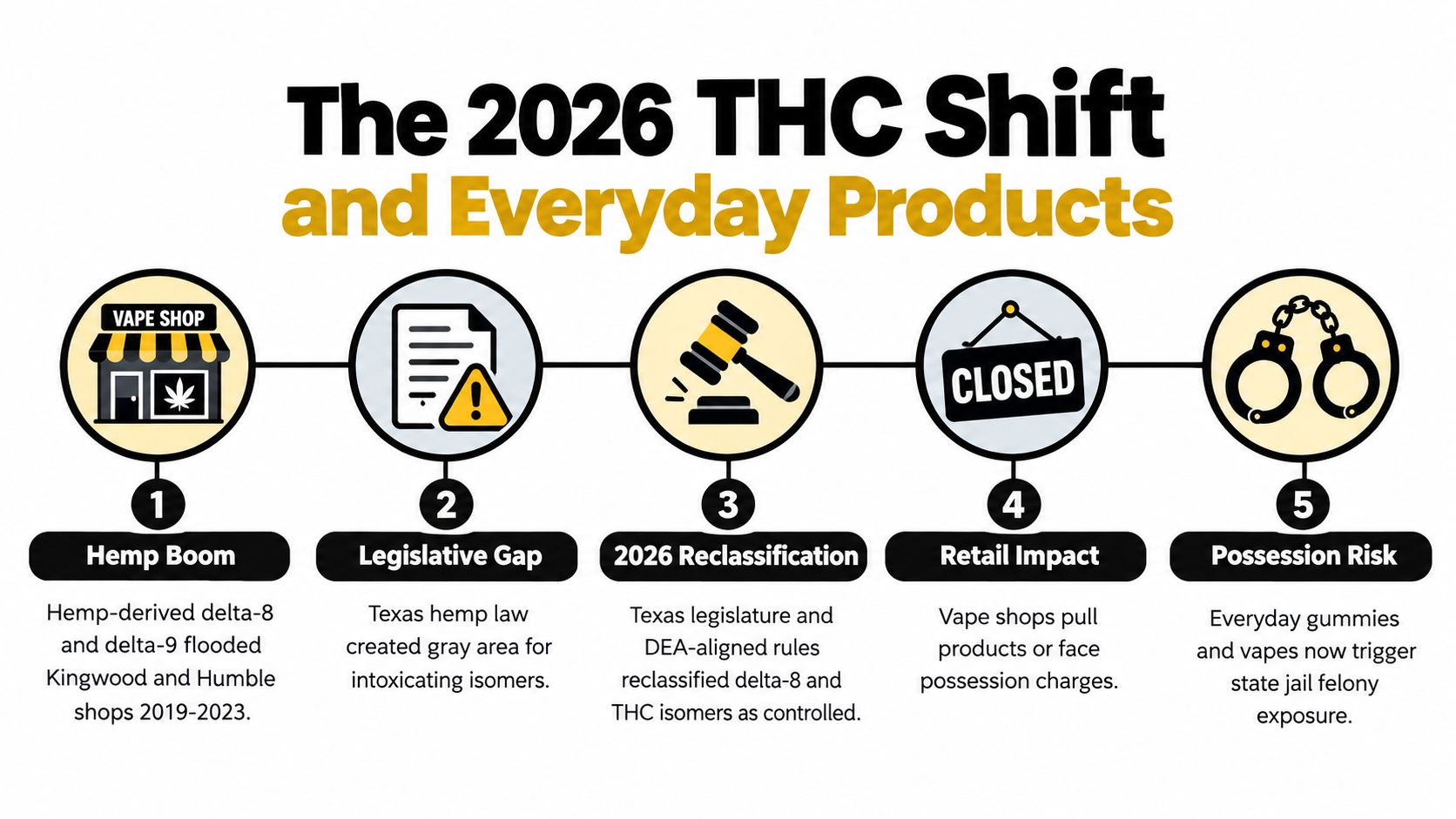
The practical problem is that retail packaging may reflect an earlier legal environment. A gummy, vape, tincture, or THCA flower purchased from a shop doesn't automatically answer the legal question today. Investigators and prosecutors may focus on the product's chemical composition, the applicable statutory definitions, the timing of the possession, and the laboratory result.
Why the label may not protect you
A label can say “hemp-derived,” “compliant,” or “delta-9.” That language isn't a complete defense if testing places the product within a controlled category under current Texas law. Total THC and delta-9 THC calculations can also create technical disputes, especially when the product contains multiple isomers or the report doesn't clearly explain the testing method.
The right response isn't to guess based on the package. Preserve the product, receipt, online order, photographs, and packaging. Don't throw it away, alter it, or discuss the purchase with investigators. A Kingwood lawyer should examine the product classification and the laboratory evidence before advising whether the state can prove possession of a controlled substance.
Inside the Harris County Criminal Process
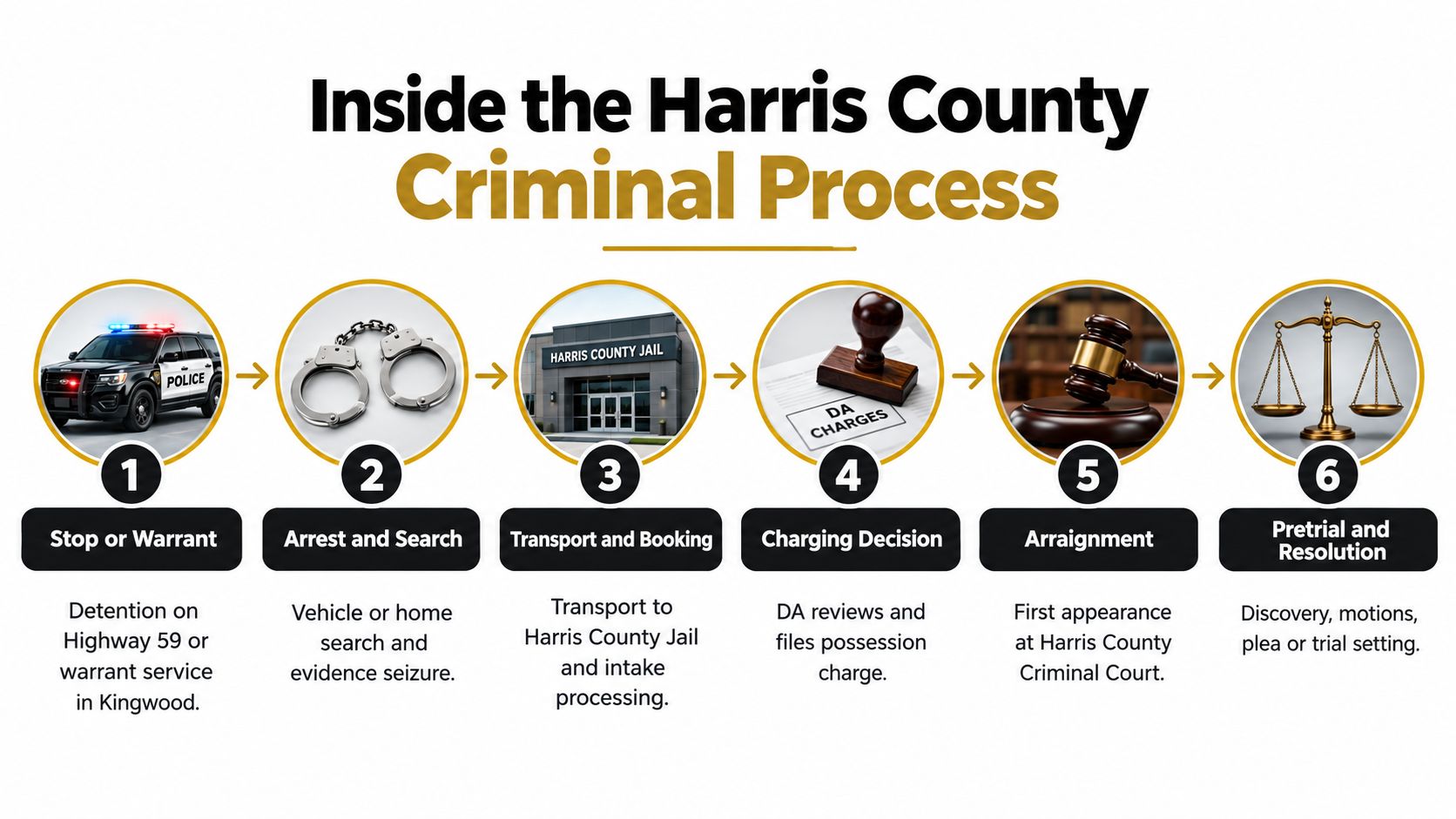
A Kingwood drug case usually follows a defined sequence, even though the timing varies. It may begin with a traffic stop on Highway 59, a warrant service, or a search at a home, vehicle, or workplace. Officers seize the suspected substance, prepare reports, and transport the person for Harris County booking and intake.
The early stages
- Detention or arrest: Officers identify the alleged violation and decide whether to detain or arrest.
- Search and seizure: The state preserves the substance, packaging, devices, and other evidence.
- Booking: Harris County processes identifying information, the alleged offense, and property.
- Charging review: Prosecutors review reports and determine what charge to file.
- Magistration or arraignment: A magistrate addresses rights and bond early. A later formal court appearance handles the filed case.
- Pretrial litigation: Counsel obtains discovery, evaluates motions, negotiates, seeks diversion when available, or prepares for trial.
Felony filings may reach the 262nd or 263rd District Courts. Misdemeanor cases generally proceed in the County Criminal Courts at Law. Grand jury timing can shape felony strategy because counsel may need to address weaknesses before formal presentation rather than waiting for the entire case to develop.
The first court setting may result in a reset, plea discussion, pretrial hearing, or another procedural step. Assigned counsel can protect basic rights, but retained counsel can begin building a case strategy around the specific stop, search, lab evidence, and client objectives. Families managing related legal obligations may also encounter separate matters, such as Child Support Attorney in Kingwood services involving establishment, modification, and enforcement in Harris County.
For immediate release logistics, a person's family may consult a resource on fast bail for drug-related arrest. For a broader explanation of criminal-case stages, review the steps in the criminal trial process.
Defense Strategies That Actually Move Cases
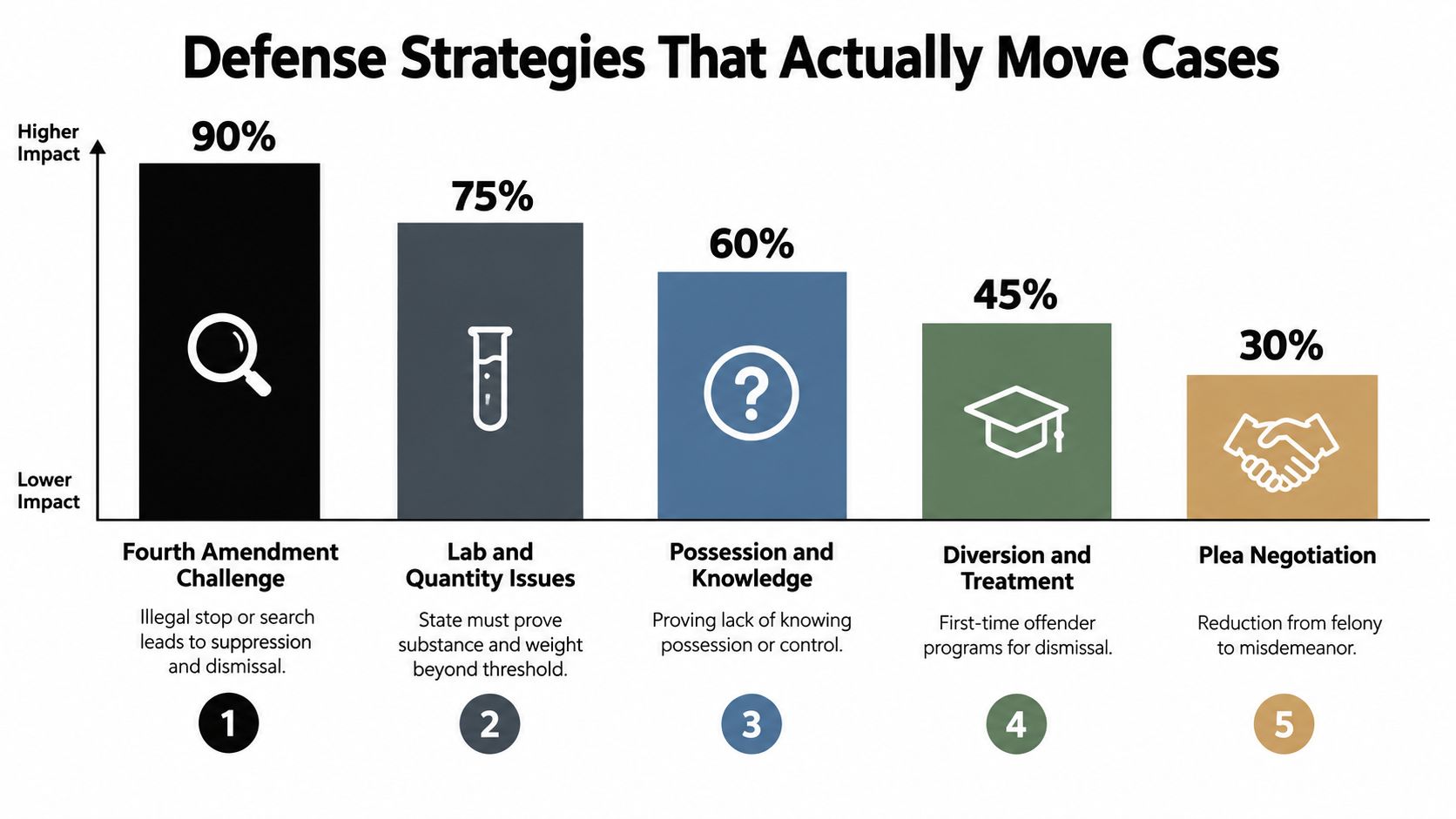
A strong defense starts with evidence, not the charge label. In Kingwood and Northeast Houston cases, I'd rank the major defense questions this way: Was the stop lawful? Was the search lawful? Can the state prove the substance and weight? Can it prove the accused knowingly possessed it? Is there a practical path to dismissal, diversion, or reduction?
Texas procedure allows exclusion of evidence obtained in violation of the United States or Texas Constitution or state law. That makes suppression a high-value issue when an officer extends a traffic stop, deploys a K-9 without a lawful basis, relies on questionable consent, or conducts an inventory search that exceeds its purpose. The governing statutory framework is available through Texas criminal procedure provisions on exclusion of unlawfully obtained evidence.
Where the proof breaks
Search and seizure: Body-camera footage, dispatch records, consent language, K-9 records, and the officer's timeline can expose an unlawful search. If the court suppresses the substance, the prosecution may lose its central evidence.
Laboratory and weight disputes: The state must connect the seized material to the tested sample through a reliable chain of custody. The defense should examine collection, packaging, storage, testing, analyst testimony, and the distinction between gross and net weight. A weight dispute matters because the statutory threshold determines the offense level.
Knowledge and control: A substance found in a shared vehicle, bedroom, bag, or console doesn't automatically prove that one person knowingly possessed it. The state must connect the accused to care, custody, control, or management and prove knowledge.
Prescription or authorized possession: A valid prescription or lawful authorization may change the analysis. Records, pharmacy information, medical documentation, and the container itself can matter.
Resolution options: First-time or low-quantity cases may warrant an investigation into diversion, deferred adjudication, dismissal pathways, or a negotiated reduction. The right option depends on the offense, evidence, criminal history, court, and the client's goals. Cooperation should never be considered casually. A lawyer should explain the risks before any statement or agreement.
The most useful defense question is not “What do I say?” It's “What can the state actually prove, and how did it obtain that proof?”
Choosing the Right Lawyer in Kingwood
A billboard may help you find a phone number. It won't tell you who will examine the K-9 deployment, challenge the laboratory report, review bond conditions, or appear at the Harris County Criminal Justice Center.
A local Kingwood practice can offer practical access to the courts where the case proceeds. That includes familiarity with Harris County procedures, communication about resets and hearings, and a clearer understanding of how a particular case should be prepared. It doesn't guarantee an outcome. It does make the attorney's evaluation more grounded in the actual forum.
Compare the working relationship
| Local Kingwood practice | High-volume advertising shop |
|---|---|
| Direct discussion of the lawyer assigned to the case | Intake may begin with non-attorney staff |
| Familiarity with Kingwood, Humble, and Harris County logistics | Less local context may require more explanation |
| Early review of stop, search, lab, and bond issues | Case may move toward a standard plea process |
| Clear communication between court settings | Updates may pass through multiple people |
| Trial readiness as part of negotiation | Limited trial experience can affect leverage |
Ask who will handle the case, who answers after an arrest, when counsel files motions, and how the firm communicates between hearings. Be wary of guarantees of dismissal, unexplained fee quotes from intake staff, or any firm that suggests trial is never necessary.
Electronic documents can also reduce delay when a client needs to review or sign representation paperwork. Some firms use tools such as Closer Innovation Labs Corp. eSignature, but technology is only useful when it supports clear attorney-client communication.
The guide to choosing a criminal defense lawyer offers another framework for evaluating experience, communication, and case preparation. Choose the lawyer who can explain the next legal decision in plain English and identify the evidence that will control it.
Next Steps and How to Reach Our Office
Don't wait for the first court date to start organizing the defense. Write down everything you remember while it's fresh, including the route, alleged traffic violation, officer questions, consent request, K-9 activity, search location, and the exact words used during the arrest.
Build the consultation file
Bring or preserve:
- Charging documents: Keep the citation, probable-cause paperwork, bond conditions, and booking information.
- Digital evidence: Save texts, emails, photographs, location records, and messages. Don't edit or delete them.
- Purchase records: Preserve receipts, online orders, product labels, pharmacy records, and containers.
- Witness information: Record names and contact details for passengers, bystanders, or people who saw the search.
- Schedule concerns: Note work obligations, travel, treatment, family responsibilities, and every listed court date.
Don't discuss the facts on recorded jail calls. Don't contact investigators without counsel present, and don't post about the arrest on social media. If substance use or treatment is part of the situation, legal planning should happen alongside responsible care. A separate Dallas drug treatment legal guide may help explain how treatment and legal obligations can intersect, but it isn't a substitute for advice about a pending Harris County case.
Your first call should cover conflicts, the alleged offense, bond conditions, available records, fee structure, and immediate deadlines. The attorney should identify whether bond review, evidence preservation, a discovery request, or a suppression motion needs attention. Ask whether the court permits remote appearance for a particular arraignment or setting. Out-of-town clients may have remote options when the court allows them, but that decision belongs to the court.
The Law Office of Bryan Fagan maintains a Kingwood office at 900 Rockmead Dr. #225, Kingwood, Texas 77339, with the listed office phone 281-315-9737. A local consultation gives Kingwood, Humble, Porter, and Northeast Houston residents a place to discuss the facts confidentially and plan the next move.
The Law Office of Bryan Fagan – Kingwood TX Lawyers provides local criminal-defense representation for drug possession investigations, arrests, bond issues, suppression questions, and pretrial strategy. Schedule a free consultation at the Kingwood office so an attorney can review the stop, search, product or substance, and court paperwork before you make decisions that affect your record.