When you’re facing a DUI charge here in Texas, a dismissal doesn’t just happen. It's earned by your attorney meticulously picking apart the prosecution's case, piece by piece. For our clients in Kingwood and the surrounding communities, this means challenging the evidence, finding procedural mistakes made by law enforcement, and knowing Texas law inside and out. It all starts with the very first moves you make after the arrest.
Your First Moves After a DUI Arrest in Kingwood
The hours and days after being arrested for a DUI in Kingwood or Humble can be a blur of confusion and stress. It's completely normal to feel lost. But what you do in this critical window can lay the groundwork for a successful defense and significantly impact your chances of getting the case dismissed. You have to act fast, and you have to act smart.
This flowchart breaks down the three most vital actions you must take right after a DUI arrest.
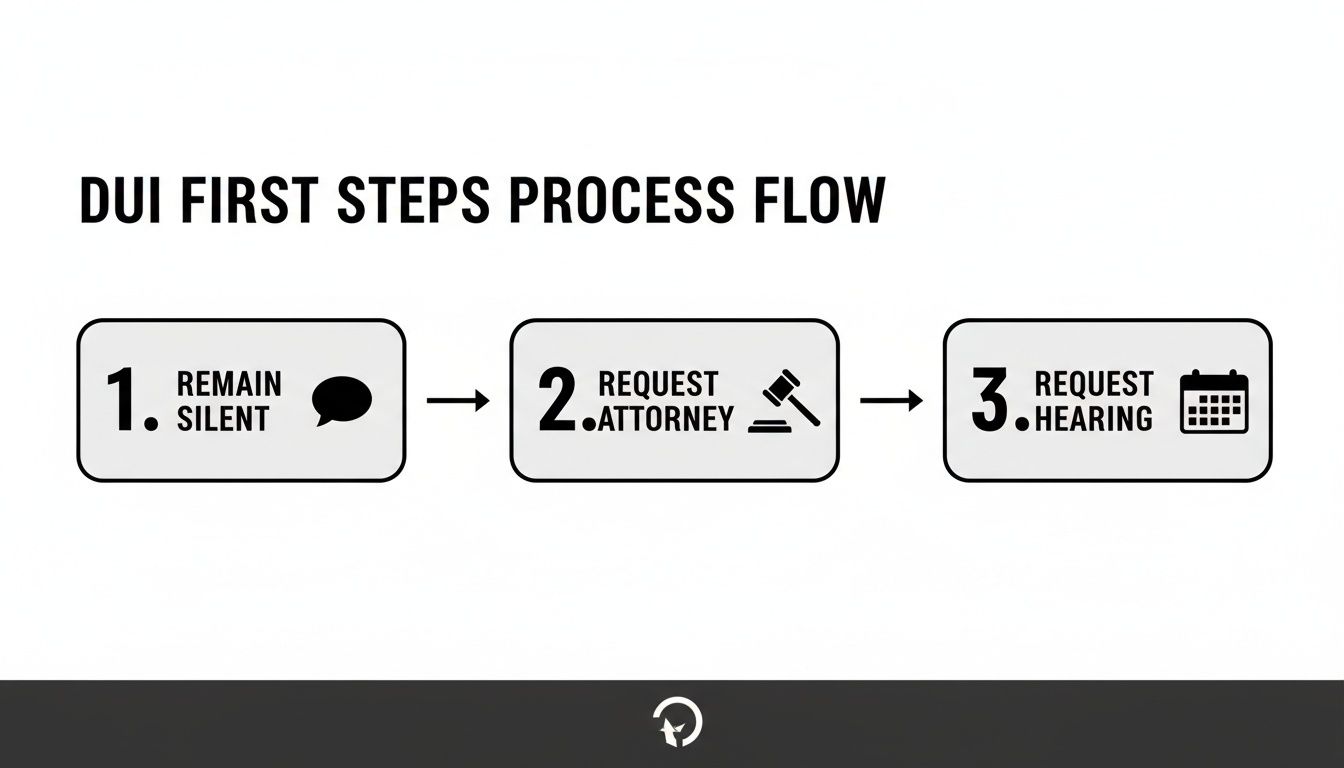
Think of it this way: your legal rights and your driver's license are two separate battles that begin at the same time. You can't afford to ignore either one.
Lock It Down: Exercise Your Right to Remain Silent
You have a constitutional right to remain silent—use it. After an arrest, the only thing you should say is that you are invoking your right to silence and that you want to speak with an attorney. Be polite, but firm.
Even innocent, off-the-cuff remarks can be twisted and used against you. Police officers are trained to gather incriminating statements. For our neighbors here in Northeast Houston, remember that the best way to start your defense is to stop talking and let a lawyer do it for you.
The 15-Day Clock on Your Driver's License Is Ticking
Getting arrested for a DWI in Texas kicks off two distinct cases. There's the criminal charge everyone knows about, and then there's a civil process called an Administrative License Revocation (ALR) hearing. This hearing is all about your driver's license.
You have a non-negotiable deadline of just 15 days from the date of arrest to request an ALR hearing. If you don't, your license gets suspended automatically.
This deadline trips up so many people in the Kingwood area. Requesting the hearing is crucial for two reasons: it’s your only shot at preventing an automatic suspension, and it gives your attorney an early chance to cross-examine the arresting officer under oath—a massive strategic advantage.
The table below breaks down the immediate actions you should prioritize. This is your game plan for the first 48 hours.
Kingwood Post-Arrest Action Plan
| Action Item | Why It Matters for Your Case | Deadline or Timing |
|---|---|---|
| Request ALR Hearing | Prevents automatic license suspension and provides a crucial early opportunity to gather evidence and testimony. | Within 15 days of arrest. |
| Write Down Everything | Your memory is freshest now. Details about the stop, officer conduct, and road conditions are vital defense tools. | Within 24-48 hours of release. |
| Contact a DUI Attorney | An experienced local Kingwood attorney can immediately protect your rights, handle the ALR request, and start building your defense. | As soon as possible, ideally within 24 hours. |
| Gather All Paperwork | Keep your bail receipt, citation, and any other documents in one safe place for your lawyer. | Immediately upon release. |
Following these steps methodically can make a real difference in the outcome of your case.
Write Down Every Single Detail—Now
As soon as you’re released, grab a pen and paper or open a new note on your phone. Write down everything you remember about the arrest, no matter how trivial it seems. Your memory is the most reliable it's going to be right now.
Be sure to include details like:
- The Initial Stop: What was the officer’s stated reason for pulling you over?
- Environment: What were the road and weather conditions like? Was it dark, raining, foggy, or were the lane markings faded?
- Your Physical State: Were you sick, tired, or dealing with an injury that could affect your balance or speech?
- The Officer's Actions: Was the officer professional? Did they properly administer the field sobriety tests, or did you feel rushed and confused?
- Witnesses: Was anyone else in the car with you? Were there other cars or people around who saw what happened?
These raw notes are often where we find the key to a defense. A small detail you remember can expose a major inconsistency in the police report. Getting a handle on the entire process, including learning more about what happens at an arraignment hearing, will also help you feel more in control. At The Law Office of Bryan Fagan, we tell our Kingwood clients that their active involvement from day one is one of their most powerful assets.
Is a DUI Dismissal a Realistic Outcome?
If you’ve been charged with a DUI in Kingwood, Humble, or anywhere in Northeast Houston, it’s natural to feel overwhelmed. Many people mistakenly believe an arrest automatically means a conviction is just around the corner. So, is getting that charge dismissed just a pipe dream?
Let me be clear: a dismissal is absolutely a realistic goal.

Getting charged is not the end of the story. It's the beginning of a legal process where the State of Texas has to prove every single element of its case against you beyond a reasonable doubt. Every piece of their evidence, from the reason they pulled you over to the blood or breath test results, can and should be scrutinized by a local Kingwood lawyer.
Understanding Your Potential Outcomes
When you decide to fight a DUI, a complete dismissal isn't the only way to win. It's crucial to understand the different ways a case can resolve in your favor.
Let’s break down the main possibilities under Texas law:
Dismissal: This is the home run. It means the prosecutor drops the charges completely, often before a trial even begins. This usually happens when a sharp attorney finds a fatal flaw in the evidence, leaving the state with a case that's too weak to move forward.
Reduced Charge: Sometimes the prosecutor’s case has some holes but isn't a total wash. In these scenarios, a good lawyer can often negotiate to get the DWI charge reduced to a lesser offense, like reckless driving. This is a huge win, as it helps you avoid the severe penalties and lasting stigma of a DWI conviction.
Acquittal: This is when a judge or jury finds you "not guilty" after a full trial. While it’s a fantastic outcome, it means you’ve had to go through the stress, time, and expense of a trial. A dismissal gets you the same result—clearing your name—without that ordeal.
And this isn't just talk. The data supports it. Out of 83,088 DWI charges filed in Texas back in 2020, a remarkable 6,771 cases were dismissed. That's about 8.15% of all charges. These aren't just flukes; they are the result of solid defense work. You can dig into these Texas DWI statistics yourself to see how often a strong legal strategy can change the outcome.
When Is a Dismissal More Likely?
While every case has its own unique facts, certain situations definitely improve the odds of getting a DUI dismissed. Success often comes down to identifying—and attacking—the specific weak points in the prosecution's case.
For instance, a first-time offense with no "aggravating factors" (like a car accident or an extremely high Blood Alcohol Concentration) gives your attorney much more leverage. Judges and prosecutors in Harris and Montgomery Counties are often more willing to consider alternatives when it looks like an isolated mistake, not a pattern of dangerous behavior.
But the most fertile ground for a dismissal is almost always procedural error. Police officers have to follow a very strict set of rules during a traffic stop, investigation, and arrest. Any deviation can get critical evidence thrown out of court.
Think about a common scenario right here in Kingwood: an officer pulls someone over for weaving, but their report conveniently leaves out the fact that the driver was on a stretch of Northpark Drive notorious for potholes and uneven pavement. A defense attorney can argue that the driving wasn't due to impairment, but was a normal reaction to poor road conditions, making the entire stop illegal from the start.
This leads to the single most powerful tool for getting a case dropped: challenging the evidence. If the breathalyzer machine hadn't been calibrated in months, if the officer wasn’t properly certified to conduct the field sobriety tests, or if there's a gap in the "chain of custody" for a blood sample, that evidence can be suppressed. A dismissal often follows.
Proven Legal Defenses to Challenge a DUI Charge
After a DUI arrest anywhere from Kingwood to Porter, it’s easy to feel like the deck is stacked against you. But an arrest is just the beginning of the story, not the end. The prosecutor has to prove their case beyond a reasonable doubt, and a defense attorney's job is to find every crack in their foundation.
There are dozens of powerful, proven legal defenses we can use right here in Harris and Montgomery County courts. It’s all about shifting from a defensive crouch to an offensive strategy, where we meticulously challenge every single action the state took from the moment those flashing lights appeared in your rearview mirror.
Was the Traffic Stop Even Legal?
Every DUI case starts with one critical event: the traffic stop. Under Texas law, a police officer can’t just pull you over on a hunch. They need reasonable suspicion—a specific, legitimate reason to believe you’ve violated a traffic law or are involved in something illegal.
An officer might say they pulled you over for:
- Weaving or failing to stay in a single lane
- Speeding
- Running a stop sign
- Driving with a broken taillight
But what if their reason is flimsy? What if you swerved once to avoid a pothole on Kingwood Drive? If we can show the officer’s justification for the stop was weak or didn't meet the legal standard, everything that happened afterward—the field sobriety tests, the questions, the breath test—can be thrown out. This is often the quickest path to getting a DUI dismissed entirely.
Questioning the Arrest and Sobriety Tests
Once you're pulled over, the officer needs to build probable cause to arrest you. This is a higher legal bar than reasonable suspicion. They usually rely on their observations and, most importantly, your performance on the Standardized Field Sobriety Tests (SFSTs).
Here’s the thing: these tests are notoriously unreliable. I’ve seen countless people who were perfectly sober “fail” them for reasons that have nothing to do with alcohol.
A huge part of a strong DUI defense is picking apart the administration of these tests. Was the ground level? Was the area well-lit? Do you have a medical condition, a previous injury, or are you over a certain age or weight? Any of these factors can completely invalidate the results.
An officer’s subjective opinion is also on trial. They’ll list things like red eyes (from allergies?), fumbling for your license (nerves?), or slurred speech (just tired?) as "clues" of intoxication. A good attorney knows how to present alternative, innocent explanations for these observations. While a DUI case is different from other criminal matters, the strategy of questioning the arresting officer's justification is a cornerstone of a solid defense, similar to learning how to get assault charges dropped by challenging the accuser's credibility.
Attacking the Chemical Test Results
The breath or blood test result can feel like the final nail in the coffin. You see a number over 0.08 and think it’s game over. It’s not. In my experience, this "scientific" evidence is often the most fragile part of the prosecutor's case because it depends on both perfect science and flawless human procedure.
Breathalyzer Defenses:
- Maintenance and Calibration: The breathalyzer machines used in Texas need constant maintenance to stay accurate. We can subpoena the device’s service logs. If that machine has a history of errors or wasn't calibrated correctly, its results are junk.
- Operator Error: The officer giving the test must be certified and follow a rigid protocol, including a 15-minute observation period to make sure you don't burp or do anything else to contaminate the sample. Any slip-up can get the results thrown out.
- Medical Issues: Conditions like GERD or acid reflux can push stomach alcohol up into your mouth, leading to a falsely high reading. Even a low-carb diet can produce ketones that some machines mistake for alcohol.
Blood Test Defenses:
- Chain of Custody: The State has to document every single person who handled your blood sample, from the phlebotomist to the lab tech. Any gap in this “chain of custody” creates a risk of contamination or tampering, and it can be grounds for suppression.
- Contamination: If the sample isn't stored with the right preservatives or kept at the correct temperature, it can actually ferment inside the vial. This process creates its own alcohol, giving you a BAC reading that’s much higher than it was when the blood was drawn.
- Improper Draw: Was the person who drew your blood qualified? Did they use an alcohol-based swab to clean your arm first? Simple mistakes can compromise the entire sample.
Challenging the evidence isn’t about finding loopholes—it’s about holding the government to its own high standards. At The Law Office of Bryan Fagan, we know that the key to a dismissal is often buried deep in police reports, maintenance logs, and lab data. If you're facing a DUI charge in the Kingwood area, don't assume the evidence is unbeatable. Schedule a free consultation with our team, and let us start digging for the defense that will protect your future.
Using Pretrial Motions to Dismantle the Prosecution's Case
Many people think a DUI battle is won or lost in a dramatic courtroom trial. The truth? Some of the most significant victories happen long before a jury is ever called, through powerful legal tools known as pretrial motions.
Think of these motions as strategic challenges your attorney files to pick apart the prosecution's case. For our clients here in the Kingwood area, understanding this part of the process is crucial. It’s not about theatrics; it’s a methodical, behind-the-scenes effort to dismantle the evidence against you, often making a trial completely unnecessary.
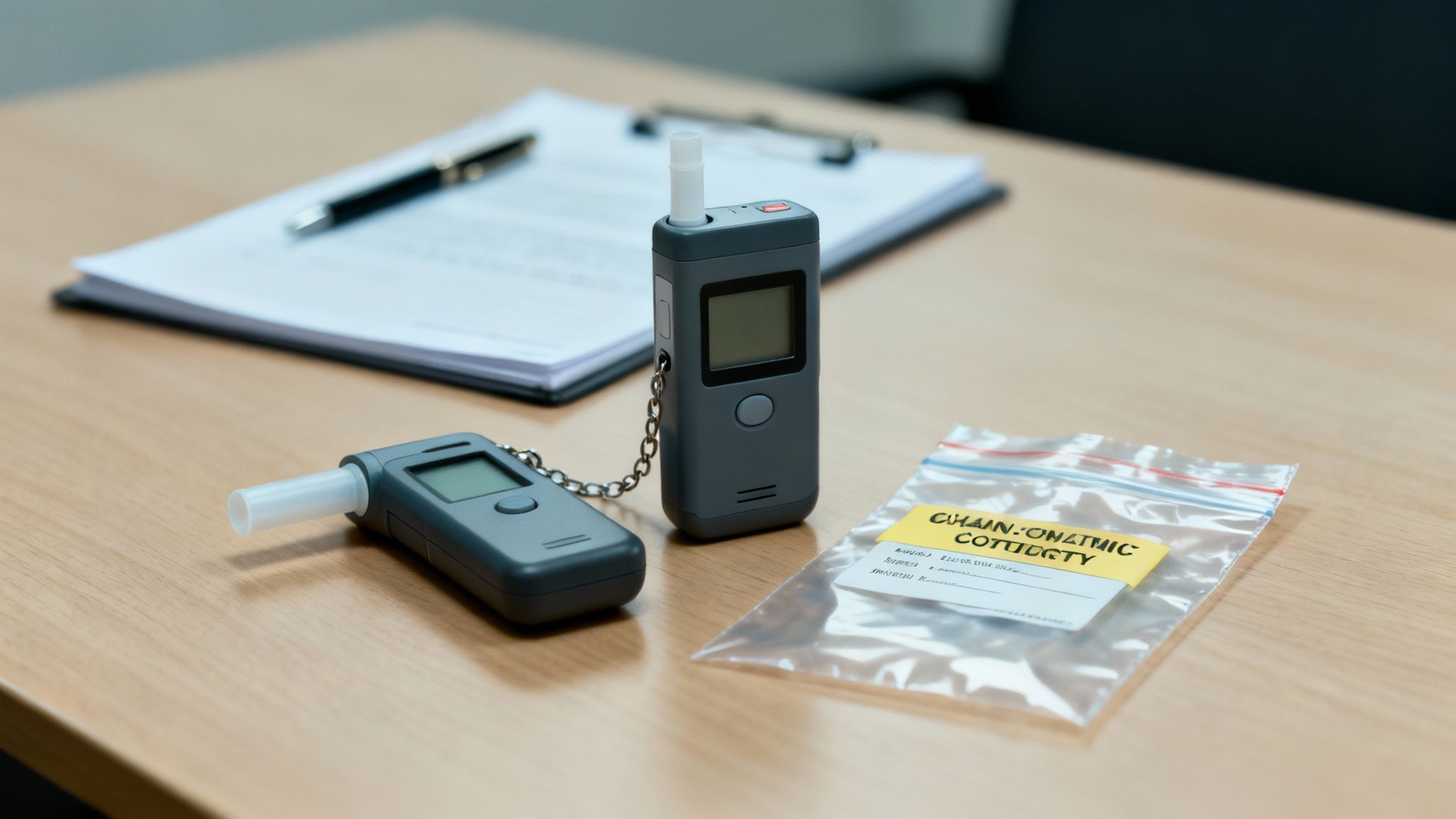
A single, well-argued motion can be the difference between a conviction and a dismissal.
The Motion to Suppress: The Ultimate Game Changer
Without a doubt, the most potent weapon in a DUI defense attorney's arsenal is the Motion to Suppress Evidence. This motion formally asks the judge to throw out—or "suppress"—specific evidence because it was obtained illegally, violating your constitutional rights.
A successful motion doesn't just poke a hole in the prosecutor's case; it can completely gut it. If a judge agrees to suppress key evidence like the breath test or the officer's observations, the prosecutor might be left with no case at all. This often forces them to either dismiss the charges entirely or offer a drastically better plea agreement.
Targeting Illegally Obtained Evidence
A Motion to Suppress zeroes in on how the police gathered their evidence. The law has strict rules for law enforcement, and when those rules are broken, any evidence they collect becomes tainted and inadmissible. This is a fundamental protection for every single resident in Humble, Porter, and across Texas.
Here are a few common situations where we would file a Motion to Suppress:
An Unlawful Traffic Stop: An officer can't just pull you over on a hunch. They need "reasonable suspicion." If they lacked a valid reason for the initial stop, everything that follows—the field sobriety tests, your statements, the chemical tests—is considered "fruit of the poisonous tree" and can be thrown out.
Statements Taken Without a Miranda Warning: Once you are in police custody (meaning you aren't free to leave), officers must read you your Miranda rights before questioning you. If they don't, any incriminating answers you give can be suppressed.
Involuntary Consent for a Test: Texas has "implied consent" laws, but your consent must still be given freely. If an officer bullies you, makes threats, or gives you false information to get you to agree to a breath or blood test, we can argue that your consent was invalid and have the results suppressed.
The bottom line is simple: the government can't benefit from its own misconduct. A successful suppression hearing protects your rights and holds law enforcement accountable to the constitutional standards they swore to uphold.
How a Suppression Hearing Actually Works
Filing the motion is just the first move. The real action happens at the suppression hearing, which is essentially a mini-trial in front of just the judge. Here, your Kingwood DUI attorney puts the arresting officer on the stand and cross-examines them under oath, forcing them to justify every single decision they made.
We dig into their stated reason for the traffic stop, the exact way they administered the sobriety tests, and the procedures they followed for the chemical test. This is where we expose shaky justifications, inconsistencies between the police report and the video, and procedural shortcuts that violate your rights.
For instance, an officer might claim in his report that you were "weaving all over the road," but his own dashcam video shows your car driving perfectly straight. That contradiction can get the entire stop thrown out. Or maybe we find that the breathalyzer's maintenance logs show it was recently malfunctioning. Suddenly, that 0.08 BAC result isn't so reliable anymore.
Successfully arguing these motions requires an intimate knowledge of Texas traffic law and local court procedures. It's a technical, detail-oriented fight that can turn a case that looks hopeless into a dismissal. If you're facing a DUI in Northeast Houston, you need an attorney who knows how to wield these tools effectively.
Contact The Law Office of Bryan Fagan for a free consultation to discuss the specific evidence in your case and how we can challenge it.
Why a Local Kingwood DUI Attorney Makes a Difference
When you’re staring down a DUI charge, trying to handle it yourself is one of the biggest gambles you can take. The stakes are just too high, and the legal system is a maze of procedural traps. The single best decision you can make is to bring in a local lawyer who knows the Kingwood area inside and out.
This isn't about finding just any attorney. It’s about finding an advocate who lives and breathes the local legal environment. Someone who works in the Harris and Montgomery County courts day in and day out knows the judges, understands how specific prosecutors build their cases, and can anticipate their next move. That kind of on-the-ground insight is an advantage you simply can't get any other way.
A Deep-Dive Investigation to Find the Truth
A good Kingwood DUI attorney does so much more than glance at the police report. Their real job is to launch a full investigation, digging into every single detail of your arrest to find the weaknesses the prosecution is hoping no one ever sees.
This means a meticulous, top-to-bottom review of everything:
- Dashcam and Bodycam Footage: We don't just watch the video; we scrutinize it frame-by-frame, looking for inconsistencies between what the officer did and what they wrote in their report.
- Police Reports and Notes: We comb through every word, hunting for contradictions, things they left out, or subtle exaggerations that can change the entire story.
- Breathalyzer Maintenance Logs: Was the machine even working correctly? We’ll subpoena the service records to see if it has a history of errors or if it missed a required calibration.
- Blood Test Chain of Custody: We trace the journey of your blood sample from the moment it was drawn to make sure it was handled properly and never compromised.
These are the kinds of details you’d never think to look for, but for a trained eye, they are the very things that can build a powerful defense.
Having a skilled lawyer in your corner isn't just a good idea—it's a proven game-changer. National data shows that when defendants hire private counsel, around 40% of initial DUI cases are either dismissed or reduced to a lesser charge. For those who represent themselves, the conviction rate can jump above 90%. You can discover more insights about these DUI defense outcomes to see just how much of a difference professional help makes.
A Local Advocate in Your Corner
Beyond the investigation, your attorney is your negotiator, your strategist, and your voice. A lawyer who has built relationships with local prosecutors can often have more productive, frank conversations about the weaknesses in their case, paving the way for a potential dismissal or a much better plea agreement.
They also handle the critical legal paperwork, like filing the pretrial motions we talked about earlier, and arguing them effectively in front of a judge. This is the nitty-gritty legal work that can dismantle the prosecution's case before you ever have to think about a trial.
Ultimately, hiring a knowledgeable local attorney from a firm that offers expert criminal defense services transforms a terrifying ordeal into a structured plan. It drastically improves your chances of getting a dismissal and gives you the peace of mind of knowing a professional is fighting for your rights.
At The Law Office of Bryan Fagan, we are proud to be that local firm for our neighbors in Kingwood, Humble, and Northeast Houston. We're right here in your backyard, ready to help. Don’t go through this alone—schedule a free, confidential consultation at our Kingwood office, and let’s start building your defense today.
Common Questions About DUI Dismissals in Texas
If you’re facing a DUI charge in Texas, you're probably trying to make sense of a confusing and stressful situation. As you start digging in, questions pop up left and right. To help our neighbors in Kingwood, Humble, and Northeast Houston get some clarity, we’ve answered a few of the questions we hear most often in our office.

These aren’t generic answers—they’re based on how Texas law actually plays out in our local courts.
Can My DUI Be Dismissed If I Failed the Breath Test?
Yes, absolutely. A breath test result over the legal limit of 0.08 doesn't automatically sink your case. A lot of folks in the Kingwood area assume this is ironclad evidence, but that’s just not true.
A good attorney knows how to challenge these results. We look into everything:
- Was the breathalyzer machine properly calibrated and maintained?
- Did the officer who gave the test have the right certification?
- Were the correct procedures followed to the letter?
- Do you have a medical condition, like acid reflux (GERD), that could have skewed the reading?
When we successfully challenge the breath test, that evidence can get thrown out. That’s a huge step toward getting the entire case dismissed.
How Long Does a DUI Case Take in the Kingwood Area?
In the Harris or Montgomery County court systems, a DUI case can last anywhere from a few months to over a year. The exact timeline really boils down to how complex your case is and the defense strategy we build.
Taking a quick plea deal might seem like the fastest way out, but fighting for a dismissal is a much more thorough process. It takes time for your lawyer to collect all the evidence, file the right pretrial motions, negotiate with the prosecutor, and show up for multiple court dates. After reviewing the specifics of your arrest, an experienced local attorney can give you a much clearer idea of what to expect.
A dismissal and an acquittal are both fantastic outcomes, but they aren't the same. A dismissal means the prosecutor has dropped the charges, usually before a trial ever starts. An acquittal (a 'not guilty' verdict) comes after a full trial where a judge or jury decides the state failed to prove its case against you.
What Is the Difference Between a DUI and DWI in Texas?
This is a really common point of confusion, and the answer is important. In Texas, these terms are not interchangeable—they mean two very different things under the law.
- DWI (Driving While Intoxicated) is the charge for an adult (21 or older) who is caught operating a vehicle in public while intoxicated.
- DUI (Driving Under the Influence) is a charge specifically for a minor (under 21) who drives with any detectable amount of alcohol in their system.
So, while "DUI" is often used as a general term, if you're an adult arrested in Texas, you are actually facing a DWI charge. Our primary goal is always to fight for a full dismissal of that DWI.
Getting a handle on these details is the first step toward regaining some control. The legal system is intimidating, but you don't have to navigate it alone.
At The Law Office of Bryan Fagan – Kingwood TX Lawyers, we believe everyone in our community deserves a smart, aggressive defense. If you're facing a DWI charge, the time to act is now. Contact our Kingwood office today for a free, no-obligation consultation. We'll review your case and show you how we can help you fight for a dismissal. Visit us at https://kingwoodattorneys.com.