Deciding to seek guardianship for a parent is gut-wrenching. It’s one of the toughest, most emotionally charged choices a family can make. Here in Texas, guardianship is a serious legal process where a court steps in and appoints someone to make critical decisions for a parent who has been found to be legally "incapacitated."
For our neighbors in Kingwood, this isn't a step to be taken lightly. It's reserved for situations where a parent truly can no longer manage their own safety and affairs, and our firm is here to offer practical advice and support during this difficult time.
When Is Guardianship the Right Call for a Parent in Texas?
For most families we work with in Kingwood, Humble, and across Northeast Houston, the journey toward guardianship isn't a single event. It’s a slow, painful realization that a parent’s well-being is declining. You notice small things at first, then bigger ones, until it becomes clear they need a level of help that requires legal authority.
While a Texas court's primary goal is to protect vulnerable adults, it's crucial to understand that guardianship is always the last resort. Why? Because it involves stripping your parent of some of their most basic rights to make their own choices.
A court will only consider guardianship when a parent, because of a physical or mental condition, is substantially unable to provide their own food, clothing, or shelter, or can't manage their finances. We see this play out in a few common, heartbreaking scenarios right here in our community.
Common Scenarios That Lead to Guardianship
One of the most frequent paths to guardianship is a diagnosis like dementia or Alzheimer's. A parent might start forgetting to pay the mortgage, missing vital doctor's appointments, or falling prey to financial predators. Once the condition progresses to where they can no longer understand what they are signing, it’s too late to create a Power of Attorney. At that point, guardianship may be the only way left to protect them.
Another all-too-common situation is a sudden medical emergency, like a major stroke or a traumatic brain injury. If your parent is suddenly unable to communicate or make informed decisions about their own medical care, someone has to be legally appointed to consent to treatments and manage their recovery plan.
As our population ages, the need for guardianship is becoming more common. Projections clearly show that as the number of older Texans grows, so will the need for legal tools like guardianship to manage health and financial decisions for those with cognitive decline.
Guardianship vs. Less Restrictive Alternatives
Before a Texas court will even consider appointing a guardian, it must determine that no "less restrictive alternative" will do the job. This is the cornerstone of Texas guardianship law. If a simpler legal tool can solve the problem, the court will not grant a guardianship. This is why having documents like a durable power of attorney and a medical power of attorney in place before a crisis is so critical.
Here’s a simple explanation of how these tools stack up against each other:
| Legal Tool | What It Does | When It's Used | Requires Parent's Capacity? |
|---|---|---|---|
| Durable Power of Attorney | Appoints an "agent" to manage financial decisions (banking, property, bills). | To manage finances if the parent becomes unable to. Must be created before incapacity. | Yes, at the time of signing. |
| Medical Power of Attorney | Appoints an "agent" to make healthcare decisions if the parent can't. | Activates only when a doctor certifies the parent is unable to make their own medical decisions. | Yes, at the time of signing. |
| Supported Decision-Making | Allows a parent with a disability to get help from trusted advisors without giving up rights. | For adults with disabilities who can still make decisions with support and guidance. | Yes, they must have some capacity. |
| Guardianship | A court-appointed person makes personal and/or financial decisions. | Last resort when no other tool is in place and the parent is fully incapacitated. | No, this is used when capacity is lost. |
The takeaway for our Kingwood clients is simple: proactive planning can often prevent the need for a stressful, public, and expensive court proceeding.
Understanding the Types of Guardianship in Texas
When guardianship is necessary, the court tailors the appointment to your parent's specific needs. It's not always an all-or-nothing arrangement.
Guardian of the Person: This person makes decisions about your parent's personal well-being. Think medical care, living arrangements, and day-to-day needs. They decide which doctors to see and consent to procedures.
Guardian of the Estate: This person is responsible for your parent's financial world. They pay the bills, manage bank accounts, protect investments, and safeguard property from loss or fraud.
Often, the court will appoint one trusted person to handle both roles. In situations with complex family dynamics or finances, however, it might appoint two different people. While many people use the terms interchangeably, it's also helpful to understand the legal differences between guardianship and conservatorship in Texas to be fully prepared.
Key Insight for Local Families: The single most important thing to remember is that Texas courts will bend over backward to find a "less restrictive alternative." If a valid Power of Attorney already exists that can address the issue at hand, a judge simply will not grant a guardianship.
Ultimately, seeking guardianship is about protecting your parent when they can no longer protect themselves. It's a profound act of love and a heavy responsibility. If you believe this is the necessary path for your family, understanding the legal road ahead is your first step. Our team at The Law Office of Bryan Fagan is right here in Kingwood to help you navigate it. Schedule a free, confidential consultation with us to talk through your family's unique situation.
Taking the First Steps in the Texas Guardianship Process
For families in Kingwood and across Northeast Houston, deciding to pursue guardianship often brings a wave of uncertainty. What do you actually do next? Taking that first legal step can feel overwhelming, but breaking it down into clear actions provides much-needed clarity. The journey officially kicks off by preparing and filing a few key legal documents with the right court.
The primary document is the Application for Appointment of Permanent Guardian. This isn't just a form; it's a formal petition to the court. For most of our clients in the Kingwood area, this means filing with the probate court in either Harris County or Montgomery County, depending on where your parent lives. In this application, you’ll need to provide detailed information about your relationship to your parent, spell out exactly why a guardianship is necessary, and describe their current condition.
Gathering the Necessary Medical Evidence
The court needs more than just your word for it. They require objective, professional proof of your parent's condition, which is where the Certificate of Medical Examination comes in. This document is a non-negotiable part of your application.
A physician must complete and sign this certificate within 120 days of you filing the case. It’s their expert opinion on your parent’s:
- Specific medical diagnosis, such as advanced dementia or Alzheimer's.
- Mental and physical limitations that prevent them from managing their own affairs.
- Prognosis and whether their condition is permanent.
Frankly, without this signed certificate, the case stops before it starts. It’s the foundational evidence that proves your parent is legally "incapacitated" under Texas law.
This flowchart shows the big picture—from that initial assessment all the way to a potential guardianship.
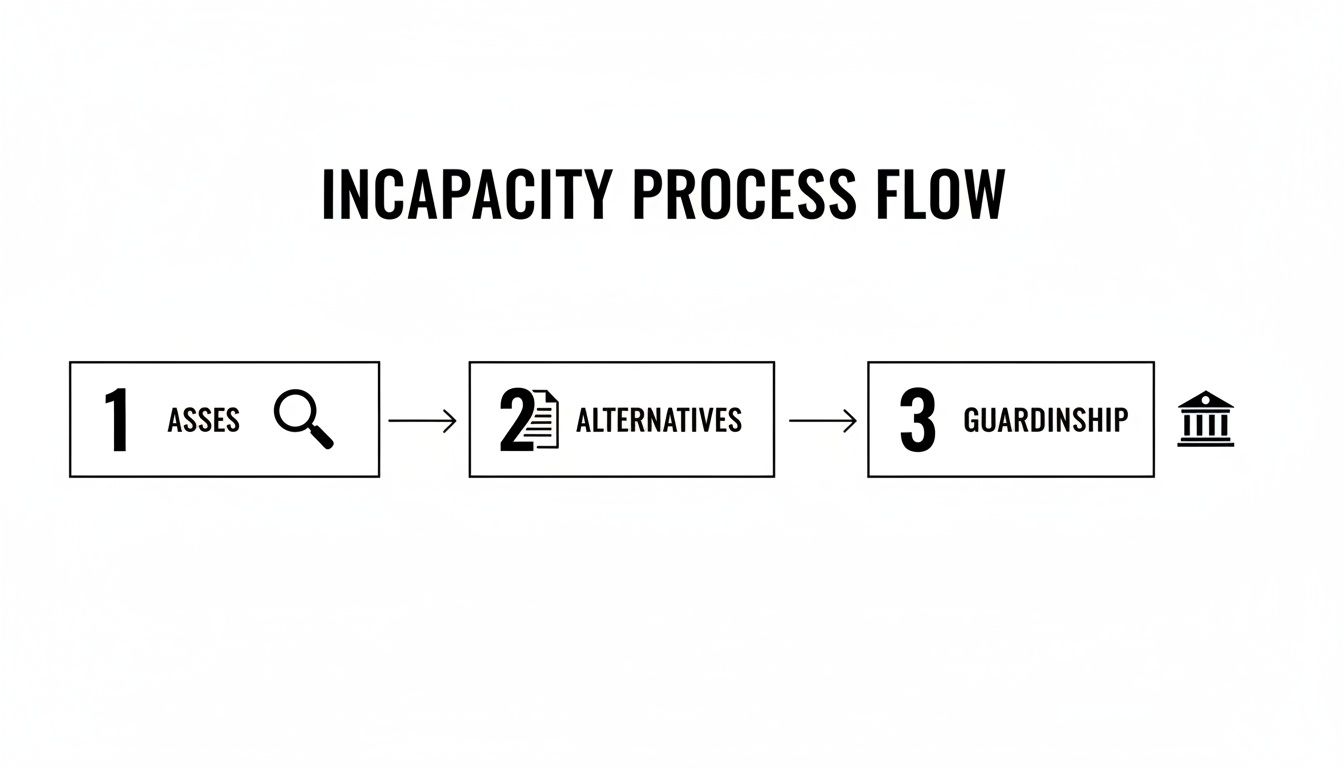
As you can see, guardianship is the final option, only considered after you've carefully assessed the situation and confirmed that less restrictive alternatives won't work.
The Court Appoints an Attorney Ad Litem
Once your application is on file with the court in Houston or Conroe, the judge will immediately appoint an independent attorney known as an attorney ad litem. This is a critical step designed to protect your parent's rights throughout the process.
The ad litem’s only client is your parent. Their sole mission is to represent your parent's best interests. To do this, they conduct a thorough investigation, which almost always involves:
- Meeting with your parent in person to explain what’s happening.
- Interviewing you, other family members, and any caregivers.
- Reviewing all medical records, especially the Certificate of Medical Examination.
After this fact-finding mission, the attorney ad litem files a formal report with the judge. This report states their professional opinion on whether a guardianship is truly needed and if you are a suitable person for the job. Their recommendation carries a lot of weight in the courtroom.
What About a Power of Attorney? A big part of the ad litem's job is to see if your parent already has legal documents that could serve as a less restrictive alternative. If a valid power of attorney is already in place and is working effectively, the court will almost certainly deny the guardianship. To learn more about this crucial document, you can find helpful information about what a power of attorney is and how it works in Texas on our site.
Getting the initial application and medical certificate right is absolutely essential. A simple error or an omission can cause significant delays, adding more stress to an already emotional time. For families in Humble, Porter, and the greater Kingwood area, our experienced team can ensure this first filing sets the tone for the entire case.
Navigating Your Guardianship Court Hearing
After all the paperwork, the reports, and the waiting, everything comes down to the court hearing. This is where a judge will listen to the evidence and make a final, life-altering decision about your parent's care and your role in it. For families in Kingwood and Humble, walking into a Harris or Montgomery County courtroom can be daunting, but knowing what to expect can take a lot of the fear out of the process.
The entire hearing boils down to proving two things with clear, convincing evidence. First, you have to show the judge that your parent is legally incapacitated—that they can no longer make safe decisions for themselves. Second, you have to prove that you are the right person for the job and will always act in their best interest.

Who Will Be in the Courtroom
A guardianship hearing is a formal proceeding, and you’ll see several key people there. Understanding everyone's role helps make sense of what's happening.
- You (The Applicant): You’ll be there to give your testimony, explaining why guardianship is needed.
- Your Attorney: Your lawyer from The Law Office of Bryan Fagan will present your case, question witnesses, and handle the legal arguments.
- The Attorney Ad Litem: This is the neutral, court-appointed attorney. They will present the findings from their investigation and give their recommendation to the judge.
- Your Parent (The Proposed Ward): Texas law is very clear that your parent has the right to be at the hearing. A doctor can state that it would be harmful for them to attend, but otherwise, they have every right to be present and share their own wishes.
Proving Incapacity with Clear Evidence
Your personal testimony is vital, but a judge will rely heavily on objective, third-party evidence. You’re not just telling a story; you are building a legal case that meets a very specific standard of proof.
The cornerstone of your case is the Certificate of Medical Examination from your parent’s physician. Your attorney will present this document to the court as expert medical proof of their diagnosis and limitations.
Then, your testimony adds the real-world context. Be ready to share specific, recent examples of your parent’s inability to manage their own health or finances. For example, you might describe incidents where they forgot to take life-sustaining medication, fell for a phone scam and lost money, or couldn't keep track of paying their basic bills.
Local Tip: I've seen it time and again—judges in Harris and Montgomery County courts are meticulous. They need to see a clear pattern of behavior that shows a lack of capacity, not just a single instance of forgetfulness. Coming prepared with an organized list of specific examples is incredibly effective.
Addressing Potential Objections and Family Disputes
Unfortunately, not every guardianship case goes smoothly. It's often in the courtroom that long-simmering family tensions finally boil over, so it pays to be prepared for potential challenges.
A common scenario is when another family member, maybe a sibling who lives out of state, objects to the guardianship. They might disagree that your parent needs a guardian at all, or they might argue that they should be the one in charge. If that happens, the hearing becomes "contested." The judge will then have to listen to testimony from everyone involved before deciding who is best suited to protect your parent’s interests.
An even more heartbreaking situation is when your parent objects to the guardianship themselves. They have the absolute right to an attorney and can fight the proceedings. In these cases, the evidence of their incapacity must be exceptionally strong to overcome their own personal wishes.
This is precisely why having an experienced Kingwood law firm in your corner is so critical. We can help you anticipate these conflicts, gather the robust evidence needed, and present a compelling case that stays focused on one thing: your parent's safety and well-being. The guardianship system is a significant part of our legal process; an estimated 1.3 million adults in the U.S. are under some form of guardianship. This shows just how many families across the country, including right here in Northeast Houston, are navigating these same difficult waters. You can read more about guardianship statistics to better understand the scale of this legal tool.
If you are facing a guardianship hearing, you don’t have to do it alone. The Law Office of Bryan Fagan is here to provide the support and representation you need. Contact our Kingwood office today for a free consultation to discuss your case.
Figuring Out Who Can Be the Guardian
When you're trying to establish guardianship for a parent, a Texas judge has one primary goal: to appoint someone trustworthy, capable, and completely focused on your parent's best interests. It's not a role just anyone can fill. The court leans heavily on a strict set of criteria in the Texas Estates Code to make sure your parent is in safe hands.
For families here in Kingwood and the surrounding areas, getting a handle on these requirements is a huge part of building your case. A judge’s decision isn't based on good intentions alone; it’s about finding the most qualified and suitable person for this critical responsibility.
Who Gets Priority in the Eyes of the Court?
Texas law doesn't leave this to chance. There's a priority list that guides the judge's decision, giving them a clear starting point. While it’s not absolutely rigid, the court generally looks to appoint someone in this order:
- The person your parent named in a legal document (like a Designation of Guardian) before they lost capacity.
- Your parent's spouse.
- The next of kin, which in most cases, means an adult child.
Nine times out of ten, an adult child is a natural and expected choice. But that doesn't mean it's automatic. The judge will still do their due diligence to ensure the candidate is a solid fit.
What Can Get You Disqualified?
Even if you're the next of kin, certain issues can immediately make you ineligible to serve as a guardian. The law is specifically designed to screen out anyone who could pose a risk to your parent's well-being or their finances.
You'll almost certainly be disqualified if you:
- Have interests that are directly opposed to your parent's (a clear conflict of interest).
- Owe your parent money, unless you pay that debt in full before the appointment.
- Lack the experience to manage their affairs or are known to have a "notoriously bad character."
- Are involved in a lawsuit against your parent regarding their welfare.
A criminal record, a shaky financial history, or being in a messy legal fight with your parent are all serious red flags. A judge will scrutinize these things very carefully.
A Word of Advice for Kingwood Families: The court wants to see a candidate with a clean record and an unwavering commitment to the parent. Even a hint of a conflict of interest or past trouble can become a major roadblock.
Navigating Sibling Disagreements and Family Dynamics
Family relationships are often at the heart of guardianship cases. It’s incredibly common for an adult child to be the one to step up. In fact, studies show that family members are overwhelmingly the most frequent guardians. For example, one analysis found that in Hispanic families, where cultural ties are strong, about 91.1% of guardians were relatives. You can learn more about these guardianship trends and see just how central family is to this process.
But what if multiple siblings in a Humble or Porter family want the job? Or, even more complicated, what if they can't agree on who is best suited to be the guardian?
When this happens, the judge will listen to everyone involved. They'll look at who has been the primary caregiver, who lives closer, and who has the best handle on managing things like healthcare and finances. If the disagreement is too intense and becomes a barrier to the parent's care, the court has another tool. It can appoint a neutral, third-party professional guardian. This is usually a last resort, as judges prefer to keep these decisions within the family whenever possible.
No matter how complex the situation gets, the judge's decision always comes back to a single, guiding principle: what is in the best interest of your parent. If you're navigating a difficult family situation, having a skilled attorney to present your case clearly is essential. An experienced lawyer can advocate for the best outcome for the parent you love. Here in Kingwood, The Law Office of Bryan Fagan can help you through it. Contact us for a free consultation to discuss your family's unique circumstances.
Your Duties After a Guardianship Is Granted
When the judge in a Harris or Montgomery County courtroom finally grants the guardianship, most families breathe a huge sigh of relief. And while that hearing is a massive milestone, your legal responsibilities are really just beginning. We always make sure our Kingwood clients understand this isn't a one-time court date; it's an ongoing commitment with strict court oversight meant to protect your parent.
This new role comes with a specific list of duties you absolutely must complete to stay in good standing with the court. Think of them as legal requirements, not suggestions. Fulfilling them properly is how you demonstrate to the court that you're taking this responsibility seriously and truly acting in your parent's best interest.

Immediate Tasks After Your Appointment
The moment the judge signs the order, the clock starts ticking on a few crucial steps you need to take to officially "qualify" and activate your authority.
- Take an Oath: You'll need to head down to the courthouse and sign a formal oath. It's a sworn promise that you will faithfully perform all the duties required of a guardian.
- Post a Bond: If you're the Guardian of the Estate, the court will almost certainly require you to buy a surety bond. This is basically an insurance policy that protects your parent’s assets from being mismanaged. The judge sets the bond amount based on the estate's value.
- Get Your "Letters": Once the oath and bond are handled, the court issues "Letters of Guardianship." This is the golden ticket—the official document proving you have the legal power to make decisions. You'll need to show copies of this to banks, doctors, and care facilities.
Creating a Detailed Inventory of Assets
One of your first big projects as Guardian of the Estate is to create a meticulous record of every single asset your parent owns. You have 90 days from your appointment to file a sworn document with the court called an "Inventory, Appraisement, and List of Claims."
This is an exhaustive report that lists and values everything, including things like:
- Real estate (their home in Kingwood or Humble, for example)
- Bank accounts, stocks, and bonds
- Vehicles and other personal property
- Any money or debts that are owed to them
Pulling this together demands some serious attention to detail. It can get tricky, especially when you have to correctly categorize assets. The logic is similar to sorting out probate and nonprobate assets in an estate.
Practical Tip for Local Guardians: The very first thing you should do is start a dedicated folder or spreadsheet. Keep every single receipt, bank statement, and bill related to your parent's finances. Trust me, staying organized from day one is the best thing you can do to make your annual reporting duties less of a nightmare.
Ongoing Reporting to the Court
Your work isn't over after that initial 90-day sprint. The court keeps a watchful eye over the guardianship for its entire duration, which means you have to file regular reports to prove you’re handling things correctly. This accountability is a cornerstone of the Texas guardianship system.
As a Guardian of the Person, you'll file an Annual Report on the Condition and Well-Being of the Ward. This is your chance to update the judge on your parent's health, their living situation, and how their overall care is going.
If you're a Guardian of the Estate, your reporting is much more intense. You have to file an Annual Account, which is a full-blown financial report. It has to show every dollar that came into the estate and every penny that went out over the last year, complete with receipts and documentation for all expenses.
Dropping the ball on these reports—filing them late or without enough detail—can lead to serious trouble, including being removed as guardian. These duties are a heavy lift, but they highlight the immense trust the court has placed in you. At The Law Office of Bryan Fagan, we help our Kingwood-area clients develop simple systems to manage these responsibilities without feeling overwhelmed. If you're already feeling the pressure, schedule a free consultation with our team to get the support you need.
Common Questions About Gaining Guardianship
When you’re considering guardianship for a parent, you’re bound to have a lot of questions. It's a heavy decision, loaded with legal hurdles and emotional weight. We’ve sat down with countless families right here in Kingwood, Humble, and Porter, helping them find clear answers based on years of experience in our local Texas courts.
Let's walk through some of the questions that come up most often.
How Long Does It Take to Get Guardianship of a Parent in Texas?
This is usually the very first thing people ask. Honestly, the timeline really depends on your specific situation.
For a straightforward case where everyone is in agreement—what we call an uncontested guardianship—you can generally expect the process to take somewhere between one and three months in Harris or Montgomery County. That timeline covers everything from filing the initial application to the day you have your final hearing before the judge.
But things can slow down considerably if the case is contested. If another family member, or even your parent, objects to the guardianship, the timeline will stretch. Contested cases demand more evidence, multiple court dates, and can easily take several months, sometimes longer, to reach a resolution.
What Is the Average Cost of Obtaining Guardianship in the Kingwood Area?
The total cost isn’t a single flat fee; it’s a combination of different expenses. When you're budgeting, you need to account for a few key things:
- Court Filing Fees: These are the basic administrative costs required to file the case and get it on the court's docket.
- Attorney Ad Litem Fee: The court appoints an independent attorney to represent your parent's interests, and the petitioner (that's you) is responsible for paying their fee, which is set by the judge.
- Your Own Attorney's Fees: This is what you pay your lawyer for their expertise in preparing documents, guiding you, and representing you in court.
In a simple, uncontested case, the total cost might be a few thousand dollars. However, a complex or highly contested guardianship will naturally cost more because of the extra time and legal work involved.
Our Commitment to You: We believe you deserve total transparency. That’s why we offer a free consultation at our Kingwood office. We’ll listen to what’s happening with your family and give you a much clearer, personalized estimate of the potential costs.
Can I Get Temporary Guardianship in an Emergency?
Yes, absolutely. Texas law has a provision for Temporary Guardianship for genuine emergencies. This is a much quicker process designed for situations where your parent is in immediate physical danger or their finances are at serious risk of being depleted or stolen.
Think of it as a short-term solution. A temporary guardianship typically lasts for only 60 days, giving you the legal authority to step in and protect your parent right away while the more thorough process for a permanent guardianship moves forward.
What Happens If My Parent Objects to the Guardianship?
This is, without a doubt, one of the toughest and most heartbreaking situations. If your parent is capable of voicing their opinion and they object to the guardianship, the court listens very, very carefully. Your parent has a legal right to attend the hearing and fight the proceeding.
The judge and the court-appointed attorney ad litem will give their objection significant weight. While the final decision will always come down to evidence of incapacity and what’s truly in your parent’s best interest, their opposition makes the case much more difficult. You'll need to present incredibly clear and compelling evidence to prove that a guardianship is absolutely necessary for their safety, even if it's against their wishes.
Taking on the guardianship process is a lot to handle, but you don't have to do it by yourself. The compassionate legal team at The Law Office of Bryan Fagan – Kingwood TX Lawyers is here to guide you with local experience and unwavering support. Schedule a free, confidential consultation with us today to talk about your family's needs and figure out the best path forward.