Skip to content
That nagging feeling that your spouse is being less than forthcoming about your finances? It's more than just divorce stress. For many families in Kingwood, it’s a genuine red flag that shouldn't be ignored. The key to protecting your future is to recognize the warning signs, start gathering the financial puzzle pieces you have access to, and then leverage the Texas legal process to bring the full picture to light.
Why That Gut Feeling About Hidden Assets Is Probably Right

If you’re worried your spouse is hiding money, you aren’t being paranoid, and you are far from alone. At our Kingwood office, we’ve sat with countless clients from Humble and Porter who started with that same uneasy suspicion. More often than not, that intuition points to a real problem buried within the marital estate.
This isn’t just anecdotal. A study from the National Endowment for Financial Education (NEFE) found that a staggering 39% of U.S. adults who combine finances have lied to their partner about money. This isn't just fudging the numbers on a shopping trip; we're talking about hidden cash, secret bank accounts, and major undisclosed purchases.
Think about that for a moment. Statistically, financial deception is happening in nearly four out of every ten marriages.
Texas Law Is on Your Side
In Texas, marriage is a partnership, and that comes with serious legal responsibilities. Spouses owe each other what’s called a fiduciary duty. This is a high legal standard that demands complete honesty and transparency when dealing with your shared community property. As your local Kingwood attorneys, we emphasize this point because it's the foundation of a fair settlement.
This legal duty means your spouse is not allowed to:
- Open secret bank accounts or squirrel away investments.
- Sell off valuable assets like vehicles, property, or collectibles without your consent.
- Drain marital funds to support an affair or a gambling habit.
- Intentionally undervalue or underreport income from a family business.
When a spouse breaks this trust, it’s more than just a moral failing—it’s a direct violation of Texas law, and it carries significant consequences in court.
A judge in Montgomery or Harris County can punish a spouse for fraudulent behavior. This isn't just a slap on the wrist; they can award a disproportionate share of the community estate to the wronged spouse, meaning you could walk away with much more than the typical 50/50 split.
It’s About Securing Your Future
Uncovering hidden assets isn't about revenge; it’s about ensuring you get the fair and just settlement you are entitled to under Texas law. A proper division of property gives you the resources you need to build your new life, whether that’s in Kingwood, Porter, or anywhere else in Northeast Houston.
Failing to uncover hidden income can also leave you with unexpected tax problems down the road. You can learn more about these complex scenarios involving hidden income and innocent spouse relief.
The path to uncovering the truth can feel overwhelming, but you don't have to walk it by yourself. At The Law Office of Bryan Fagan, our Kingwood divorce lawyers have the experience and resources to help. We know how to use the full power of Texas law to ensure you get a fair shot. Schedule a free consultation at our Kingwood office to talk through your concerns and understand your options.
Recognizing the Red Flags of Concealed Assets

More often than not, the first hint that something is financially amiss isn't found in a bank statement, but in subtle shifts in your spouse's behavior. Learning how to find hidden assets in divorce starts with trusting your gut and paying close attention to these small but significant changes.
For many of our clients here in Kingwood and Northeast Houston, these warning signs can pop up out of nowhere, leaving them feeling confused and cut off from their own finances.
One of the most common red flags we see is a sudden stonewall in communication. A spouse who used to be an open book about money might suddenly become defensive or evasive when you ask simple questions about a recent credit card bill or a withdrawal.
This secrecy is often coupled with a power play for control over financial information. Maybe they've changed all the online banking passwords, started having mail sent to a new P.O. box, or clutched their phone a little too tightly when you walk in the room. These aren't just quirks; they are deliberate actions meant to keep you in the dark about your own marital estate.
Behavioral and Lifestyle Changes
Keep a close eye on your spouse's daily routines and spending habits. These are often the first places you'll find powerful clues that money is being moved or hidden.
Some of the most common signs we see include:
- Sudden "Bad Luck" with Money: A spouse who was always financially optimistic suddenly starts complaining about being "broke" or how their business is tanking, especially right as divorce comes up. This is a classic tactic to lower your expectations for the settlement.
- Mysterious Cash Withdrawals: You see large, frequent ATM withdrawals from a joint account, but there's no clear explanation for where that cash is going. Cash is king when it comes to concealment because it leaves almost no trail.
- Spending Doesn't Match the Paycheck: Your spouse is suddenly living a lifestyle—expensive gifts, lavish trips with "friends," fancy dinners—that just doesn't line up with their known income. This spending is being funded by something, and it's likely a source you don't know about.
One red flag might have a reasonable explanation. But when you start seeing a pattern of secretive behaviors, it’s a strong signal that you need to investigate further. This isn’t about making accusations; it’s about protecting your right to a fair and just division of property under Texas law.
Digital and Business-Related Warning Signs
These days, assets are just as likely to be hidden in an app as they are in a safe deposit box. Digital trails can be harder to follow, but they often lead to the most significant discoveries. Be on the lookout for new crypto trading apps on their phone, a browser history that’s always wiped clean, or mentions of digital wallets you've never heard of.
Sometimes, a spouse’s online life tells a different story than the one they tell you. It can be useful to understand some ethical strategies for finding hidden social media accounts, as they can sometimes provide surprising insights into their real lifestyle and spending.
If your spouse owns a business in the Humble or Porter area, the red flags might look a bit different:
- Pushing off signing big new contracts or delaying client payments until after the divorce is finalized.
- Putting friends or family members on the payroll who don't actually do any work for the company.
- Intentionally overpaying business taxes or prepaying large expenses with marital funds, all with the plan of getting a hefty refund back later—after you're out of the picture.
The following table connects some of these common behaviors with the assets they might be trying to hide.
| Common Red Flags and Potential Hidden Assets |
| :— | :— | :— |
| Observable Red Flag | Potential Hidden Asset Type | Where to Look First |
| Suddenly secretive about mail; opens a new P.O. Box | New, undisclosed bank or credit card accounts | Look for small "test" transfers from known accounts to new ones |
| Complains about business losses but lifestyle hasn't changed | Undisclosed business income; skimming cash | Business financial statements; personal and business bank records |
| Frequent, unexplained cash withdrawals | Cash hoard; funding of another relationship or lifestyle | ATM withdrawal records; joint account statements |
| Computer browser history is constantly deleted | Cryptocurrency accounts; offshore bank accounts; online affairs | Look for emails from crypto exchanges (Coinbase, Binance) or financial apps |
| "Loans" to family or friends that are never repaid | Funneling money to a trusted third party to hold | Loan documents; large wire transfers to individuals |
Seeing these signs on paper can be unsettling. If this list feels all too familiar, it's a clear signal that you need to get professional help on your side. A skilled Kingwood divorce attorney can help you figure out what these red flags mean and how to legally and effectively uncover the truth to ensure you get a fair outcome.
Gathering Your Financial Puzzle Pieces
Once you start seeing the red flags of financial secrecy, it's time to shift from suspicion to action. The very next step is to start putting together a clear picture of your marital estate. It helps to think of yourself as an investigator piecing together a puzzle—because, in many ways, that's exactly what you're doing.
Even before any formal legal process kicks off, you have a right to access and copy financial documents that belong to the marriage. This isn't about being sneaky; it's about creating a factual baseline that will become the cornerstone of your case.
For many of our clients here in Kingwood and Humble, this feels like an overwhelming task, especially if their spouse always handled the money. But you have to remember, under Texas law, these are your records, too. The objective is to build a thorough financial history of your marriage, which makes it much harder for anything to slip through the cracks later on.
The Most Important Documents to Collect
What you're trying to create is a multi-year snapshot of your financial life. Getting one year of records is a good start, but three to five years is really the gold standard. A longer timeframe is crucial because it reveals patterns in income, spending, and investments—patterns that are much more difficult to manipulate or explain away.
Here’s a practical checklist of what you should be looking for:
- Tax Returns (Personal and Business): These are absolute gold mines. They show every reported source of income, business performance, sales of major assets, and even interest from investment accounts you might not have known existed.
- Bank Statements: Gather statements for every account you can find—checking, savings, money markets, even the kids' accounts. You’ll want to look closely at any large or unusual transfers, frequent cash withdrawals, or payments to names you don’t recognize.
- Credit Card Statements: These tell a story about lifestyle. Scan for things that don't add up: charges for storage units, unexplained hotel stays, or high-end gifts for unknown individuals.
- Loan and Mortgage Applications: When people apply for a loan, they want to look as good as possible, so they tend to list all of their assets and income. An old mortgage application can be a treasure trove, often revealing accounts or properties that were conveniently "forgotten" later on.
- Pay Stubs and Employment Records: These are straightforward but essential. They confirm salary, bonuses, and retirement plan contributions. You can then cross-reference these with bank deposits to see if all the money is actually making it into your accounts.
A Practical Tip for Kingwood Residents: If your financial documents are on a shared family computer, you are legally entitled to copy them to a secure personal drive. If they’re paper files in the home office, taking clear photos with your phone works just as well. The key is to do this before your spouse realizes what you’re doing and tries to lock you out or get rid of them.
What If You Can't Get Your Hands on Everything?
It's completely normal not to have access to every single piece of paper, especially if your spouse runs a business from an office somewhere in Northeast Houston. Don't let that stop you. The goal right now is simply to gather as much as you possibly can.
Even an incomplete picture is incredibly powerful. Your attorney can use the documents you do manage to find to pinpoint what’s missing. For instance, a tax return might show interest income from a bank you've never heard of. That one little clue gives your legal team a specific target to chase down during the formal discovery process.
Every bank statement you copy, every tax return you save, strengthens your position. It shifts your case from one based on feelings and suspicions to one built on hard evidence. Taking these initial steps is one of the most impactful things you can do to safeguard your financial future.
If you're feeling stuck or unsure where to begin, The Law Office of Bryan Fagan is here to guide you. Schedule a free consultation at our Kingwood office, and we can provide the clear, practical advice you need to take these crucial first steps.
Using Formal Discovery to Uncover the Truth
Once a divorce petition is filed here in Texas, the whole game changes. You’re no longer limited to rummaging through the home office for stray documents. Instead, you get a powerful set of legal tools to compel your spouse—and others—to be transparent.
This whole process is called formal discovery, and it's where an experienced Kingwood attorney really proves their worth. It's how we move from nagging suspicions to hard, undeniable evidence. The best part? Any information provided through discovery is given under oath, which means there are serious legal penalties for lying.
Your Most Powerful Legal Tools
The Texas Rules of Civil Procedure give us several ways to get the answers you deserve. Here at The Law Office of Bryan Fagan, we use these tools strategically for our clients across Kingwood, Humble, and Northeast Houston to piece together the complete financial puzzle.
We primarily rely on three key discovery methods:
- Requests for Production: Think of this as a formal, written demand for documents. We can request everything from bank statements for accounts you never knew existed to business profit-and-loss reports, loan applications, and even records of crypto transactions. It's a direct command: "Show us the papers."
- Interrogatories: These are pointed, written questions that your spouse is legally required to answer in writing and under oath. This is our chance to ask things like, "Have you opened any bank accounts in the last three years that aren't listed on your financial statement?" or "List every single source of income you have received since we separated."
- Depositions: This is where we get to question people face-to-face, under oath, but outside of a courtroom. Our attorneys can depose your spouse, their business partner, or a bookkeeper. It's a dynamic process that lets us ask follow-up questions in real-time and corner them on vague answers or suspicious transactions.
The discovery process is the absolute backbone of a hidden assets case. It’s what turns your legal rights into a real, enforceable power to demand documents and get straight answers. It ensures the final property division is based on the complete financial picture, not just the one your spouse wants you to see.
Reaching Beyond Your Spouse with Subpoenas
So, what happens if your spouse just flat-out refuses to hand over the statements for a secret account? This is where discovery gets really powerful. We can issue a subpoena directly to the financial institution—whether it's a local credit union in Porter or a major bank in downtown Houston.
A subpoena is a legal order that compels a third party, like a bank, to produce records. They must comply. This lets us sidestep a difficult spouse and get the documents straight from the source, giving us a clean, untainted view of all the activity.
You can get a deeper understanding of this critical process by reading our guide on what discovery is in a divorce.
The flowchart below shows how crucial these documents—bank statements, tax returns, and credit card bills—are to the investigation.
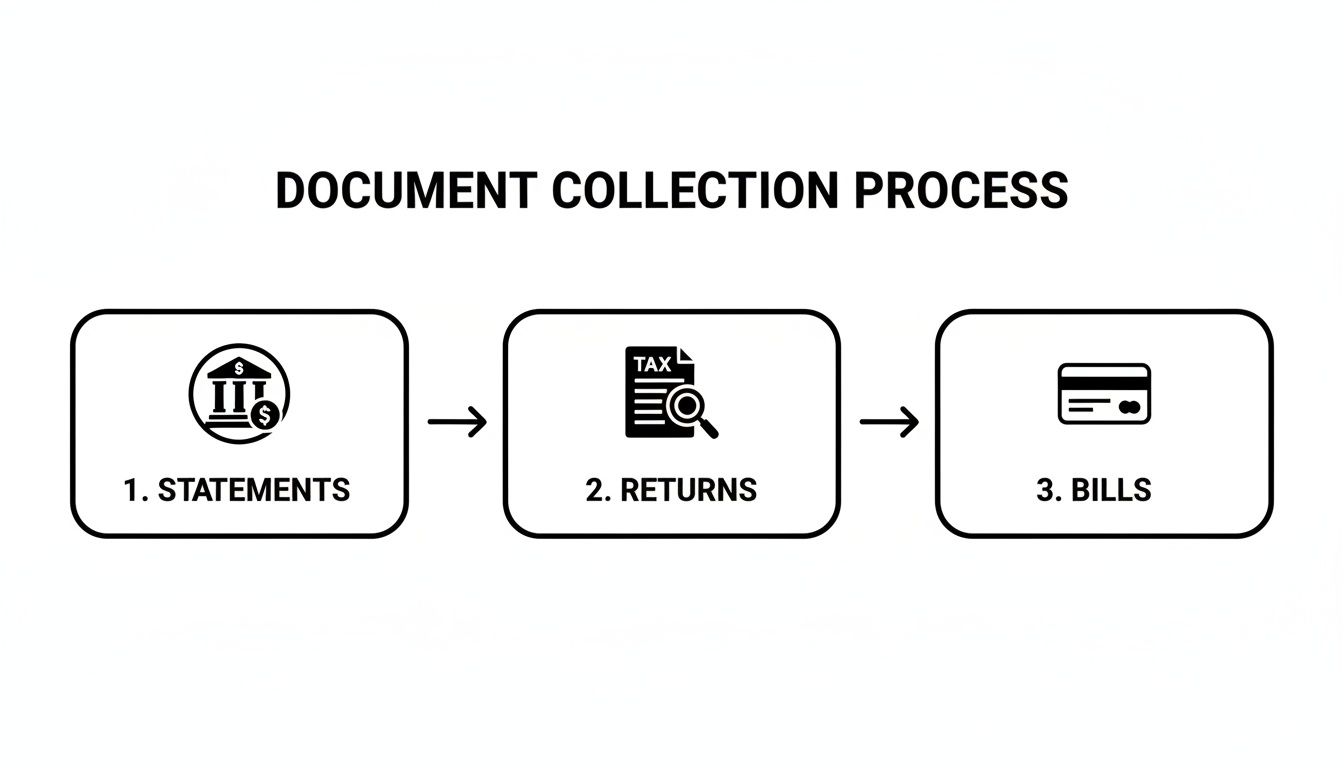
As you can see, each document adds another layer to the story. Bank statements show where the money went, and tax returns confirm what income should have been there in the first place.
Successfully navigating discovery isn't for amateurs. There's an art to drafting requests that are specific enough to get what we need without being so broad that a judge throws them out. Our Kingwood-based team at The Law Office of Bryan Fagan knows exactly how to frame these requests to get results and uncover the truth. If you even suspect hidden assets are a factor in your divorce, don't wait. Let's talk about it in a free consultation.
Advanced Strategies for Tracing Complex Assets

Sometimes, finding hidden assets means you have to look beyond the obvious bank and brokerage accounts. Money today moves silently through digital wallets and can be easily disguised within business ledgers, making it easier than ever for a spouse to hide what's rightfully yours.
When a divorce involves these kinds of complex assets, you need a strategy that goes much deeper. For our clients across Kingwood and Northeast Houston, particularly in high-net-worth cases or when one spouse owns a business, these advanced methods are often the key to securing a fair settlement.
Following the Digital Breadcrumbs
Digital assets like cryptocurrency or funds stashed in peer-to-peer payment apps are popular hiding spots. They feel less tangible and don't typically show up on standard financial statements, which is exactly why they're so tempting to use for concealment.
But here’s the thing: almost every digital transaction leaves a footprint. Uncovering these assets usually starts by tracing the money from a known account to an unknown one. For example, a forensic accountant can comb through bank statements looking for transfers to crypto exchanges like Coinbase or Binance. They can also flag frequent, unexplained payments to platforms like PayPal, Venmo, or Zelle that just don't line up with any known household expenses.
These are common ways we see funds being moved out of sight:
- Online Brokerage Accounts: Small, consistent transfers to accounts with platforms like Robinhood or E*TRADE can quietly build into a substantial hidden portfolio.
- Cryptocurrency Wallets: A spouse might buy Bitcoin or other digital currencies, thinking they're untraceable. While it's complicated, a skilled expert can often follow the blockchain trail right back to its source.
- Payment Apps: Using Venmo or PayPal to "pay" friends can be a simple way to transfer money to a trusted third party who holds it until the divorce is final.
Uncovering these digital assets is rarely a do-it-yourself job. It requires specialized knowledge and sophisticated tools. This is exactly why we maintain a network of trusted forensic accountants who are experts at navigating these digital mazes for our Kingwood-area clients.
When Your Spouse Owns a Business
Business ownership opens up a whole different world of opportunities for hiding assets. A business-owning spouse has immense control over the company's books, which can be manipulated to artificially lower the business's value or simply hide cash income.
One of the most common schemes we see in the Humble and Porter areas is the sudden "struggling business" narrative that appears just as a divorce is on the horizon. Funny how that happens.
Digital and business-related concealment is now one of the fastest-growing fronts in the battle to find hidden assets. Forensic accountants who specialize in this area regularly find that 10–30% of genuine profits are being moved off the visible books through under-reported revenue, inflated expenses, or payments to 'ghost' vendors. You can read more about why hidden assets are more common than you think.
The Power of a Forensic Accountant
Think of a forensic accountant as a financial detective. They are trained to scrutinize complex financial records, find inconsistencies, and sniff out evidence of fraud. They don't just look at the numbers; they look for the story the numbers are trying to tell—or hide.
Here’s how a forensic expert makes a real difference in a complex divorce:
- Analyze Business Records: They'll cross-reference business tax returns against actual bank deposits and credit card processing statements. If a local Kingwood business claims $400,000 in annual revenue but its bank accounts show $550,000 in deposits, where did that extra $150,000 go? It's almost certainly skimmed cash income.
- Identify Fictitious Expenses: A good expert can spot payments to "ghost" employees who don't exist or inflated invoices paid to shell companies controlled by the spouse or a friend.
- Provide Expert Testimony: A forensic accountant doesn't just hand you a report; they can present their findings in court as an expert witness. Their objective testimony can be incredibly persuasive in a deposition or at trial.
Bringing a forensic accountant onto your team sends a powerful message: you are serious about uncovering the complete financial picture. We often use their findings as leverage during depositions, where we question the other spouse under oath. It's a critical step, and it pays to be prepared. We've put together a guide on how to prepare for a deposition in your divorce case to help you get ready.
If your case involves a business or you suspect digital assets are in play, The Law Office of Bryan Fagan can connect you with the right experts. Schedule a free consultation at our Kingwood office to discuss your concerns and learn how we can build a team to protect your financial future.
Partnering with a Local Kingwood Legal Team
Trying to uncover hidden assets alone isn't just a massive undertaking; it can be legally treacherous and, frankly, often fruitless. Moving from suspicion to solid proof requires a seasoned guide who knows the Texas legal landscape inside and out. This is precisely where having a dedicated, local legal team in your corner makes all the difference.
Think of your attorney as your strategist. They take the threads you've collected—the odd bank statements, inconsistencies in tax returns, and those gut feelings about your spouse's behavior—and weave them into a comprehensive legal strategy. For our clients here in Kingwood, we manage the entire discovery process. We're the ones drafting surgical requests for documents and conducting depositions that get straight to the point, leaving no stone unturned.
The Smart Investment: Bringing in a Forensic Expert
When you're dealing with something complex like a family business in Humble or the murky world of digital assets, a forensic accountant is often a non-negotiable part of the team. We understand that clients worry about the cost. But it's crucial to see it not as an expense, but as a strategic investment.
A forensic expert has specialized tools and a knack for following money trails that would be invisible to anyone else.
The truth is, the value of the assets a good forensic accountant uncovers—whether it's cash skimmed from a business or a hidden cryptocurrency wallet—almost always dwarfs their fee. It's an investment in getting your fair share.
You Don't Have to Do This Alone
The road to a fair settlement can feel incredibly lonely, especially when you're dealing with the betrayal of hidden finances. But if you live in Kingwood, Humble, or anywhere in Northeast Houston, you absolutely do not have to walk this path by yourself.
The most critical decision you'll make is choosing the right legal partner to guide you. For more on what to look for, check out our guide on how to choose a divorce attorney.
Securing your financial future begins with a simple, honest conversation. The Law Office of Bryan Fagan is a local firm, deeply rooted in the Kingwood community. We understand the challenges you’re facing because we help your neighbors navigate them every day.
We invite you to schedule a free, confidential consultation at our Kingwood office. Let's talk through your situation and map out a clear, actionable plan. You deserve a just outcome, and our team is ready to fight for it.
Common Questions We Hear About Hidden Assets
Going through a divorce is tough. When you add the suspicion that your spouse is hiding money, it can feel overwhelming. Here in our Kingwood office, we get a lot of practical questions from people worried about getting their fair share. Let's walk through some of the most common ones.
What Happens if We Catch My Spouse Hiding Assets?
Texas judges do not take kindly to financial deception. If a court in Harris or Montgomery County finds out your spouse deliberately hid assets, the penalties can be steep.
First, the judge can award you a disproportionate share of the community estate. That means you could walk away with much more than the standard 50/50 split. The court can also order your spouse to pay for all your attorney’s fees and the expert costs you incurred to find the money, like hiring a forensic accountant. In Texas, financial transparency isn't optional; it's the law.
How Much Will a Forensic Accountant Cost in the Kingwood Area?
It’s best to think of a forensic accountant as an investment, not an expense. The cost really depends on how tangled your financial web is, but many respected forensic accountants in the greater Houston area will offer an initial consultation to get a sense of the scope.
At The Law Office of Bryan Fagan, we can help you figure out if this is the right move for your case and connect you with professionals we trust. We often find that the value of the assets they uncover is many times greater than the cost of their fee.
Should I Look into Assets My Spouse Had Before We Got Married?
This is a great question, and the answer is often yes. While property owned before marriage is typically considered "separate property" in Texas and isn't divided, it can still be a critical piece of the puzzle for Kingwood families.
Here's why: if money earned during the marriage (community funds) was used to pay down debt on or improve that separate property—like making mortgage payments on a house they owned before you married—the community estate is often entitled to be reimbursed for those contributions. A sharp Kingwood attorney will know exactly how to trace these commingled funds to protect your financial stake.
Getting to the truth is the only way to achieve a fair outcome in your divorce. The team at The Law Office of Bryan Fagan – Kingwood TX Lawyers is ready to provide the strategic guidance and tough advocacy you deserve. You can schedule a free, no-pressure consultation at our Kingwood office today by visiting us at https://kingwoodattorneys.com.